The Texas Bird Records Committee's official state list has 16 woodpeckers, and Texas is two woodpecker countries: the Red-bellied rules the eastern half, while the Golden-fronted and the Ladder-backed hold the mesquite to the west. Ten of the 16 nest here. Two are review species, and one, the Ivory-billed, is marked extirpated.
Texas woodpeckers on the official list
The committee's list, last updated October 24, 2026, holds 682 species, and 181 of them are review species: every sighting has to be written up and sent to the committee before it counts. Two woodpeckers are in that group, the Red-breasted Sapsucker and the Ivory-billed Woodpecker, which also carries the list's only "(e)" for extirpated. Of the other 14, ten nest in Texas, and the Texas Breeding Bird Atlas, kept by Texas A&M AgriLife Research, has an account of each:
| Woodpecker | Where it nests in Texas | Season | How common |
|---|---|---|---|
| Red-bellied Woodpecker | The eastern half, west to about the 100th meridian; north into the Panhandle as far as Hutchinson County | All year | The most common and conspicuous woodpecker of the eastern half |
| Golden-fronted Woodpecker | Everywhere but the northernmost Panhandle, East Texas and the far western Trans-Pecos | All year; eggs from March 30 to July 6, most in May | Locally common |
| Ladder-backed Woodpecker | West of I-35 and the Balcones Escarpment; most numerous south of the Nueces River | All year | Common to uncommon in the western two-thirds |
| Red-cockaded Woodpecker | Pine forests of East Texas, mostly the four national forests | All year; young in the nest in April and May | Rare to locally uncommon |
| Pileated Woodpecker | The wooded eastern third; strays west to Gainesville and Fort Worth | All year; nests from late March to late May | Fairly common locally to uncommon |
| Red-headed Woodpecker | Mostly East Texas and the Panhandle; rare to the south and west | Breeds from late February to late August | Declining in Texas since 1966 |
| Acorn Woodpecker | The Chisos, Davis and Guadalupe Mountains; small, isolated groups in Kerr and Real counties | All year | Common where its woodland is found |
| Downy Woodpecker | Almost only east of the 99th meridian, plus the northern Panhandle; all but absent from the Edwards Plateau | All year | Fairly common where found |
| Hairy Woodpecker | The eastern third, the Canadian River in the northeast Panhandle, the Guadalupe Mountains | All year | Uncommon to fairly common |
| Northern Flicker | Nests in the eastern quarter, the northern Panhandle and the Trans-Pecos mountains | Nests April to July; winters statewide | A rare, local nester |
The other four come as visitors: the Yellow-bellied, Red-naped and Williamson's Sapsuckers and Lewis's Woodpecker. The atlas covers only nesting birds, and Texas Parks and Wildlife's woodpecker pages wouldn't load for us on November 11, 2026, so we give no months for them rather than guess. Three western woodpeckers may already have slipped in unrecorded: the committee says the Arizona, Three-toed and Gila Woodpeckers "may well have occurred in Texas," but no report of them has met its standards. The full state list is on our Texas bird page, and the continent's count is in how many woodpeckers North America has.
What is the most common woodpecker in Texas?
It depends on which half of Texas you're in: in the east, the Red-bellied Woodpecker, which the Texas Breeding Bird Atlas calls the most common and conspicuous there; west of the I-35 line, the Golden-fronted and the Ladder-backed. No source we read ranks them across the whole state.
Each has a heartland. The Red-bellied's woods run out at the Nueces River bottom, its last good habitat before the South Texas mesquite. The Golden-fronted is thickest in the brush country of Jim Hogg, Brooks and Zapata counties, where Breeding Bird Survey routes, the roadside counts run each nesting season, find 24 to 28 of them apiece, the highest in Texas. Where the two overlap, the Red-bellied's painting page explains how to tell them apart.
At an East Texas feeder, the small black-and-white woodpecker is usually a Downy, and it holds an odd distinction: it is "one of the very few Texas birds that is not found in Mexico," the atlas says.
Which woodpeckers live in my part of Texas?
| Where you live | Woodpeckers to expect |
|---|---|
| East Texas, the Pineywoods and the Big Thicket | Red-bellied, Downy, Hairy, Pileated, Red-headed; Red-cockaded in old pines on the national forests; flickers in winter, and a few nesting |
| Houston and the upper coast | Red-bellied, Downy, Pileated in the bottomland woods; Red-cockaded at W.G. Jones State Forest near Conroe |
| Dallas–Fort Worth | Red-bellied and Downy; a Pileated now and then as far as Fort Worth; Golden-fronted and Ladder-backed toward the west |
| Austin, San Antonio and the Hill Country | Golden-fronted and Ladder-backed; Red-bellied east of the Balcones; Acorn only in small groups in Kerr and Real counties |
| South Texas and the Rio Grande Valley | Golden-fronted, densest in Jim Hogg, Brooks and Zapata counties; Ladder-backed |
| The Panhandle | Red-bellied north to Hutchinson County, Red-headed, Downy, Hairy along the Canadian River; red-shafted flickers, most numerous along the Canadian in winter |
| Trans-Pecos and the Big Bend | Acorn in the Chisos, Davis and Guadalupe Mountains; Ladder-backed; Golden-fronted; Hairy in the Guadalupes |
We pieced the rows together from the ten atlas accounts. Ranges shift over the decades, so treat the edges loosely.
East Texas pines: the Red-cockaded Woodpecker's Texas comeback
This is the woodpecker that ended clear-cutting on Texas's national forests. After its numbers fell through the 1970s and 1980s, "a landmark legal decision, upheld on appeal, stopped all clear-cutting on Texas national forests," Jerome A. Jackson writes in the Texas Breeding Bird Atlas.
It had a long way back. The bird once lived in as many as 40 Texas counties and was down to 9 by 1968. In 1994 the state held an estimated 925 of them, 74% on federal land. Then the numbers turned: in its 2018–2022 report, the National Forests and Grasslands in Texas counted an "all-time high of over 650 active clusters," more than 400 of them on the Sam Houston National Forest, whose population "met its recovery goal." A cluster is the set of cavity trees one family group uses; how the birds guard those trees is in our woodpecker guide's Red-cockaded section. In November 2024 the federal government moved the species from endangered to threatened.
The same report carries a twist. A US Forest Service study on the Angelina National Forest, begun in 1986, found that "southern pine beetles do preferentially attack active Red-cockaded Woodpecker cavity trees," and that the trees the birds nested in the season before are the likeliest to be hit. The artificial cavities that managers fit into pines don't add to the risk.
Closer to Houston, at W.G. Jones State Forest near Conroe, the Red-cockadeds are banded as chicks, and the nesting areas are closed to the public from March 15 to July 15, the Texas A&M Forest Service says.
Golden-fronted and Ladder-backed: woodpeckers of the mesquite
In 1865 the naturalist H. E. Dresser called the Golden-fronted the "mesquite woodpecker," and the name still fits: most nests are in old mesquite. It isn't fussy, though. The atlas lists nests in pecan, live oak and anaqua trees, in fence posts, utility poles and nest boxes. The earliest Texas eggs on record were found in Travis County on March 30, 1917, and in the late 20th century the bird spread west into the Big Bend.
Its small neighbor of the dry brush is the Ladder-backed Woodpecker, named for the black-and-white bars across its back. It lives west of a line along I-35 and the Balcones Escarpment, is most numerous south of the Nueces River, and is common to uncommon across the western two-thirds of Texas.
Both have set records here. The oldest wild Golden-fronted on the USGS Bird Banding Laboratory's list was banded in Texas in 2009 and caught again in 2012, at least 5 years and 11 months old. The oldest Ladder-backed, banded in Texas in 2018 and caught again in 2024, was at least 7. Every species' record is on our oldest wild birds page.
Was the Ivory-billed Woodpecker ever in Texas?
Yes, in the river-bottom forests of East Texas: the last two documented were adult males that Vernon Bailey collected in Liberty County on November 26, 1904.
Hope lasted much longer. The Big Thicket produced "a flurry of reports, photographs, and tape recordings" in the late 1960s and early 1970s, so from 2007 to 2009 the Gulf Coast Bird Observatory searched the bottomland forests of the Neches and Trinity rivers. Twice its team heard "very loud blows" in Big Thicket National Preserve, and both times they came from Pileated Woodpeckers. Then Hurricane Ike "tracked right over the study area" on September 13, 2008. John C. Arvin's report concluded that "there probably is not a remnant population" in southeastern Texas, while noting that the team had covered less than 10% of the bottomland forest that remains.
On the committee's list the bird is now extirpated, gone from Texas; federally it is still listed as endangered. The question of whether it survives anywhere is taken up in Audubon's birds, then and now.
A Texas field check: big and black, white-faced or barred?
| What you saw | Most likely | Where in Texas |
|---|---|---|
| Crow-sized and black, with a red crest | Pileated Woodpecker | The wooded eastern third |
| Black and white, with a big white cheek, in old pines | Red-cockaded Woodpecker | East Texas national forests |
| A pale face and underparts over a barred back | Golden-fronted in the west and south, Red-bellied in the east | How to tell them apart |
| Small, black and white, with a white back | Downy, or the larger Hairy | The east; the Hairy also in the Guadalupes |
| Small, with a barred back, in dry brush | Ladder-backed Woodpecker | West of I-35 |
| A red cap over a black-and-white face, in mountain oaks | Acorn Woodpecker | The Chisos, Davis and Guadalupe Mountains |
| An all-red head and big white wing patches | Red-headed Woodpecker | East Texas and the Panhandle |
| Brown, feeding on the ground in winter | Northern Flicker | Anywhere in the state |
The giant one is the Pileated. Texans once had their own names for it, the atlas records: "log-god," "Indian hen," "woodchuck" and "cock-of-the-woods." The bigger Ivory-billed hasn't been documented in the state since 1904. More about the Pileated is on its painting page, and the small pair is sorted out in Downy or Hairy.
What smell do woodpeckers hate the most?
None has been shown to keep them away: "taste or odor repellents are generally ineffective," says a New Mexico State University guide that reprints figures from Texas's own wildlife damage service.
Utility companies learned the same lesson. Chemicals with "objectionable tastes and odors" have been tried on wooden poles, and "most have proven ineffective and not cost-effective," says the Internet Center for Wildlife Damage Management; even creosote and pentachlorophenol, which treat the wood, "do not resolve problems." That matters in Texas, where Golden-fronted, Red-headed and Acorn Woodpeckers all use utility poles, the atlas says. Peppermint, vinegar, garlic and citronella turn up in online lists; we found no trials behind any of them.
What the two guides do recommend:
- Bird netting stretched taut, with 3/4-inch mesh and at least 3 inches between the net and the wall.
- Hawk or falcon silhouettes. Owl decoys are "generally ineffective," the New Mexico guide says.
- Sticky repellents only on masking tape, because they stain. The wildlife damage center warns that small birds can get stuck in polybutene gels.
Whatever you try, don't harm the bird. Texas Parks and Wildlife Code § 64.002 makes it an offense to "catch, kill, injure, pursue, or possess" any bird that isn't a game bird, and its exceptions (starlings, House Sparrows, feral Rock Pigeons, and certain blackbirds, grackles, cowbirds, crows and magpies doing damage) name no woodpecker. The federal Migratory Bird Treaty Act covers every native woodpecker too. The fines are listed in our birds of prey guide, and the reasons a woodpecker hammers on a house are in the woodpecker guide.
From the Sam Houston to the Chisos: where to look in Texas
| Place | Woodpeckers | Worth knowing |
|---|---|---|
| Sam Houston National Forest, and the Angelina, Davy Crockett and Sabine | Red-cockaded, Pileated, Red-headed | More than 400 active Red-cockaded clusters on the Sam Houston alone in 2018–2022 |
| W.G. Jones State Forest, near Conroe | Red-cockaded | Nesting areas closed March 15 to July 15 |
| Big Thicket National Preserve | Pileated | The longleaf pines of the Sundew Trail hold "several species of woodpeckers," the Park Service says |
| Trinity River National Wildlife Refuge | Pileated | Part of the 2007–2009 Ivory-billed search |
| Chisos Mountains, Big Bend National Park | Acorn | Pinyon, juniper and oak woodland from 5,000 to 8,000 feet |
| Davis and Guadalupe Mountains | Acorn; Hairy in the Guadalupes | Guadalupe Mountains National Park lists the Ladder-backed among its common desert birds |
| Jim Hogg, Brooks and Zapata counties | Golden-fronted | The state's highest survey counts |
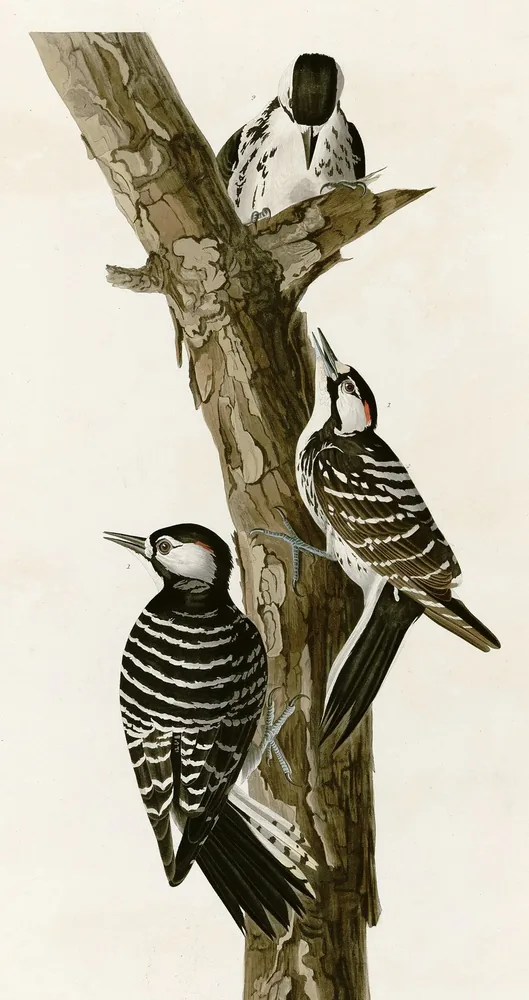
Audubon's three Red-cockadeds
The painting at the top is plate 389 in The Birds of America, John James Audubon's big book of bird plates: three Red-cockaded Woodpeckers working a broken trunk. More of the set is on Audubon's famous plates.
A Golden-fronted at a Hill Country feeder and a Red-cockaded in the Sam Houston pines both belong on a life list, and a Birdfolio prints each bird you've seen beside a classic painting like this one: a Texas life list as a hardcover book.
Questions people ask
Are woodpeckers good to have in a Texas yard?
Mostly, yes, because their old holes become homes for other birds. Eastern Bluebirds raise their young in old woodpecker holes as well as in tree hollows and nest boxes (bluebirds in Texas), and in the Big Bend and deep South Texas the Elf Owl nests in them (the small owl of Texas), the atlas says. The catch: a Golden-fronted may choose your fence post.
What looks like a woodpecker in Texas but isn't one?
Usually a nuthatch or a creeper, birds that climb trunks the same way; our look-alike section tells them apart. In the Big Thicket's longleaf pines, the Brown-headed Nuthatch shares the woodpeckers' trees, the National Park Service says.
Which woodpeckers live in Houston?
The Red-bellied and the Downy, with Pileateds in the bottomland woods. The nearest Red-cockadeds are at W.G. Jones State Forest, near Conroe.