Classic bird paintings
Red-bellied Woodpecker painting: Audubon's plate and other classic portraits
John James Audubon painted the Red-bellied Woodpecker on plate 416 of The Birds of America (1827–38), which shows five kinds of woodpeckers. A free high-resolution scan is on Audubon.org. The picture shown here is from his smaller octavo edition (1840–44), where the Red-bellied Woodpecker has a plate of its own, number 270.
Updated
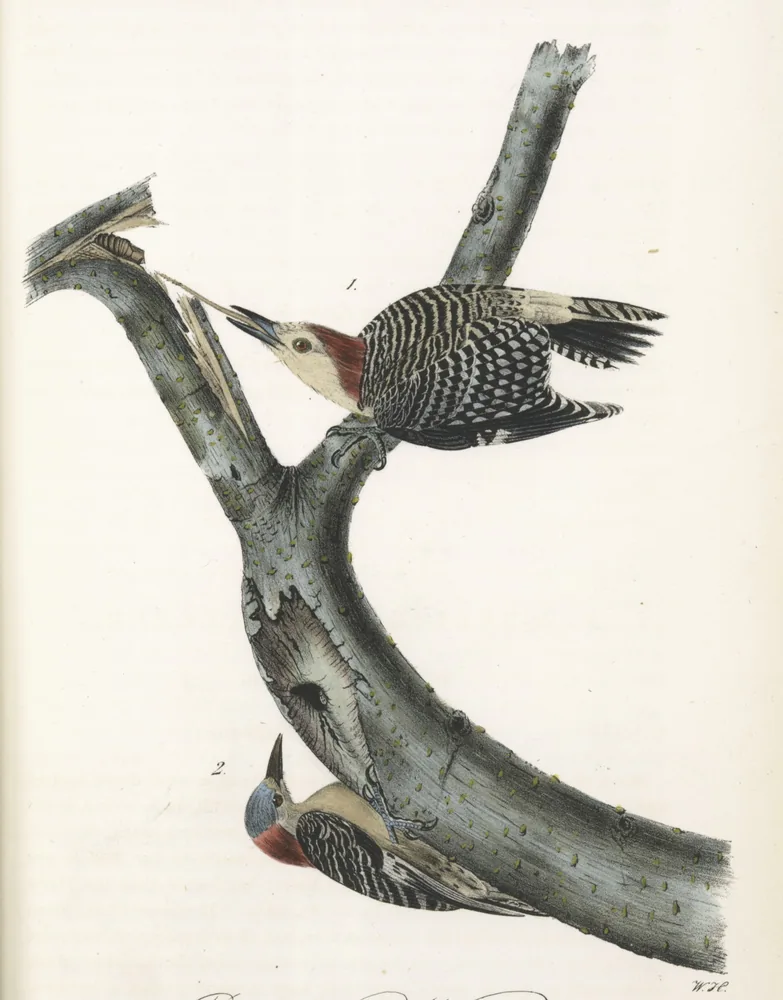
About this painting
In the octavo edition of the 1840s the Red-bellied Woodpecker has a page to itself, plate 270, which is the picture shown here. More about both editions in our guide to John James Audubon.
Audubon’s Red-bellied Woodpecker: plate 416, “Hairy Woodpecker; Red-bellied Woodpecker; Red-shafted Woodpecker; Lewis' Woodpecker; Red-breasted Woodpecker”
The crew of the US schooner Spark called it chaw-chaw. Audubon thought the name came from its call, a quick chow or chaw that sounded as if the bird had a bad cold yet carried a hundred yards, and perhaps partly from the many the sailors cooked into a dish of the same name. In winter he found it the most common woodpecker in the Florida pine barrens, especially on the plantations along the St. Johns River, where half a hundred could easily have been shot in a day.
He never found its nest in Louisiana or South Carolina, but did in Kentucky, and in Pennsylvania orchards, usually near where a branch meets the trunk. In woods that had been burned, its underparts came out almost black with soot, and in the Florida winter its plumage was usually dirtier than in summer.
Plate 416, near the end of The Birds of America, is crowded with five kinds of woodpeckers. The Red-bellied are figures 3 and 4, and he wrote: “I have represented a male and a female, in their perfect spring plumage.”
Story: Audubon, Ornithological Biography, vol. 5 (1839), pp. 169–172. See plate 416 free at Audubon.org.
Which other woodpeckers are on Audubon's plate 416?
Four more kinds, each a male and a female: the Hairy Woodpecker, the Red-shafted Woodpecker, Lewis's Woodpecker and the Red-breasted Woodpecker. Today the Red-shafted counts as part of the Northern Flicker, and the Red-breasted is called the Red-breasted Sapsucker.
For the three western birds his text leans on others. Thomas Nuttall met the Red-shafted along a fork of the Platte and kept seeing it all the way to the Pacific shore. Lewis's Woodpecker, Audubon wrote, was discovered on Lewis and Clark's journey west, and all he knew of its habits came from Nuttall and Dr. Townsend; Nuttall saw flocks of 12 to 20 in late August, “playing about like so many sportive Crows.” Of the Red-breasted he had specimens Townsend collected on the Columbia River. The Hairy, he wrote, lives all year from New Hampshire to “the Texas, where I have found it numerous.”
Sources: Audubon, Ornithological Biography, vol. 5 (1839), p. 164; vol. 5 (1839), p. 176; vol. 5 (1839), p. 179; vol. 5 (1839), p. 174; AviList v2026.
More classic portraits, free to see
- John James Audubon, The Birds of America, octavo edition (1840–44), plate 270: “Red-bellied Woodpecker” (the painting shown above). Free scan (New York Public Library Digital Collections)
- Louis Agassiz Fuertes, for Elon H. Eaton’s Birds of New York (1910–14), plate 64: “Red-bellied Woodpecker”, with the Northern Flicker. Free scan (Internet Archive)
About the Red-bellied Woodpecker
- Red-bellied Woodpeckers can store nuts and seeds in bark crevices for the winter. (Source: National Audubon Society)
- Despite the name, the reddish wash on its belly can be hard to see in the field. (Source: National Audubon Society)
It has moved north over the decades, and Audubon credits Christmas Bird Count data with documenting the change. Counts run again from December 14 to January 5: how to take part. (Source: National Audubon Society)
A woodpecker that stores seeds for the winter is worth watching all season. If one visits your yard between November 1 and April 30, it can go into your Project FeederWatch tally, and joining late is fine. Start a FeederWatch count.
Are there Red-bellied Woodpeckers in Texas?
Yes, in the eastern half, where it is the most common and conspicuous woodpecker, the Texas Breeding Bird Atlas says. It breeds regularly west to about the 100th meridian, farther in the Panhandle, and in South Texas the Nueces River bottom is its last good woodland before the dry mesquite brush.
Most keep a territory all year. The name puzzles people, since the small pale red patch on the belly usually lies flat against the tree; the atlas credits it to early naturalists who looked at birds they had shot. What you see is the zebra-striped back and the red on the head, which on the male runs from the nape over the crown to the bill, “like a punk-rocker with a red Mohawk haircut.” The male digs most of the nest hole, usually on the underside of a leaning limb so rain stays out, and he alone sits with the young at night.
Source: Texas Breeding Bird Atlas, Red-bellied Woodpecker (Shackelford, about 1997).
How do you tell a Red-bellied from a Golden-fronted Woodpecker?
By the nape and the forehead. The Golden-fronted Woodpecker has an orange-yellow nape and yellow just above the bill, and its male a red cap, National Audubon's guide says; the Red-bellied's nape is red.
The Golden-fronted is the woodpecker of the mesquite country, nesting all over Texas except the far north of the Panhandle, East Texas and the far west of the Trans-Pecos, the Texas Breeding Bird Atlas says. The two meet in a narrow strip from central Texas north to southwestern Oklahoma, where each defends its trees against the other and they now and then interbreed. The Golden-fronted has the louder, harsher voice, and it isn't shy: a female at Bastrop State Park took bread from the atlas author and carried it to a tree.
Sources: National Audubon Society, Golden-fronted Woodpecker; Texas Breeding Bird Atlas, Golden-fronted Woodpecker (Casto, updated 2006); Texas Breeding Bird Atlas, Red-bellied Woodpecker (Shackelford, about 1997).
How long does a Red-bellied Woodpecker live?
For the Red-bellied Woodpecker, the guides we checked give only a maximum age, not a typical one. The oldest known wild Red-bellied Woodpecker was at least 12 years and 3 months old (USGS Bird Banding Laboratory): it was banded in Georgia in 2003 and found there again in 2012.
Source: USGS Bird Banding Laboratory. A banding record is the minimum age of one bird when it was found again, not a typical lifespan. How long do wild birds live?
How can you tell if a plate 416 print is an original?
By its size: an original plate 416 is a hand-colored sheet about 26 by 38 inches; the Red-bellied Woodpecker’s octavo version, plate 270, is book-size, from 1840–44. Many prints sold today are reproductions: how to tell an original from a reproduction. Plate 416 and the other 434 also come bound in one modern book: which Birds of America book to buy.
In a Birdfolio hardcover, this painting sits beside the date and place you first saw a Red-bellied Woodpecker. See your own list as a book, free.