Florida's official bird list has 10 woodpeckers: the eight that live here, the Golden-fronted as a rare stray, and the Ivory-billed, which the list marks extinct. The one you'll most likely see is the Red-bellied; the big stories are a woodpecker recovery on an Air Force bombing range and a 2005 report of the Ivory-bill on the Choctawhatchee River.
How many kinds of woodpeckers live in Florida?
Eight live in Florida, by the count of the Florida Ornithological Society Records Committee, whose official list of July 2024 has 10 woodpeckers in all.
The other two are a rare visitor and a bird that may be gone. The Golden-fronted Woodpecker, a bird of Texas and Mexico, is a review species here, so the committee examines every report of one. The Ivory-billed Woodpecker stays on the list as "Extinct," and the list explains why: "Extinct species do not reduce the size of the Florida list." Counting everything, the committee's list has 559 taxa and 545 living species, 17 of them established exotics; the full count is on our Florida bird list page. UF/IFAS Extension, the University of Florida's outreach service, agrees on the eight: "Florida is home to eight species of woodpeckers."
| Woodpecker | On the Florida list | What Florida sources say |
|---|---|---|
| Red-bellied Woodpecker | Regular | "The most common woodpecker to spot in Sarasota" (UF/IFAS, 2022) |
| Pileated Woodpecker | Regular | Seen regularly in Gainesville's wooded neighborhoods (a 2024 study) |
| Red-cockaded Woodpecker | Regular | About a quarter of the whole species lives in Florida |
| Downy Woodpecker | Regular | No Florida range or season in a source open to us |
| Hairy Woodpecker | Regular | The same |
| Red-headed Woodpecker | Regular | The same |
| Northern Flicker | Regular | The oldest wild flicker on record was a Florida bird |
| Yellow-bellied Sapsucker | Regular | Winters across the Southeast, says National Audubon's guide; no Florida months found |
| Golden-fronted Woodpecker | Review species | A rare stray from the west |
| Ivory-billed Woodpecker | "Extinct" | Still listed as endangered under federal law |
Florida's breeding bird atlas is published by the state's Fish and Wildlife Conservation Commission, whose website doesn't admit reading tools like ours. Where a row says no Florida source, we chose a gap over a guess.
What is the most common woodpecker in Florida?
The Red-bellied Woodpecker is the one Floridians see most: UF/IFAS Extension calls it "the most common woodpecker to spot in Sarasota." That's one county's verdict; no statewide count ranking them was open to us.
The Red-bellied is the zebra-backed one with red on its head, and why a red-capped bird is named for its belly is explained on its painting page. It has a rougher side in the pinewoods: Red-bellieds move into the holes Red-cockaded Woodpeckers dig, which is where Florida's rat snakes come in, below.
Are there Pileated Woodpeckers in Florida, or was it an Ivory-bill?
Yes, the Pileated lives across Florida: it is a regular on the state list, its range "includes the entire southeastern United States," and in Gainesville it lives in wooded neighborhoods.
So when a huge black woodpecker lands in a Florida suburb, UF/IFAS Extension's guide is blunt: "you certainly did not see an Ivory-billed Woodpecker." Its authors, Steve A. Johnson, Mark Hostetler and Martin Main, list the field marks, the features birders check, that separate the two:
| Field mark | Pileated Woodpecker | Ivory-billed Woodpecker |
|---|---|---|
| Length | 16 to 19 inches, about a crow's size | 19 to 20 inches |
| Bill | Gray, with a dark tip | White |
| Back, when perched | Solid black | Two white stripes down the back and a white triangle low on it |
| Wings in flight | A black trailing edge | A white trailing edge |
| Crest | Red on both sexes; the male also has a red "mustache" | Red on the male, black on the female |
The last row settles the female question: a female Pileated keeps her red crest, while a female Ivory-bill's was black. For every other species, see which woodpeckers wear red where.
The Ivory-billed Woodpecker and the Choctawhatchee search
A century ago Florida looked like the last place left for it. By the early 1900s the bird was thought "confined to a few isolated portions of Florida," Reed wrote in 1925, as UF/IFAS quotes him, though he allowed it might also hang on in Indian Territory.
Then, on May 21, 2005, what UF/IFAS calls "a small group of scientists from Auburn University" saw a bird they identified as an Ivory-billed Woodpecker "along the Choctawhatchee River north of the town of Bruce," in the Panhandle. They came back to search from December 2005 to May 2006 and logged 14 sightings. They heard sounds that matched the bird on 41 occasions, recorded 99 possible double knocks and 210 possible kent calls, and measured 131 tree cavities, 33 of them taller than the largest Pileated entrance in the published record. A double knock is two quick raps on wood; a kent is the bird's nasal call.
Even the team held back. The bird's survival "will be established definitively only by a clear photograph or video image," Geoffrey E. Hill and four colleagues wrote in Avian Conservation and Ecology in 2006.
UF/IFAS has since weighed the modern reports together: Florida's 14 firsthand accounts, plus trail-camera images and a drone video, Louisiana's 16 reports and the Arkansas video. Of them all, "only one observation includes mention of the namesake white beak." The state list now calls the species extinct, while federal law still lists it as endangered. Whether it is gone for good has a page of its own, and the 2004 sighting is told on our Arkansas page.
Red-cockaded Woodpeckers on an Air Force bombing range
Some of Florida's luckiest woodpeckers live where the Air Force practices bombing. Avon Park Air Force Range covers 106,000 acres and is home to more than 40 at-risk species. Between 1998 and 2016, Archbold Biological Station, the U.S. Fish and Wildlife Service and the Air Force moved 54 Red-cockaded Woodpeckers there from six donor populations.
It worked. About 70% survived their release, and the newcomers and their young went on nesting for more years than birds hatched on the range, a study in a special edition of PNAS, the Proceedings of the National Academy of Sciences, found; Alex Lewanski was its first author and Sarah Fitzpatrick its senior author. Michigan State University's headline in August 2025: "On a Florida bombing range, endangered woodpeckers get a second chance."
Florida carries a big share of the species. The state holds "approximately 25 percent" of all Red-cockadeds, the St. Johns River Water Management District says, and a University of Florida estimate in 2011 put Florida's birds at "fewer than 4,000." On the District's Hal Scott property, a remnant of mature longleaf pine is kept for them, and Brown-headed Nuthatches and Bachman's Sparrows share it.
The federal Migratory Bird Treaty Act protects every native woodpecker in Florida, and since late 2024 the Red-cockaded has been listed as threatened rather than endangered.
What is the enemy of a woodpecker?
Snakes, rat snakes above all, but a University of Florida study found a twist: around Red-cockaded nests, rat snakes also evict the birds that steal the woodpeckers' holes.
The study ran at Camp Blanding Joint Training Center in Clay County and Goethe State Forest in Levy County. A Red-cockaded keeps sap flowing around its nest hole; a squatter such as a Red-bellied Woodpecker doesn't, and the rat snakes clear it out. The UF News story of 2011 quotes researcher Kappes: it is "counterintuitive that a principal predator" can also help. The sap defense itself is explained in our Red-cockaded section.
The commonest squatter has fur. Southern flying squirrels are "the principal kleptoparasite" of Red-cockaded roost and nest holes, found a 2007 study from the Jones Ecological Research Center (a kleptoparasite steals another animal's home or food). Red fox urine and rat snake musk "proved ineffective" at keeping the squirrels out, and the woodpeckers paid the smells no attention.
What do Florida woodpeckers sound like?
The voice people most want to hear survives only on tape: UF/IFAS says the Ivory-bill's call is known "from just a single audio recording from 1935." It likens the call to "the squeak of a clarinet or tin horn."
The big woodpecker you'll actually hear is the Pileated, with its "series of loud, repeated chattering notes," the same guide says. The calls and drums of the rest are in our woodpecker sounds table.
Goethe State Forest, Hal Scott and Gainesville: where to look in Florida
| Place | Woodpeckers | Why it's here |
|---|---|---|
| Goethe State Forest, Levy County | Red-cockaded | One of the two sites of the UF rat snake study |
| Hal Scott, St. Johns River Water Management District | Red-cockaded | Mature longleaf pine kept for them |
| Gainesville's wooded neighborhoods | Pileated | Seen there regularly, a 2024 study found |
| The Choctawhatchee River north of Bruce, in the Panhandle | Pileated | Where the 2005–2006 Ivory-bill search took place |
Avon Park Air Force Range and Camp Blanding are military sites. We found no public-access rules for either, so they are stories on this page, not places to visit.
Audubon's Ivory-billed Woodpecker
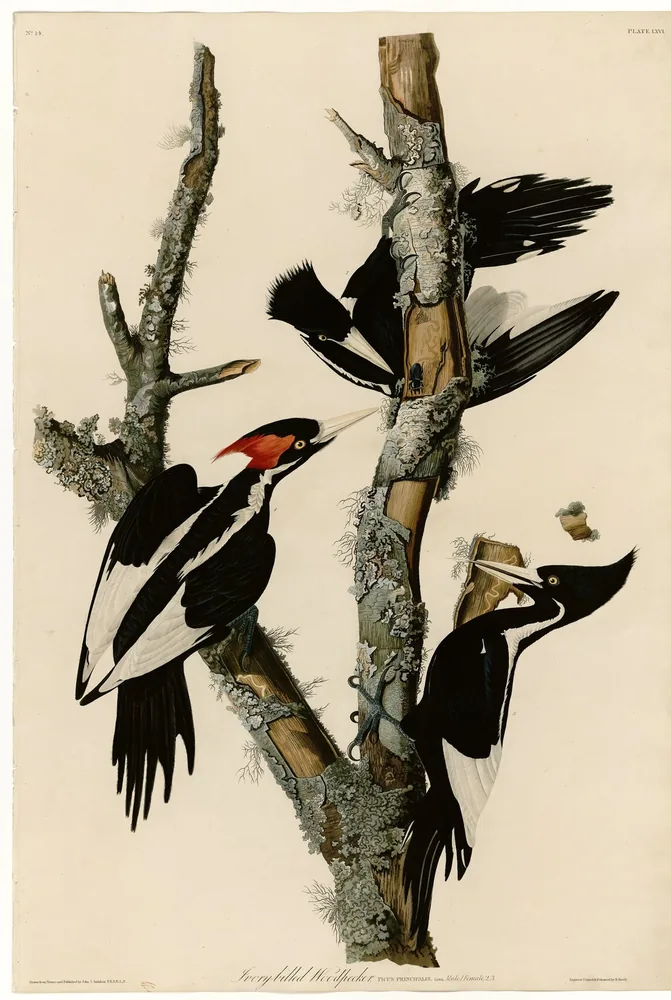
John James Audubon gave the Ivory-billed Woodpecker plate 66 of The Birds of America, and it shows three of them on dead, lichen-covered branches. The male is the one with the red crest. The other two are females, and their black crests are the same clue the UF/IFAS guide gives today. It is among the best-known Audubon plates.
Seen a Pileated in a Gainesville neighborhood or a Red-cockaded at Goethe? A Birdfolio prints every bird on your life list beside a classic painting: the hardcover made from your own list.
Questions people ask
What does it mean to see a big woodpecker in your Florida yard?
Usually that your street has enough trees for one: Pileateds are "regularly seen in wooded neighborhoods" around Gainesville, UF/IFAS notes, citing a 2024 study by Pegg and colleagues in Florida Scientist. It doesn't mean the Ivory-bill is back; the clues are in the Pileated check above.
Do woodpeckers help other Florida wildlife?
Yes, by building housing. Most woodpeckers use a cavity for a year and then leave it, and "other species of birds and some mammals will then use the cavities," UF/IFAS says. If one is drilling your house instead, see why woodpeckers peck at houses.
Has a Golden-fronted Woodpecker been seen in Florida?
Yes, at least once. The official list takes only species that have "occurred in Florida," and the Golden-fronted is on it as a review species, so the committee checks every report. We couldn't read the details of the record.
How long can a Florida woodpecker live?
The oldest wild Northern Flicker on record was a Florida bird: banded in Florida in March 1965 and found dead there in 1973, it was at least 9 years and 2 months old, says the USGS Bird Banding Laboratory. The oldest wild birds has the record for each species.