Texas's official bird list has 39 birds of prey that hunt by day: 28 hawks, eagles and kites, 10 falcons and caracaras, and the Osprey. The hawk you're most likely to see is the Red-tailed Hawk, a common resident almost everywhere in the state, says the Texas Breeding Bird Atlas. Owls have their own guide.
Birds of prey in Texas at a glance
Of the 39, 12 are strays so rare that the Texas Bird Records Committee asks for proof of every sighting; 27 are regulars. The table has 25 of those, with where and when from the Texas Breeding Bird Atlas, a Texas A&M project covering the birds that nest here. The Rough-legged Hawk and the Merlin don't nest in Texas, so it has no account of them. Texas Parks and Wildlife's species pages wouldn't load for us on October 22, 2026. For the whole list, see how many bird species Texas has.
| Bird | Where in Texas | When | How common |
|---|---|---|---|
| Red-tailed Hawk | Almost everywhere; fewer on the High Plains, in the Pineywoods and the lower Rio Grande Valley | All year; most from mid-October to mid-March | Common |
| Red-shouldered Hawk | Pineywoods, prairies and Coastal Prairies west to the Edwards Plateau | All year; in South Texas mainly winter | Uncommon to common |
| Harris's Hawk | South Texas Brush Country and the southern coast | All year | Common to uncommon |
| White-tailed Hawk | Coastal prairies and South Texas brush | All year | Uncommon to locally common |
| Gray Hawk | Lower Rio Grande, Webb to Hidalgo County; Trans-Pecos | All year in the south, summer in the west | Rare to locally uncommon; threatened in Texas |
| Swainson's Hawk | Panhandle and plains south to about the 31st parallel | Late March to early November | Uncommon to common in the north |
| Broad-winged Hawk | East of the Trinity River; Austin to Waco and north-central Texas | March to October | Local nester; huge flocks in fall |
| Zone-tailed Hawk | Trans-Pecos and Edwards Plateau | Mid-March to late October | Uncommon and local; threatened in Texas |
| Common Black Hawk | Davis Mountains | Summer; gone in winter | Rare to locally uncommon |
| Ferruginous Hawk | Nests in the northern Panhandle | Nests March to July | Far fewer than in 1912 |
| Cooper's Hawk | Pineywoods, Edwards Plateau, South Texas, Trans-Pecos | All year; more from late August to May | Rare to locally uncommon nester |
| Sharp-shinned Hawk | Wintering birds; a few nest in East Texas | Mid-September to early May | Uncommon to common in winter |
| Northern Harrier | Low over open fields | Commonest late August to mid-October and early April to mid-May | Common in migration; rare in summer |
| Mississippi Kite | North-central Texas and the Panhandle | April to August | Fairly common |
| White-tailed Kite | Coast, lower Rio Grande Valley, South Texas brush | All year | Uncommon to common |
| Swallow-tailed Kite | Southeast coast and the lower Sabine River | Mid-March to mid-October | Rare to locally uncommon |
| Hook-billed Kite | Rio Grande in Hidalgo and Starr counties | All year | Two or three pairs in 1987–92 |
| Bald Eagle | Coastal Prairies, southern Pineywoods, big lakes and rivers | August to May; nests in winter | About 140 pairs nesting in 2004 |
| Golden Eagle | Trans-Pecos and Panhandle | All year; winter visitors October to mid-March | Rare to locally uncommon |
| Osprey | Coast, lakes and big rivers | Mid-March to May, September to November; coast in winter | Uncommon to rare; rare nester |
| Crested Caracara | South Texas Brush Country to the Coastal Prairies | All year | Uncommon to common |
| American Kestrel | Statewide | All year; most in winter and migration | Common to abundant in winter |
| Aplomado Falcon | Coast from Cameron to Calhoun County | All year | Rare to locally uncommon; reintroduced |
| Peregrine Falcon | Nests in the Guadalupe and Chisos mountains and Rio Grande cliffs | Nests February to July; fall migrants on the coast | Very local nester |
| Prairie Falcon | Trans-Pecos; one Panhandle nest | All year; more from August to April | Rare and local |
Two vultures share the sky with them, the Turkey and the Black; our Turkey Vulture page tells them apart.
What is the most common hawk in Texas?
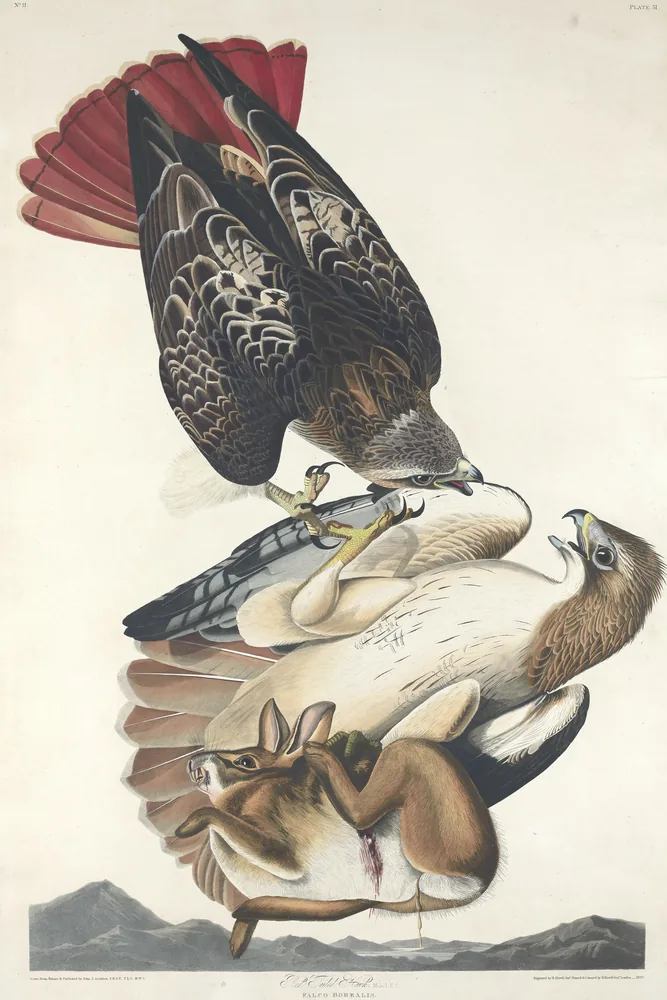
The Red-tailed Hawk: a common resident almost everywhere in Texas, the atlas says, and common statewide in winter, when birds from the north arrive. It sits and waits on a pole or treetop and takes mammals, birds, insects and even fresh carrion. Its season, its many plumages and its Texas nests are on our Red-tailed Hawk painting page.
Each region has a runner-up. In East Texas woods it's the Red-shouldered Hawk. In the South Texas brush it's Harris's Hawk: Texas has most of the country's Harris's Hawks, with 32 of the 41 survey routes that find the bird. And the small falcon on the roadside wire, the American Kestrel, smallest and most numerous of our falcons, is common to abundant statewide in winter.
What hawk has a red breast in Texas?
Usually a Red-shouldered Hawk: adults have reddish shoulders and chest, says National Audubon's guide, and they live all year in East and Central Texas. Look for narrow black-and-white bands across the wings and tail. Its call, a shrill kee-yeeear, is often copied by Blue Jays. It hunts from a perch rather than soaring, and in bottomland forest it often nests near Barred Owls, the atlas says: one hunts by day, the other by night.
Two more have rusty fronts. An adult Cooper's Hawk is blue-gray above and pale reddish below. Harris's Hawk has bright rufous shoulders, wing linings and thighs on a dark body. A Red-tailed Hawk's red is in its tail; below, many show a dark belly band.
What hawk has a white head in Texas?
If it's huge and near water, an adult Bald Eagle: white head and tail on a brown body, a pattern that's complete by about 5½ years, National Audubon's guide says. Smaller birds with white heads are common in Texas too:
- Osprey: white below, a black stripe through the eye, long wings bent at the wrist. It eats almost nothing but fish.
- White-tailed Kite: gray and white with black shoulders, often hovering over a coastal field for mice.
- Crested Caracara: a white neck and cheeks under a black crest, and a yellow-orange face.
- White-tailed Hawk: a white tail and rump that show at great distance, over the coastal prairie and South Texas ranches.
For a young Bald Eagle, which is dark all over, see Bald Eagle or Golden Eagle?
What are the gray hawks in Texas?
The Gray Hawk is a species of its own: a bird of the lower Rio Grande, from Webb to Hidalgo County, all year, and of the Trans-Pecos in summer. The adult is gray and finely barred below, with bold black-and-white bands on its tail. It lives mostly on lizards, caught in riverside woods. Once called the Mexican Goshawk, it is listed as threatened in Texas.
Three other raptors look gray. The Mississippi Kite is mostly gray, with a paler head and a black tail. The adult male Northern Harrier is gray with black wingtips and a white rump, flying low over fields with its wings in a shallow V. The White-tailed Kite is gray and white.
What is the small hawk in Texas?
Usually an American Kestrel, the smallest falcon in North America and about the size of a robin, often perched on a roadside wire. It bobs its tail, hovers over fields on fast-beating wings, and nests in cavities: Texas atlas workers found nests in a stadium press box, a water tower, a church and an idle pump jack. The male has a rusty back and tail and blue-gray wings.
In winter, look for the Sharp-shinned Hawk too. It's smaller than the look-alike Cooper's Hawk and lives mostly on birds from sparrow size to robin size.
Hawk or falcon: which did I see?
Look at the wings: a falcon's are long and pointed, a hawk's broad and rounded. National Audubon's guide gives the Kestrel and the Peregrine wings that are long, pointed, swept and tapered; the Cooper's Hawk has broad, rounded wings and a long, rounded tail. Falcons hunt in the open: the Kestrel hovers, and a Peregrine diving on prey may reach 200 mph. A Cooper's Hawk moves from perch to perch in cover, then bursts out after its prey.
Is a caracara a hawk? No: the official Texas list puts the Crested Caracara in the falcon family, yet it acts like no falcon. It eats carrion, digs up turtle eggs and watches for vultures dropping to a carcass.
Which bird of prey did I see? A Texas field check
| What you saw | Most likely | What to check |
|---|---|---|
| Big hawk on a highway pole, pale breast | Red-tailed Hawk | Red tail on adults; a dark belly band |
| Small falcon on a wire, bobbing its tail, or hovering | American Kestrel | Rusty back; male's blue-gray wings |
| Dark hawk with rusty shoulders and thighs, South Texas brush | Harris's Hawk | Tail black with white at the base and tip |
| Black-crested bird with a white neck near roadkill | Crested Caracara | Yellow-orange face; walks on the ground |
| Gray birds with pale heads over a town in summer | Mississippi Kite | Catching insects in the air |
| Gray-and-white bird hovering over a coastal field | White-tailed Kite | Black shoulders |
| Slow flier low over a field, white rump | Northern Harrier | Wings in a shallow V |
| Fast hawk darting through trees or at a feeder | Cooper's or Sharp-shinned Hawk | Long tail; broad, rounded wings |
| Black "vulture" with white tail bands | Zone-tailed Hawk | West and Central Texas, spring to fall |
| Huge, dark, white head and tail | Bald Eagle | Near lakes, rivers and the coast |
What bird is mistaken for a hawk?
A soaring vulture, and one Texas hawk uses the likeness: the Zone-tailed Hawk soars with its wings in a shallow V like a Turkey Vulture, so smaller animals may ignore it. When it spots prey, it drifts lower until cover hides it, then attacks, National Audubon's guide says. Look for a few white bands on its black tail; the atlas notes it's sometimes seen soaring with Turkey Vultures.
Where can you see eagles in Texas?
Texas has two eagles: the Bald Eagle, which nests near the coast and in East Texas and is most numerous from early October to late May, and the Golden Eagle of the Panhandle and the western mountains. Bald Eagles nest in winter, from late October to early May, beside reservoirs, big rivers, marshes and the coast, the atlas says. About 140 pairs were nesting in Texas in 2004, the figure the atlas cites; a bird banded in a nest on the Texas coast was later found breeding in Arizona.
Golden Eagles stay all year in the canyons and mountains of the west, and winter visitors arrive from early October to mid-March. They live mostly on rabbits, especially black-tailed jackrabbits, plus ground squirrels and prairie dogs, though people sure they threaten livestock have long shot, trapped and poisoned them, the atlas says.
A third eagle is on the Texas list from a single bird: a Steller's Sea-Eagle at Coleto Creek Reservoir in Victoria County on March 7, 2021, the first one documented in the state, says the Texas Bird Records Committee.
When is hawk migration in Texas?
Fall is the big show: hundreds of thousands of hawks pour down the Texas coast, nearly all of them Broad-winged Hawks. The Corpus Christi HawkWatch, at Hazel Bazemore County Park near Calallen, has counted them every fall since 1997, from mid-August to mid-November. HawkWatch International gives yearly totals from 445,000 to more than a million, with Broad-wings 88 to 98% of them.
The site's records: 989,957 Broad-winged Hawks in the fall of 2004, and more than half a million of them on a single day that year. The same count logged 170,976 Turkey Vultures in 2015, a site record, and 343 Peregrine Falcons in 2017. Mississippi and Swallow-tailed Kites pass in sizable flights too.
Spring is quieter but long. Swainson's Hawks, which winter on the pampas of Argentina, come through mostly from late March to mid-May, the atlas says.
What is a kite bird in Texas?
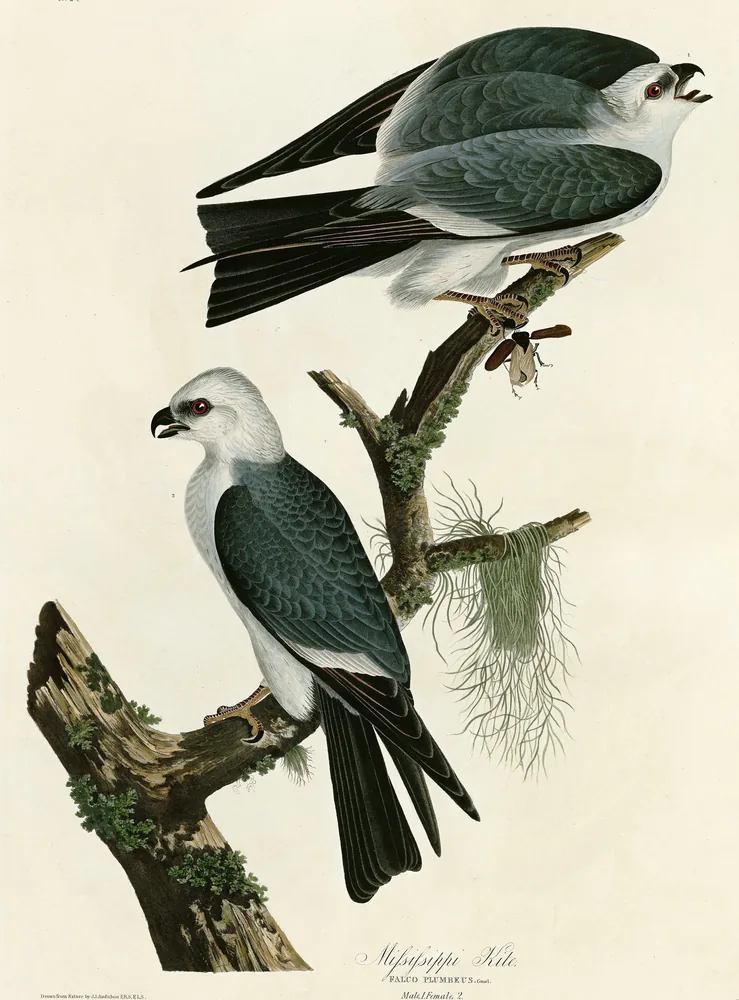
A kite is a bird of prey, and four kinds nest in Texas: the Mississippi, White-tailed, Swallow-tailed and Hook-billed Kites. The Mississippi Kite is the one most people meet: it nests in north-central Texas and the Panhandle, in shelterbelts, river trees and towns such as Lubbock. It eats grasshoppers, cicadas, beetles and dragonflies, and winters in South America.
The White-tailed Kite hovers over coastal fields for small mammals, which make up 95% of its diet. The Swallow-tailed Kite, once a summer bird across much of eastern Texas, now nests mainly near the southeast coast. The Hook-billed Kite feeds on snails along the Rio Grande, where only two or three pairs nested during the atlas years.
Which birds of prey live in my part of Texas?
| Region | Look for |
|---|---|
| Panhandle and the plains | Swainson's Hawk and Mississippi Kite in summer, Ferruginous Hawk, Golden Eagle, Prairie Falcon; the most nesting Kestrels in the state |
| Dallas-Fort Worth and north-central Texas | Mississippi Kite, Broad-winged Hawk in summer, Red-tailed and Red-shouldered Hawks |
| East Texas | Red-shouldered Hawk, Broad-winged Hawk in summer, Bald Eagle, Cooper's Hawk |
| Houston and the upper coast | White-tailed Kite, Bald Eagle, White-tailed Hawk, Swallow-tailed Kite in summer, Osprey in winter |
| Austin, San Antonio and the Hill Country | Red-shouldered Hawk, Zone-tailed Hawk in summer, Broad-winged Hawk on the Balcones Escarpment, Crested Caracara |
| South Texas and the Rio Grande Valley | Harris's Hawk, White-tailed Hawk, Crested Caracara, Gray Hawk, Hook-billed Kite, Aplomado Falcon |
| West Texas and the Trans-Pecos | Zone-tailed Hawk, Common Black Hawk, Golden Eagle, Peregrine and Prairie Falcons, Gray Hawk in summer |
Each row comes from the atlas's account of each bird.
Can a hawk pick up a small dog?
Almost certainly not: a Red-tailed Hawk weighs at most 3 pounds and can't fly carrying more than its own weight, says The Nature Conservancy's Matthew L. Miller. That rules out a 25-pound dog, and a 5-pound one outweighs any Red-tail. Cooper's and Sharp-shinned Hawks barely weigh a pound. A biologist Miller quotes puts an eagle's limit at "four or five pounds, maximum."
That doesn't make a small pet safe. A large hawk can still injure or kill one, Miller writes, and if a bird does take a pet, a Great Horned Owl is the likeliest culprit; see owls in Texas. Our Bald Eagle page answers the 20-pound dog question.
What does it mean when a hawk hangs around your yard?
Most often that it's hunting there: a yard with feeders draws small birds, and in winter Sharp-shinned and Cooper's Hawks from the north join the ones that stay. The Sharp-shin lives mostly on small birds and waits for them inside foliage; the Cooper's Hawk slips from perch to perch through cover. A Red-shouldered Hawk on a low branch is waiting to pounce.
Old Southern folklore didn't treat a hawk as a message. It treated it as a threat to the chickens. A North Carolina collection, published by Duke University Press in 1964, lists remedies: keep a white flint rock hot in the fireplace, string eggshells in the chimney, or hang a dead hawk in a tree. Another entry reads a white hawk flying low in winter as a sign of foul weather. None of that is fact; it's folklore.
What is the penalty for killing a hawk in Texas?
Under federal law, up to $15,000 and six months in jail; Texas adds a fine of $25 to $500 and the value of the bird. Hawks are covered by the Migratory Bird Treaty Act, which makes it unlawful to kill or possess a protected bird, or any part of one, without a permit. Breaking it is a misdemeanor, punished by a fine of up to $15,000, up to six months in jail, or both (16 U.S.C. § 707); killing one to sell is a felony.
Texas law says no one may "catch, kill, injure, pursue, or possess" a bird that isn't a game bird, dead or alive, or any of its feathers (Parks and Wildlife Code § 64.002). That's a Class C misdemeanor with a fine of $25 to $500, and the killer is also liable for the bird's value. Eagles carry more: under the Bald and Golden Eagle Protection Act, a first offense can bring a $100,000 fine and a year in prison, and a second is a felony.
So a hawk feather you pick up and keep counts as possession under both laws. Some uses are allowed by federal permit, banding among them. This is a summary, not legal advice.
Audubon's Harris's Hawk
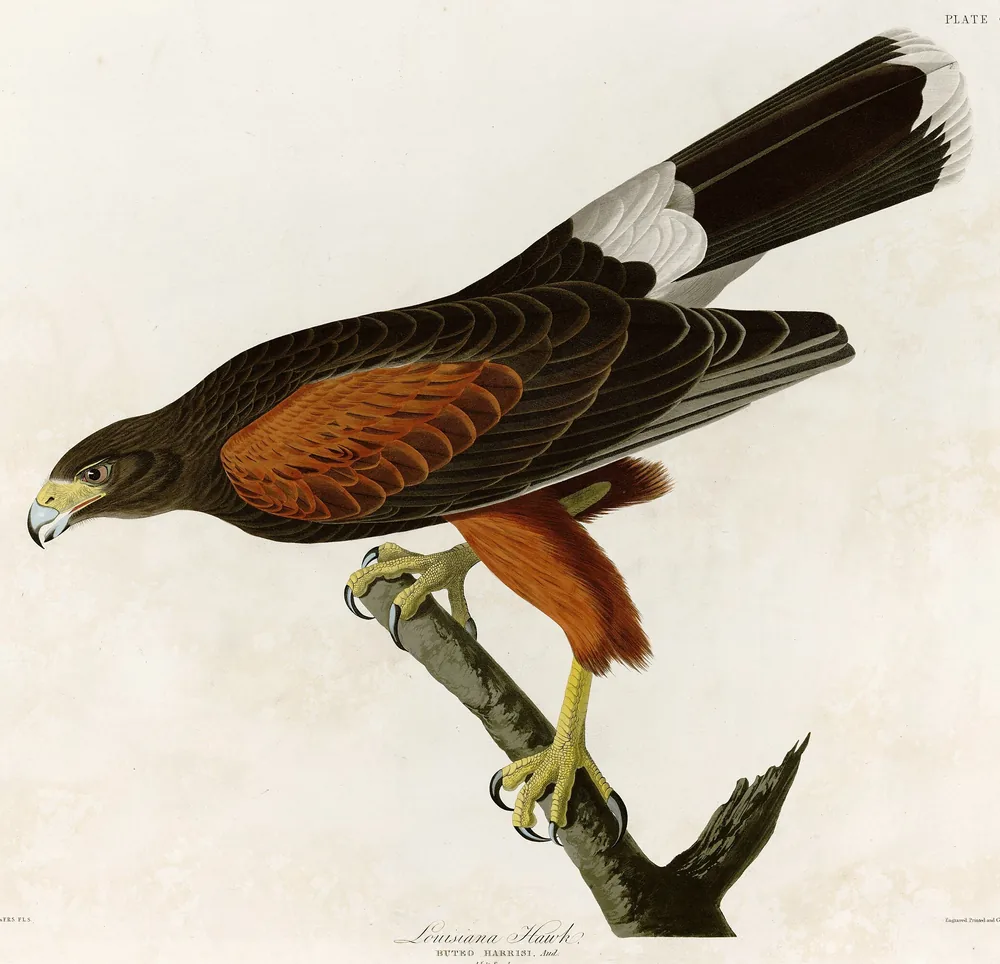
The painting at the top is John James Audubon's plate 392, which he called the Louisiana Hawk. He drew it from a female shot between Bayou Sara and Natchez and knew nothing of its habits. He wrote, "I have much pleasure in naming it after my friend Edward Harris," who had often aided his work, and the bird still carries the name.
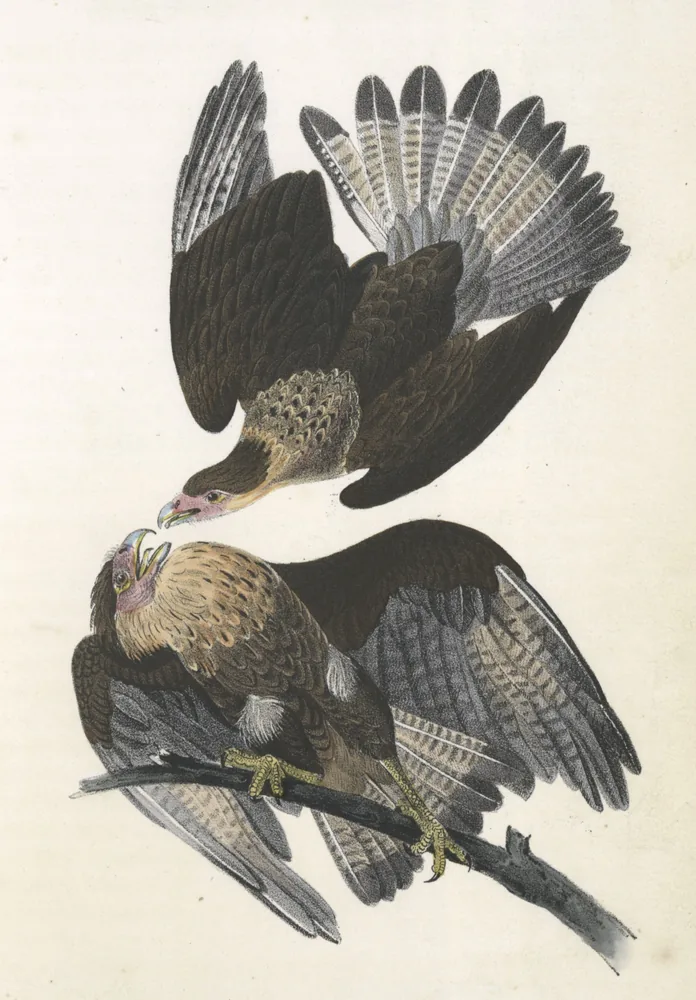
So Audubon missed what the bird is known for today. In family groups, Harris's Hawks chase prey as large as hares in relays and share the kill "as a wolf pack does," the atlas says, though in Texas the helpers are rarer than in Arizona. The caracaras above are from Audubon's smaller octavo edition; Texas has more breeding Crested Caracaras than any other state.
If a Harris's Hawk or a caracara is on your list, a Birdfolio prints it beside a classic painting, with every other bird you've seen: see a life list printed as a book.
Questions people ask
What is the biggest bird of prey in Texas?
The eagles: a Bald Eagle's wings span about 6 feet 8 inches, National Audubon's guide says. Among hawks, the Ferruginous Hawk is the largest buteo in North America; a few nest in the northern Panhandle.