California's official checklist has 17 woodpeckers, plus a Eurasian Wryneck that strayed here once, and the state lists two of them as endangered. Its signature woodpecker is the Acorn, a hoarder that lives in feuding family groups, and its everyday backyard one, the Nuttall's, barely lives anywhere else.
What types of woodpeckers are found in California?
Seventeen woodpeckers are on the California Bird Records Committee's official checklist, updated October 27, 2026, plus the Eurasian Wryneck, an Old World member of the family that has strayed here once.
The checklist covers 696 species. Sixteen of the woodpeckers carry no mark, meaning at least one California specimen backs each of them. The Red-headed Woodpecker, a rare visitor from the East, is a review species, and so is the wryneck, documented by photograph alone. A University of California pest guide gives the same total: "There are 17 species found in California, 2 of which are California-listed endangered species."
| Woodpecker | In California |
|---|---|
| Acorn Woodpecker | Oak woodland across the state, storing acorns in pines, oaks, sycamores, redwoods and palms; the Sierra foothills |
| Nuttall's Woodpecker | Oaks and streamside woods; all year in the Central Valley; the commonest backyard woodpecker in Santa Clara County's suburbs |
| Downy and Hairy Woodpeckers | Backyards in Santa Clara County, alongside the Nuttall's |
| Northern Flicker | Pine and oak woodland, as at Pinnacles National Park |
| Black-backed Woodpecker | Burned forests on the Sierra Nevada's national forests |
| Gila Woodpecker | Streamside desert woods of the lower Colorado River; endangered in California |
| Gilded Flicker | Endangered in California |
| Ladder-backed, White-headed, Lewis's and Pileated Woodpeckers; Williamson's, Red-breasted, Red-naped and Yellow-bellied Sapsuckers | On the list; we couldn't open a California account of their ranges |
| Red-headed Woodpecker | A review species: a rare stray from the East |
| Eurasian Wryneck | One record: San Clemente Island, September 25, 2017 |
California's Department of Fish and Wildlife refused our connection on November 11, 2026, and the San Diego County Bird Atlas turns automated readers away, so the rows without a California source stay short. The whole checklist is counted on the California page of our state bird lists.
Which woodpecker is most common in California?
In suburban yards, at least around San Jose, it's the Nuttall's: "In suburban areas, the Nuttall's Woodpecker is the most common backyard visitor," says the Santa Clara Valley Bird Alliance.
No source we could read ranks them across the state, so take that as a Bay Area answer. Away from the suburbs, the other everyday woodpecker of California's oaks is the Acorn, the bird of the next section.
The Acorn Woodpecker: California's hoarder
At UC Berkeley's Hastings Natural History Reservation in Carmel Valley, Acorn Woodpeckers have been studied since 1968 and "continuously monitored since 1974." What the researchers found reads like a soap opera. One group can hold "up to 7 cobreeding males, 4 joint-nesting females," plus helpers. That makes it "polygynandrous," with several males and several females sharing the breeding, one of the few such mating systems known, and the chicks are "equally divided among the mothers." Michael and Barbara MacRoberts started the project, Walt Koenig arrived in 1974, and Eric Walters has led it since 2016, Bay Nature reported.
The magazine also told the story of a war. After a Cooper's Hawk killed one group's last breeding female, more than 20 woodpeckers fought over the vacancy for seven days, beginning on April Fools' Day, some flying in "from miles away," until a coalition of unbanded female helpers won.
The whole household runs on holes. One acorn hole takes a woodpecker about 20 minutes to drill, Walters told Bay Nature, and a group needs at least 1,000 of them to survive. The storage trees, called granaries, turn up in pines, oaks, sycamores, redwoods "and Stanford University's palm trees," KQED's Deep Look reported, and Koenig told it he knows of no other animal that stores acorns one by one in holes in trees.
Sometimes the granary is a house. In 2023 a pest-control technician in Sonoma County, called about "worms coming from a bedroom wall," found "at least 700 pounds of acorns" inside it, by his estimate, dropped there by Acorn Woodpeckers through a hole in the chimney. His crew filled eight big garbage bags, CBS News Bay Area reported. The species' pantries elsewhere, and the cartoon bird it may have inspired, are in the hub's Acorn section.
Nuttall's Woodpecker vs Downy: how to tell them apart
The back gives it away: a Nuttall's is barred black and white across it, while a Downy has a white stripe down the middle.
Dave Zittin of the Santa Clara Valley Bird Alliance puts the clues simply:
- The back. Nuttall's has "white barring" on "an otherwise black back"; the Downy, like the Hairy, "a prominent white streak."
- The bill. The Downy's is "tiny."
- The place. Nuttall's is "found almost exclusively in this state," in oaks and streamside woods. National Audubon's guide calls it "a California specialty" that reaches only a short way into Baja California and rarely strays to Oregon.
In the desert the look-alike is the Ladder-backed, and Nuttall's "looks much darker," with a "broad black area across upper back," Audubon's guide says.
How do you tell a male Nuttall's Woodpecker from a female?
By the back of the head. The male's red "covers the entire rear of the head," above a forehead streaked black and white, while the female's crown is black, the Bird Alliance says, and National Geographic agrees that "females lack red patch on nape and hindcrown." The two even feed apart: males work trunks and big limbs, females small branches and twigs, and the male digs most of each year's new nest hole, Audubon's guide says.
Listen, too, for a "loud metallic rattle call" and a drum that is "a steady roll of about 20 taps over a second," in National Geographic's words.
California holds both birds' age records. The oldest wild Downy known, banded in California in 1985 and caught again in 1996, was at least 11 years and 11 months old; the oldest Nuttall's, banded in 2000 and caught again in 2006, at least 8 years and 9 months, by the USGS Bird Banding Laboratory's records. Every species is on our list of the oldest wild birds, and the Downy's own painting page shows Audubon's pair.
California's two endangered woodpeckers
The Gila Woodpecker and the Gilded Flicker are both listed as endangered by California, says UC IPM, the University of California's pest management program.
The Gila's troubles show along the lower Colorado River. Its cottonwood-willow woods there were cleared for farms and invaded by tamarisk, and starlings "can outcompete Gila Woodpeckers for cavities," the Sonoran Joint Venture's 2023 account says. The Gilded Flicker shares the listing; its size and range are in our table of North America's woodpeckers.
The listing changes what you may do. California classes woodpeckers as non-game, UC IPM says. The others may be killed only under a permit from the U.S. Fish and Wildlife Service's law enforcement division, and harmless ways of keeping them off a house are allowed "except for the two endangered species." Over all of it sits federal law: "All woodpeckers are protected under the Migratory Bird Treaty Act of 1918."
Black-backed Woodpeckers after Sierra fires
When fire sweeps a Sierra Nevada forest, the Black-backed Woodpecker follows. The Institute for Bird Populations has surveyed it on the Sierra's national forests since a pilot season in 2008, with annual reports through 2021. It is a burned-forest specialist, but a choosy one. It needs "pyrodiversity," a mix of burns of different severity and age, and parents nest in severely burned patches that have live trees nearby, where the young hide. After the most extreme wildfires, one of the institute's paper titles reports "few detections."
The wryneck: a woodpecker that doesn't look like one
On September 25, 2017, at a spot called Lemon Tank on San Clemente Island, in Los Angeles County, a birder found what the records committee called "a completely unexpected addition to the California avifauna": a Eurasian Wryneck, probably eating ants on a rocky hillside.
The committee knew of only three other wrynecks in North America, all in Alaska, in 1945, 2003 and 2019, plus one found dead in Indiana that probably arrived in a shipping container. That makes the San Clemente bird the only one ever seen alive outside Alaska, according to the committee's report.
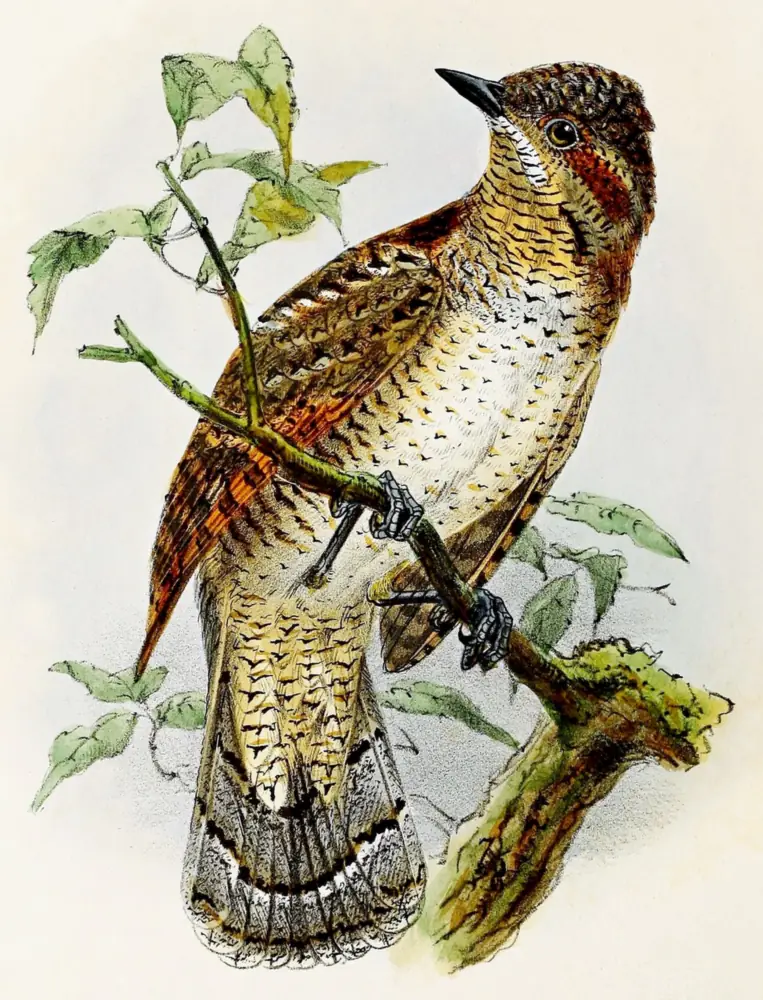
A wryneck belongs to the woodpecker family, yet it looks like a brown songbird patterned like bark, and it feeds on ants on the ground. How rare it is across the continent is in the rare woodpeckers section of our guide.
Palms, oak parks and burned forests: where California's woodpeckers are
| Place | Woodpeckers | What to look for |
|---|---|---|
| Stanford University's campus | Acorn | Granaries in the palm trees |
| Plaza de Cesar Chavez, San Jose | Acorn | Acorn Woodpeckers in a city plaza |
| Marin and Contra Costa counties | Acorn | Oak country |
| The foothills of Sequoia and Kings Canyon National Parks | Acorn | "Calling to one another among the oaks," the Park Service says |
| Pinnacles National Park | Northern Flicker | Pine and oak woodland |
| Santa Clara County's suburbs | Nuttall's, Downy, Hairy | The Nuttall's leads in backyards |
| The Central Valley | Nuttall's | Here all year, says the Central Valley Bird Club |
| Burned forests in the Sierra Nevada | Black-backed | Severely burned patches next to live trees |
| The lower Colorado River | Gila | Endangered in California |
The Hastings reserve is a research station, and we found no visitor rules for it, so it's a story here, not a stop.
An 1850s portrait of the White-headed Woodpecker
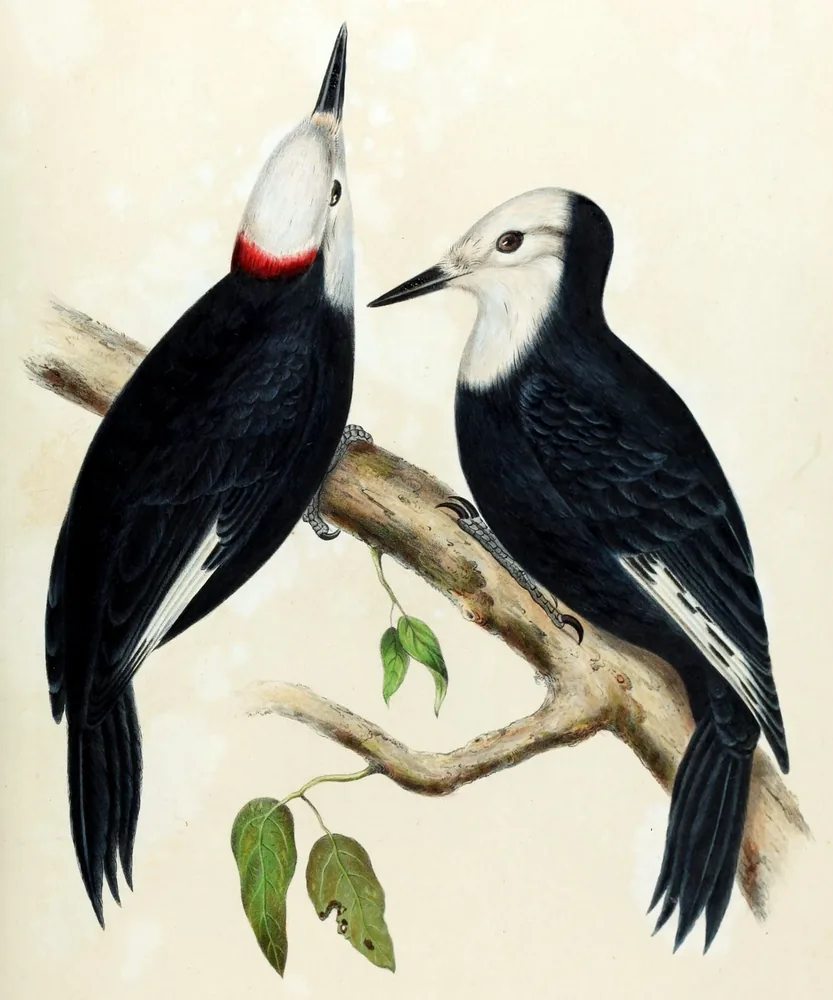
The painting at the top shows a pair of White-headed Woodpeckers: the male reaching up, with a red band at the back of his white head, and the female beside him. H. L. Stephens drew them, and William E. Hitchcock put the drawing on the lithographic stone, for the Journal of the Academy of Natural Sciences of Philadelphia in the early 1850s. If you saw an all-black woodpecker with a white head in California, this is the bird; it's on the state list, and the guide's male-or-female table has its red patch. The wryneck is by John Gerrard Keulemans, from the Dutch book Onze vogels in huis en tuin, "Our birds in house and garden," of 1876.
Keep a list long enough and it outgrows the notebook. A Birdfolio prints all of it, from an Acorn in the Stanford palms to the Nuttall's in your yard, each bird beside a classic painting: see a life list made into a book.
Questions people ask
Are woodpeckers a problem for California homes?
Usually not, unless they're Acorn Woodpeckers that have found your roof. UC IPM calls them "very destructive" when they wedge acorns under shakes or shingles, and suggests checking forest vacation homes "several times during the spring and fall." Netting is "the most effective method," it says, and our house-pecking section explains why woodpeckers drill houses at all.
What bird can be mistaken for a woodpecker?
Nuthatches and creepers, mostly; the look-alikes are covered in our woodpecker guide. California's stranger answer runs the other way: the wryneck is a woodpecker that people could take for something else.