Reference
How many bird species are in Louisiana?
Louisiana has 493 bird species on its official list (Louisiana Bird Records Committee, no date on the list), the 15th highest count of the 49 states with a verified count. It counts species only: 10 subspecies and forms on the same checklist are left out. Extinct birds such as the Carolina Parakeet stay on it.
Louisiana’s state bird is the Brown Pelican: our Louisiana state bird page tells how it was chosen.
Updated
What are the most common birds in Louisiana?
In summer, the 25 most common birds in Louisiana are led by the Western Cattle-Egret, at about 244 birds per survey route, then the Red-winged Blackbird and the Cliff Swallow, by the USGS Breeding Bird Survey’s counts for 2021–2025. Together these 25 made up 66% of all the birds counted on Louisiana’s 49 survey routes.
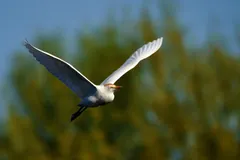
Photo: Bill Levine, CC BY 4.0 1 Western Cattle-Egretabout 244 per routeon 92% of routesno clear trend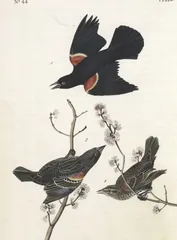
John James Audubon, The Birds of America (1840–44) about 112 per routeon 88% of routesno clear trend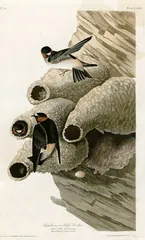
John James Audubon, The Birds of America (1827–38) 3 Cliff Swallowabout 72 per routeon 76% of routesno clear trend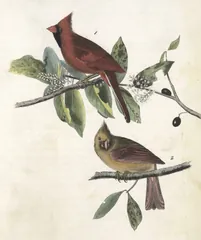
John James Audubon, The Birds of America (1840–44) about 60 per routeon 100% of routesfalling since 2015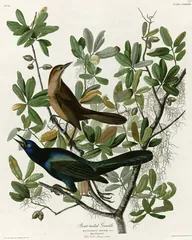
John James Audubon, The Birds of America (1827–38) 5 Boat-tailed Grackleabout 58 per routeon 24% of routesno clear trend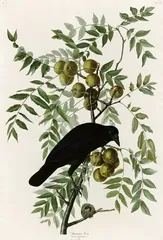
John James Audubon, The Birds of America (1827–38) about 41 per routeon 96% of routesno clear trend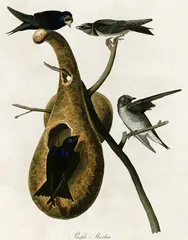
John James Audubon, The Birds of America (1827–38) 7 Purple Martinabout 40 per routeon 94% of routesno clear trend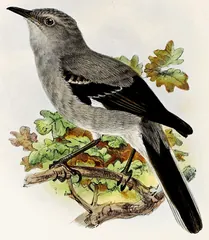
John Gerrard Keulemans, Onze Vogels in Huis en Tuin (1869–76) about 38 per routeon 100% of routesfalling since 2015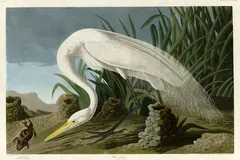
John James Audubon, The Birds of America (1827–38) about 38 per routeon 84% of routesno clear trend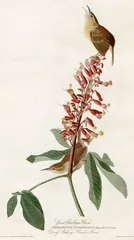
John James Audubon, The Birds of America (1827–38) about 34 per routeon 98% of routesrising since 2015
Show all 25
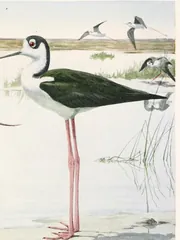
Louis Agassiz Fuertes, The Game Birds of California (1918) 11 Black-necked Stiltabout 34 per routeon 20% of routesno clear trend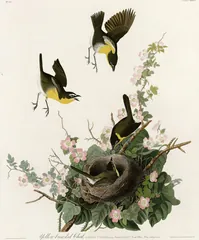
John James Audubon, The Birds of America (1827–38) 12 Yellow-breasted Chatabout 27 per routeon 86% of routesno clear trend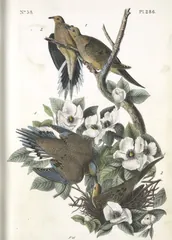
John James Audubon, The Birds of America (1840–44) about 27 per routeon 100% of routesno clear trend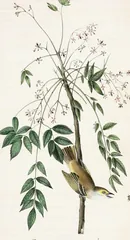
John James Audubon, The Birds of America (1840–44) 14 White-eyed Vireoabout 25 per routeon 92% of routesrising since 2015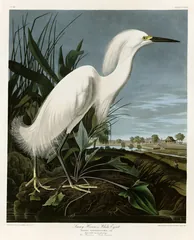
John James Audubon, The Birds of America (1827–38) 15 Snowy Egretabout 25 per routeon 53% of routesno clear trend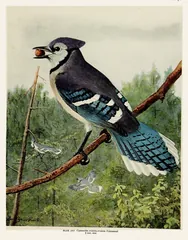
Louis Agassiz Fuertes, Elon H. Eaton's Birds of New York (1910–14) 16 Blue Jayabout 19 per routeon 98% of routesfalling since 2015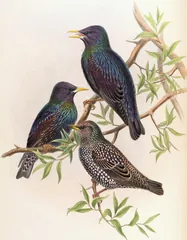
John Gould and Henry Constantine Richter, The Birds of Asia, vol. 5 (1850–83) 17 European Starlingabout 18 per routeon 86% of routesfalling since 2015introduced species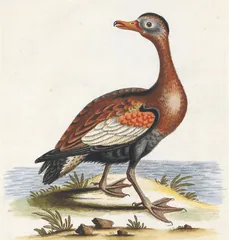
George Edwards (engraved by Johann Sebastian Leitner), Seligmann, Sammlung verschiedener ausländischer und seltener Vögel, part VI, pl. 89 (1749–76) 18 Black-bellied Whistling-Duckabout 15 per routeon 51% of routesno clear trend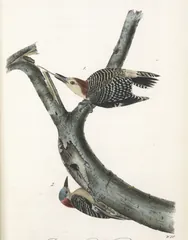
John James Audubon, The Birds of America (1840–44) about 15 per routeon 100% of routesno clear trend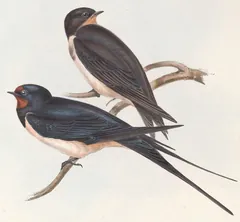
John and Elizabeth Gould, The Birds of Europe (1832–37) 20 Barn Swallowabout 15 per routeon 100% of routesfalling since 2015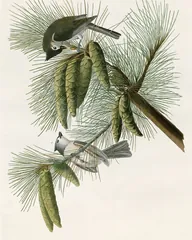
John James Audubon, The Birds of America (1827–38) about 14 per routeon 92% of routesno clear trend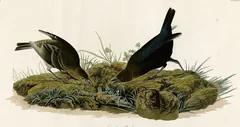
John James Audubon, The Birds of America (1827–38) 22 Brown-headed Cowbirdabout 14 per routeon 98% of routesno clear trend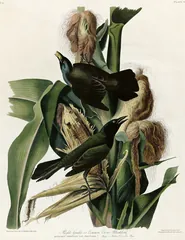
John James Audubon, The Birds of America (1827–38) 23 Common Grackleabout 12 per routeon 82% of routesfalling since 2015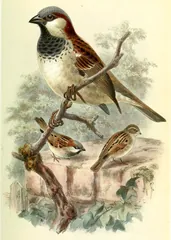
John Gerrard Keulemans, Lord Lilford’s Coloured Figures of the Birds of the British Islands (1885–97) 24 House Sparrowabout 12 per routeon 88% of routesfalling since 2015introduced species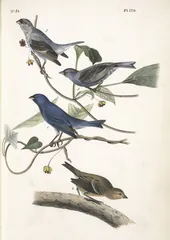
John James Audubon, The Birds of America (1840–44) 25 Indigo Buntingabout 11 per routeon 82% of routesno clear trend
If the Western Cattle-Egret, first on this list, or the Indigo Bunting, last on it, has you curious about the rest of Louisiana’s 493 species, see our comparison of the best bird books of 2026, from the friendliest for beginners to the newest.
What is the most common bird in Louisiana?
The Western Cattle-Egret leads Louisiana’s summer survey: about 244 a route on average in 2021–2025, more than twice the Red-winged Blackbird’s 112, seen on 92% of the 49 routes. USGS finds no clear rise or fall in its Louisiana numbers since 2015.
Wading birds are the state's showpiece. Louisiana is thought to have more of them than any other state, hundreds of thousands, says the Barataria-Terrebonne National Estuary Program, and Christmas Bird Counts in the rice parishes of Lafayette, Acadia, Jefferson Davis and Cameron find the Great Egret the most numerous heron or egret even in winter.
Sources: Official Louisiana State Field Check-list (Louisiana Bird Records Committee); Wings Over the Wetlands: Wading Birds in Louisiana (Barataria-Terrebonne National Estuary Program, 2008), read October 8, 2026.
How was this list made?
Each of Louisiana’s 49 routes is a roadside count, 50 stops along about 25 miles, run once a year in early summer by a volunteer. We took USGS’s yearly estimate for each species in Louisiana, the number of birds a typical route records, averaged it over the five latest survey years (there was no survey in 2020) and ranked the birds by it. To keep the list to birds you’re likely to meet across Louisiana, we left out species recorded on fewer than one in five of its routes, and those USGS can only estimate very roughly, which usually means big flocks or colonies on a few routes.
For Louisiana that left out the White-faced Ibis, the White Ibis, the Laughing Gull and 3 more.
The share of routes is our own count from USGS’s route data for Louisiana, using only counts that met the survey’s standards; “rising” and “falling” are USGS’s trends for the state since 2015, named only where it finds a clear change. Roadside counts on early-summer mornings miss most of Louisiana’s owls and waterbirds, and its winter visitors aren’t here at all.
Louisiana’s counts come from two USGS data releases, the North American Breeding Bird Survey Analysis Results 1966–2025 (Hostetler et al., 2026) and its Dataset 1966–2025 (Ziolkowski et al., 2026), gathered by volunteer observers and free for anyone to use; Birdfolio isn’t connected with the USGS.
How many bird species are in Louisiana?
| Official count | 493 species |
|---|---|
| List’s date | Not given on the Louisiana list (we read it on October 3, 2026) |
| Kept by | Louisiana Bird Records Committee (Louisiana Ornithological Society) |
| Review species | 150, printed in bold on the checklist (our count) |
| Extinct or gone | 4 extinct, 1 probably extinct, 1 no longer found in Louisiana |
| Earlier totals | 482 in 2016; 455 in 2003; 411 in 1974 |
| Among US states | 15th highest of the 49 states with a verified count |
| Official list | Official Louisiana State Field Check-List (LBRC) |
What does Louisiana’s count include?
- Every species the Louisiana Bird Records Committee has accepted, named and ordered as in the American Ornithological Society's checklist through its 65th supplement (2024).
- 150 review species, printed in bold: a sighting of any of them, or of a bird new to Louisiana, should be documented for the committee (our count).
- Extinct species, such as the Passenger Pigeon, Eskimo Curlew, Carolina Parakeet and Bachman's Warbler, and the Ivory-billed Woodpecker, marked as probably extinct.
- The Greater Prairie-Chicken, no longer found in Louisiana, and the Whooping Crane, the subject of a reintroduction program.
- Introduced birds now living wild, such as the Monk Parakeet around New Orleans, the Eurasian Collared-Dove and the House Finch.
- Seabirds out to 200 nautical miles from the coast, in waters nearer to Louisiana than to any other state.
- Not counted: 10 subspecies and forms, shown indented on the checklist, such as the Great White Heron and Audubon's Warbler.
Why do other sources give a different number?
Louisiana's list has grown by about 1.7 species a year since 1974, so a figure only a few years old already falls short:
- 497. The tally in the Louisiana Ornithological Society's newsletter for spring 2026: two species split by the American Ornithological Society, plus a South Polar Skua seen off Venice in August 2024 and a Gray Gull found in 1987, both accepted after the checklist was printed. A swallow awaiting a vote would make 498. Source: Louisiana on Verge of 500th Species! (LOS News 269, Spring 2026, Louisiana Ornithological Society).
- 482. The committee's state list of August 2016, which also set 3 subspecies and forms apart from the count. Source: Official Louisiana State List, August 2016 (Louisiana Bird Records Committee).
- 455. The total after the ninth report (2003), which added seven species, the Kelp Gull among them, and dropped the Red-throated Loon for lack of a photo or specimen. Source: Ninth Report of the Louisiana Bird Records Committee (2003).
- 411. The species George H. Lowery Jr. accepted in the 1974 edition of Louisiana Birds, the last full guide to the state's birds; the society's 50-year review of December 2024 counted 494 by its own reckoning. Source: Fifty Years of Changes to Louisiana's Birds, December 11, 2024 (Louisiana Ornithological Society).
Louisiana’s list follows its own committee’s rules, and so does every other state’s: see why the counts differ from state to state.
Louisiana records, from a Siberian plover to a kite that followed the snails
- On April 22, 1975, birders in New Orleans for a National Audubon Society convention photographed a small plover at Grand Isle. It was a Mongolian Plover, now called the Siberian Sand-Plover, and the first ever found in North America outside Alaska. The committee's first report, in 1982, called the photographs irrefutable. Sources: First Annual Report of the Louisiana Ornithological Society Bird Records Committee (LOS News 98, October 1, 1982); Fifty Years of Changes to Louisiana's Birds, December 11, 2024 (Louisiana Ornithological Society), read October 8, 2026.
- On June 3, 2008, two birders in Peveto Beach Woods, a chenier woodland in Cameron Parish, photographed a Crowned Slaty Flycatcher from South America: the first for Louisiana and the United States, and only the second for North America, after one in Panama five months earlier. Sources: Louisiana Bird Records Committee Annual Report 2008, its first online newsletter; Fifty Years of Changes to Louisiana's Birds, December 11, 2024 (Louisiana Ornithological Society), read October 8, 2026.
- In July 2024 the state gained two species. A Snail Kite was photographed at McElroy Swamp near Sorrento, in Ascension Parish, on July 5, and a Heermann's Gull, a Pacific Coast species, turned up on Grand Isle. Birders had half expected the kite. The Giant Apple Snail has spread fast through Louisiana, Limpkins, which eat apple snails, followed it and began nesting, and many guessed that Snail Kites would be next. Source: 2024 Newsletter of the Louisiana Bird Records Committee, with its Twenty-seventh Report, read October 8, 2026.
Questions people ask about Louisiana’s birds
What is the rarest bird in Louisiana?
The rarest are the birds the official list marks as gone: the extinct Passenger Pigeon, Eskimo Curlew, Carolina Parakeet and Bachman's Warbler, and the Ivory-billed Woodpecker, probably extinct, whose last widely accepted sighting was in Louisiana in 1944. Among living birds, 150 species are rare enough that the records committee reviews every sighting (our count). Some, such as the Snail Kite and Heermann's Gull, were first found here only in 2024.
Sources: Official Louisiana State Field Check-list (Louisiana Bird Records Committee); 2024 Newsletter of the Louisiana Bird Records Committee, with its Twenty-seventh Report; Removal of 23 Extinct Species From the Lists of Endangered and Threatened Wildlife and Plants, proposed rule (Federal Register 86:187, September 30, 2021), read October 8, 2026.
Which birds live in Louisiana?
Birds of the beaches, marshes, cheniers, swamps and rice fields. Louisiana State University's Sea Grant program points to gulls, terns and shorebirds on the beaches of Grand Isle and Cameron Parish, waterfowl in the coastal marshes, and the cheniers of the southwest, islands in the marsh where migrants rest on their way across the Gulf. The swamps around Lake Maurepas and the Atchafalaya Basin, and the rice fields south of Lafayette, draw many more.
Herons, egrets and ibises are everywhere: 17 kinds of wading birds occur in the state regularly. South of New Orleans, the National Park Service's Barataria Preserve, on the Mississippi Flyway, counts over 200 species, from herons along the canal banks to Prothonotary Warblers and Painted Buntings in the woods.
The mix keeps changing. Ross's Goose, the Black-bellied Whistling-Duck and wintering hummingbirds, rarities when the last edition of Lowery's Louisiana Birds came out in 1974, are now expected on a Louisiana January day, the society's 50-year review says. The Limpkin, unknown here then, arrived in 2017, eleven years after exotic apple snails from South America appeared.
Sources: Louisiana Birding, a fact sheet (Louisiana State University, Sea Grant fisheries resources); Wings Over the Wetlands: Wading Birds in Louisiana (Barataria-Terrebonne National Estuary Program, 2008); Animals, Jean Lafitte National Historical Park and Preserve (National Park Service); Fifty Years of Changes to Louisiana's Birds, December 11, 2024 (Louisiana Ornithological Society), read October 8, 2026.
How did a gull from the Southern Hemisphere end up nesting on a Louisiana island?
Nobody knows for sure. On July 8, 1989, two birders photographed a pair of big black-backed gulls on Curlew Island, in the Chandeleur Islands, a remote tern colony in Breton National Wildlife Refuge. They sent the photos in as Lesser Black-backed Gulls, a vote turned that down, and a closer look showed Kelp Gulls, until then a bird of the Southern Hemisphere. They were the first ever found in the United States.
In July 1990 a Kelp Gull on North Gosier Island was paired with a Herring Gull, itself out of place there, and had a full-grown chick. The timing worried the committee: the gulls appeared just after Sea World had imported eggs and handed out captive-bred birds. But new records from Texas, Mexico's Yucatán and Trinidad pointed to a natural spread, and the committee accepted the gulls as wild, creating a category called Origin Hypothetical for such puzzles along the way; today it marks the Baikal Teal.
The pure Kelp Gulls seem to have died out, but their mixed offspring live on as what birders call Chandeleur Gulls, so like Kelp Gulls that in 1994 the committee turned down a reported Kelp Gull, 3 votes to 4, because a hybrid couldn't be ruled out.
Sources: Ninth Report of the Louisiana Bird Records Committee (2003); Fifty Years of Changes to Louisiana's Birds, December 11, 2024 (Louisiana Ornithological Society); Tenth Report of the Louisiana Bird Records Committee (Journal of Louisiana Ornithology 8, 2010); Official Louisiana State Field Check-list (Louisiana Bird Records Committee), read October 8, 2026.
Why does Louisiana still list the Ivory-billed Woodpecker as only probably extinct?
Because the species' last undisputed sighting was in Louisiana, and the hunt for it has never quite stopped. The checklist marks it E?, probably extinct but still on the review list. The last widely accepted sighting anywhere was in April 1944, in the Singer Tract along the Tensas River in northeast Louisiana, the U.S. Fish and Wildlife Service wrote in 2021.
On April 1, 1999, a pair was reported at the northern edge of Pearl River Wildlife Management Area. The committee found the description good but wanted photos or video and more than one observer, and a two-month search in 2002 by the LSU museum, Cornell University and the state wildlife department found no proof. From 2005 to 2013 searchers spent about 1,500 hours in the Pearl River swamp and a Florida swamp, with only blurry, inconclusive video to show for it.
In 2021 the Fish and Wildlife Service proposed taking the woodpecker off the endangered list as extinct. Scientists disagreed so sharply that its final rule of October 2023 left the bird out and promised a separate decision; that rule did declare Bachman's Warbler, another species on Louisiana's list, extinct.
Sources: Official Louisiana State Field Check-list (Louisiana Bird Records Committee); Removal of 23 Extinct Species From the Lists of Endangered and Threatened Wildlife and Plants, proposed rule (Federal Register 86:187, September 30, 2021); Ninth Report of the Louisiana Bird Records Committee (2003); Removal of 21 Species From the List of Endangered and Threatened Wildlife, final rule (Federal Register 88:199, October 17, 2023), read October 8, 2026.
Where is the official Louisiana bird list, and how often is it updated?
On the Louisiana Ornithological Society's website, on the records committee's page: the Official Louisiana Checklist, a PDF field list with no printed date. It follows the American Ornithological Society's checklist through its 65th supplement (2024), prints the review species in bold and has no fixed update schedule; the committee's 2024 newsletter, with its 27th report, put the total at 493 after the Snail Kite, Heermann's Gull and a shearwater split.
The committee, formed in 1979 within the society (founded in 1947), has nine voting members, and a record passes in its first round only with all nine votes. Since March 2025 a species stays on the review list only while it averages two or fewer records a year over ten years. An introduced bird joins the list only after ten straight years of nesting, among other tests. The paper files are kept at the LSU Museum of Natural Science.
Sources: Louisiana Bird Records Committee, home page (Louisiana Ornithological Society); Official Louisiana State Field Check-list (Louisiana Bird Records Committee); 2024 Newsletter of the Louisiana Bird Records Committee, with its Twenty-seventh Report; Bylaws of the Louisiana Bird Records Committee, as amended March 15, 2025 (Louisiana Ornithological Society); About the Louisiana Ornithological Society, read October 8, 2026.
How do you count your own Louisiana list?
Your Louisiana list is every species you’ve seen in Louisiana. eBird can filter your life list to Louisiana, and your eBird data download gives the state of every sighting. On paper, count the species you’ve seen in Louisiana; what is a life list? explains how birders keep their lists.
To print your whole list, Louisiana birds and all, see how to print your bird life list, or let Birdfolio make it a hardcover book.
Louisiana’s state bird
Louisiana’s state bird is the Brown Pelican, the state bird since 1966. Its story, the state flower and animal, and a free picture card for a report are on our Louisiana state bird page.
Birding festivals in Louisiana
Our birding festivals calendar lists 2 in Louisiana, with dates from each festival’s own website:
- Wings Over the Delta – Plaquemines Parish Birding Festival, Belle Chasse: November 21, 2026
- Grand Isle Migratory Bird Celebration, Grand Isle: dates not announced yet; expected in April 2027 (2026 festival: April 17–18, 2026)
Christmas Bird Count in Louisiana
Louisiana had 31 Christmas Bird Count circles on Audubon’s map last winter, each counted on a single day between December 14 and January 5. Our guide shows where to find Louisiana’s counts and lists 1 Louisiana count date already announced for this winter; it’s free, and beginners are welcome.
More about bird counts
- How many bird species are in each state: Louisiana beside all 50 states, DC and Canada.
- Bird lists of nearby states: Arkansas, Mississippi and Texas.
- State birds of all 50 states, Louisiana’s Brown Pelican among them
- How many bird species are in the US and Canada
- Bird splits and lumps
If you’re shopping for a birder in Louisiana, our gift guide for birders and our pick of coffee table bird books are good places to start.