A raven is the bigger bird: 22 to 27 inches long and about 1½ to 3½ pounds, against 16 to 21 inches and 11 to 22 ounces for an American Crow, with a wedge-shaped tail, a heavier bill, shaggy throat feathers and a deep croak instead of a caw. In most of the US the big black bird in the yard is a crow; ravens hold the West, Alaska, the northern woods and the Appalachians, and are spreading back into the Northeast.
Crow vs raven at a glance
Every measurement is from National Audubon's Guide to North American Birds, so the columns compare like with like. The last row we took ourselves from the US Geological Survey's Breeding Bird Survey results, the yearly trend for the US and Canada; the ratios below the table are our arithmetic.
| Common Raven | Chihuahuan Raven | American Crow | Fish Crow | Common Grackle | |
|---|---|---|---|---|---|
| Length | 22–27 in | 18.1–20.5 in | 16–21 in | 14–16 in | 11–13.4 in |
| Wingspan | 46–47 in | 39–43 in | 34–39 in | 30–34 in | 14–18 in |
| Weight | 1 lb 8 oz–3 lb 9 oz | 1 lb 9 oz–2 lb 8 oz | 11–22 oz | 9.9–12.3 oz | 2.6–5 oz |
| Tail | Wedge-shaped | Wedge-shaped | Square-tipped, opens like a fan | Like the American Crow's | Long, creased down the middle |
| Voice | Deep croak | Harsh kraak, higher | Caw-caw | Nasal ah-ah | Squeak like a rusty hinge |
| Seen in | Pairs | Flocks after nesting | Families; winter roosts | Flocks near water | Flocks |
| Trend since 1966 | +1.78% a year | −0.17% a year (no clear trend) | −0.17% a year | +0.94% a year | −1.52% a year |
By these figures a raven weighs 2.2 to 2.6 times as much as an American Crow. Length can mislead: a male Great-tailed Grackle is as long as an American Crow, 18 to 23 inches, yet weighs only 6.7 to 9.4 ounces, because most of that length is tail.
How can you tell a crow from a raven in flight?
Watch the tail and the wingbeats: a raven's tail spreads into a wedge and it soars on flat wings like a hawk, while a crow's tail opens like a fan and it rows along with steady flaps. Ravens "soar and ride thermals," says a BirdNote script on Audubon's site; crows do "more flapping." Mass Audubon gives the raven longer, slightly pointed wings, against the crow's "broader, shorter, less pointed" ones, and adds that a soaring raven sometimes tumbles. On the ground, a raven's walk is "punctuated by a few two-footed hops."
What does a raven sound like compared to a crow?
A raven croaks, deep and hoarse; a crow caws, higher and clearer.
Edgar Allan Poe's first choice for the bird that says "Nevermore" was a parrot. He switched to a raven, he explained in "The Philosophy of Composition" (1846), because it was "equally capable of speech" and far better suited to the poem's mood. He had the talking right: ravens in human care "can mimic simple sounds," even human speech, says the Smithsonian's National Zoo. The voices in words, from Audubon's guide:
| Bird | What it sounds like |
|---|---|
| Common Raven | "Deep, varied, guttural croaking; a hollow wonk-wonk" |
| Chihuahuan Raven | A harsh kraak, "higher pitched than Common Raven's" |
| American Crow | "Familiar caw-caw or caa-caa" |
| Fish Crow | "A nasal kwok and a nasal, two-noted ah-ah"; to Mass Audubon, sometimes "uh oh!" |
The Fish Crow "is recognized with certainty only by sound," the guide warns, and young American Crows sound nasal too. To hear a raven, try the National Park Service's Common Raven from Grand Teton, or another from the same park in Montana State University's Acoustic Atlas. Two more Poe-and-raven puzzles are among our bird trivia questions.
Is a crow smarter or a raven?
Neither has been shown to be smarter, because no study has given crows and ravens the same full set of tests; both rank at the top of bird intelligence, and each shines in different experiments. Ranking animals this way "is a precarious exercise," writes the corvid researcher Kaeli Swift. Crows stand out at faces and at learning from each other, ravens at planning.
Is crow as intelligent as raven?
Roughly, yes, as far as tests can tell: both belong to the genus Corvus, both carry primate-like numbers of neurons in the forebrain, and both have matched young children or great apes on particular tasks. Large-brained corvids have forebrain neuron counts "equal to or greater than primates with much larger brains," a 2016 study in PNAS found.
How smart are crows?
Smart enough to remember a human face for well over a decade, and to teach crows that never met that person to scold them too.
In 2006, University of Washington researchers trapped seven crows on campus while wearing a caveman mask; a second, "neutral" mask showed Dick Cheney, then vice president, a university page says. The scolding peaked around 2013, and on a masked walk in September 2023, about 17 years on, not one crow scolded. The bigger finding was in birds never caught: at five Seattle sites the scolding "doubled in frequency" in five years and spread "at least 1.2 km," three-quarters of a mile, as young crows learned it from their parents (Proceedings of the Royal Society B, 2011).
The famous tool-makers are New Caledonian Crows, from a Pacific island. In water-and-stone tests modeled on Aesop's fable, their grasp of cause and effect was "rivalling that of 5-7 year old children" (PLOS ONE, 2014). That is the source of "as smart as a 7-year-old": one species, one kind of puzzle, and they failed the two hardest versions. Among American Crows, one wild bird was seen shaping wood into a probe, once (The Wilson Bulletin, 2000).
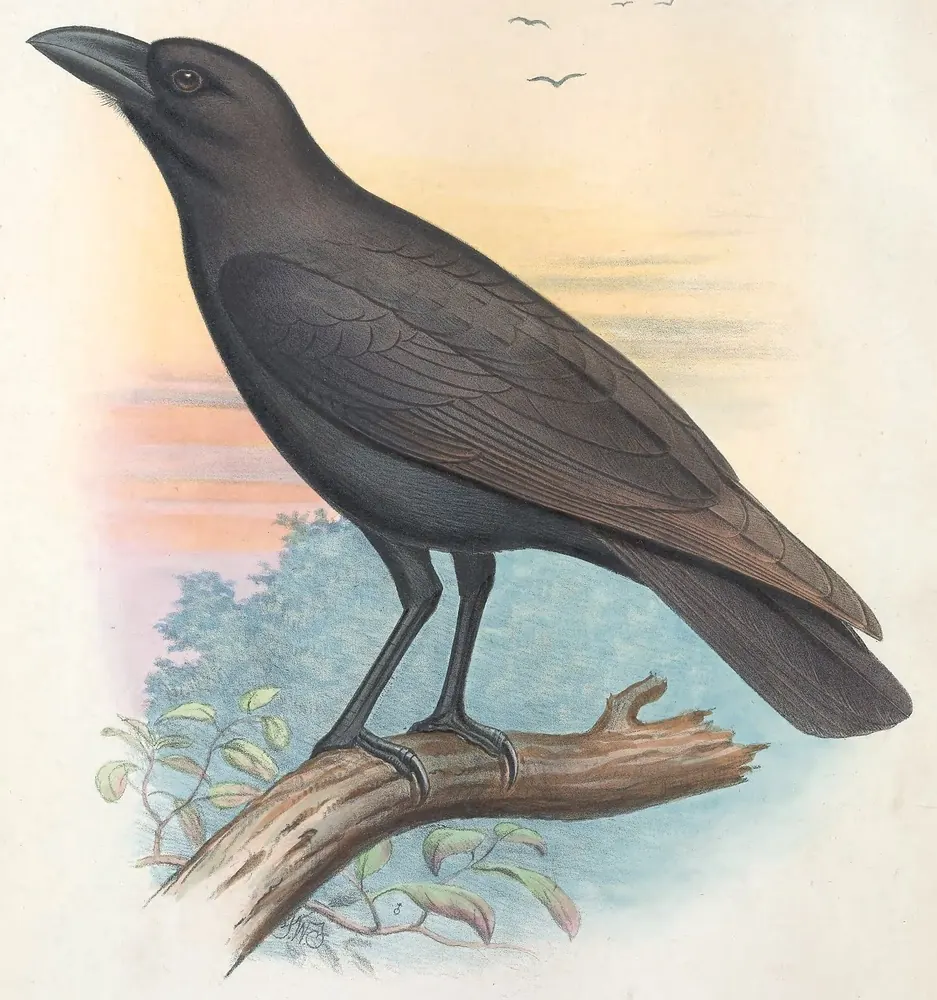
The one US crow known to use tools as a species is the Hawaiian Crow, or ʻAlalā. University of St Andrews researchers tested "104 of the 109 ʻAlalā alive at the time," all of them in captivity (the last wild birds had been seen in 2002), and "the vast majority" used tools without training, the university reported in 2016. Five captive-bred birds were released on Maui in November 2024, and the recovery project says they "continue to thrive"; our Northwestern Crow page follows the releases.
How smart are ravens?
Smart enough to plan many hours ahead, to keep track of what other ravens can see, and to fly from memory to the places where food tends to turn up.
For decades the story went that ravens find wolf kills by following wolves. Then Matthias-Claudio Loretto and colleagues tracked 69 GPS-tagged ravens and 20 collared wolves in Yellowstone and found only one clear case of a raven following a wolf. Instead, ravens flew up to 155 kilometers (96 miles) in a day straight to places where kills tend to happen, from memory, the Max Planck Institute of Animal Behavior reported in March 2026 (the paper is in Science). Close-range cues such as howling may still help.
In Sweden, ravens chose and kept a tool, or a token to trade, for use up to 17 hours later (Science, 2017). In Austria, ravens guarded their food when they heard a rival behind a screen, but only while a peephole was open (Nature Communications, 2016). Young ravens given a test battery built for primates showed "full-blown cognitive skills" by four months, close to adult great apes (Scientific Reports, 2020), though Swift notes that only eight birds were tested, and they differed a lot.
Is a crow more intelligent than a dog?
There's no verdict, because crows and dogs have never taken the same tests; what can be compared is brain wiring, and there crows hold their own. Corvid brains are small but packed with neurons, at primate-like counts; a golden retriever's cerebral cortex has about 623 million, the most of any carnivore in a 2017 study, and a cat's about 250 million (Frontiers in Neuroanatomy).
Do crows have high IQ?
There's no IQ test for birds; on particular puzzles, crows and ravens match young children or great apes, and that is the honest version of the claim. Carrion crows in Germany even learned to produce nested sequences and "perform on par with children" (Science Advances, 2022), though a 2023 reply argues that simple associative learning explains it.
Do crows remember kindness?
They remember the people who feed them: in brain scans at the University of Washington, the face of a person who had cared for crows lit up regions tied to motivation, and a captor's face regions tied to threat (PNAS, 2012).
In Seattle, an 8-year-old girl who fed the neighborhood crows peanuts kept the small things they left her: sea glass, a rusty screw, a tube of lip balm, even a lens cap she had lost, Audubon reported in 2015. Crows don't always bring gifts, John Marzluff told the magazine, but "I have seen an awful lot of things crows have brought people." Take it as one family's story, not a rule. The so-called crow funerals, where crows gather calling around a dead crow, turned out to be lessons in danger: in a 2015 study the birds scolded a person seen with a dead crow for up to six weeks (Animal Behaviour, as Carl Zimmer reported in The New York Times). More is on our American Crow page.
Which is stronger, a raven or a crow?
One on one, the raven, which weighs more than twice as much as a crow; but crows win the fights anyway. In about 2,000 clashes reported across North America, crows were the attackers about 97% of the time, usually in small groups and mostly from March to May, when ravens raid crow nests (Benjamin Freeman and Eliot Miller, The Auk, 2018). The attacks go on in winter too.
Do crows and ravens hate each other?
Not both ways: the study shows crows harassing ravens, mostly because ravens eat crow eggs and nestlings, rather than a feud on both sides.
Can a raven breed with a crow?
Almost never: the only documented wild pair we found was a Common Raven and an American Crow in Toronto, which raised two young in 1993. A 1994 note in Ontario Birds reported it, Kaeli Swift writes on her blog, Corvid Research. Crows attack ravens too readily for such pairs to be common, and the two aren't close relatives.
The Common Raven is itself a merger. In western North America it carries the mixed genes of two lineages that split about 1.5 million years ago and later fused (Nature Communications, 2018). One of them, the "California" lineage, is the Chihuahuan Raven's closest relative, yet Common and Chihuahuan Ravens don't interbreed today, though they share ground. Crows have merged too: the Northwestern Crow was folded into the American Crow in 2020, as its own page tells.
Should I befriend a crow or a raven?
A crow, if you mean the bird you'll actually see: crows live in towns in family groups and learn the faces of people who feed them, while ravens mostly keep to wilder country. Either way they stay wild birds, to watch but not to keep.
The law treats them differently. Federal rules let states set crow hunting seasons of up to 124 days a year, never during the peak nesting period and never from aircraft; in Hawaii no crow may be taken (50 CFR 20.133). Ravens have no season. Killing one takes a federal depredation permit, and on September 14, 2026, the US Fish and Wildlife Service let western states hand out raven permits to protect greater sage-grouse and livestock, with nonlethal methods still required. Both birds fall under the Migratory Bird Treaty Act, which "prohibits the take of protected bird species unless permitted," the Service says. We found no federal rule on feeding them either way, so check your local rules.
What US states do ravens live in?
Common Ravens live across the West and Alaska, around the northern Great Lakes, in northern New England and down the Appalachians: the USGS Breeding Bird Survey found them on its routes in 36 states in 2021 to 2025. The Chihuahuan Raven adds the dry grasslands of Texas, New Mexico, Arizona, Colorado and Oklahoma.
Fifty years ago a raven in New York was almost unheard of: the Breeding Bird Survey, a count run each June along the same roadside routes, found ravens on just 1 of its 106 routes there in 1966 to 1975. By 2021 to 2025 they were on 57 of 69. These counts are ours, from the survey's published route data.
| Ravens on | States, 2021 to 2025 |
|---|---|
| Most routes (over 70%) | Washington, Nevada and New Hampshire (every route), Oregon, Utah, Arizona, California, Vermont, Idaho, Alaska, New Mexico, Maine, Connecticut, Montana, New York, West Virginia, Wyoming, Pennsylvania, Massachusetts, Colorado |
| Some routes (20 to 70%) | Virginia, Wisconsin, Michigan, Minnesota, Rhode Island, Maryland, North Dakota, New Jersey, Texas (the west and the Edwards Plateau), North Carolina (the mountains) |
| A route or a few | Tennessee, Oklahoma, South Carolina, Georgia, Ohio, Nebraska |
| None | Alabama, Arkansas, Delaware, Florida, Illinois, Indiana, Iowa, Kansas, Kentucky, Louisiana, Mississippi, Missouri, South Dakota |
A June roadside count can miss a few pairs, so "none" isn't proof: South Dakota had its first raven nest in over a century in 2024, as our South Dakota page tells, though Missouri's checklist does list the raven as no longer found. Hawaii isn't surveyed. Ravens "disappeared from much of the eastern and midwestern United States before 1900," says Audubon's guide, and the return shows decade by decade (our count):
| Routes with ravens | 1966–75 | 1986–95 | 2006–15 | 2021–25 |
|---|---|---|---|---|
| New York | 1 of 106 | 28 of 112 | 69 of 105 | 57 of 69 |
| Pennsylvania | 12 of 91 | 41 of 114 | 75 of 110 | 82 of 107 |
| West Virginia | 5 of 29 | 25 of 54 | 41 of 54 | 45 of 55 |
| Connecticut | 0 of 16 | 0 of 18 | 8 of 17 | 10 of 12 |
| New Jersey | 0 of 19 | 1 of 32 | 4 of 29 | 8 of 27 |
| Ohio | 0 of 45 | 0 of 74 | 1 of 68 | 1 of 49 |
The survey's steepest state trends since 1966 are mostly in the Northeast, led by Connecticut at +15.3% a year. Across the US, +2.28% a year compounds to about 3.8 times as many ravens as in 1966 (our arithmetic). In the West, "The number of ravens has exploded in recent years," says the National Park Service at Joshua Tree, which credits more roads (and roadkill), landfills and power poles. A USGS-led study found ravens increased in 73% of North America's ecoregions from 1966 to 2018, and were 204% more abundant inside the greater sage-grouse's range than outside it (Human–Wildlife Interactions, 2021). Our state pages follow ravens on winter bird counts in Alaska, Arizona and New Jersey.
Which crows and ravens live in the US?
Six are on the American Birding Association's list: the Common and Chihuahuan Ravens, the American and Fish Crows, and two rarities, the Tamaulipas Crow of the Mexican border and the Hawaiian Crow, which survives mostly in captivity. The ABA's codes run from 1, widespread, to 6, not to be found in the wild.
| Bird | ABA code | Where in the US | Population in Audubon's guide |
|---|---|---|---|
| Common Raven | 1 | West, Alaska, northern woods, Appalachians; spreading in the Northeast | 29,000,000 |
| Chihuahuan Raven | 1 | Dry grasslands of Texas, New Mexico, Arizona, southeastern Colorado, western Oklahoma | 840,000 |
| American Crow | 1 | Every state but Hawaii | 28,000,000 |
| Fish Crow | 1 | Atlantic and Gulf coasts, up big rivers; spreading inland | 470,000 |
| Tamaulipas Crow | 4 | Far south Texas, mostly in winter | 200,000 |
| Hawaiian Crow (ʻAlalā) | 6 | Released on Maui since 2024 | Over 100 in captivity |
These populations look like whole-range estimates (our assumption), so the raven's includes Europe and Asia. The Tamaulipas Crow's story, with the five crows and ravens of Texas, is on our American Crow page.
The Fish Crow is moving inland: on 1 of 37 Missouri survey routes in 1966 to 1975 and 38 of 81 in 2021 to 2025 (our count). Its numbers are "probably increasing as it expands its range farther north and inland," says Audubon's guide.
Fish Crow or American Crow?
Listen: a Fish Crow says a nasal "uh-oh," an American Crow a plain caw. The Fish Crow is a little smaller, 14 to 16 inches against 16 to 21, and stays nearer water, but its voice is the only sure sign, and young American Crows can sound nasal too.
Chihuahuan Raven or Common Raven?
A Chihuahuan Raven is smaller, with a smaller bill and a higher "kraak," it flocks outside the nesting season, and it lives on dry grassland, where the Common Raven keeps to mountains and cactus desert. Go by length, 18 to 20.5 inches: Audubon's guide calls it "about the size of an American Crow" yet gives it a raven's weight, and the Texas Breeding Bird Atlas, which notes its old name, White-necked Raven, calls it "intermediate." AviList, the world bird list, calls the Common Raven the Northern Raven and counts 47 species in the genus Corvus, nine of them named ravens (our count).
Grackle vs crow: what's the difference?
A grackle is a blackbird, not a crow: about two-thirds a crow's length and a quarter of its weight, with pale yellow eyes, a glossy purple-blue head and a long, keel-shaped tail.
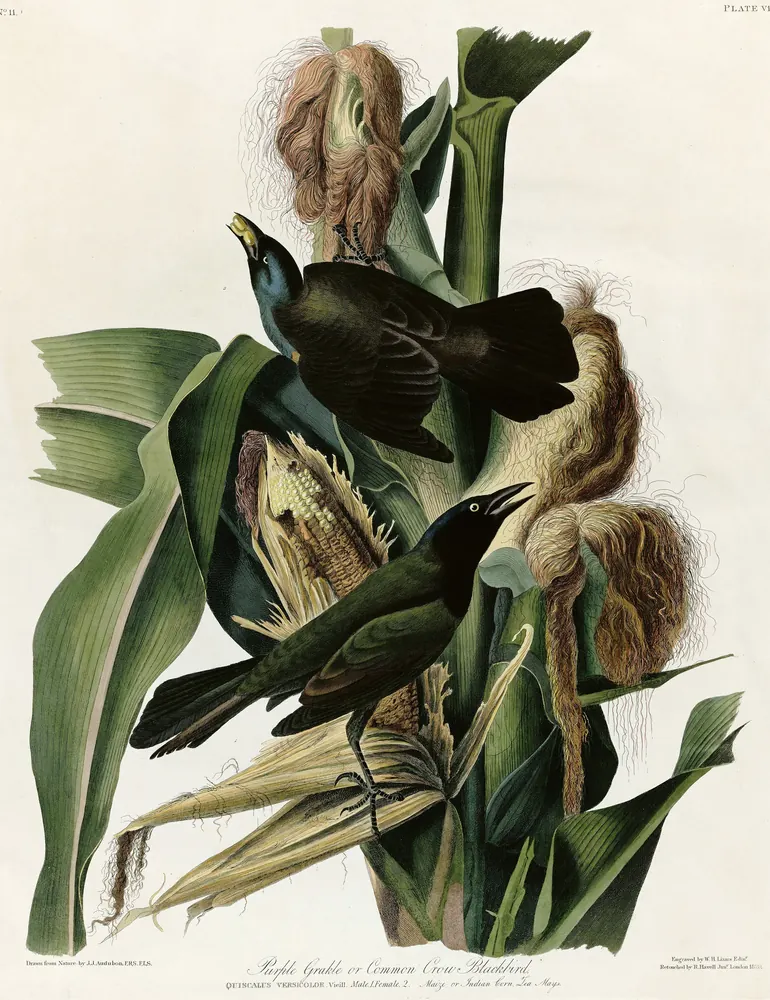
Audubon titled his grackle plate "Purple Grakle or Common Crow Blackbird" (plate 7, below), but the bird he called a crow blackbird belongs to another family altogether. Grackles are New World blackbirds, family Icteridae, 108 species in AviList's 2026 list; crows and ravens are corvids, family Corvidae, 135 species (our count).
A Common Grackle is 11 to 13.4 inches and 2.6 to 5 ounces, with "whitish-yellow eyes" and a tail with a "crease" down the middle, says Audubon's guide; Mass Audubon hears a "squeaky, rusty hinge." A crow is "entirely black," in the guide's words, with dark eyes, and outweighs a Common Grackle about four times (our arithmetic). Two bigger grackles, the Great-tailed of Texas and the Southwest and the Boat-tailed of the Atlantic and Gulf coasts, have crow-length males and brown females; our Red-winged Blackbird page explains the noisy grackle flocks of Texas towns.
The Common Grackle is in trouble. It is now rated Near Threatened, and the survey trend, −1.52% a year since 1966, works out to about 60% fewer birds (our arithmetic), though Audubon's guide still prints 67 million.
Raven or blackbird?
A raven is about twice a grackle's length and roughly ten times its weight: 22 to 27 inches and up to 3½ pounds, against 11 to 13.4 inches and at most 5 ounces. Smaller black birds, from cowbirds to starlings, are sorted out on our Red-winged Blackbird page.
Crows and ravens in history and legend
The Tower of London's ravens have a shorter history than their legend. The story says the kingdom will fall if they leave, supposedly since Charles II, but the folklorist Boria Sax found that they "only enter the record around 1883," and he calls the Charles II story "most definitely not historically accurate," JSTOR Daily reported.
On the Northwest Coast, Raven is Yéil in Tlingit, Xuyaa in Haida and Txaamsm in Tsimshian, says the Sealaska Heritage Institute: "a legendary cultural hero, world-maker, and trickster," best known for stealing the daylight. That story is its tellers' to tell, so we leave it to them.
"A murder of crows" and "an unkindness of ravens" come from old lists of fanciful group names. The earliest such list is in the Book of Saint Albans of 1486, "a kind of handbook on manliness," Nicholas Lund wrote in Audubon. Birders and scientists just say "flock."
Audubon's crows and ravens
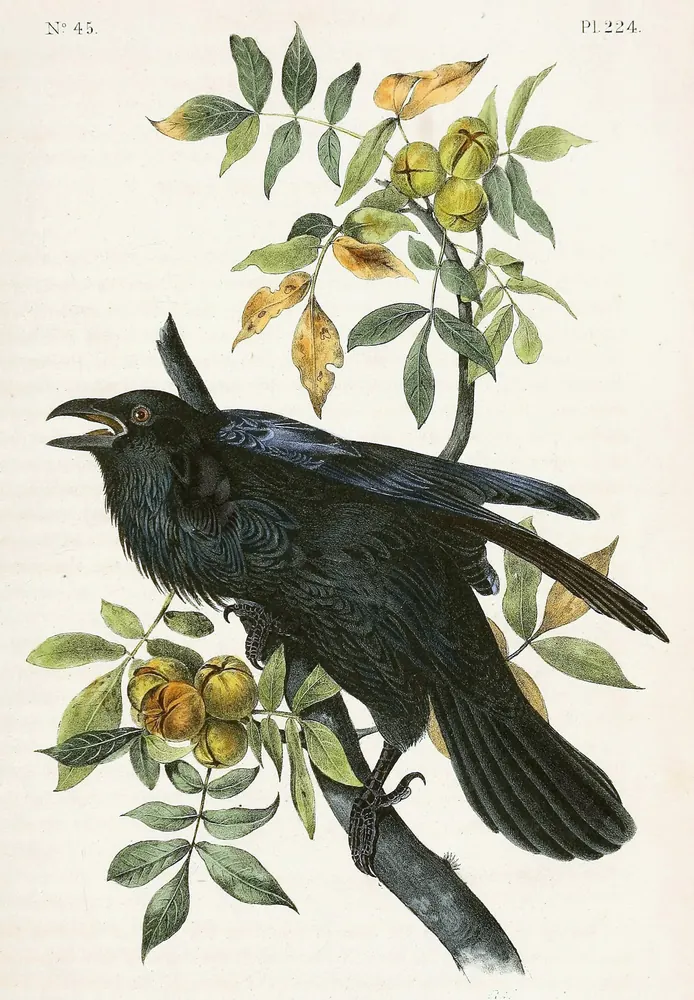
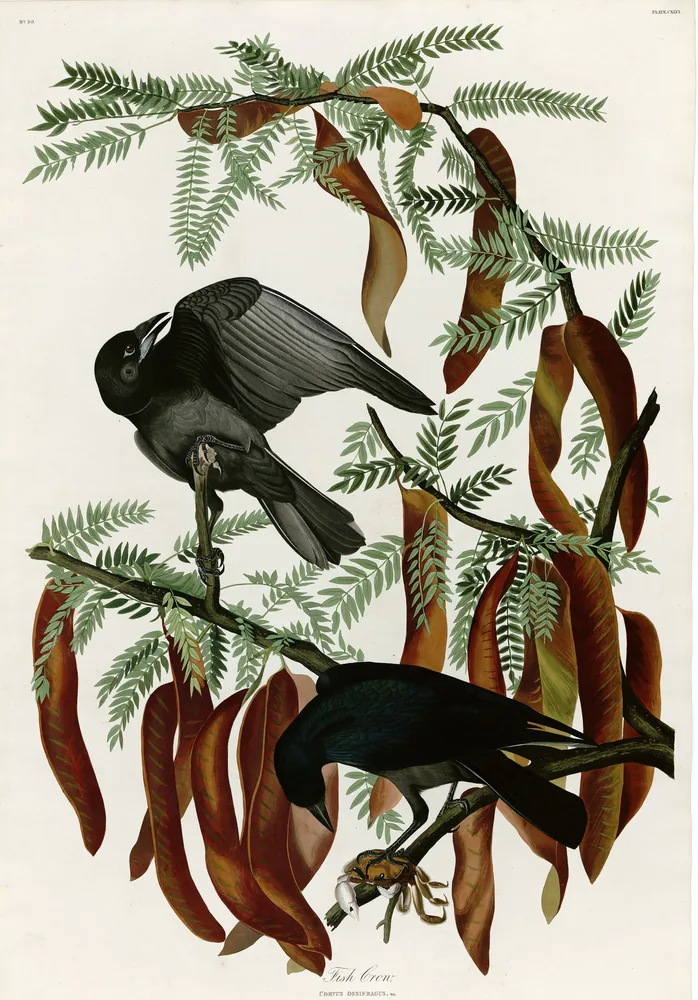
The raven at the top is plate 224 of the octavo edition of John James Audubon's The Birds of America (1840–44), the smaller edition's version of his plate 101. He painted his raven and his American Crow on branches heavy with nuts; the crow's is a black walnut. The Fish Crows (plate 146) and the "Common Crow Blackbird" (plate 7) come from the big edition, where every bird is life-size, as our guide to Audubon explains.
Can you tell a crow from a raven, a Fish Crow and a grackle by the painting alone? One question in the backyard birds level of our bird quiz asks just that.
Crow, raven or grackle, each one you're sure of earns its line on your life list, and a Birdfolio prints every bird on yours beside an old painting like these: see the pages of one.
Questions people ask
How long do ravens and crows live?
Ravens usually live 10 to 15 years in the wild and American Crows 4 to 6. The oldest known wild Common Raven reached at least 22 years and 6 months (lifespan guide), the oldest banded American Crow 18 years and 4 months (American Crow page).
Do ravens mate for life?
Some do. The National Zoo describes "some pairs even mating for life," and Audubon's guide notes that ravens usually forage in pairs.
What is the biggest crow?
In North America, the Common Raven, the biggest member of the crow family here, says Audubon's guide: up to 27 inches long, with a wingspan of nearly 4 feet.
Are crows rare?
American Crows are not: Audubon's guide puts them at 28 million. West Nile virus, which reached North America in 1999, cut their numbers by up to 45% (Nature, 2007), and the survey trend since 1966 works out to about 9% fewer across the US and Canada (our arithmetic). The rare ones are the Tamaulipas Crow and the ʻAlalā.