Classic bird paintings
Downy Woodpecker painting: Audubon's plate and other classic portraits
John James Audubon painted the Downy Woodpecker as plate 112 of The Birds of America (1827–38): a male and a female on a trumpet-flower vine, under the same name. That plate is the painting shown here, and you can see a free high-resolution scan on Audubon.org.
Updated
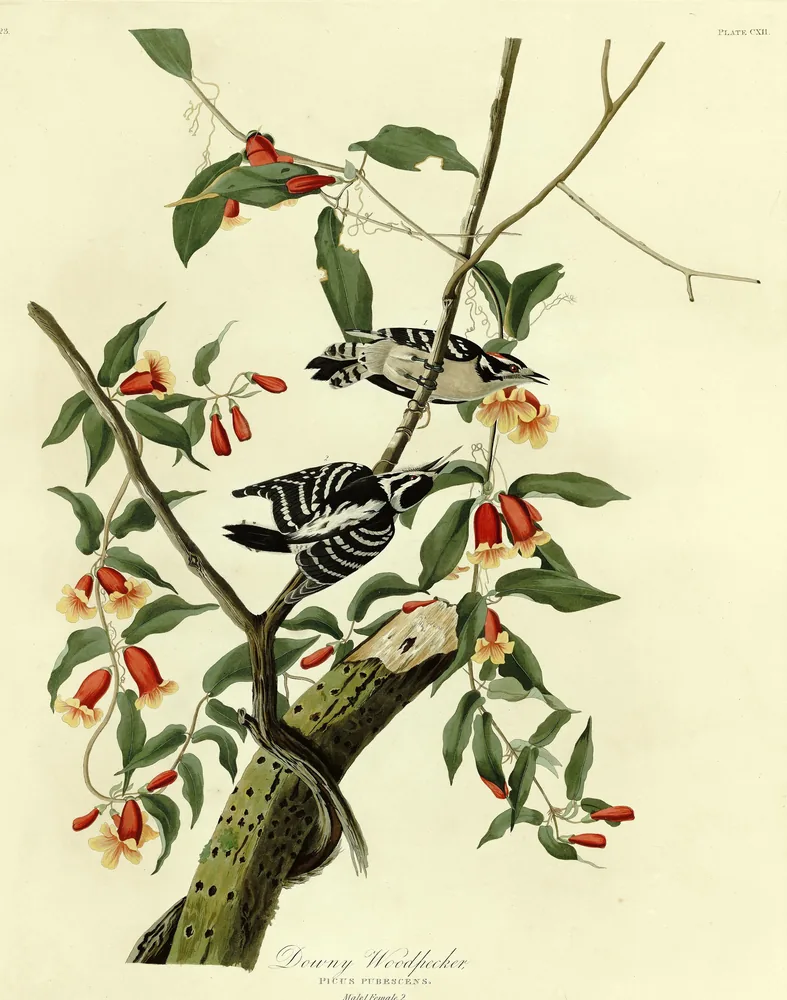
Audubon’s plate: plate 112, “Downy Woodpecker”
Sap-sucker was the name most Americans knew the Downy Woodpecker by, Audubon wrote, and he defended the habit behind it. Watching the bird in woods, orchards and gardens, he became convinced that its neat rows of holes in the bark helped trees grow, stay healthy and bear more fruit. Few farmers agreed with him, he admitted, but he was sure that fruit growers who had watched the results would back him up.
In the middle of April, he wrote, a pair works together for several days, sometimes a whole week, to dig a nest hole a foot or more deep, with a round entrance just wide enough for one bird. It hardly notices people and keeps working while you stand beside its tree. In Florida, Georgia and the Carolinas he saw wintering Downies so blackened by soot, from trunks charred when the grass was burned, that they could pass for another species. He found it from Louisiana to Labrador, and wrote: “It seems, in fact, to accommodate itself to circumstances, and to live contented anywhere.”
The plate shows a male and a female; she lacks his narrow red band on the back of the head. Their vine is the ramping trumpet-flower, Bignonia capreolata, whose flowers have no scent, though hummingbirds love to search them for food.
Story: Audubon, Ornithological Biography, vol. 2 (1834), pp. 81–83. See plate 112 free at Audubon.org.
More classic portraits, free to see
- John James Audubon, The Birds of America, octavo edition (1840–44), plate 263: “Downy Woodpecker”. Free scan (New York Public Library Digital Collections)
- Louis Agassiz Fuertes, for Elon H. Eaton’s Birds of New York (1910–14), plate 59: “Downy Woodpecker”, with the Hairy Woodpecker. Free scan (Internet Archive)
About the Downy Woodpecker
- Downy Woodpeckers can feed on thin twigs and weed stalks as well as on big tree trunks. (Source: National Audubon Society)
If a Downy Woodpecker visits your yard this winter, it can go into your Project FeederWatch counts: the 2026–27 season runs from November 1 to April 30. How to take part in FeederWatch.
How long does a Downy Woodpecker live?
A Downy Woodpecker's median lifespan is between one and two years, the National Park Service says at Shenandoah, so a five-year-old is an old bird. Heavy losses in the first year of life keep that median far below the maximum. The oldest known wild Downy Woodpecker was at least 11 years and 11 months old (USGS Bird Banding Laboratory): it was banded in California in 1985 and found there again in 1996.
Sources: National Park Service; USGS Bird Banding Laboratory. A banding record is the minimum age of one bird when it was found again, not a typical lifespan. How long do wild birds live?
How can you tell if a plate 112 print is an original?
By its size: an original plate 112 is a hand-colored sheet about 26 by 38 inches; the Downy Woodpecker’s octavo version, plate 263, is book-size, from 1840–44. Many prints sold today are reproductions: how to tell an original from a reproduction. Rather have every plate in one book? Here’s which Birds of America book to buy.
In a Birdfolio hardcover, this painting sits beside the date and place you first saw a Downy Woodpecker. See your own list as a book, free.