Free bird trivia
Bird Trivia Questions and Answers: 89 Questions, Easy to Hard
Here are 89 bird trivia questions with answers: 32 easy, 34 medium and 23 hard, from presidents' pets and wartime pigeons to world records and the bird that inspired a bullet train. Each answer comes with the story behind it and the page we checked it against, and the whole list prints with or without the answers, for a trivia night, a classroom or a seniors' group.
Updated . Every answer checked against the source linked after it.
Easy bird trivia questions (1–32)
32 questions most adults, and plenty of children, can answer: a good warm-up round, or a whole game for a mixed crowd.
In a 1784 letter, which bird did Benjamin Franklin call “a much more respectable Bird” than the Bald Eagle? · History
Answer: The turkey. He wrote it to his daughter, Sarah Bache, on January 26, 1784, and called the eagle “a Bird of bad moral Character.” It was a private letter, not a proposal to Congress. (Annotation blog, U.S. National Archives)
Which birds are the only ones that can fly backward? · Bird bodies
Answer: Hummingbirds. Their wings don't just flap: the motion “involves a lot of wing rotation,” a researcher told National Geographic. (National Geographic)
Which bird, holding an olive branch, is landing on the Moon on the Apollo 11 mission patch? · National symbols
Answer: The Bald Eagle. The patch shows the eagle touching down on the lunar surface with Earth behind it; the olive branch stands for peace, the Smithsonian's Air and Space Museum says. (Smithsonian National Air and Space Museum)
Baltimore's NFL team is named after a poem by which writer? · Sports
Answer: Edgar Allan Poe. In a 1996 Baltimore Sun phone poll, 21,108 of more than 33,000 callers picked Ravens, after Poe's poem “The Raven.” (Maryland Public Television, Knowing Poe: The Poe Library)
Which red songbird is the state bird of seven states? · National symbols
Answer: The Northern Cardinal. Seven eastern states chose it: Illinois, Indiana, Kentucky, North Carolina, Ohio, Virginia and West Virginia. The Western Meadowlark is next, with six. (Audubon Field Guide)
True or false: an ostrich's eye is bigger than its brain. · Bird bodies
Answer: True. An ostrich eye can be about 2 inches (50 mm) across, roughly twice as wide as a human eye, while its brain is no bigger than a walnut, Guinness World Records says. (Guinness World Records)
Which president made Pelican Island, Florida, America's first national wildlife refuge in 1903? · History
Answer: Theodore Roosevelt. His 1903 executive order set the island aside to protect its nesting birds, making it the nation's first national wildlife refuge, the U.S. Fish and Wildlife Service says. (U.S. Fish & Wildlife Service)
The CIA once built a camera light enough for which bird to carry? · War and spies
Answer: A pigeon. It didn't work out: the CIA says the birds had trouble flying over the exact places it needed photographed. (CIA Museum artifact page)
Coal miners once carried which small yellow songbird underground to warn them of poison gas? · History
Answer: The canary. Carbon monoxide has no color or smell, so a canary's collapse gave miners time to get out. Many miners whistled to their birds and treated them as pets. Britain only outlawed canaries in its coal mines in December 1986, Smithsonian magazine says. (Smithsonian magazine, Kat Eschner, updated by Sonja Anderson, 30 Dec 2016, updated 7 Mar 2024)
Which bird does the US president “pardon” at the White House each Thanksgiving? · Holidays and traditions
Answer: A turkey. The White House Historical Association credits Abraham Lincoln with the first pardon, at Christmas: his son Tad pleaded for a live turkey meant for dinner. The formal Thanksgiving tradition took hold in 1989 under George H. W. Bush. (White House Historical Association, press backgrounder)
Which Sesame Street character stands 8 feet, 2 inches tall, with lemon-yellow feathers and orange feet? · Film, TV and books
Answer: Big Bird. He has been on Sesame Street since 1969, BirdNote notes, and he lives in a huge nest behind 123 Sesame Street. The first time he saw the alphabet, he thought it was one really, really long word. (BirdNote, Bob Sundstrom, 20 Nov 2018)
True or false: in real life, a coyote can run faster than a roadrunner. · Film, TV and books
Answer: True. A Greater Roadrunner can reach about 20 mph and a coyote up to 43 mph, BirdNote says, citing a Texas field guide. The fastest human clocks about 22 mph. (BirdNote special)
In Norman Rockwell's Thanksgiving painting Freedom from Want (1943), which bird is being carried to the family table? · Art
Answer: A turkey. The woman holding the big turkey was the Rockwell family's cook, Mrs. Thadeus Wheaton, the Norman Rockwell Museum says. Neighbors and family posed for the scene one at a time in his studio. (Norman Rockwell Museum, curriculum page, Feb 2024)
Canada's one-dollar coin, first issued in 1987, is nicknamed the “loonie” after the bird on it. Which bird? · National symbols
Answer: The loon. The loon was a stand-in. Dies for the planned design, a voyageur in a canoe, were lost after the mint tried to save $43.50 by shipping them by ordinary courier, says a 1987 report quoted in the University of British Columbia's Dictionary of Canadianisms. (Dictionary of Canadianisms on Historical Principles, 3rd edition, University of British Columbia)
Legend says the Tower of London, and the monarchy with it, will fall if which birds that live there are ever killed? · Holidays and traditions
Answer: The ravens. In one version BirdNote tells, King Charles II's soothsayer gave the warning in 1666, though nobody knows which origin story, if any, is true. A Ravenmaster still looks after at least six ravens at the Tower, with ample food and comfy quarters. (BirdNote, adapted from a script by Bob Sundstrom, 20 Aug 2025)
In old European folklore, which big bird brings new babies to their families? · Holidays and traditions
Answer: The stork. The legend probably began in what is now northern Germany, BirdNote says. White Storks returned each spring, just when many babies were born, so people welcomed their big stick nests on roofs and chimneys. Many still see storks as good luck. (BirdNote, Frances Wood, 2 Feb 2020)
Which common shorebird got its name from its own loud call, “kill-dee, kill-dee, kill-dee”? · Words and names
Answer: The Killdeer. It often gives the call as an alarm when a predator comes near its nest, BirdNote says. The Northern Bobwhite and the Whip-poor-will are also named for their calls. (BirdNote, Frances Wood, 23 Aug 2025)
Which birds fly over the stormy field in Vincent van Gogh's 1890 painting Wheatfield with ___? · Art
Answer: Crows. It is often called his last painting, but Smithsonian magazine reports that Van Gogh Museum researchers think a lesser-known canvas, Tree Roots, is the more likely candidate. A letter dates Wheatfield with Crows to around July 10, 1890. (Smithsonian magazine, Meilan Solly, 26 Feb 2019)
Pittsburgh's NHL team is named after a flightless bird, partly because its old arena was nicknamed the “Big Igloo.” Which bird? · Sports
Answer: The penguin. In 1967 the name was suggested by 716 different people, the Pittsburgh Post-Gazette recalls. Not everyone approved: critics said penguins can't fly, have flippers instead of wings and, cute as they are, don't inspire fear. (Pittsburgh Post-Gazette, The Digs, 8 Jun 2016)
Which bird sits in the center of Mexico's flag, perched on a cactus and eating a snake? · National symbols
Answer: A Golden Eagle. In the legend BirdNote retells, the god Huitzilopochtli told the Mexica people to settle where they saw that sign. They found it on a tiny islet in Lake Texcoco and built Tenochtitlan, which grew into Mexico City. (BirdNote, Lucina Melesio, 13 Mar 2026)
Which Australian bird is famous for copying almost any sound it hears, even a chainsaw? · Behavior
Answer: The Superb Lyrebird. About 80 percent of a Superb Lyrebird's song is borrowed, the Australian Museum says, and it can include anything the bird hears nearby: chainsaws, car engines, barking dogs and other native birds. (The Australian Museum)
Where does a flamingo get its pink color? · Birds of the world
Answer: From its food. Flamingos really are what they eat, says the Smithsonian's National Zoo. The algae and brine shrimp they eat carry natural pigments, the kind that make carrots orange, and the bird's body turns them into pink feathers. Chicks hatch gray-white. (Smithsonian's National Zoo and Conservation Biology Institute, 29 Jun 2021)
True or false: an ostrich buries its head in the sand when it senses danger. · Birds of the world
Answer: False. It's a myth, says San Diego Zoo Wildlife Alliance. An ostrich that can't run away flops down with its pale head and neck flat on the ground, so from a distance it only looks as if its head is buried. (San Diego Zoo Wildlife Alliance, Animals & Plants)
The world's smallest bird is often mistaken for an insect. What is it called? · Records
Answer: The Bee Hummingbird. Found only in Cuba, it is about 2¼ inches long and weighs less than two grams, less than a dime, BirdNote says. The female's nest is barely an inch across, and her eggs are about the size of a coffee bean. (BirdNote, via Audubon magazine, 17 Sep 2018)
Which ocean wanderer has the greatest wingspan of any living bird, almost 3.5 meters (about 11 feet)? · Records
Answer: The Wandering Albatross. It spends most of its life in flight, landing only to breed and feed, the Australian Museum says. One banded bird covered 6,000 kilometers (about 3,700 miles) in twelve days. (The Australian Museum)
True or false: penguins and polar bears live together near the North Pole. · Birds of the world
Answer: False. Penguins live only in the Southern Hemisphere and polar bears only around the North Pole, so they are never neighbors except at a zoo, Audubon magazine says. (Audubon magazine, Erica Langston and Xander Zellner, 20 Jan 2016)
In emperor penguins, which parent keeps the egg warm on its feet through the Antarctic winter? · Birds of the world
Answer: The father. The mother hands him the egg and heads to sea, the Australian Antarctic Division says. Huddled with other males in winter storms, he can't leave to eat, and by the time the chick hatches he has fasted for about four months. (Australian Antarctic Program, Australian Antarctic Division)
Hummingbirds use a sticky, stretchy material as “duct tape” for their tiny nests. What is it? · Behavior
Answer: Spider silk. A female Ruby-throated Hummingbird gathers it by sticking it all over her bill and breast, BirdNote says. The silk glues the nest together and stretches as the chicks grow. (BirdNote, written by Bob Sundstrom, 7 Jun 2026)
In 2002 a crow named Betty amazed scientists at Oxford by bending a straight piece of garden wire. What did she make? · Behavior
Answer: A hook, to lift a food bucket out of a tube. The twist came in 2016: University of St Andrews biologists saw wild New Caledonian crows bending their twig tools as a matter of course, which casts doubt on how inventive Betty really was. (University of St Andrews news, 10 Aug 2016)
True or false: protein from a T. rex bone turned out to be more like a chicken's than a lizard's. · Science
Answer: True. In 2007–2008 studies, protein from a 68-million-year-old T. rex bone closely matched the bone protein of chickens and ostriches, Smithsonian magazine reported. So what did T. rex taste like? Its answer: “Well, possibly chicken.” (Smithsonian magazine, Mark Strauss, 26 Nov 2008)
True or false: all of a frigatebird's feathers together weigh more than its whole skeleton. · Bird bodies
Answer: True. Bird bones are built to be light, BirdNote explains: a Red-tailed Hawk's bones are hollow, braced inside by struts, and the bones of frigatebirds, masters of the air, weigh less than their feathers. (BirdNote, written by Dennis Paulson, 5 Jun 2025)
According to the UN's Food and Agriculture Organization, the world had over 33 billion of which farm bird in 2020? · Birds of the world
Answer: Chickens. About 46 percent of them were in Asia, the FAO says. More than 1,600 chicken breeds are recognized, and a commercial laying hen can lay over 300 eggs a year. (Gateway to poultry production and products, Food and Agriculture Organization of the United Nations)
Medium bird trivia questions (33–66)
34 questions for people who know a little history or have watched a feeder for a while. Most have an answer you can reason your way to.
Which World War I pigeon carried the message that helped save the “Lost Battalion” in 1918? · War and spies
Answer: Cher Ami. Cher Ami is credited with saving the Lost Battalion in the Argonne Forest in October 1918. France awarded the pigeon the Croix de Guerre, the U.S. Army says. (U.S. Army, CECOM historian, Aug. 27, 2021)
Before 1900, many Americans spent Christmas on a “side hunt.” Which ornithologist proposed counting birds instead? · Holidays and traditions
Answer: Frank M. Chapman. On Christmas Day 1900, Chapman's first Christmas Bird Census drew 27 birders to 25 counts. The Christmas Bird Count still runs every winter. (Audubon)
Which Civil War eagle, named for President Lincoln, went into battle with a Wisconsin company? · War and spies
Answer: Old Abe. The Bald Eagle went with Company C into nearly 40 battles, BirdNote says (counts vary by source), then retired to the Wisconsin Capitol and appeared at parades and veterans' gatherings. (BirdNote, Feb. 12, 2016)
The Baltimore Oriole's orange and black match the coat of arms of which 17th-century lord? · Words and names
Answer: Lord Baltimore. That match is the usual explanation for the bird's name, the National Audubon Society says. Baltimore's baseball team later took its name from the bird. (Audubon Field Guide)
The Philadelphia Eagles took their name from a blue eagle, the symbol of which Depression-era program? · Sports
Answer: The National Recovery Act. Bert Bell spotted the blue eagle on a placard in a Philadelphia shop window. It stood for the country's resolve to beat the Depression, the Philadelphia Inquirer says. (The Philadelphia Inquirer, Oct. 12, 2019)
A strange seabird event in Capitola, California, helped inspire which Alfred Hitchcock film? · Film, TV and books
Answer: The Birds (1963). Scientists later suspected domoic acid, a nerve poison made by certain ocean algae, was behind the birds' strange behavior. (Greater Farallones Association)
Gas companies add a smell like rotting meat to natural gas. Which bird gathers at pipeline leaks? · Science
Answer: The Turkey Vulture. The added chemical, ethyl mercaptan, is a key part of the smell of carrion. A Union Oil employee noticed vultures gathering where gas was leaking, BirdNote tells. (BirdNote, Jan. 30, 2023)
How do vultures cool off on a hot day? · Bird bodies
Answer: They poop on their own legs. Birds can't sweat or pant the way we do, so a hot vulture excretes down its legs and lets evaporation cool it, the National Park Service explains. (U.S. National Park Service)
In a 1995 study, pigeons learned to tell apart the paintings of which two artists? · Art
Answer: Monet and Picasso. The pigeons learned to sort color slides of the two painters' works, then sorted paintings they had never seen. Turning a Monet upside down confused them; an upside-down Picasso didn't. (Journal of the Experimental Analysis of Behavior, 1995; abstract on Europe PMC)
How did Audubon fit a life-size American Flamingo onto one page of The Birds of America? · Art
Answer: With its neck bent down. The flamingo is one of the birds that needed a special pose to fit the giant page at life size, the University of Wisconsin–Madison's library explains. (UW-Madison Libraries Special Collections)
Legend says the swallows return to Mission San Juan Capistrano, California, on the same saint's day every March. Which day? · Holidays and traditions
Answer: St. Joseph's Day (March 19). The legend has the Cliff Swallows leave again on October 23, San Juan's Day. Audubon magazine says the real birds trickle in through March, and by 2016 none had returned to nest at the old stone church since workers removed their nests in the 1990s. (Audubon magazine, Alisa Opar and Troy Harvey, 7 Jul 2016)
In 1976, 154 fans suggested the same bird name for Toronto's new baseball team in its naming contest. What name was it? · Sports
Answer: The Blue Jays. The contest drew more than 30,000 entries, MLB.com recounts, and many fans wanted the Toronto Blues. With 154 people sending in Blue Jays, a draw picked the winner: a periodontist who got two 1977 season tickets and a trip to spring training. (MLB.com, Keegan Matheson, 1 Dec 2021)
True or false: baseball's St. Louis Cardinals were originally named after the red bird. · Sports
Answer: False. The name came from a color. The story goes that a fan called the team's new 1899 uniforms “a lovely shade of cardinal,” and a newspaper columnist ran with it. MLB.com says management didn't think of the birds until 1921. (MLB.com, Anne Rogers, 1 Dec 2021)
In 1965 a schoolteacher won the contest to name Atlanta's new NFL team by writing that this bird “never drops prey.” Which bird? · Sports
Answer: The falcon. Several people suggested Falcons, the team's own history recalls, but Julia Elliott, a teacher from nearby Griffin, won for her reasons: the falcon is “proud and dignified, with great courage and fight.” (AtlantaFalcons.com, 30 Jun 2015)
The University of Kansas Jayhawk is a made-up bird. Which two real birds does its name come from? · Sports
Answer: The blue jay and the sparrow hawk. In a 1926 radio talk, KU's F. W. Blackmar called the Jayhawk “a myth” built on two Missouri Valley birds: the noisy, quarrelsome blue jay and the sparrow hawk. Who first joined the names, he said, no one knows. (KU History, University of Kansas; talk by F. W. Blackmar, December 1926)
In 1921 a turkey named Supreme II flew toward the White House in an aviation helmet and goggles. Why did it finish the trip by train? · Holidays and traditions
Answer: It got airsick. It also wore a black and gold sweater held on by a pink bow, the White House Historical Association says. Flying was still a novelty then, and the turkey made national news. (White House Historical Association, press backgrounder)
In 1943 a US Army pigeon flew 20 miles in 20 minutes to stop Allied planes bombing an Italian village their own troops had just taken. What was its name? · War and spies
Answer: G.I. Joe. His message arrived just as the bombers were about to take off, saving at least 100 Allied soldiers, the British animal charity PDSA says. In 1946 he became the first non-British recipient of its Dickin Medal, presented at the Tower of London. (PDSA)
During World War II, psychologist B.F. Skinner designed a missile that would be steered by which birds? · War and spies
Answer: Pigeons. In “Project Pigeon,” three trained pigeons sat in tiny cockpits in the nose cone and pecked at a picture of the target to steer. Despite a successful demonstration, officials canceled it. The nose cone is at the Smithsonian's American History Museum. (Smithsonian magazine, Joseph Stromberg, 18 Aug 2011)
Woody Woodpecker was supposedly born on cartoonist Walter Lantz's honeymoon. What was a real woodpecker doing to annoy him? · Film, TV and books
Answer: Hammering on the roof of their cabin. BirdNote says it was probably an Acorn Woodpecker, pounding at the shingles of their California cabin. Lantz was ready to shoot it, but his bride, Grace, suggested he vent his frustration creatively instead. (BirdNote, Ellen Blackstone, 14 Oct 2020)
On the Moon, Apollo 15 commander David Scott dropped a hammer and a feather together on live TV. Which bird did the feather come from? · History
Answer: A falcon. With no air to slow it, the feather fell as fast as the hammer, as Galileo had concluded centuries before, NASA explains. Mission Controller Joe Allen found that reassuring: the astronauts' trip home depended on the same theory. (NASA Space Science Data Coordinated Archive, Goddard Space Flight Center, David R. Williams, updated 31 Mar 2023)
The phrase “halcyon days” comes from a Greek myth about birds said to nest during seven calm days each year. Which birds? · Words and names
Answer: Kingfishers. In the myth, retold by BirdNote, the gods took pity on two lovers lost at sea, Ceyx and Alcyone, and turned them into “halcyon birds”: kingfishers. Many kingfishers still carry “halcyon” or “Ceyx” in their scientific names. (BirdNote, Bob Sundstrom, 12 Jun 2025)
When his patron refused to pay his full fee, painter James McNeill Whistler painted the two of them on the dining room wall as which quarreling birds? · Art
Answer: Fighting peacocks. Whistler titled the mural Art and Money. The patron, shipping magnate Frederick Leyland, banned him from the room but kept dining in it. The Peacock Room is now at the Smithsonian's Freer Gallery of Art in Washington. (Freer Gallery of Art and Arthur M. Sackler Gallery, Smithsonian; Peacock Room REMIX exhibition pages)
A male Satin Bowerbird decorates the stick bower where he courts females with objects of one favorite color, including stolen bottle tops and straws. Which color? · Behavior
Answer: Blue. Blue clothespins, drinking straws and bottle tops are among his favorite stolen items, the Australian Museum says. Away from people, he uses mostly bright blue parrot feathers, flowers and brown snail shells. (The Australian Museum)
A flamingo's leg seems to bend backward at the knee. What joint are you really looking at? · Bird bodies
Answer: Its ankle. Flamingo legs bend just like ours, the Smithsonian's National Zoo explains. The real knees sit higher up, hidden by the body and feathers, so think of a flamingo as standing on tiptoe. (Smithsonian's National Zoo and Conservation Biology Institute, 29 Jun 2021)
An ostrich egg weighs only about 2 percent of its mother. Which flightless bird lays an egg of about 15 percent of her body weight? · Records
Answer: The kiwi. For its body size, the kiwi lays the second-largest egg of any bird, says the Smithsonian's National Zoo, which in 1975 became the first place outside New Zealand to hatch a brown kiwi. (Smithsonian's National Zoo and Conservation Biology Institute, 7 Oct 2016)
An ostrich egg is the largest egg laid today. About how many chicken eggs would it take to match its weight? · Records
Answer: About 24. At more than 3 pounds, the ostrich egg is the largest single cell on the planet today, San Diego Zoo Wildlife Alliance says; only dinosaurs laid bigger eggs. (San Diego Zoo Wildlife Alliance, Animals & Plants)
About how many times a minute does an active hummingbird's heart beat? · Bird bodies
Answer: About 1,200. That's twice as fast as a flying pigeon's heart, at 600, BirdNote says. A human athlete going all out reaches only about 150 beats a minute. (BirdNote, via Audubon, 4 Nov 2021)
A woodpecker's tongue is at least three times as long as its bill. Where does the bird keep it when it isn't using it? · Bird bodies
Answer: Curled around the back of its skull. The tongue has sticky barbs at the tip for snagging ants deep in the wood, BirdNote says. When it's pulled in, it sits in a sheath that runs up the back of the skull and curls all the way around to the eyes. (BirdNote, written by Bob Sundstrom, 7 Dec 2018)
Before the Wright brothers built their first glider, which circling birds did they watch to work out how to bank and turn? · Science
Answer: Buzzards. The buzzards rolled by tilting one wingtip up and the other down, a NASA history says. Wilbur then twisted a small cardboard box in his hands and hit on wing warping; a century later NASA tested a jet fighter that twists its wings in flight. (PDF)
Why do pet parrots copy human speech, according to parrot scientist Irene Pepperberg? · Behavior
Answer: To fit in: they treat their people as their flock. Wild parrots use their voices to fit in with the flock, Audubon magazine reports, so a pet parrot joins its human “flock” the same way. Pepperberg is best known for Alex, an African Grey Parrot who lived in her lab for 30 years. (Audubon magazine, Ashley P. Taylor, 6 Aug 2015, updated 24 Apr 2026)
Which penguin is named after the same 18th-century fashion as the “macaroni” in “Yankee Doodle”? · Birds of the world
Answer: The Macaroni Penguin. In the 18th century, British explorers thought it looked like the fashionable dressers back home called “macaronis,” who wore feathers in their hats, Audubon magazine says. “Stuck a feather in his cap and called it macaroni” refers to that same fashion. (Audubon magazine, Erica Langston and Xander Zellner, 20 Jan 2016)
Japanese bullet trains boomed loudly when bursting out of tunnels at high speed. Which bird's beak inspired the 500 Series' long nose that eased the problem? · Science
Answer: The kingfisher. A kingfisher dives from air into water without a splash, engineer Eiji Nakatsu, a Wild Bird Society of Japan member, told Japan for Sustainability. Tests found the ideal nose almost identical to its beak; the train ran 10 percent faster on 15 percent less electricity. (Japan for Sustainability, 31 Mar 2005)
Under ultraviolet light, streaks on an Atlantic Puffin's bill glow cyan-green. What did scientists make to protect the puffins' eyes while they studied this? · Bird bodies
Answer: Puffin sunglasses. Birds have four kinds of color-sensing cones to our three, so they can see ultraviolet light, Audubon magazine explains. Designers at Goldsmiths, University of London, built foam-and-neoprene “sunglasses” that perch on the puffin's bill. (Audubon, Jillian Mock, 5 Feb 2019)
Which green, flightless New Zealand parrot is the heaviest parrot in the world, with males weighing up to 4 kilograms (about 9 pounds)? · Birds of the world
Answer: The kākāpō. It comes out at night, has an owl-like face and a waddling walk, and may be the longest-lived bird species, at 60 to 90 years, New Zealand's Department of Conservation says. Every kākāpō alive today is wild. (New Zealand Department of Conservation, Te Papa Atawhai)
Hard bird trivia questions (67–89)
23 questions for the quiz buffs and the keen birders: records, numbers and names. Partial credit is fair.
In what year did a law make the Bald Eagle the official national bird of the United States? · National symbols
Answer: 2024. It had been on the Great Seal since 1782, but Public Law 118-206, signed December 23, 2024, was the first law to name it the national bird. (govinfo.gov)
In 2022 a Bar-tailed Godwit flew nonstop from Alaska to Tasmania. About how many days did it fly? · Records
Answer: 11 days. It flew about 8,425 miles (13,560 km) across the Pacific without stopping for food or rest, the longest recorded nonstop migration by a bird, Guinness World Records says. (Guinness World Records)
Arctic Terns make the longest migration of any animal. How far can one fly in a year? · Records
Answer: More than 80,000 km (about 50,000 miles). Tracking devices weighing 1.4 grams showed some terns flying more than 80,000 kilometers a year, a 2010 study found. The mile figure is our conversion. (PNAS, 2010; PubMed Central)
Common Swifts stay in the air almost nonstop for about how many months a year? · Records
Answer: About ten months. Data loggers showed swifts spend more than 99 percent of their 10-month non-breeding season flying, a 2016 study found. (Cell Press, via ScienceDaily, Oct. 28, 2016)
Wisdom, a Laysan Albatross first banded in 1956, is the oldest known wild bird. About how old was she in April 2026? · Records
Answer: About 75. The U.S. Fish and Wildlife Service put her at about 75 and estimated that 30 of her chicks have fledged. She nests on Midway Atoll. (US Fish and Wildlife Service, April 20, 2026)
Which bird holds the record for the highest flight, after hitting a jet at 37,000 feet over Ivory Coast in 1973? · Records
Answer: A Rüppell's Vulture. The plane met it at 11,300 meters (37,000 feet) over Abidjan, Guinness World Records says, and the American Museum of Natural History identified the bird from feather remains. (Guinness World Records)
The last Passenger Pigeon died at the Cincinnati Zoo in 1914. Which first lady was she named after? · History
Answer: Martha Washington. Martha, the last of her species, died on September 1, 1914, at about 29, in the Cincinnati Zoological Garden, the U.S. Fish and Wildlife Service says. (U.S. Fish & Wildlife Service media library)
In 1963, how many Bald Eagle nesting pairs were known in the lower 48 states? · History
Answer: 417. Protection, the ban on DDT and decades of conservation turned that around: the U.S. Fish and Wildlife Service estimated about 316,700 Bald Eagles in the lower 48 by 2021. (U.S. Fish & Wildlife Service, Mar. 24, 2021)
Edgar Allan Poe's poem “The Raven” took inspiration from a real talking pet raven named Grip. Which famous novelist owned Grip? · Film, TV and books
Answer: Charles Dickens. Dickens wrote Grip into his novel Barnaby Rudge. Poe reviewed the book and felt the raven deserved a bigger part, Atlas Obscura recounts. Grip's stuffed body is now at the Free Library of Philadelphia. (Atlas Obscura, Allison Meier, 7 Oct 2013)
Which great composer kept a pet starling and, the story goes, wrote the bird's whistling into one of his piano concertos? · Film, TV and books
Answer: Wolfgang Amadeus Mozart. BirdNote tells the story: while Mozart rehearsed his Piano Concerto No. 17 in G, the starling whistled along, and he liked it enough to write it into the music's grace notes. When the bird died, Mozart wrote a poem about it. (BirdNote, Ellen Blackstone, 25 Nov 2018)
The call of which Arctic bird turns up in the soundtrack of Jurassic World and in the opening scene of Raiders of the Lost Ark, set in a Peruvian jungle? · Film, TV and books
Answer: The Willow Ptarmigan. Audubon magazine flagged the ptarmigan's “goofy sounds” in the 2015 dinosaur blockbuster and noted that the movie's island is a long way from the Arctic tundra. Its Raiders cameo, in a scene set in the Peruvian jungle, was no closer to home. (Audubon magazine, National Audubon Society, 13 Nov 2015)
On two walks through Manhattan in 1886, ornithologist Frank Chapman spotted 40 kinds of native birds, from sparrows to woodpeckers. Where were they? · History
Answer: On women's hats. About three-quarters of the 700 hats he saw carried birds or parts of birds, says a Stanford essay by Ehrlich, Dobkin and Wheye. The North American feather trade was at its height. (Paul R. Ehrlich, David S. Dobkin and Darryl Wheye, 1988; Stanford Birds, Stanford University)
In 1945 Harry Truman had the eagle on the presidential seal turn its head. It used to face the arrows in its talon. What does it face now? · National symbols
Answer: The olive branch. The Truman Little White House museum says the head was turned to the right, the place of honor, but more importantly toward the olive branch, marking America as a nation of peace. Truman was the first president to define the seal by executive order. (Truman Little White House, Key West)
Which medieval English poet first linked St. Valentine's Day with love, in a poem where every bird comes to choose its mate? · Holidays and traditions
Answer: Geoffrey Chaucer. His Parlement of Foules (1382) gathers all the birds in the Garden of Love on St. Valentine's Day, JSTOR Daily says. In truth, it adds, February 14 was a little early for birds to start mating in 14th-century England. (JSTOR Daily, Matthew Wills, 10 Feb 2016)
Theodore Roosevelt's children kept a large blue macaw at the White House. Its name honored the benefactor of which university? · History
Answer: Yale (the macaw was named Eli Yale). The White House Historical Association says the Roosevelt children's pets also included a green snake named Emily Spinach, a badger named Josiah, a hen named Baron Spreckle and a one-legged rooster. (White House Historical Association)
Medieval Britons never found the eggs of one winter goose, so they decided it must hatch from shellfish. Which goose still carries that name? · Words and names
Answer: The Barnacle Goose. The geese arrived each autumn and vanished in spring, BirdNote explains, and certain stalked barnacles looked like eggs growing from a goose neck. In truth the geese fly to the Arctic to breed, but the name stuck. (BirdNote, Ariana Remmel, 19 Feb 2026)
Emperor penguins dive deeper than any other bird. About how deep was the deepest dive Australia's Antarctic scientists have on record? · Records
Answer: 565 meters (about 1,850 feet). Most emperor dives go 100 to 200 meters, the Australian Antarctic Division says; the record bird had been diving past 450 meters regularly. Among many thousands of recorded dives, two lasted 22 minutes on a single breath. (Australian Antarctic Program, Australian Antarctic Division)
Someone actually sat down and counted every feather on a Tundra Swan. About how many did they find? · Records
Answer: About 25,000 (25,216). At least 80 percent were on the swan's long neck, BirdNote says. Some hummingbirds have fewer than 1,000 feathers, while one project counted around 80,000 on a single Emperor Penguin. (BirdNote, written by Bob Sundstrom, 2017, rebroadcast 28 Sep 2026)
Bird and other wildlife strikes on planes are more common than most people think. About how many were reported at U.S. airports in 2025? · Science
Answer: About 24,500. The FAA counts about 344,000 reported strikes with civil aircraft from 1990 to 2025. More than half of bird strikes happen from July to October, when young birds have just left the nest and fall migration is under way. (Federal Aviation Administration)
Frigatebirds can stay over the ocean on nonstop flights of up to ten days, sleeping on the wing. On average, about how long do they sleep per day in flight? · Science
Answer: About 42 minutes. Back on land they sleep more than twelve hours a day, the Max Planck Society reported in 2016. While circling, the half of the brain linked to the eye facing the turn typically stayed awake, suggesting they watch where they're going. (Max Planck Society press release, 3 Aug 2016; study in Nature Communications)
Bar-headed geese that spend the winter at sea level in India migrate over the Himalayas. How long can the crossing take them? · Records
Answer: A single day. Tracked geese typically climbed 4,000 to 6,000 meters (about 13,000 to 20,000 feet) in 7 to 8 hours, a 2011 study in PNAS found, without waiting for helpful upslope tailwinds, even climbing in the still air at night. (Hawkes and others, PNAS, 2011; abstract on U.S. Geological Survey publications)
A Clark's Nutcracker carries pine seeds to its hiding places in a stretchy pouch under its tongue. About how many seeds can it hold at once? · Behavior
Answer: Upwards of 100. In peak season it buries up to 500 seeds an hour in little clusters, sometimes as far as 20 miles from the tree, Audubon magazine says. The seeds it never comes back for can sprout into new pine trees. (Audubon magazine, Lesley Evans Ogden, 8 Nov 2016)
“Bird brain” is no insult. Ounce for ounce, about how many times as many neurons do parrot and songbird brains hold as primate brains? · Bird bodies
Answer: About twice as many. Bird neurons are much smaller and packed more densely, a 2016 study found. A macaw's brain is the size of an unshelled walnut and a macaque monkey's the size of a lemon, yet the macaw has more forebrain neurons, Vanderbilt University reported. (Vanderbilt University News, 13 Jun 2016; study in PNAS)
What is some interesting trivia about birds?
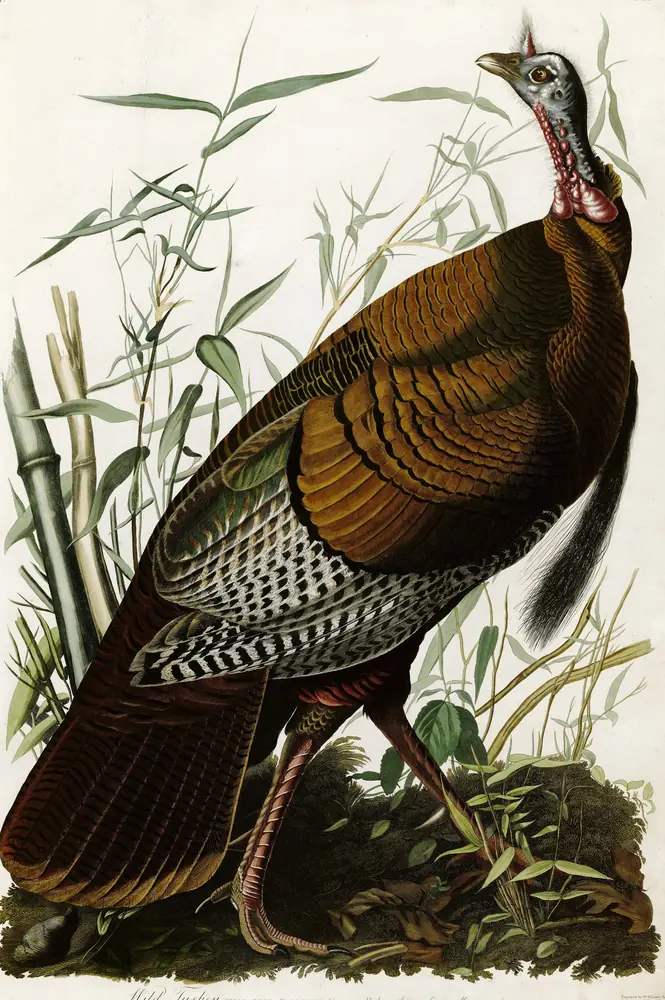
The trivia people remember crosses into history, engineering or the movies: Benjamin Franklin preferring the turkey to the Bald Eagle (question 1), Japan’s bullet train borrowing the shape of a kingfisher’s beak (question 64), or a turkey bound for the White House in 1921 that had to finish the trip by train (question 48). Audubon painted that same Wild Turkey as plate 1 of The Birds of America; it has its own Wild Turkey painting page.
What is a funny fact about birds?
On a hot day a vulture cools off by pooping down its own legs, since birds can’t sweat (question 40). Close behind: a real coyote would catch the Road Runner (question 12), and an ostrich never buries its head in the sand (question 23). In all, 22 of the 89 answers tend to get a laugh, from the White House turkey that got airsick to the scientists who made sunglasses for puffins.
What are 10 interesting facts about birds?
Ten true stories from our bird quiz, one bird each:
- American Crow: In 2006 University of Washington researchers trapped seven crows while wearing a scary mask. More than ten years later, over half the crows on campus still raised the alarm at the sight of it. (Audubon magazine, Rachel Fritts, 25 Aug 2021)
- Tufted Titmouse: Titmice pull hair from living animals to line their nests. A University of Illinois study of online videos caught them plucking it from 47 humans, 45 dogs, three cats, three raccoons and a porcupine. (University of Illinois News Bureau, 29 Jul 2021; study in Ecology)
- Burrowing Owl: Burrowing Owls use bait. They collect mammal dung around their burrows to lure dung beetles, a favorite food, a 2004 study in Nature reported: a rare case of a bird using a tool. (Nature, 2004; abstract)
- Mallard: The famous marching ducks of the Peabody Hotel in Memphis began as a 1930s prank: two men back from a hunting trip put their live decoy ducks in the lobby fountain. Live decoys were legal then. (The Peabody Memphis)
- Canada Goose: After US Airways Flight 1549 landed on the Hudson in 2009, scientists tested the feathers of the geese it hit. Chemical clues showed they were migrants from Labrador, not local birds. (Ecological Society of America, 8 June 2009)
- Snowy Owl: Hedwig is a female in the Harry Potter films, but every owl that played her was a male Snowy Owl, with names like Gizmo, Kasper and Oops. (Literary Hub, Jennifer Ackerman, excerpt from What an Owl Knows, Penguin Press)
- Red-tailed Hawk: That fierce “eagle scream” in the movies is often a Red-tailed Hawk. Many films play a red-tail's cry when a Bald Eagle appears on screen. (Audubon magazine, Carlyn Kranking, 3 Dec 2021)
- Hermit Thrush: The Hermit Thrush sings in the same math as human music. A 2014 study found most of its songs favor the simple frequency ratios of the harmonic series, the basis of many musical scales. (Doolittle et al., PNAS, 2014)
- Ruddy Duck: Ruddy Ducks lay huge eggs for their size. A full clutch can weigh more than the hen that laid it, Ducks Unlimited says. (Ducks Unlimited)
- House Finch: In 1940 dealers were selling California House Finches in the East as “Hollywood Finches,” which was illegal. Undercover Audubon investigators helped expose the trade, and about 100,000 finches had been shipped east. (Audubon magazine, Nicholas Lund, 15 Jul 2016)
Birdfolio turns a birder’s own sightings into a hardcover book, every species beside a classic painting. Look inside a Birdfolio.