Reference
How many bird species are in Indiana?
Indiana has 420 bird species on its official list (Indiana Bird Records Committee, August 2013), the 44th highest count of the 49 states with a verified count. A species joins it on physical evidence or a convincing written description; species whose wild origin is in doubt are listed separately.
Indiana’s state bird is the Northern Cardinal: our Indiana state bird page tells how it was chosen.
Updated
What are the most common birds in Indiana?
In summer, the 25 most common birds in Indiana are led by the European Starling, at about 267 birds per survey route, then the Red-winged Blackbird and the House Sparrow, by the USGS Breeding Bird Survey’s counts for 2021–2025. Together these 25 made up 78% of all the birds counted on Indiana’s 59 survey routes.
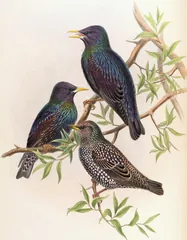
John Gould and Henry Constantine Richter, The Birds of Asia, vol. 5 (1850–83) 1 European Starlingabout 267 per routeon 100% of routesno clear trendintroduced species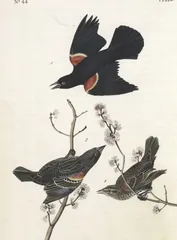
John James Audubon, The Birds of America (1840–44) about 159 per routeon 100% of routesfalling since 2015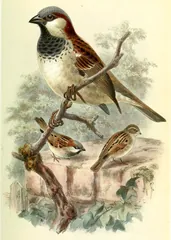
John Gerrard Keulemans, Lord Lilford’s Coloured Figures of the Birds of the British Islands (1885–97) 3 House Sparrowabout 124 per routeon 100% of routesno clear trendintroduced species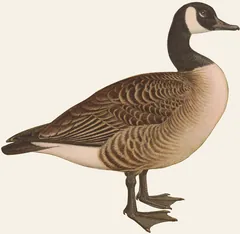
Marinus Adrianus Koekkoek, E. D. van Oort's Ornithologia Neerlandica (1922) about 92 per routeon 76% of routesno clear trend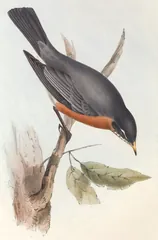
John and Elizabeth Gould, The Birds of Europe (1832–37) about 79 per routeon 100% of routesfalling since 2015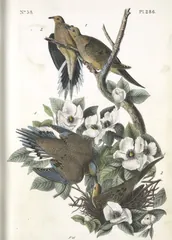
John James Audubon, The Birds of America (1840–44) about 56 per routeon 100% of routesno clear trend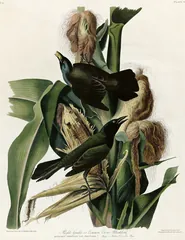
John James Audubon, The Birds of America (1827–38) 7 Common Grackleabout 54 per routeon 100% of routesfalling since 2015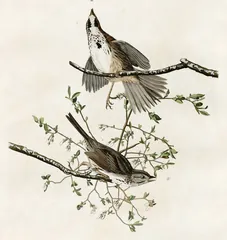
John James Audubon, The Birds of America (1827–38) about 51 per routeon 100% of routesno clear trend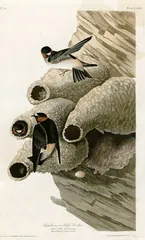
John James Audubon, The Birds of America (1827–38) 9 Cliff Swallowabout 47 per routeon 59% of routesno clear trend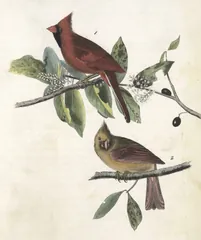
John James Audubon, The Birds of America (1840–44) about 32 per routeon 100% of routesrising since 2015
Show all 25
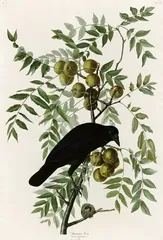
John James Audubon, The Birds of America (1827–38) about 30 per routeon 100% of routesno clear trend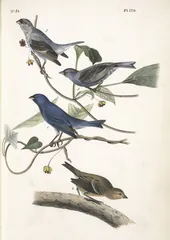
John James Audubon, The Birds of America (1840–44) 12 Indigo Buntingabout 26 per routeon 100% of routesfalling since 2015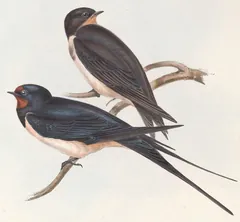
John and Elizabeth Gould, The Birds of Europe (1832–37) 13 Barn Swallowabout 26 per routeon 100% of routesno clear trend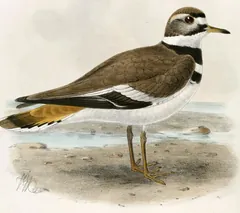
John Gerrard Keulemans, H. E. Dresser's A History of the Birds of Europe, Supplement (1895–96) 14 Killdeerabout 24 per routeon 100% of routesno clear trend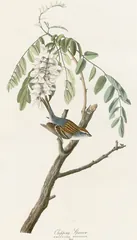
John James Audubon, The Birds of America (1827–38) 15 Chipping Sparrowabout 20 per routeon 100% of routesfalling since 2015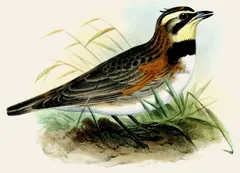
Joseph Wolf, Proceedings of the Zoological Society of London (1855) 16 Horned Larkabout 19 per routeon 86% of routesfalling since 2015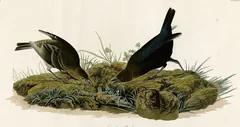
John James Audubon, The Birds of America (1827–38) 17 Brown-headed Cowbirdabout 19 per routeon 100% of routesno clear trend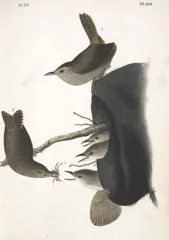
John James Audubon, The Birds of America (1840–44) 18 Northern House Wrenabout 17 per routeon 98% of routesno clear trend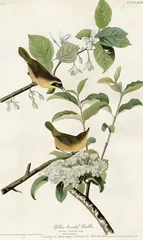
John James Audubon, The Birds of America (1827–38) 19 Common Yellowthroatabout 16 per routeon 100% of routesno clear trend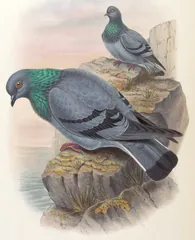
John Gould and William Matthew Hart, The Birds of Asia (1850–83) 20 Rock Pigeonabout 16 per routeon 90% of routesno clear trendintroduced species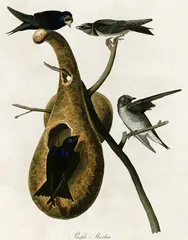
John James Audubon, The Birds of America (1827–38) 21 Purple Martinabout 16 per routeon 76% of routesrising since 2015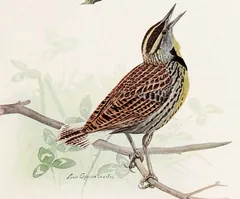
Louis Agassiz Fuertes, Elon H. Eaton’s Birds of New York (1910–14) 22 Eastern Meadowlarkabout 16 per routeon 97% of routesfalling since 2015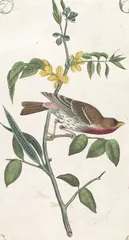
John James Audubon, The Birds of America (1840–44) 23 House Finchabout 12 per routeon 98% of routesno clear trend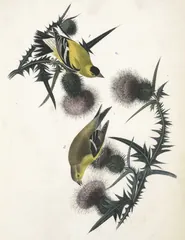
John James Audubon, The Birds of America (1840–44) about 11 per routeon 100% of routesfalling since 2015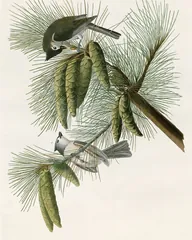
John James Audubon, The Birds of America (1827–38) about 11 per routeon 98% of routesno clear trend
A field guide to North America covers the Red-winged Blackbird, the House Sparrow and most of the 420 species on Indiana’s list; we compared the best bird books of 2026 to find the one that suits a beginner.
What is the most common bird in Indiana?
The European Starling, a bird people brought to North America, leads Indiana’s summer survey: about 267 a route on average in 2021–2025, ahead of the Red-winged Blackbird at about 159, seen on every one of the 59 routes. USGS finds no clear rise or fall in its Indiana numbers since 2015.
Indiana's breeding bird atlas, from surveys in 2005-2011, calls the Red-winged Blackbird and Common Grackle two of the most abundant nesting birds, found in nearly all of its survey blocks, and the European Starling the second most abundant bird on the state's Breeding Bird Surveys.
Winter brings robins by the tens of thousands. Indiana's Ohio River count found 57,055 American Robins in the 2024-25 Christmas Bird Count, the highest robin count in the country.
Sources: Atlas of Breeding Birds of Indiana, 2005-2011 (Indiana Department of Natural Resources, 2023); The 125th Christmas Bird Count High Counts of Species in the United States (National Audubon Society, October 29, 2025), read October 10, 2026.
How was this list made?
Each of Indiana’s 59 routes is a roadside count, 50 stops along about 25 miles, run once a year in early summer by a volunteer. We took USGS’s yearly estimate for each species in Indiana, the number of birds a typical route records, averaged it over the five latest survey years (there was no survey in 2020) and ranked the birds by it. To keep the list to birds you’re likely to meet across Indiana, we left out species recorded on fewer than one in five of its routes, and those USGS can only estimate very roughly, which usually means big flocks or colonies on a few routes.
The share of routes is our own count from USGS’s route data for Indiana, using only counts that met the survey’s standards; “rising” and “falling” are USGS’s trends for the state since 2015, named only where it finds a clear change. Roadside counts on early-summer mornings miss most of Indiana’s owls and waterbirds, and its winter visitors aren’t here at all.
Indiana’s counts come from two USGS data releases, the North American Breeding Bird Survey Analysis Results 1966–2025 (Hostetler et al., 2026) and its Dataset 1966–2025 (Ziolkowski et al., 2026), gathered by volunteer observers and free for anyone to use; Birdfolio isn’t connected with the USGS.
How many bird species are in Indiana?
| Official count | 420 species |
|---|---|
| List’s date | August 2013 |
| Kept by | Indiana Bird Records Committee (Indiana Audubon Society) |
| Review list | 129 species, 17 of them only away from set places such as the Lake Michigan shore (our count, October 2026) |
| First state list | 1879: 302 species, from museum specimens |
| Among US states | 44th highest of the 49 states with a verified count |
| Official list | Official IBRC Bird Checklist (Indiana Audubon birds page), the Internet Archive's copy of October 12, 2026 |
What does Indiana’s count include?
- Species accepted on physical evidence, such as a photo or a specimen, or on a convincing written description.
- Not counted: species of doubtful origin, on a separate list.
Why do other sources give a different number?
Indiana's 420 comes from a checklist table last updated in August 2013, so newer pages round the number up rather than restate it:
- Over 420. The committee's newer Indiana Official Bird List page, last updated in March 2026, gives no exact total. It says the list is compiled by Indiana's state ornithologist and reviewed from time to time by the records committee. Source: Indiana Official Bird List, last updated March 2026 (Indiana Audubon Society).
- More than 420. The Indiana Department of Natural Resources' figure for species documented in the state, which it says includes rare and accidental birds that wander beyond their usual range. Source: Birds (Indiana Department of Natural Resources, Fish and Wildlife).
- Over 400. The printed field checklist, updated October 2024, which leaves out species with fewer than 5 Indiana records. Source: Indiana field checklist, updated October 2024 (Indiana Audubon Society).
- 302. The species in the first systematic list of Indiana's birds, which physician A. W. Brayton published in 1879, based on museum specimens. Source: Birds, with the Official IBRC Bird Checklist (Indiana Audubon Society).
Indiana’s list follows its own committee’s rules, and so does every other state’s: see why the counts differ from state to state.
Indiana firsts in the committee's files
- One of the committee's first state records reaches back to March 15, 1879: an Eskimo Curlew at Chalmers, White County. The species is now extinct. Source: IBRC Bird Record Decisions 2003 (Indiana Bird Records Committee), read October 4, 2026.
- A Hooded Crane stayed at Goose Pond Fish and Wildlife Area in Greene County from February 8 to 11, 2012, and was accepted on physical evidence. The species is on the official checklist as a review species. Sources: IBRC Bird Record Decisions 2012 (Indiana Bird Records Committee); Birds, with the Official IBRC Bird Checklist (Indiana Audubon Society), read October 4, 2026.
- Not every rarity counts. An Audubon's Oriole in Jefferson County in January 2007 sits under Origin Hypothetical: correctly identified, but with its wild origin unresolved, so it stays off the 420. Sources: IBRC Committee Voting Summaries (Indiana Audubon Society); Birds, with the Official IBRC Bird Checklist (Indiana Audubon Society), read October 4, 2026.
- The committee's online table lists every record it has reviewed, more than 730 in all; its yearly reports appear in the Indiana Audubon Quarterly. Sources: IBRC Committee Voting Summaries (Indiana Audubon Society); Records Committee (Indiana Audubon Society), read October 4, 2026.
- The Indiana Audubon Society, which runs the committee, was founded in 1898. It is not a chapter of the National Audubon Society, and is older than it. Source: About Us: Our History (Indiana Audubon Society), read October 4, 2026.
Questions people ask about Indiana’s birds
Which US state has the most bird species?
California, with 696 species on its official list as of September 8, 2026, followed by Texas at 682 (our table). Indiana's official count is 420, and the state's Department of Natural Resources says more than 420 species have been documented there, rare strays included.
Sources: Official California Checklist, updated 8 September 2026 (California Bird Records Committee, Western Field Ornithologists); Birds (Indiana Department of Natural Resources, Fish and Wildlife), read October 4, 2026.
What is the rarest bird in Indiana?
The Whooping Crane may be the rarest you can see: the state's Department of Natural Resources calls it one of the rarest species in North America, with fewer than 900 left, and those that pass through or winter in Indiana belong to an experimental eastern population of about 100 birds. Among nesting birds, fewer than 10 pairs of Loggerhead Shrikes breed in the state each year.
Source: Birds (Indiana Department of Natural Resources, Fish and Wildlife), read October 4, 2026.
What are common birds in Indiana?
Some of Indiana's most common birds, its breeding bird atlas says, are the Mourning Dove, Blue Jay, American Crow, Northern Cardinal, Indigo Bunting and Barn Swallow, and chickadees and Tufted Titmice are among the most common at feeders. The Bald Eagle is becoming quite common too and can be seen all over the state; in the 1980s the department released 73 eaglets at Monroe Lake to bring it back.
Sources: Atlas of Breeding Birds of Indiana, 2005-2011 (Indiana Department of Natural Resources, 2023); Bird FAQs (Indiana Department of Natural Resources, Fish and Wildlife), read October 10, 2026.
Where can I find a list of Indiana birds?
The official list is the Indiana Bird Records Committee's checklist, on the Indiana Audubon Society's website. The state's Department of Natural Resources keeps its own Birds of Indiana List, compiled by the state ornithologist and revised in September 2021, with each bird's state and federal status; it leaves out extinct birds such as the Passenger Pigeon (our check), and it cites the committee's checklist.
Source: Birds of Indiana List, revised September 2021 (Indiana Department of Natural Resources), read October 10, 2026.
Which birds live in Indiana?
Birds of the Lake Michigan dunes, restored marshes and prairies, the big rivers, farmland and the heavily forested south. The state's specialty is cranes: Jasper-Pulaski Fish and Wildlife Area had the country's highest Sandhill Crane count on the 2024-25 Christmas Bird Count, 16,104, and Whooping Cranes from the experimental eastern population winter mostly on or near Goose Pond Fish and Wildlife Area, the state's Department of Natural Resources says.
Lake Michigan: Indiana Dunes National Park, at the lake's southern tip, is in the top five of all national parks for recorded bird species, with over 350; in fall, southbound migrants following the shoreline are funneled into the dunes.
Wetlands and rivers: Goose Pond, 9,098 acres of prairie and marsh in Greene County, has more than 300 species on record, and the state's breeding bird atlas found all four of its rail species there. The Least Tern, the smallest tern in North America, nests on river islands and sandbars, and on islands built for it at Goose Pond and Cane Ridge Wildlife Management Area.
Grasslands and forests: Vesper, Lark, Savannah, Grasshopper and Henslow's Sparrows nest in native prairie and in pastures, hayfields and reclaimed mine lands, the atlas says, and in the heavily forested south Scarlet Tanagers are most abundant and Eastern Whip-poor-wills and Chuck-will's-widows are found most often.
Sources: The 125th Christmas Bird Count High Counts of Species in the United States (National Audubon Society, October 29, 2025); Birds (Indiana Department of Natural Resources, Fish and Wildlife); Birds, Indiana Dunes National Park, last updated August 30, 2023 (National Park Service); Goose Pond Fish & Wildlife Area (Indiana Department of Natural Resources); Atlas of Breeding Birds of Indiana, 2005-2011 (Indiana Department of Natural Resources, 2023), read October 10, 2026.
When is the best time to see Sandhill Cranes at Jasper-Pulaski?
From mid-October to mid-December, when thousands of cranes use the shallow marshes of Jasper-Pulaski Fish and Wildlife Area; numbers peak in late November or early December, says the Indiana Department of Natural Resources. Indiana Audubon calls it the largest concentration of Sandhill Cranes east of the Mississippi River.
Time your visit for the ends of the day. At sunrise the flocks lift off the roosting marshes to feed in the farm fields around the area, and from about an hour before sunset they fly back in from all directions. Watch from the observation platform at the Sandhill Crane Observation Area and bring binoculars or a scope: the birds are usually several hundred yards away, and the roosting marshes are closed to the public. Staff count the cranes each week from October to December.
Sources: Sandhill Cranes Fall Migration, Jasper-Pulaski Fish and Wildlife Area (Indiana Department of Natural Resources); Birds, with the Official IBRC Bird Checklist (Indiana Audubon Society), read October 4, 2026.
Was the last wild Passenger Pigeon shot in Indiana?
The Indiana Historical Bureau says so: its state marker at the Whitewater Canal State Historic Site in Metamora, Franklin County, records that the last verified wild Passenger Pigeon was shot about five miles away, near Laurel, on April 3, 1902. The species died out when the last captive bird died on September 1, 1914.
The marker's notes describe how many pigeons Indiana once held. A newspaper of 1858 reported a nesting in Decatur County about twenty-eight miles long and fourteen wide, and in 1854 a roost near Brookville, in Franklin County, stretched ten miles by five. The Passenger Pigeon stays on Indiana's official checklist, marked extinct.
Sources: Passenger Pigeon Extinction, state historical marker (Indiana Historical Bureau); Birds, with the Official IBRC Bird Checklist (Indiana Audubon Society), read October 4, 2026.
Which rare birds turn up on Indiana's Lake Michigan shore?
Jaegers, Sabine's Gulls and Black-legged Kittiwakes, among others. Indiana Audubon describes an almost pelagic experience on the lakeshore in migration and winter, with three species of jaeger, Sabine's Gull and Black-legged Kittiwake seen regularly; several species are regular there but rare in the rest of the state, so the committee asks for notes on them only away from the lake.
Two of Indiana's most unexpected gulls came from that stretch of Lake County shore: a Kelp Gull at Hammond on October 19-20, 1996, and a Black-tailed Gull at Miller Beach on August 5, 2003, each accepted as a first state record.
Sources: Birds, with the Official IBRC Bird Checklist (Indiana Audubon Society); Indiana Bird Records Committee Review List (Indiana Audubon Society); IBRC Bird Record Decisions 2003 (Indiana Bird Records Committee); IBRC Bird Record Decisions 2004 (Indiana Bird Records Committee), read October 4, 2026.
Where is the official Indiana bird list, and how often is it updated?
On Indiana Audubon's website, in two places: the Official IBRC Bird Checklist table on its birds page, which gives the 420 and was last updated in August 2013, and the newer Indiana Official Bird List page (March 2026), with a field checklist in PDF and the full list as Excel and PDF files to download. Species whose identification is certain but whose wild origin isn't are kept in an Origin Hypothetical section at the end.
The Indiana Bird Records Committee has seven members on staggered three-year terms. A record passes in its first round with at least 80% of the votes, in a second round with 70%, and a third round takes place at a meeting. Sightings of the 129 review species, and of any bird new to Indiana, go to the committee chair as a written report with any photos, or through its online form.
Sources: Birds, with the Official IBRC Bird Checklist (Indiana Audubon Society); Indiana Official Bird List, last updated March 2026 (Indiana Audubon Society); Indiana Bird Records Committee Rules of Operation, current as of 2019 (Indiana Audubon Society); Indiana Bird Records Committee Review List (Indiana Audubon Society); Records Committee (Indiana Audubon Society), read October 4, 2026.
How do you count your own Indiana list?
Your Indiana list is every species you’ve seen in Indiana. eBird can filter your life list to Indiana, and your eBird data download gives the state of every sighting. On paper, count the species you’ve seen in Indiana; what is a life list? explains how birders keep their lists.
To print your whole list, Indiana birds and all, see how to print your bird life list, or let Birdfolio make it a hardcover book.
Indiana’s state bird
Indiana’s state bird is the Northern Cardinal (officially, the “Red Bird or Cardinal”), the state bird since 1933. Its story, the state flower and animal, and a free picture card for a report are on our Indiana state bird page.
Birding festivals in Indiana
Our birding festivals calendar lists 4 in Indiana, with dates from each festival’s own website:
- Marsh Madness Sandhill Crane Festival, Linton: February 19–20, 2027
- Indiana Dunes Birding Festival, Porter: May 13–16, 2027
- Hummingbird Migration Celebration, Connersville: dates not announced yet; expected in August 2027 (2026 festival: August 1, 2026)
- Owl Fest at Eagle Creek Park, Indianapolis: dates not announced yet; expected in October 2027 (2026 festival: October 17–18, 2026)
Christmas Bird Count in Indiana
Indiana had 58 Christmas Bird Count circles on Audubon’s map last winter, each counted on a single day between December 14 and January 5. Our guide shows where to find Indiana’s counts and how to join one; it’s free, and beginners are welcome.
More about bird counts
- How many bird species are in each state: Indiana beside all 50 states, DC and Canada.
- Bird lists of nearby states: Illinois, Kentucky, Michigan and Ohio.
- State birds of all 50 states, Indiana’s Northern Cardinal among them
- How many bird species are in the US and Canada
- Bird splits and lumps
If you’re shopping for a birder in Indiana, our gift guide for birders and our pick of coffee table bird books are good places to start.