Reference
How many bird species are in Idaho?
Idaho has 432 bird species on its official list (Idaho Bird Records Committee, 2020), tied for the 38th highest count of the 49 states with a verified count. The checklist dates from 2020, and it holds the Cassia Crossbill, a bird found nowhere on Earth but two small mountain ranges in southern Idaho.
Idaho’s state bird is the Mountain Bluebird: our Idaho state bird page tells how it was chosen.
Updated
What are the most common birds in Idaho?
In summer, the 25 most common birds in Idaho are led by the Cliff Swallow, at about 135 birds per survey route, then the Brewer's Blackbird and the American Robin, by the USGS Breeding Bird Survey’s counts for 2021–2025. Together these 25 made up 57% of all the birds counted on Idaho’s 37 survey routes. USGS rates most of these Idaho estimates as less precise, so read the order as a rough guide.
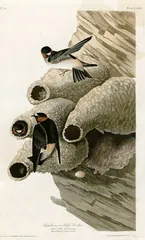
John James Audubon, The Birds of America (1827–38) 1 Cliff Swallowabout 135 per routeon 68% of routesno clear trend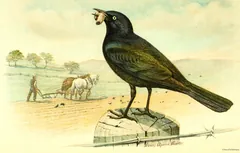
Louis Agassiz Fuertes, Bulletin, Biological Survey (1908) 2 Brewer's Blackbirdabout 34 per routeon 73% of routesno clear trend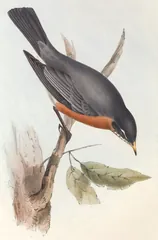
John and Elizabeth Gould, The Birds of Europe (1832–37) about 34 per routeon 100% of routesno clear trend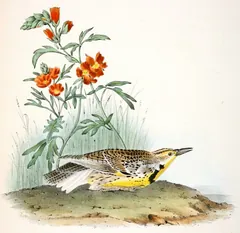
John James Audubon, The Birds of America (1840–44) 4 Western Meadowlarkabout 29 per routeon 78% of routesrising since 2015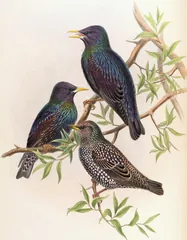
John Gould and Henry Constantine Richter, The Birds of Asia, vol. 5 (1850–83) 5 European Starlingabout 25 per routeon 62% of routesno clear trendintroduced species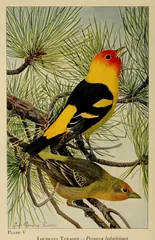
Louis Agassiz Fuertes, Birds of the Rockies (1902) 6 Western Tanagerabout 24 per routeon 81% of routesno clear trend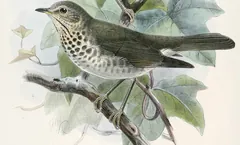
John Gerrard Keulemans, H. E. Dresser’s A History of the Birds of Europe (1871–96) 7 Swainson's Thrushabout 22 per routeon 57% of routesno clear trend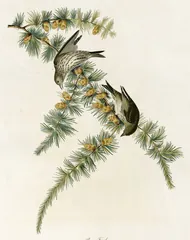
John James Audubon, The Birds of America (1827–38) 8 Pine Siskinabout 22 per routeon 68% of routesno clear trend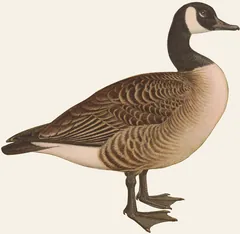
Marinus Adrianus Koekkoek, E. D. van Oort's Ornithologia Neerlandica (1922) about 22 per routeon 54% of routesno clear trend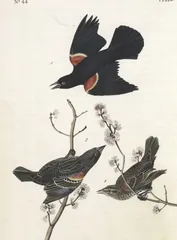
John James Audubon, The Birds of America (1840–44) about 22 per routeon 84% of routesno clear trend
Show all 25
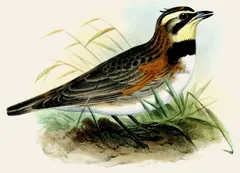
Joseph Wolf, Proceedings of the Zoological Society of London (1855) 11 Horned Larkabout 20 per routeon 62% of routesno clear trend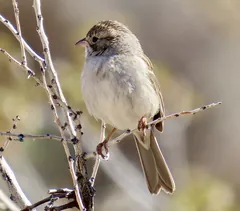
Photo: an iNaturalist contributor, CC0 1.0 12 Brewer's Sparrowabout 19 per routeon 70% of routesno clear trend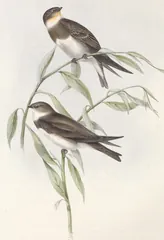
John and Elizabeth Gould, The Birds of Europe (1832–37) 13 Bank Swallowabout 18 per routeon 35% of routesno clear trend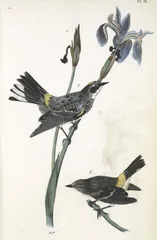
John James Audubon, The Birds of America (1840–44) about 18 per routeon 65% of routesno clear trend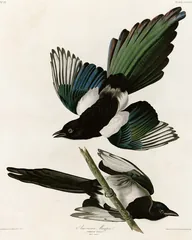
John James Audubon, The Birds of America (1827–38) 15 Black-billed Magpieabout 16 per routeon 78% of routesno clear trend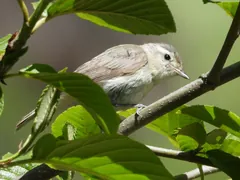
Photo: P Holroyd, CC BY 4.0 16 Western Warbling Vireoabout 11 per routeon 78% of routesno clear trend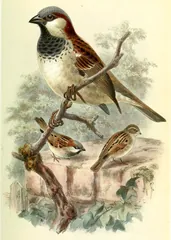
John Gerrard Keulemans, Lord Lilford’s Coloured Figures of the Birds of the British Islands (1885–97) 17 House Sparrowabout 11 per routeon 49% of routesno clear trendintroduced species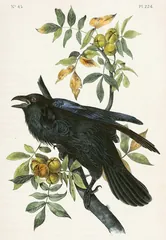
John James Audubon, The Birds of America (1840–44) 18 Common Ravenabout 11 per routeon 95% of routesno clear trend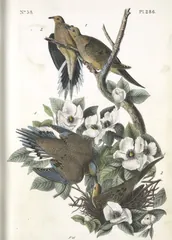
John James Audubon, The Birds of America (1840–44) about 11 per routeon 81% of routesno clear trend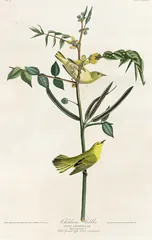
John James Audubon, The Birds of America (1827–38) 20 Northern Yellow Warblerabout 11 per routeon 89% of routesno clear trend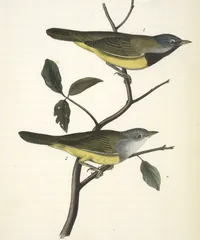
John James Audubon, The Birds of America (1840–44) 21 MacGillivray's Warblerabout 10 per routeon 59% of routesno clear trend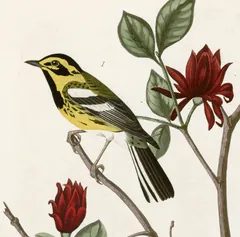
John James Audubon, The Birds of America (1827–38) 22 Townsend's Warblerabout 9.9 per routeon 27% of routesfalling since 2015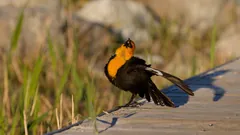
Photo: Daughter Dad, CC BY 4.0 23 Yellow-headed Blackbirdabout 9.3 per routeon 41% of routesno clear trend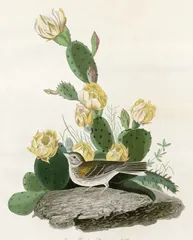
John James Audubon, The Birds of America (1827–38) 24 Vesper Sparrowabout 9.1 per routeon 62% of routesno clear trend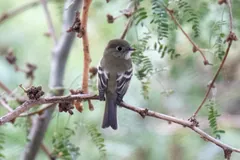
Photo: Kevin Floyd, CC BY 4.0 25 Hammond's Flycatcherabout 8.5 per routeon 46% of routesrising since 2015
If the Cliff Swallow, first on this list, or the Hammond's Flycatcher, last on it, has you curious about the rest of Idaho’s 432 species, see our comparison of the best bird books of 2026, from the friendliest for beginners to the newest.
What is the most common bird in Idaho?
The Cliff Swallow leads Idaho’s summer survey: about 135 a route on average in 2021–2025, more than twice the Brewer's Blackbird’s 34, seen on 68% of the 37 routes. USGS finds no clear rise or fall in its Idaho numbers since 2015.
How was this list made?
Each of Idaho’s 37 routes is a roadside count, 50 stops along about 25 miles, run once a year in early summer by a volunteer. We took USGS’s yearly estimate for each species in Idaho, the number of birds a typical route records, averaged it over the five latest survey years (there was no survey in 2020) and ranked the birds by it. To keep the list to birds you’re likely to meet across Idaho, we left out species recorded on fewer than one in five of its routes, and those USGS can only estimate very roughly, which usually means big flocks or colonies on a few routes.
For Idaho that left out the White-faced Ibis and the Franklin's Gull.
The share of routes is our own count from USGS’s route data for Idaho, using only counts that met the survey’s standards; “rising” and “falling” are USGS’s trends for the state since 2015, named only where it finds a clear change. Roadside counts on early-summer mornings miss most of Idaho’s owls and waterbirds, and its winter visitors aren’t here at all.
Idaho’s counts come from two USGS data releases, the North American Breeding Bird Survey Analysis Results 1966–2025 (Hostetler et al., 2026) and its Dataset 1966–2025 (Ziolkowski et al., 2026), gathered by volunteer observers and free for anyone to use; Birdfolio isn’t connected with the USGS.
How many bird species are in Idaho?
| Official count | 432 species |
|---|---|
| List’s date | 2020 |
| Kept by | Idaho Bird Records Committee |
| Review species | 134, marked with an asterisk (our count) |
| Extinct | 1, the Passenger Pigeon |
| Found only in Idaho | The Cassia Crossbill, fewer than 6,000 birds |
| Among US states | Tied for 38th highest of the 49 states with a verified count, alongside Delaware and Iowa |
| Official list | Idaho Bird Checklist (IBRC, 2020) |
What does Idaho’s count include?
- Every species on the Idaho Bird Records Committee's checklist dated 2020, the one its website still showed at the end of 2024.
- 134 review species, marked with an asterisk, from the Emperor Goose and Ross's Gull to Asian strays such as the Red-flanked Bluetail, Siberian Accentor and Brambling (our count).
- The extinct Passenger Pigeon, marked with two asterisks.
- The Cassia Crossbill, a species that lives only in Idaho.
- Not counted: birds reported but not accepted, which the committee lists apart as additional species, and species first documented after 2020, such as the Tricolored Blackbirds of 2023.
Why do other sources give a different number?
Idaho's checklist hasn't changed since 2020, so the figures that differ come from single places or from newer finds:
- 223. The species seen on or over Craters of the Moon National Monument and Preserve: one park's list, not the state's. Source: Birds, Craters of the Moon National Monument and Preserve (National Park Service).
- Up to 30. Tricolored Blackbirds found at cattle feedlots in Payette and Gem counties in 2023, the first documented in Idaho. The species isn't among the 2020 checklist's 432. Source: First Record of Tricolored Blackbirds in Idaho (Western Birds 55:43-50, 2024).
- 433. A total that older lists give for January 2022. The committee hasn't posted a checklist with it: its checklist page still showed the 2020 list of 432 at the end of 2024. Source: Checklist of Idaho Birds (Idaho Bird Records Committee; Internet Archive copy, December 31, 2024).
Idaho’s list follows its own committee’s rules, and so does every other state’s: see why the counts differ from state to state.
Idaho records, from a gull that scorned bread to owls in a burned forest
- The very early Idaho records in the committee's database come from Thomas Burleigh's book Birds of Idaho (1972), among them a Passenger Pigeon collected at Pack River in Bonner County on June 17, 1860. Source: History of the Idaho Bird Records Database (Idaho Bird Records Committee; Internet Archive copy, May 19, 2026), read October 8, 2026.
- Idaho's first Golden-winged Warbler sang in a yard in Shoshone, Lincoln County, on June 1, 1980. The observer knew the song from years of birding in Wisconsin, where the species is a common spring migrant. Source: First Record of the Golden-winged Warbler in Idaho (Western Birds 12:55, 1981), read October 8, 2026.
- A Western Gull, one of the West Coast's gulls, turned up at American Falls Reservoir on October 21, 1984, and stayed until at least October 27: Idaho's first. The observers threw bread to draw the gulls in, but the Western Gull never took any from the water; it harassed the other gulls instead, the way a jaeger does. Source: First Record of the Western Gull from Idaho (Western Birds 19:81-82, 1988), read October 8, 2026.
- A male Garganey fed among Cinnamon Teal on the Snake River about 15 kilometers (9 miles) west of Hammett on April 20, 1990, and was photographed on Kodachrome film. None of three nearby residents knew of anyone raising Garganeys, and the committee accepted it as the state's first. Source: First Record of a Garganey in Idaho (Western Birds 22:3, 1991), read October 8, 2026.
- In July 2014 two families of Northern Hawk Owls, a bird of the northern forests, were found in the Salmon River Mountains east of Warm Lake, more than 440 kilometers (270 miles) south of any earlier nest of the species. They were raising young in forest that had burned in 2006. Source: Southernmost Breeding of the Northern Hawk Owl in the United States (Western Birds 47:81-83, 2016), read October 8, 2026.
Questions people ask about Idaho’s birds
What birds are common in Idaho?
That depends on the habitat. At Craters of the Moon, where 223 species have been seen, the National Park Service says ravens, Clark's Nutcrackers and chickadees live all year, and Brewer's Sparrows, Sage Thrashers and sage-grouse live in much higher numbers than in similar country busier with people. Mountain Bluebirds, Violet-green Swallows and Rock Wrens shelter in the bare lava, and mountain and Arctic birds such as Gray-crowned and Black Rosy-Finches, Snow Buntings and Rough-legged Hawks stay the winter.
In the Snake River canyon, crags, crevices and rising warm air hold what the Bureau of Land Management calls the greatest concentration of nesting birds of prey in North America: some 800 pairs of hawks, owls, eagles and falcons each spring, about 30 of them Golden Eagles nesting on cliffs or on big transmission towers.
Sources: Birds, Craters of the Moon National Monument and Preserve (National Park Service); Morley Nelson Snake River Birds of Prey National Conservation Area (Bureau of Land Management); Meet the Raptors, Morley Nelson Snake River Birds of Prey National Conservation Area (Bureau of Land Management), read October 8, 2026.
Which US state has the most bird species?
California, with 696 species on its official checklist (September 8, 2026), followed by Texas with 682 (our table). Idaho's checklist of 2020 has 432, which leaves it 264 species behind California (our arithmetic).
Sources: Official California Checklist, updated 8 September 2026 (California Bird Records Committee); Idaho Bird Checklist, 2020 (Idaho Bird Records Committee; Internet Archive copy, July 4, 2024), read October 8, 2026.
What is the top 1 rarest bird?
In Idaho, the answer is the Cassia Crossbill: an estimated 6,000 or fewer exist, and all of them live in Idaho. As visitors go, the rarest are the 134 review species on the checklist, which include strays from Asia such as the Red-flanked Bluetail and Siberian Accentor. Some birds never made it onto the list at all: a Hooded Crane reported near Carey in April 2011 was turned down by the committee in two rounds of votes.
Sources: A New Cassia Crossbill Project (Intermountain Bird Observatory, Boise State University, November 16, 2021); Idaho Bird Checklist, 2020 (Idaho Bird Records Committee; Internet Archive copy, July 4, 2024); Additional Species Reported (Idaho Bird Records Committee; Internet Archive copy, June 11, 2026), read October 8, 2026.
Which bird lives only in Idaho?
The Cassia Crossbill, Idaho's only bird found nowhere else. It lives in the South Hills and Albion Mountains of Cassia County, two small, isolated ranges in a sea of sagebrush, and its whole range covers about 27 square miles. It was recognized as a species of its own in 2017; the whole lower 48 states have only 16 birds found nowhere else, The Nature Conservancy says.
It exists because squirrels never got there. Pine squirrels, the crossbills' main competitors elsewhere, never reached these mountains, so the lodgepole pines grew cones in abundance and the crossbills, normally nomads, stayed put. Their bills grew thicker for the lodgepole cones, and the pines answered with thicker cones: a coevolutionary arms race, one researcher called it. There are fewer than 6,000 of the birds, and a researcher expects hotter summers and wildfires, which make the cones open early and drop their seeds, could cut that by as much as three quarters.
Sources: A Search for the Cassia Crossbill, Idaho's Endemic Bird (The Nature Conservancy, Cool Green Science, October 6, 2025); A New Cassia Crossbill Project (Intermountain Bird Observatory, Boise State University, November 16, 2021); Idaho Bird Checklist, 2020 (Idaho Bird Records Committee; Internet Archive copy, July 4, 2024), read October 8, 2026.
Why does Idaho have so many nesting birds of prey?
The Snake River canyon gives them crags and crevices to nest in and warm updrafts to ride, and people chose to protect it. Congress made it the Snake River Birds of Prey National Conservation Area on August 4, 1993, and in 2009 renamed it for Morley Nelson, who began filming the canyon's raptors in the 1940s and helped win it special protection in 1971.
Nelson's story crosses into war, film and power lines. A captain in the 10th Mountain Division in World War II, he moved to Boise in 1948 to run snow surveys, persuaded the Idaho Legislature to protect raptors in 1958, and in the early 1960s trained falcons, eagles and hawks for Walt Disney's True-Life Adventure films. He also worked with the Idaho Power Company and the Edison Electric Institute to stop eagles being electrocuted on power lines, and designed nesting platforms that attach to big transmission lines, fixes now used around the world, the Congressional Record notes.
Sources: Morley Nelson Snake River Birds of Prey National Conservation Area (Bureau of Land Management); Tribute to Morley Nelson (Congressional Record, April 22, 2008, page E685), read October 8, 2026.
Where is the official Idaho bird list, and how often is it updated?
On the Idaho Bird Records Committee's website, ibrc.idahobirds.net, which shows the 2020 checklist of 432 species as a printable PDF. Decisions since then appear as accepted rare bird reports, such as a Hudsonian Godwit and a Prairie Warbler in 2023. The site also keeps the review list: any species with no accepted Idaho record, any seen four or fewer times a year in each of the past ten years, and any the committee calls rare or hard to identify. A separate page lists birds reported but not accepted, from Barnacle Geese, treated as escapes, to a pair of parakeets in a Pocatello yard.
The committee's roots go back to the mid-1980s, when two ornithologists sorting Idaho's rare-bird reports for a 1987 paper wrote its first bylaws and set it up. That first committee floundered, it says, partly because the state had few dedicated birders and every report went by mail. It took its present form in the fall of 2004, when J. Harry Krueger, who died in 2013, helped set up the IdahoBirds.net website with an online rare bird report form. The site's database of Idaho sightings, begun by one birder around 1984 on two home computers, now holds 187,712 records.
Sources: Checklist of Idaho Birds (Idaho Bird Records Committee; Internet Archive copy, December 31, 2024); List of Idaho Review Species (Idaho Bird Records Committee; Internet Archive copy, July 11, 2026); Additional Species Reported (Idaho Bird Records Committee; Internet Archive copy, June 11, 2026); IBRC History (Idaho Bird Records Committee; Internet Archive copy, July 11, 2026); J. Harry Krueger, a tribute (Idaho Bird Records Committee; Internet Archive copy, July 11, 2026); History of the Idaho Bird Records Database (Idaho Bird Records Committee; Internet Archive copy, May 19, 2026), read October 8, 2026.
How do you count your own Idaho list?
Your Idaho list is every species you’ve seen in Idaho. eBird can filter your life list to Idaho, and your eBird data download gives the state of every sighting. On paper, count the species you’ve seen in Idaho; what is a life list? explains how birders keep their lists.
To print your whole list, Idaho birds and all, see how to print your bird life list, or let Birdfolio make it a hardcover book.
Idaho’s state bird
Idaho’s state bird is the Mountain Bluebird, the state bird since 1931. Its story, the state flower and animal, and a free picture card for a report are on our Idaho state bird page.
Birding festivals in Idaho
Our birding festivals calendar lists one festival in Idaho, with dates from its own website:
- Greater Yellowstone Crane Festival, Teton Valley: dates not announced yet; expected in September 2027 (2026 festival: September 23–26, 2026)
Christmas Bird Count in Idaho
Idaho had 31 Christmas Bird Count circles on Audubon’s map last winter, each counted on a single day between December 14 and January 5. Our guide shows where to find Idaho’s counts and lists 5 Idaho count dates already announced for this winter; it’s free, and beginners are welcome.
More about bird counts
- How many bird species are in each state: Idaho beside all 50 states, DC and Canada.
- Bird lists of nearby states: Montana, Nevada, Oregon, Utah and Washington.
- State birds of all 50 states, Idaho’s Mountain Bluebird among them
- How many bird species are in the US and Canada
- Bird splits and lumps
If you’re shopping for a birder in Idaho, our gift guide for birders and our pick of coffee table bird books are good places to start.