Reference
How many bird species are in Massachusetts?
Massachusetts has 524 bird species on its official list (Massachusetts Avian Records Committee, January 2026), the 9th highest count of the 49 states with a verified count. It includes extinct species, species no longer found in Massachusetts and introduced ones; birds of uncertain origin are on a separate list.
Massachusetts’s state bird is the Black-capped Chickadee: our Massachusetts state bird page tells how it was chosen.
Updated
What are the most common birds in Massachusetts?
In summer, the 25 most common birds in Massachusetts are led by the American Robin, at about 71 birds per survey route, then the Canada Goose and the House Sparrow, by the USGS Breeding Bird Survey’s counts for 2021–2025. Together these 25 made up 75% of all the birds counted on Massachusetts’s 19 survey routes.
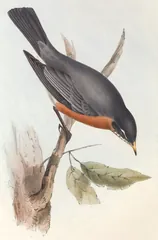
John and Elizabeth Gould, The Birds of Europe (1832–37) about 71 per routeon 100% of routesno clear trend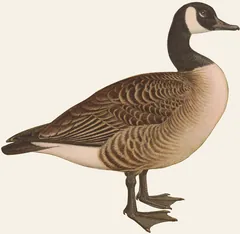
Marinus Adrianus Koekkoek, E. D. van Oort's Ornithologia Neerlandica (1922) about 67 per routeon 89% of routesno clear trend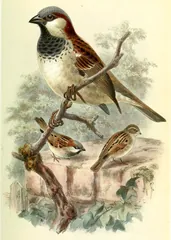
John Gerrard Keulemans, Lord Lilford’s Coloured Figures of the Birds of the British Islands (1885–97) 3 House Sparrowabout 50 per routeon 95% of routesfalling since 2015introduced species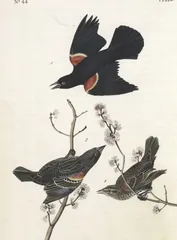
John James Audubon, The Birds of America (1840–44) about 47 per routeon 100% of routesno clear trend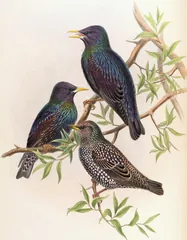
John Gould and Henry Constantine Richter, The Birds of Asia, vol. 5 (1850–83) 5 European Starlingabout 38 per routeon 95% of routesno clear trendintroduced species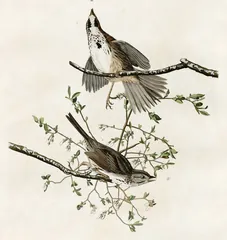
John James Audubon, The Birds of America (1827–38) about 38 per routeon 100% of routesrising since 2015
John James Audubon, The Birds of America (1827–38) 7 Chipping Sparrowabout 35 per routeon 100% of routesno clear trend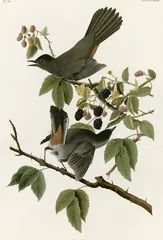
John James Audubon, The Birds of America (1827–38) 8 Gray Catbirdabout 35 per routeon 100% of routesno clear trend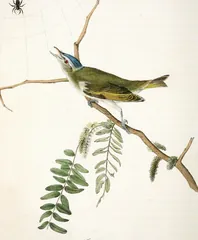
John James Audubon, The Birds of America (1840–44) 9 Red-eyed Vireoabout 33 per routeon 95% of routesno clear trend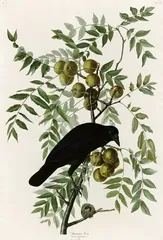
John James Audubon, The Birds of America (1827–38) about 30 per routeon 100% of routesno clear trend
Show all 25
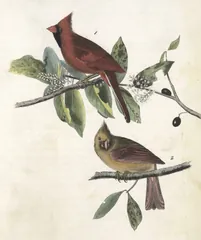
John James Audubon, The Birds of America (1840–44) about 29 per routeon 100% of routesno clear trend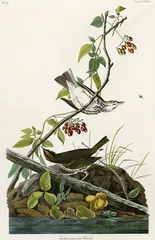
John James Audubon, The Birds of America (1827–38) 12 Ovenbirdabout 28 per routeon 100% of routesno clear trend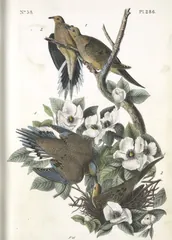
John James Audubon, The Birds of America (1840–44) about 26 per routeon 100% of routesno clear trend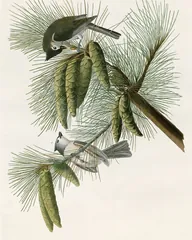
John James Audubon, The Birds of America (1827–38) about 25 per routeon 100% of routesno clear trend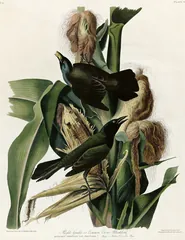
John James Audubon, The Birds of America (1827–38) 15 Common Grackleabout 24 per routeon 95% of routesno clear trend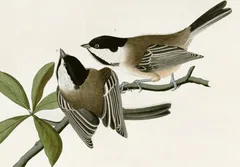
John James Audubon, The Birds of America (1827–38) about 22 per routeon 100% of routesfalling since 2015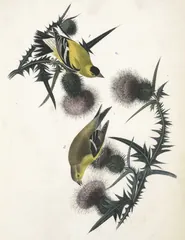
John James Audubon, The Birds of America (1840–44) about 19 per routeon 100% of routesno clear trend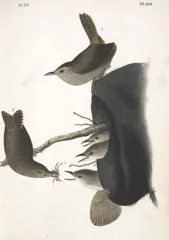
John James Audubon, The Birds of America (1840–44) 18 Northern House Wrenabout 17 per routeon 100% of routesno clear trend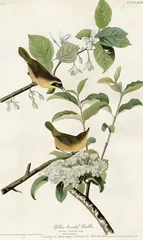
John James Audubon, The Birds of America (1827–38) 19 Common Yellowthroatabout 16 per routeon 100% of routesno clear trend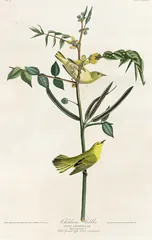
John James Audubon, The Birds of America (1827–38) 20 Northern Yellow Warblerabout 15 per routeon 100% of routesno clear trend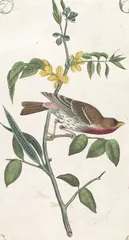
John James Audubon, The Birds of America (1840–44) 21 House Finchabout 15 per routeon 100% of routesno clear trend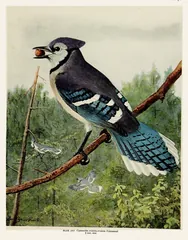
Louis Agassiz Fuertes, Elon H. Eaton's Birds of New York (1910–14) 22 Blue Jayabout 13 per routeon 100% of routesno clear trend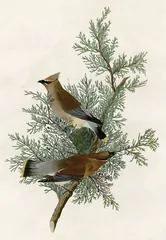
John James Audubon, The Birds of America (1827–38) about 12 per routeon 89% of routesno clear trend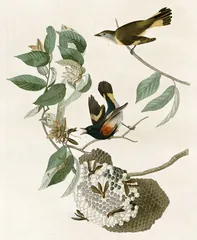
John James Audubon, The Birds of America (1827–38) 24 American Redstartabout 11 per routeon 79% of routesno clear trend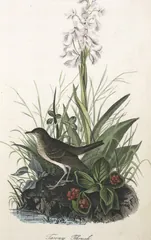
John James Audubon, The Birds of America (1840–44) 25 Veeryabout 11 per routeon 79% of routesno clear trend
From the American Robin to the Veery, these are Massachusetts’s common summer birds; for the rest of its 524 species, our guide to the best bird books of 2026 compares the five big North American guides, Sibley’s and Peterson’s among them.
What is the most common bird in Massachusetts?
The American Robin leads Massachusetts’s summer survey: about 71 a route on average in 2021–2025, ahead of the Canada Goose at about 67, seen on every one of the 19 routes. USGS finds no clear rise or fall in its Massachusetts numbers since 2015.
The Song Sparrow is the most widespread: Mass Audubon's second Breeding Bird Atlas, from 2007 to 2011, found it in 1,022 survey blocks, 98.6 percent of them, more than any other bird, just as the first atlas of the 1970s had. Widespread isn't the same as numerous.
The Red-winged Blackbird came fifth by blocks, and the state bird, the Black-capped Chickadee, tied for sixth with the Mourning Dove.
Sources: Song Sparrow, Breeding Bird Atlas 2 species account (Mass Audubon); Red-winged Blackbird, Breeding Bird Atlas 2 species account (Mass Audubon); Black-capped Chickadee, Breeding Bird Atlas 2 species account (Mass Audubon), read October 10, 2026.
How was this list made?
Each of Massachusetts’s 19 routes is a roadside count, 50 stops along about 25 miles, run once a year in early summer by a volunteer. We took USGS’s yearly estimate for each species in Massachusetts, the number of birds a typical route records, averaged it over the five latest survey years (there was no survey in 2020) and ranked the birds by it. To keep the list to birds you’re likely to meet across Massachusetts, we left out species recorded on fewer than one in five of its routes, and those USGS can only estimate very roughly, which usually means big flocks or colonies on a few routes.
The share of routes is our own count from USGS’s route data for Massachusetts, using only counts that met the survey’s standards; “rising” and “falling” are USGS’s trends for the state since 2015, named only where it finds a clear change. Roadside counts on early-summer mornings miss most of Massachusetts’s owls and waterbirds, and its winter visitors aren’t here at all.
Massachusetts’s counts come from two USGS data releases, the North American Breeding Bird Survey Analysis Results 1966–2025 (Hostetler et al., 2026) and its Dataset 1966–2025 (Ziolkowski et al., 2026), gathered by volunteer observers and free for anyone to use; Birdfolio isn’t connected with the USGS.
How many bird species are in Massachusetts?
| Official count | 524 species |
|---|---|
| List’s date | January 2026 |
| Kept by | Massachusetts Avian Records Committee |
| Extinct | 3 species: Labrador Duck, Passenger Pigeon and Great Auk |
| Gone from the state | 1, the Heath Hen |
| Introduced | 8 species, from the Mute Swan to the House Finch |
| Review species | 202, in bold on the list (our count) |
| Records committee since | 1989 |
| Among US states | 9th highest of the 49 states with a verified count |
| Official list | MARC Official State List |
What does Massachusetts’s count include?
- Extinct species, and species no longer found in Massachusetts.
- Introduced species.
- Not counted: birds of uncertain origin, on a supplemental list.
- Species names and order follow the Clements Checklist (2025 version).
- Three entries that stop short of a single species, which the committee's 29th report calls non-species taxa: an Apus swift, a Cape Verde or Desertas Petrel, and a Streaked or Sulphur-bellied Flycatcher.
Why do other sources give a different number?
Massachusetts has printed a new total in almost every annual report since the 1990s, so older figures are easy to find, and other counts measure something narrower:
- 521. The entries identified to a single species, if you leave out the three that the 29th report admits as non-species taxa (our arithmetic). Source: Twenty-ninth Report of the Massachusetts Avian Records Committee (Bird Observer).
- 519. The total in the committee's 27th report (2024), which added the American Flamingo and Western Wood-Pewee, gained Scopoli's Shearwater through a taxonomic change and lost the Hoary Redpoll to a merger. Source: Twenty-seventh Report of the Massachusetts Avian Records Committee (Bird Observer 52:6, 2024).
- 503. The total after the 22nd report, which added the Trumpeter Swan, from a bird at a Charlton farm in May 2018, and the Western Meadowlark, from one on Plum Island in November 2017. Source: Twenty-second Report of the Massachusetts Avian Records Committee (Bird Observer).
- 468. The official state list in the committee's sixth report, published in Bird Observer in April 2002. Source: Sixth Report of the Massachusetts Avian Records Committee (Bird Observer, April 2002).
- More than 200. The breeding species in Mass Audubon's second Breeding Bird Atlas, for which more than 650 volunteers spent over 43,000 hours in the field from 2007 to 2011. A nesting count, not the state list. Source: Breeding Bird Atlases (Mass Audubon).
- More than 300 a year. Mass Audubon's figure for the species the state hosts each year, which Google's AI summary for “birds of massachusetts” repeated in October 2026. A single year's birds, not the 524 accepted over the years. Source: Birds in Massachusetts (Mass Audubon).
Massachusetts’s list follows its own committee’s rules, and so does every other state’s: see why the counts differ from state to state.
Massachusetts firsts, from a 1916 warbler to a Pacific petrel
- A Juan Fernandez Petrel photographed on a whale watch near Gloucester was only the third for the United States and the first for the Atlantic Basin. The 29th report added it to the state list along with the Ferruginous Hawk, Vega Gull and Varied Bunting. Source: Twenty-ninth Report of the Massachusetts Avian Records Committee (Bird Observer), read October 5, 2026.
- The committee accepted a Kirtland's Warbler seen in Roslindale, Boston, on May 26, 1916, from a letter one of its three observers published in 1917. Her description of a large warbler that fed low and kept wagging its tail won members over, helped by a 2008 Kirtland's in Maine, and the 15th report (2011) made it the state's first and only record. Source: Fifteenth Report of the Massachusetts Avian Records Committee (Bird Observer 39:3, 2011), read October 5, 2026.
- A Little Shearwater of the baroli form, photographed about 18 miles north of Veatch Canyon off Nantucket on August 25, 2007, was the state's first and only the second documented for North America, after a bird that hit a lighthouse on Sable Island, Nova Scotia, in 1896. Source: Fifteenth Report of the Massachusetts Avian Records Committee (Bird Observer 39:3, 2011), read October 5, 2026.
- Hurricane Idalia carried American Flamingos to 18 US states in 2023. The next summer a young one shuttled between New York, Massachusetts and Rhode Island, standing on Chapin Memorial Beach in Dennis in early June and again on July 15, 2024; it is the first flamingo the committee treats as a wild bird. Source: Twenty-seventh Report of the Massachusetts Avian Records Committee (Bird Observer 52:6, 2024), read October 5, 2026.
- A Common Gull banded as a chick near Akureyri Airport in Iceland on June 23, 2013, came back to King's Beach in Lynn and Revere Beach from February 2017 to March 2023, known each time by its leg band; the 28th report calls it Akila. The same report finds that just three returning Kamchatka Gulls, a form that nests in eastern Russia, account for every Massachusetts record of that form. Source: Status of the Mew Gull Complex in Massachusetts: Special Twenty-eighth Report of the Massachusetts Avian Records Committee (Bird Observer 53:5, 2025), read October 5, 2026.
Our guide to rare bird alerts shows where Massachusetts rare birds are reported, and how MARC reviews them, and how to report a sighting to the committee.
Questions people ask about Massachusetts’s birds
Which US state has the most bird species?
California, with 696 species on the checklist of its records committee, updated September 8, 2026, comes first and Texas, with 682, second (our table). Massachusetts, a far smaller state, lists 524, and 202 of them are review species, rare enough that the records committee checks every report (our count of the bold names).
Sources: Official California Checklist, updated 8 September 2026 (California Bird Records Committee, Western Field Ornithologists); Official State List, January 2026 (Massachusetts Avian Records Committee), read October 5, 2026.
What is the rarest bird in Massachusetts?
Five birds the records committee added in its 29th report have a single accepted Massachusetts record each: the Vega Gull, Juan Fernandez Petrel, Ferruginous Hawk, Varied Bunting and Eurasian Whimbrel. The Varied Bunting came to a feeder in Provincetown and was the first winter record for the whole East Coast; the petrel, the committee wrote, is "among the most shocking birds ever to have occurred in Massachusetts."
Source: Twenty-ninth Report of the Massachusetts Avian Records Committee (Bird Observer), read October 5, 2026.
What are common birds in Massachusetts?
Mass Audubon's list of common Massachusetts birds names the everyday ones: the Black-capped Chickadee, the state bird, found wherever there are at least a few trees, with the American Robin, Blue Jay, Northern Cardinal, Mourning Dove, Tufted Titmouse, White-breasted Nuthatch, American Goldfinch and Dark-eyed Junco. The Mallard is the duck people meet most often, and the Red-winged Blackbird the most common and widespread of the blackbirds.
Source: Birds in Massachusetts (Mass Audubon), read October 10, 2026.
Where can I find a list of Massachusetts birds?
On the Massachusetts Avian Records Committee's website: the Official State List, a table of 524 species dated January 2026, with review species in bold. For one corner of the state, Cape Cod National Seashore sells bird checklists and field guides at the bookstore of its Salt Pond Visitor Center.
Sources: Official State List, January 2026 (Massachusetts Avian Records Committee); Birds, Cape Cod National Seashore (National Park Service), read October 10, 2026.
What is the biggest bird in Massachusetts?
By length, the Mute Swan, a naturalized bird of the southeastern coast: up to about 5 feet long, with wings up to about 8 feet across (our conversions of figures a federal Fish and Wildlife Service summary quotes). A big male Wild Turkey, at 16 to 25 pounds, can be the heaviest, and the Bald Eagle, with wings of 6.5 to 7 feet, is the largest bird of prey, MassWildlife says.
At least 88 pairs of eagles held nesting territories in Massachusetts in 2024, and they use the Quabbin Reservoir and the Connecticut and Merrimack rivers all year. Turkeys were all but gone from the state until 37 birds trapped in New York were released in 1972 and 1973; the fall population is now more than 30,000 to 35,000. Among the waders, the Great Blue Heron stands about 4 feet tall, and at 30 inches the Great Black-backed Gull is the largest gull.
Sources: Mute Swan, Ecological Risk Screening Summary, revised March 2019 (U.S. Fish and Wildlife Service), the Internet Archive's copy of July 20, 2026; Mute Swan, Breeding Bird Atlas 1 (Mass Audubon); Learn about turkeys (MassWildlife), the Internet Archive's copy of September 23, 2026; Bald Eagle (MassWildlife), the Internet Archive's copy of May 12, 2026; Wild Turkeys (Mass Audubon); Great Blue Herons (Mass Audubon); Gulls (Mass Audubon), read October 11, 2026.
Which birds live in Massachusetts?
Birds of the beaches and salt marshes, the offshore waters, the farm fields and grasslands, and the forests that climb to the spruce and fir on Mount Greylock. Its specialties are beach nesters: Massachusetts held about 1,200 pairs of Piping Plovers in 2024, more than half of the whole Atlantic Coast population, Mass Audubon says, and most of the endangered Roseate Terns of the Northwest Atlantic gather on its southeastern beaches before they migrate.
Seacoast: Cape Cod National Seashore records about 370 species, some 80 of them nesting, and features beach and shore birds such as the Piping Plover, Least Tern, American Oystercatcher and Red Knot. The Great Marsh on the North Shore, the largest unbroken stretch of salt marsh north of Long Island, has a list of more than 300 species, and Least Terns nest there in significant numbers.
Offshore: Stellwagen Bank, a national marine sanctuary at the eastern edge of Massachusetts Bay, is a feeding ground for seabirds from far parts of the ocean: Northern Fulmars and alcids that nest in the Arctic, Wilson's Storm-Petrels from the Antarctic and Cory's Shearwaters from the eastern Atlantic.
Fields and grasslands: Bobolinks, Eastern Meadowlarks and Savannah Sparrows nest in big fields in summer, and the state wildlife agency says most of the state's Grasshopper Sparrows and Upland Sandpipers live at airports, where much of the remaining sandplain grassland survives.
Mountains: the top of Mount Greylock, at 3,491 feet the state's highest peak, has a northern, boreal plant community found nowhere else in Massachusetts. Mass Audubon says it holds the state's entire population of Blackpoll Warblers, with Swainson's Thrushes and Dark-eyed Juncos nesting in its damp conifers.
Sources: Coastal Waterbirds (Mass Audubon); Birds, Cape Cod National Seashore (National Park Service); Important Bird Area: Great Marsh (Mass Audubon); Important Bird Area: Stellwagen Bank (Mass Audubon); Grassland Bird Program (Mass Audubon); Grassland Bird Conservation (MassWildlife, Massachusetts Division of Fisheries and Wildlife), the Internet Archive's copy of June 9, 2026; Important Bird Area: Mt. Greylock (Mass Audubon), read October 10, 2026.
What happened to the Heath Hen?
It died out on Martha's Vineyard. The Heath Hen, the eastern subspecies of the Greater Prairie-Chicken, once nested from Massachusetts south to Virginia. Mainland Massachusetts lost its last one, shot near Northampton, in the 1830s, and by 1870 the only birds left anywhere were on Martha's Vineyard and Naushon Island. After a fire in 1894, a hunter who knew the birds well could not find one in the fall of 1897. In 1907 Massachusetts set aside a 1,600-acre reservation on the Vineyard, and by 1916 the island may have held nearly 2,000.
Then a fire driven by a May gale swept the island's interior in 1916, and goshawks invaded the following winter. Numbers recovered to over 400 in 1920 before cold, wet springs, disease and, quite possibly, too few females wore them down. From 1928 only one bird was known, a male called Booming Ben, who displayed alone each spring until he vanished in March 1932. The state's official list still carries the Heath Hen, marked extirpated.
Sources: The Life and Death of the Heath Hen (Bird Observer, February 2015); Official State List, January 2026 (Massachusetts Avian Records Committee), read October 5, 2026.
Why do Snowy Owls spend the winter at Boston's Logan Airport?
Because the airport looks like home to them. Snowy Owls, the largest owls in North America by weight, stop where the land resembles Arctic tundra, and the low, flat ground around Boston Logan International Airport, with short scruffy plants and plenty of small mammals and birds to eat, fits. Mass Audubon says Logan has the largest known concentration of Snowy Owls in the Northeast. They usually arrive in early November, October 22 at the earliest, and leave in early April.
The owls help by scaring off other birds that endanger aircraft, but they are big enough to be a danger themselves, so a Mass Audubon researcher who has studied them since 1981 captures them each year and moves them, and since 1997 he has fitted the healthiest with transmitters. In 2013-14 two owls stayed between Logan and the Boston Harbor Islands through the following summer, fall and winter, the first time Snowy Owls were recorded living in Massachusetts for more than a year.
Source: Snowy Owl Project (Mass Audubon), read October 5, 2026.
How did Mass Audubon begin?
Over tea. In January 1896 Harriet Lawrence Hemenway of Boston, shaken by an article about plume hunters killing birds for the feathers on women's hats, and her cousin Minna B. Hall began holding tea parties to talk other women out of wearing them. They then brought those women together with ornithologists to found the Massachusetts Audubon Society, to further the protection of birds and discourage the buying and wearing of wild birds' feathers.
Its first president, the ornithologist William Brewster (1896-1913), worked for laws against killing birds and selling their plumage; his successor, Edward Howe Forbush, opened its first wildlife sanctuary, Moose Hill in Sharon, in 1916. Mass Audubon calls itself the longest-running independent Audubon society. Its first Breeding Bird Atlas, from surveys in 1974-1979, was the first of its kind in the United States.
Sources: Our History (Mass Audubon); Breeding Bird Atlases (Mass Audubon), read October 5, 2026.
Where is the official Massachusetts bird list, and how often is it updated?
On the Massachusetts Avian Records Committee's website: the Official State List, a table of 524 species dated January 2026, with review species in bold and E, e and I for extinct, extirpated and introduced. Below it, a supplemental list names birds that may have reached the state wild but could have escaped from captivity, such as the European Goldfinch and Eurasian Tree Sparrow. The total moves with each annual report: the 29th, covering records from 1980 to mid-2025, judged 213 records of 82 taxa, accepted 188 and brought the list to 524.
The committee dates itself to 1989. Bird Observer announced it in June 1992, it issued a first state list in 1994, and its first annual report appeared in the October 1995 Bird Observer, where the reports still run. Nine voting members serve staggered three-year terms. A record passes in the first round only if every member accepts it; in later rounds all but one is enough, fewer than two in favor rejects it, and anything else goes to a meeting for a final vote.
Sources: Official State List, January 2026 (Massachusetts Avian Records Committee); Twenty-ninth Report of the Massachusetts Avian Records Committee (Bird Observer); About (Massachusetts Avian Records Committee); First Annual Report of the Massachusetts Avian Records Committee (Bird Observer, October 1995); Annual Reports (Massachusetts Avian Records Committee); Bylaws (Massachusetts Avian Records Committee), read October 5, 2026.
How do you count your own Massachusetts list?
Your Massachusetts list is every species you’ve seen in Massachusetts. eBird can filter your life list to Massachusetts, and your eBird data download gives the state of every sighting. On paper, count the species you’ve seen in Massachusetts; what is a life list? explains how birders keep their lists.
To print your whole list, Massachusetts birds and all, see how to print your bird life list, or let Birdfolio make it a hardcover book.
Massachusetts’s state bird
Massachusetts’s state bird is the Black-capped Chickadee (officially, the “chickadee”), the state bird since 1941. Its story, the state flower and animal, and a free picture card for a report are on our Massachusetts state bird page.
Christmas Bird Count in Massachusetts
Massachusetts had 33 Christmas Bird Count circles on Audubon’s map last winter, each counted on a single day between December 14 and January 5. Our guide shows where to find Massachusetts’s counts and lists 3 Massachusetts count dates already announced for this winter; it’s free, and beginners are welcome.
More about bird counts
- How many bird species are in each state: Massachusetts beside all 50 states, DC and Canada.
- Bird lists of nearby states: Connecticut, New Hampshire, New York, Rhode Island and Vermont.
- State birds of all 50 states, Massachusetts’s Black-capped Chickadee among them
- How many bird species are in the US and Canada
- Bird splits and lumps
If you’re shopping for a birder in Massachusetts, our gift guide for birders and our pick of coffee table bird books are good places to start.