Nineteen kinds of owls nest in the United States and Canada, and three rare strays from Asia and the tropics bring the official list to 22. They run from the soda-can-sized Elf Owl to the Great Gray, up to 33 inches long. The one you're likeliest to hear is the Great Horned Owl, found across nearly all of North America.
Owls of North America at a glance
The 19 nesting owls, most familiar first. Sizes are the National Audubon Society guide's (its text is adapted from Kenn Kaufman's Lives of North American Birds), filled in by The Peregrine Fund and, for the Ferruginous Pygmy-Owl, the Fish and Wildlife Service.
| Owl | Length | Weight | Where | Call |
|---|---|---|---|---|
| Great Horned Owl | 18–24 in | 2–5½ lb | Lower 48, Alaska, most of Canada | Deep hoo, hoo-hoo, hoo, hoo |
| Barred Owl | 17–20 in | 16–37 oz | The East, the Pacific Northwest | Who cooks for you? |
| American Barn Owl | 13–16 in | 15–25 oz | Most of the Lower 48; Hawaii | Screams, hisses |
| Eastern Screech-Owl | About 10 in | 5–7 oz | The East | Falling whinny, trill |
| Western Screech-Owl | 7.5–9.8 in | 3.5–8.6 oz | The West | Bouncing-ball whistles |
| Whiskered Screech-Owl | 6–7 in | 2.5–3.5 oz | Southwest border canyons | Morse-code toots |
| Flammulated Owl | 5.9–6.7 in | 1.3–2 oz | Western mountains, summer | Low hoots, on and on |
| Burrowing Owl | 7.5–9.8 in | 5.2–5.5 oz | The West, Great Plains, Florida | Coo-coooo; a hiss |
| Elf Owl | 4.7–5.7 in | 1.3–1.9 oz | Mexican border, summer | Puppy-like yaps |
| Northern Pygmy-Owl | 6.3–7.1 in | 2.1–2.6 oz | Western forests | Even whistles, by day |
| Ferruginous Pygmy-Owl | About 6.7 in | 2.0–2.6 oz | South Texas, southern Arizona | Repeated poip |
| Spotted Owl | 17–19 in | 20–25 oz | Northwest, California, Southwest | Barking hoots |
| Great Gray Owl | 24–33 in | 2–4 lb | Far North, western mountains | Very deep whoos |
| Long-eared Owl | 14–16 in | 7.8–15 oz | Widespread | Soft, low hoots |
| Short-eared Owl | About 16 in | 7–17 oz | Tundra, prairie, marsh; Hawaii | Barks, wing claps |
| Snowy Owl | About 24 in | 1½–6½ lb | Arctic; northern states in winter | Usually silent |
| Northern Hawk Owl | 14.9–17.7 in | 10.6–15.5 oz | Boreal Canada, Alaska | Ki-ki-ki-ki |
| Boreal Owl | 8.3–10.2 in | 3.7–7.4 oz | Boreal forest, high western mountains | Fast whistled trill |
| Northern Saw-whet Owl | About 7 in | 1.9–5.3 oz | Canada, northern US, western mountains | Tooting whistles |
The three strays, the Oriental Scops-, Mottled and Stygian Owls, are under the rarest owls.
Can you give me a list of different owl breeds?
Owls have no breeds, since no one bred them: they're wild species, and the table lists the 19 that nest in the US and Canada. "Breed" is a word for animals people have shaped, like dogs and cattle. Our owl quiz shows 12 of the 19 in old paintings.
What are the different names of owls?
Many owls also carry old names and nicknames. On his plates for The Birds of America, John James Audubon called the Great Gray the Great Cinereous Owl, the Northern Saw-whet the Little Owl, the Boreal Owl Tengmalm's Owl and the Eastern Screech-Owl the Mottled Owl (his plates). The Great Horned Owl is sometimes the "tiger owl," says the Audubon guide, and cowboys called Burrowing Owls "howdy birds," thinking they nodded hello. The Barred Owl is the hoot owl, Hawaiians call the Short-eared Owl pueo, and South Texas calls the barn owl lechuza.
How many types of owls are there in North America?
Nineteen nest in the US and Canada, the American Birding Association's checklist lists 22, and the world has 246. The ABA codes each bird by how often it turns up (version 8.19, January 2026):
- Codes 1 and 2 (18 owls): "regular breeding species and visitors."
- Code 3, rare (1): the Ferruginous Pygmy-Owl, which nests in southern Arizona and South Texas. Add it and you have the 19 nesters that the Owl Research Institute and Audubon magazine count.
- Code 5, accidental (3): the Oriental Scops-Owl from Asia, and the Mottled and Stygian Owls, tropical owls seen a handful of times in Texas.
Hawaii's Pueo is a race of the Short-eared Owl, not a 20th species. One of the 22 is a barn owl (family Tytonidae), the other 21 "typical owls" (Strigidae). AviList's 2026 world list has 15 barn and bay owls and 231 typical owls, and in October it split the Great Horned Owl: South America's birds became the Tropical and Paramo Horned Owls, and ours keeps its name. Our barn owl was renamed in 2024: it's the American Barn Owl. All 1,161 species on the ABA's list are tallied in our count of US and Canadian birds.
What is the most common owl in North America?
The Great Horned Owl, which lives "in practically all habitats," from swamps and deserts to northern forests near the treeline, says the Audubon guide. The guide puts it at 5.7 million birds, ahead of the American Barn Owl (3.6 million) and the Barred Owl (3.5 million). It doesn't say where those figures come from; we take them to cover each owl's whole range, Latin America included (an assumption). Its painting page has more on the bird.
Closer to home, the likelier neighbor is a screech-owl. The Eastern Screech-Owl is common "in city parks and shady suburbs," where many people never notice it; New York's Central Park even had its screech-owls brought back (Audubon magazine, 2015).
What are the most common types of owls?
An Audubon guide to owl calls picks five: the Barred, Barn, Eastern Screech-, Great Horned and Burrowing Owls. In the West, add the "locally very common" Western Screech-Owl. Northern Saw-whets are common too, but seldom seen.
What are the biggest owls in North America?
By length, the Great Gray Owl, up to 33 inches with a 5-foot wingspan; by weight, the Snowy Owl, at up to 6½ pounds. "Heaviest" is our comparison of the figures below, with the Great Horned Owl close behind; no source we read ranks them outright.
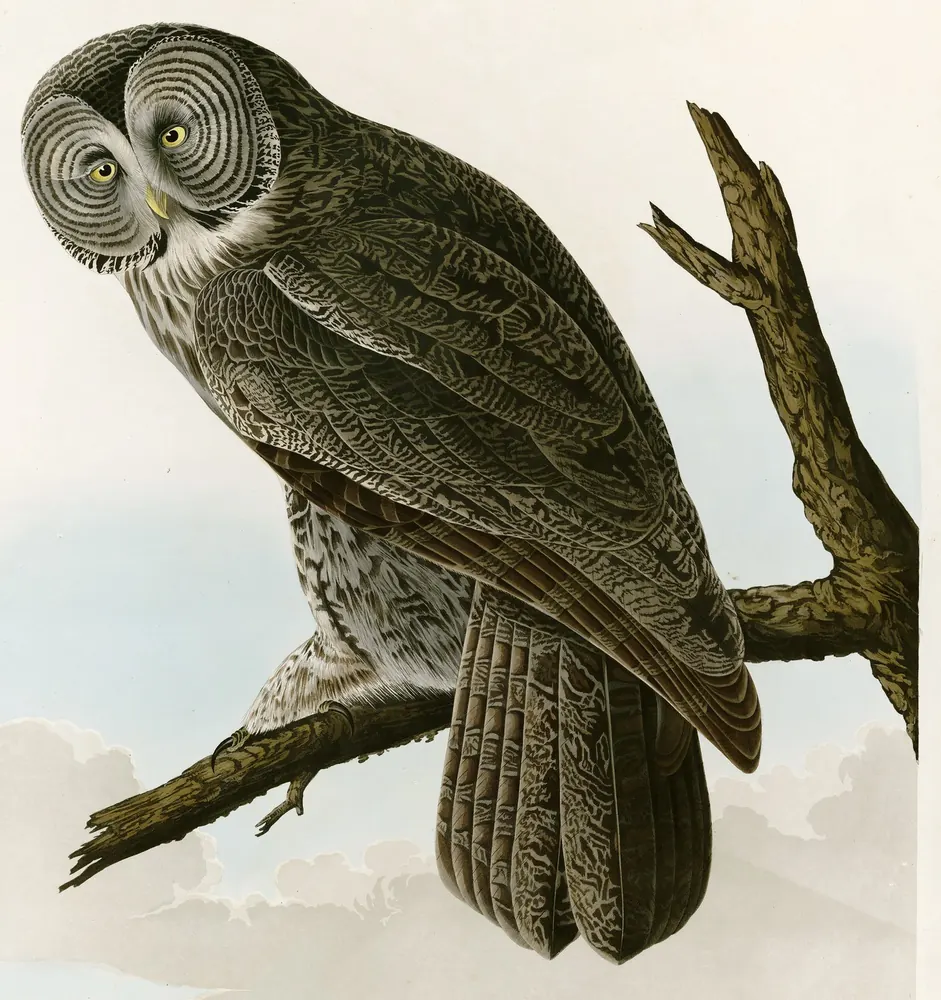
The Great Gray is mostly feathers. Its size "is partly illusion," says the Audubon guide: under thick, fluffy plumage the body is small, so it lives mostly on tiny rodents. The Peregrine Fund calls it "little owl in big owl clothing," at 2 to 4 pounds. Yet it finds rodents by sound and plunges into the snow after ones "more than a foot below the surface."
| Owl | Length | Wingspan | Weight |
|---|---|---|---|
| Great Gray Owl | 24–33 in | About 5 ft | 2–4 lb |
| Snowy Owl | About 24 in | 4 ft 7 in | 1½–6½ lb |
| Great Horned Owl | 18–24 in | 3 ft 4 in – 4 ft 9 in | 2–5½ lb |
| Barred Owl | 17–20 in | 3 ft 3 in – 3 ft 7 in | 16–37 oz |
| Spotted Owl | 17–19 in | 3 ft 9 in – 3 ft 11 in | 20–25 oz |
| Northern Hawk Owl | 14.9–17.7 in | 2 ft 7 in – 2 ft 9 in | 10.6–15.5 oz |
| Short-eared Owl | About 16 in | 3–3½ ft | 7–17 oz |
| Long-eared Owl | 14–16 in | 2 ft 11 in – 3 ft 3 in | 7.8–15 oz |
| American Barn Owl | 13–16 in | 3 ft 3 in – 4 ft 1 in | 15–25 oz |
The figures are the Audubon guide's, with The Peregrine Fund's for the Great Gray's and Snowy's weights and the Short-eared Owl's span and weight. In owls the female is the bigger bird; a female Boreal Owl can weigh twice as much as a male, says Audubon magazine. More on the Snowy's size is on its painting page.
What is the largest species of owl?
Blakiston's fish owl of the Russian Far East and northern Japan, whose 6-foot wingspan makes it "the world's biggest owl," says National Geographic. It catches salmon, trout and lamprey in icy rivers, and only 1,000 to 1,900 are thought to remain.
The giant now has two names. AviList's October 2026 update split it: the birds of Hokkaido, the southern Kurils and Sakhalin stay Blakiston's Fish Owl, and those of far eastern Russia, where the Wildlife Conservation Society reported the 6-foot span, became the Northern Fish Owl. No source we read says which of the two is bigger. The other giant, the Eurasian Eagle-Owl, spans 5 to 6 feet and weighs up to 9 pounds (The Peregrine Fund), but it isn't on the ABA list.
What are the five largest owls in the world?
Lists differ by measure; we could confirm only two world giants, the fish owl (now Blakiston's and Northern) and the Eurasian Eagle-Owl. We found no reliable top five, so we don't print one.
What owl has a 7 foot wingspan?
None that has been reliably measured: the widest owls, the fish owl and the Eurasian Eagle-Owl, span about 6 feet. The highest figure we found is Audubon magazine's 6.5 feet for the eagle-owl, in 2015.
Can an owl pick up a 12 lb cat?
No: North Carolina's largest owls weigh only about 5 pounds, says its Wildlife Resources Commission, though very rarely one may dive at a small dog or cat. The Great Horned Owl is often called a weight lifter that flies off with several times its own weight, but "there is no evidence to back up this claim," writes Matthew L. Miller of The Nature Conservancy. It can kill prey bigger than itself and eat it where it falls, and if a large bird ever takes a small pet, Miller says, it's probably this owl. For hawks and eagles, see our birds of prey guide and the Bald Eagle page.
What is the smallest owl?
The Elf Owl, "about the size of a soda can," says Audubon magazine, and under 2 ounces. The Audubon guide calls it "the smallest owl in the world," at 4.7 to 5.7 inches and 1.3 to 1.9 ounces.
It lives like a desert apartment dweller, nesting "almost always" in an old woodpecker hole, often 10 to 30 feet up a saguaro cactus, sometimes in a utility pole (who digs those holes). It may pull the stinger off a scorpion before eating it. It winters in Mexico, since insects get scarce here in the cold, and on moonlit spring nights its yapping is "surprisingly loud for the size of the bird."
Next by weight come the Flammulated Owl, 1.3 to 2 ounces, and the two pygmy-owls, 2 to 2.6. For the Ferruginous we use the Fish and Wildlife Service's 2023 figures, since other sources disagree.
Owl sounds: which owl did I hear?
Most owls heard in the US are one of five: the Great Horned Owl's deep hoots, the Barred Owl's "Who cooks for you?", a screech-owl's whinny or trill, the Barn Owl's scream or the Burrowing Owl's soft coo.
You may know two of them from the movies. The Great Horned Owl's hoot is "the classic owl sound effect used in TV and film," says Nature Canada, and the Eastern Screech-Owl's trill is "often used to 'set the mood'" in night scenes, says the Owl Research Institute. Most owls call hardest just after sunset and before sunrise, Mass Audubon says, and Eastern Screech-Owls and Barred Owls call by day too.
| What you heard | Most likely | When |
|---|---|---|
| Deep, soft hoots in a rhythm, hoo, hoo-hoo, hoo, hoo | Great Horned Owl | Fall and winter nights |
| Who cooks for you? Who cooks for you all?, plus barks | Barred Owl | All year, day or night |
| A long, harsh scream or a hiss | American Barn Owl | At night, often in flight |
| A falling, horse-like whinny or a one-note trill | Eastern Screech-Owl | Late winter and spring, in the East |
| Whistles speeding up like a dropped ball | Western Screech-Owl | All year, in the West |
| Toots in a Morse-code rhythm | Whiskered Screech-Owl | Nights, in border canyons |
| Monotonous toots, on and on | Northern Saw-whet Owl | Late winter and spring nights |
| Mellow whistles, songbirds scolding | Northern Pygmy-Owl | Often by day, in the West |
| Low hoots repeated almost endlessly | Flammulated Owl | Spring and summer nights, in western pines |
| High yips, like a puppy | Elf Owl | Spring nights, near Mexico |
| A soft coo-coooo, or a rattlesnake hiss | Burrowing Owl | Often by day |
| Barking hoots and a louder hooo-ah | Spotted Owl | Dusk and night |
| Ten or more very deep whoos | Great Gray Owl | Night and dusk |
| A fast ki-ki-ki-ki, like a kestrel | Northern Hawk Owl | Daytime |
| A fast whistled trill | Boreal Owl | Very early spring nights |
| Barks, and wing claps over a marsh | Short-eared Owl | Dusk, in the nesting season |
| Soft hoots, like blowing across a bottle | Long-eared Owl | The breeding season |
| Nothing | Snowy Owl | "Usually silent" here |
The descriptions are the Audubon guide's, with Mass Audubon's and Nature Canada's. You can hear a few in National Park Service recordings: a Spotted Owl at Yosemite in its sound gallery, and a Great Horned Owl at Devils Postpile and a Barred Owl at Muir Woods in Montana State University's Acoustic Atlas.
Do owls say hoo or hoot?
Both: the call is written "hoo" or "whoo," and "hoot" is its name. The Cambridge Dictionary defines a hoot as "the sound an owl makes." Many owls never hoot: Barn Owls scream, screech-owls whinny and saw-whets toot.
What is the sound of an owl called?
A hoot, though birders also speak of calls and songs, and owls bark, scream, whistle and snap their bills too.
What does a Barred Owl's call sound like?
A loud, barking hoo, hoo, hoo-hoo; hoo, hoo; hoo, hooo-aw!, remembered as "Who cooks for you? Who cooks for you all?" The Owl Research Institute's other memory aid is "You cook today, I cook tomorrow." Pairs often call back and forth (Audubon guide), all year and by day as well as by night (Mass Audubon).
What does a Great Horned Owl sound like?
A low, far-carrying hoo, hoo-hoo, hoo, hoo, the second and third notes shorter, says the Audubon guide; BirdNote's memory aid is "Who's awake? Me, too." In a pair's duet the female goes first, her voice higher than the male's. Audubon called the bird "the owl world's version of Barry White."
What noises do screech owls make?
Whinnies and trills: "Despite the name, screech-owls do not screech," says the Audubon guide. The Eastern gives "a tremulous, descending wail" (Audubon likened it to "a horse on helium"); the Western, whistles that speed up like a bouncing ball; the Whiskered, toots like Morse code. The Owl Research Institute says Eastern Screech-Owls do screech, among many other sounds.
What does a Barn Owl sound like?
A scream, never a hoot, with hisses, grunts and bill snaps besides, says the Audubon guide. How long the scream lasts, and a courtship call only American Barn Owls give, are on our Barn Owl split page.
What does it mean when you hear an owl outside your house?
Usually that an owl is claiming a territory or courting a mate, and winter is the season for both. Great Horned Owls start courting in October and call most in November and December, says North Carolina's wildlife agency, and two owls calling back and forth are "likely courting," says Mass Audubon. The folklore is in our Texas owl guide.
Barn Owl vs Barred Owl: how to tell them apart
The face settles it: a Barn Owl's is white and heart-shaped over a pale body, a Barred Owl's round and gray-brown above a chest crossed with bars.
| Clue | American Barn Owl | Barred Owl |
|---|---|---|
| Face | White, heart-shaped | Round, gray-brown, no ear tufts |
| Eyes | Dark | Dark |
| Body | Pale, white to buff below | Bars across the chest, streaks down the belly |
| Size | 13–16 in, 15–25 oz | 17–20 in, 16–37 oz |
| Voice | Screams, hisses, bill snaps | Who cooks for you?, barking hoots |
| Where | Farms, fields, marshes, towns | Dense woods, river bottoms, swamps |
| Active | At night, seldom by day | Night and day, most at dawn and dusk |
| Family | Barn owls (Tytonidae) | Typical owls (Strigidae) |
The rows are the Audubon guide's. Both owls have dark eyes, so the eyes won't settle it.
Why isn't a Barn Owl a true owl?
It is an owl, just not a "typical" one: barn owls have their own family, Tytonidae, while our other 18 nesting owls are Strigidae, the typical owls. The name comes from the Greek tuto, "night owl," says the Owl Research Institute, and the family's marks are a heart-shaped face, a short tail, small eyes and long legs.
How rare is it to see a barred owl?
Not rare in eastern woods: the Audubon guide calls it "still widespread and common," and it often calls, even hunts, by day. In the West it is a newcomer, and the trouble it brings is told under the rarest owls.
Is it good to have a barred owl in your yard?
Generally yes: it eats "many mice and other small rodents" and is "markedly less aggressive" than the Great Horned Owl, says the Audubon guide. Like all native owls it's protected: "It is illegal to kill, injure, or harass native owls," says North Carolina's wildlife agency. Its painting is on our Barred Owl page.
Barred Owl vs Great Horned Owl, and other look-alikes
- Barred or Great Horned? The Great Horned has "conspicuous 'ear' tufts," yellow eyes and bars across its belly; the Barred a round head, dark eyes and streaks running down.
- Barred or Spotted? The Spotted is "much like Barred Owl but a bit smaller," brown with white spots below, and the two sometimes interbreed.
- Barn Owl or screech-owl? A screech-owl is robin-sized, about 10 inches, with short ear tufts that go up or down; a Barn Owl is 13 to 16 inches, with none.
What is the rarest owl in North America?
Of the owls that nest here, the Spotted Owl is in the most trouble: "near threatened" worldwide, with two of its three subspecies federally threatened. By the ABA's codes, the rarest nester is the Ferruginous Pygmy-Owl, the list's one Code 3 owl, and three strays have turned up five or fewer times.
The Spotted Owl's worst enemy is a cousin. Barred Owls are "native to eastern North America," the U.S. Fish and Wildlife Service wrote in 2024; they began spreading west around 1900, likely because of European settlement, and in the Pacific Northwest they pushed Spotted Owls out of their territories. That September the Service adopted a plan to remove Barred Owls in Washington, Oregon and California: "a maximum of about 450,000 invasive barred owls, or about 15,000 per year," over 30 years. It calls that an upper limit, under one half of 1% of the continent's Barred Owls a year. Where none were removed in an earlier experiment, Spotted Owls declined 12% a year.
Then the Senate weighed in. A May 2025 opinion of the Government Accountability Office made the plan a "rule" that Congress could overturn, and Senator John Kennedy of Louisiana moved to do so. On October 29, 2025, the Senate voted 25 to 72 not to take up his resolution, and the plan survived.
- Northern Spotted Owl: threatened since 1990; in 2020 the Service found moving it to endangered "warranted but precluded." Its 1990 Time cover is in our owl quiz.
- Mexican Spotted Owl: threatened since 1993, and the rarest of the three in the US (Audubon magazine, 2015).
- California Spotted Owl: a federal judge has given the Service until April 30, 2027, to decide on listing it (Courthouse News, November 2, 2026).
- Ferruginous Pygmy-Owl: its northern race, the cactus ferruginous pygmy-owl, federally threatened since August 2023 as its habitat disappears; in Arizona it nests mainly in saguaros.
- Other listings: the Snowy Owl is "Vulnerable" worldwide; the Burrowing Owl is endangered in some states and parts of Canada, and its western birds have been a candidate for California's endangered list since October 2024; the Elf Owl is almost gone from California (Owl Research Institute). For the Snowy, see how rare it is.
What is the rarest owl type?
The rarest are the ones already gone: AviList's 2026 world list marks seven owls as extinct, among them New Zealand's Laughing Owl and the Bermuda Saw-whet Owl.
What is the most aggressive owl?
The Great Horned Owl, "aggressive and powerful in its hunting," says the Audubon guide: it takes rabbits, hawks, snakes and even skunks. Few other predators hunt skunks, The Nature Conservancy notes, and it "will even attack porcupines," often fatally for both. Small owls can be fierce too: the Northern Pygmy-Owl is "an aggressive hunter despite its small size," with songbirds up to a third of its diet. Great Horned Owls eat smaller owls as well; see an owl's worst enemy. For chickens, North Carolina's wildlife agency advises closing the coop at night.
What do owls eat?
Mostly mice and voles; small owls add big insects, and big owls take rabbits, birds and even skunks.
One owl brings its prey home alive, on purpose. Near Waco, Texas, Baylor University researchers Fred Gehlbach and Robert Baldridge found Eastern Screech-Owls carrying live Texas blindsnakes into their nests, though screech-owls normally kill what they catch. Of more than 70 nest boxes, 14 held live snakes, as many as 15 in one; the snakes ate fly larvae and other nest pests, and owlets in those nests grew faster and survived better, Marfa Public Radio reported. Audubon has filed the story under the Western Screech-Owl, but the owls studied were Eastern.
| Owl | Lives in | Eats mostly | Also eats |
|---|---|---|---|
| American Barn Owl | Farms, fields, marshes, towns | Voles, mice, rats, shrews | Rarely frogs or fish |
| Barred Owl | Dense woods, wooded swamps | Mice, squirrels, rabbits, opossums | Crayfish, crabs, fish |
| Burrowing Owl | Prairie, prairie-dog towns, airports | Big insects in summer; small mammals | Frogs, lizards, snakes |
| Great Horned Owl | Nearly every habitat | Rats, mice, rabbits, skunks | Geese, ducks, hawks, smaller owls |
| Snowy Owl | Tundra; open fields and beaches in winter | Lemmings; rabbits, hares and voles in winter | Ducks, geese, grebes |
| Eastern Screech-Owl | Woods, farm groves, suburbs | Large insects, small rodents | Bats, crayfish, small fish |
| Great Gray Owl | Northern forest near meadows and bogs | Voles; pocket gophers in the West | Weasels, small birds |
| Elf Owl | Saguaro desert, canyons | Insects, spiders | Scorpions |
The rows are the Audubon guide's. Owls swallow small prey whole and cough up the fur and bones as pellets: "Sometimes you can find dozens of these pellets under a single tree," says Mass Audubon.
Owl or hawk: what's the difference?
Both are birds of prey, but they sit in different orders, and most owls hunt at night, by ear as much as by eye, on almost silent wings. Owls are the order Strigiformes; hawks and eagles, the Accipitriformes. An owl's facial disc directs sound waves to its ears (Audubon magazine), and soft-edged wing feathers "dampen sound as the bird flies or glides" (North Carolina's wildlife agency).
Those feathers helped quiet a bullet train. The pantograph of Japan's 500 Series Shinkansen, the arm that touches the overhead wire, borrowed the serrations of owl feathers, says the rail site Norimono News, and Trellis credits the idea to the engineer Eiji Nakatsu, a birdwatcher.
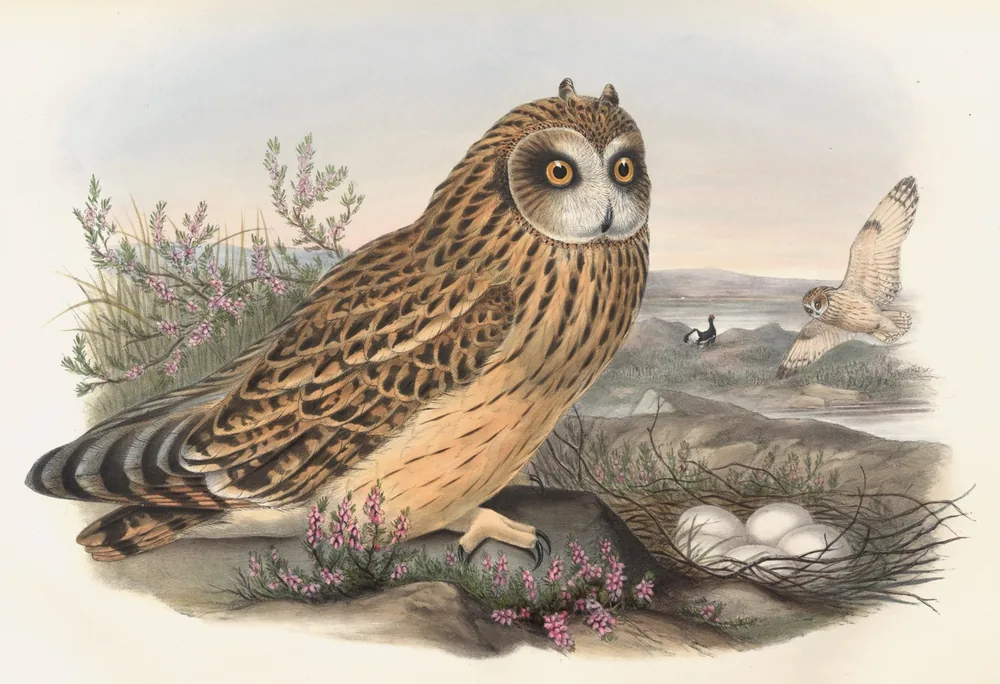
Some owls work days. The Northern Hawk Owl often hunts in daylight and is "rather hawk like in both appearance and behavior," says the Audubon guide; Burrowing Owls and Hawaii's Pueo hunt by day too, and the Short-eared Owl flies "like a giant moth" over fields by day and at dusk.
The day shift has its own guide to Texas's 39 birds of prey, and one level of our bird quiz mixes owls with hawks.
Which owls can you see in winter?
Most owls stay all year, and winter brings visitors from the north: Snowy Owls, and in some years Northern Hawk, Great Gray and Boreal Owls. It's also Great Horned Owl courting season.
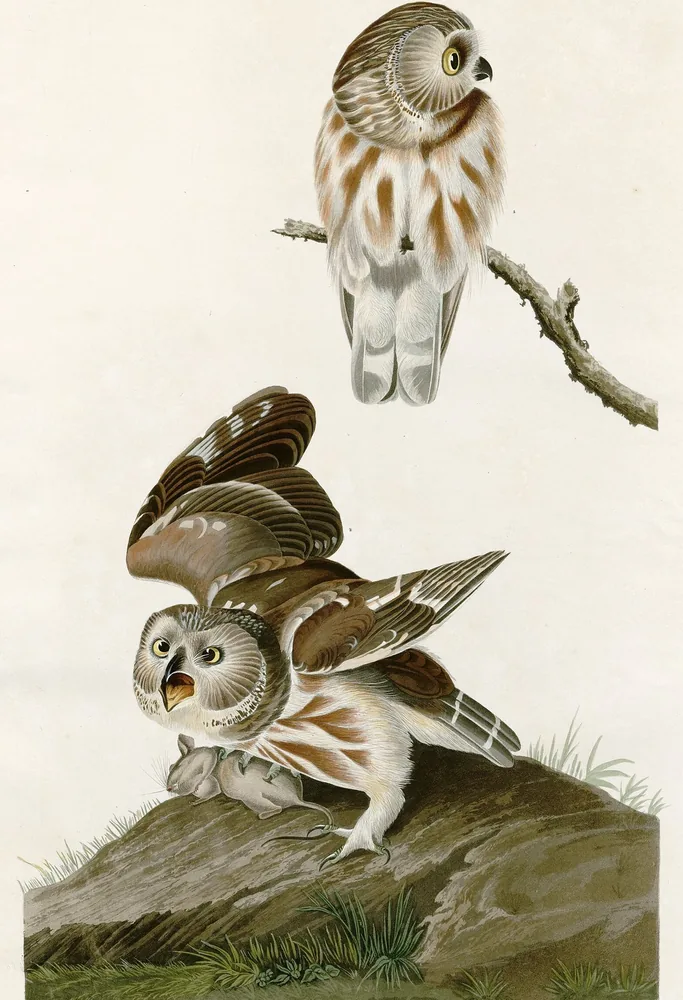
One small owl kept its travels secret. The Northern Saw-whet Owl "long duped scientists" into thinking it was non-migratory and rare in the US, says Audubon magazine; it simply migrates by night, unseen. Project Owlnet, started in 1994 by Dave Brinker of Maryland's Department of Natural Resources, now links "hundreds of owl-migration researchers" who catch and band saw-whets on the move.
- Snowy Owls come south in big numbers after good nesting years: what an irruption is, and the Snowy Owls of Boston's Logan Airport.
- Northern Hawk Owls that wander south "may remain for weeks, attracting birders from far and wide," says the Audubon guide.
- Great Gray Owls drift into the Northeast when voles crash, and winter invasions bring a few Boreal Owls south.
Owling, going out at night to listen for owls, is a winter pastime because many owls court and call most then, Mass Audubon says.
Owl facts that sound made up
- The owl scientist who found whale songs. For his PhD, Roger Payne showed that barn owls can find a mouse in total darkness, "based solely on hearing it move," he told Nautilus. Then he co-discovered the songs of humpback whales and produced the album Songs of the Humpback Whale.
- A pantry kept warm. In northern winters, a Great Horned Owl may store prey it hasn't eaten and later thaw the frozen carcass by "incubating" it, says the Audubon guide.
- An owl nobody knew nested south of Canada. "Until the 1970s the Boreal Owl was not known to breed anywhere south of Canada," says the same guide; it turned out to live high in western mountains.
- A rattlesnake impression. Young Burrowing Owls hiss like a rattlesnake, says The Peregrine Fund.
- Hawaii's owl is a newcomer. The Pueo probably reached the islands after the Polynesians did, says Hawaii's Department of Land and Natural Resources.
Audubon's owls
Before "The Owl and the Pussy-cat," Edward Lear painted real owls. He drew plates for John Gould's The Birds of Europe (1832–37), says the Linda Hall Library, and "worked with both" Gould and Audubon, says the Harvard Gazette; a Harvard exhibit in 2012 showed "Lear's fondness for owls, the animals that later appeared so frequently in his nonsense sketches." By 1837 his eyesight was failing, and he told Gould he had to stop, "lamenting that he would soon only be able to draw ostriches."
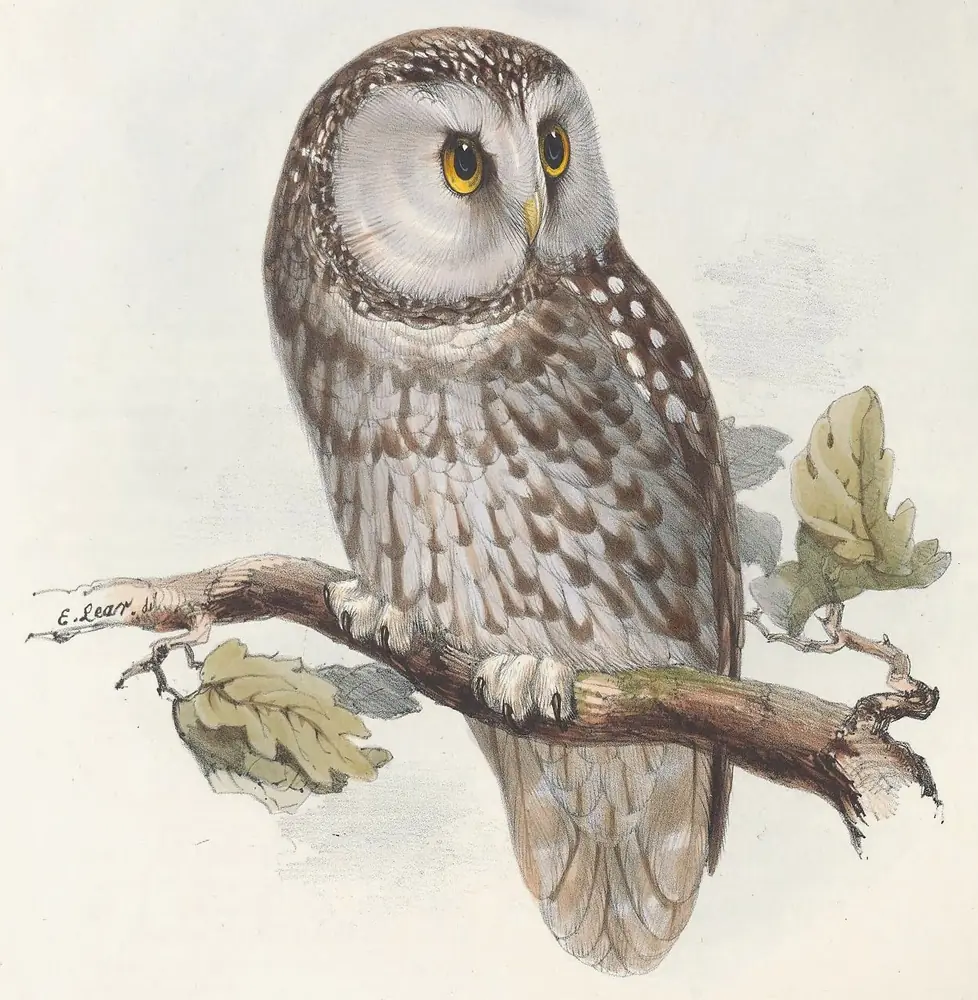
Our Boreal Owl is one of his: the plate is lettered "E. Lear del et lith.," shorthand for drawn and lithographed by Lear, and he signed the branch too.
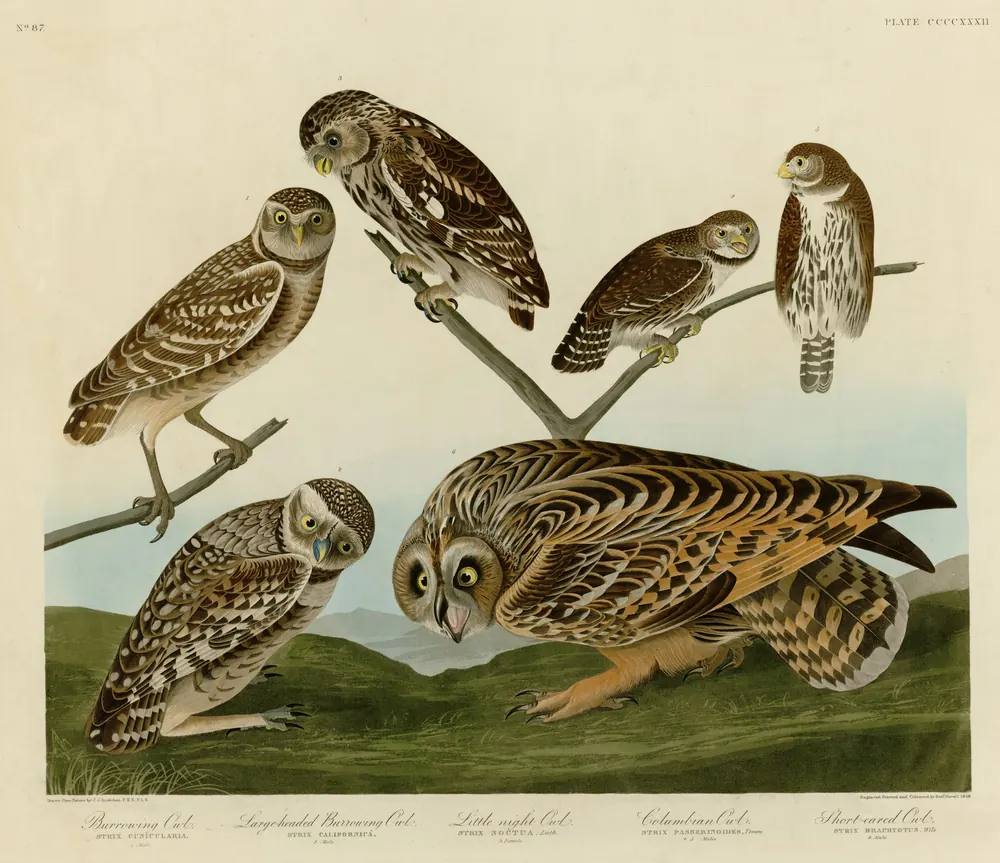
Audubon fitted six owls onto plate 432, the one at the top of this page, which Robert Havell engraved, printed and colored in 1838. The five names are Audubon's: Burrowing, Large-headed Burrowing, Little night, Columbian and Short-eared Owls. The first two are one species, and Audubon.org lists three species on the plate today. His other owl plates are on our page of Audubon's plates, and his life in our Audubon guide.
Lear's and Audubon's owls are the kind of painting a Birdfolio uses: it prints every bird on your life list beside a painting like these, or a credited photo where there's none. See what's inside one.
Owls where you live
Some of our state pages tell owl stories: North Dakota's counts its hawks and owls, Idaho's has Northern Hawk Owls nesting in a burned forest, and Tennessee's a Burrowing Owl that kept coming back to a power plant. Texas has a whole owl guide, with all 17 of its owls.
For your own state's bird list and official count, start with Arizona, California, Colorado, Florida, Georgia, Hawaii, Illinois, Indiana, Michigan, Missouri, North Carolina, Ohio, Oregon, Virginia, Washington or Wisconsin, or pick it from all the states.
Questions people ask
Do owls live in Hawaii?
Yes, two: the Pueo, Hawaii's own race of the Short-eared Owl, and the American Barn Owl, brought to the islands in the late 1950s. The Pueo is endangered on Oʻahu; why the barn owl counts as an invader is on our Barn Owl split page.
How long do owls live?
Some wild owls pass 20 years: the oldest banded Great Horned Owl lived at least 28 years and 10 months (Ohio, banded 1997). In the USGS Bird Banding Laboratory's records, the Barred Owl's best is 26 years and 7 months, the Snowy Owl's 23 years and 10 months and the Spotted Owl's 21 years and 1 month. The oldest wild birds page has a record for each owl.
Can I keep an owl feather?
No: possessing native owls "or any of their parts requires both state and federal permits," says North Carolina's wildlife agency, and a feather counts. The Texas rules, and the federal law behind them, are in our Texas owl guide.