Free owl quiz
Owl Quiz: Name the Owl from Its Classic Painting
This owl quiz shows you a classic painting of a North American owl, from the Great Horned Owl to the tiny Ferruginous Pygmy-Owl, and asks which owl it is. Pick one of four names, then read the painter's credit and one true story about the owl. Twelve owls, ten a round, free and with nothing to sign up for. Below the quiz are 13 owl trivia questions with their answers.
Updated . 12 owls in classic paintings and 13 owl trivia questions.
Play the owl quiz
Owls of North America: 10 paintings. Tap the name you think is right; the answer and the bird’s story open under it.
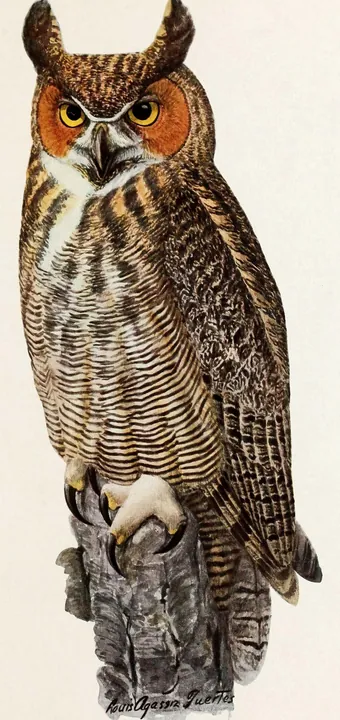
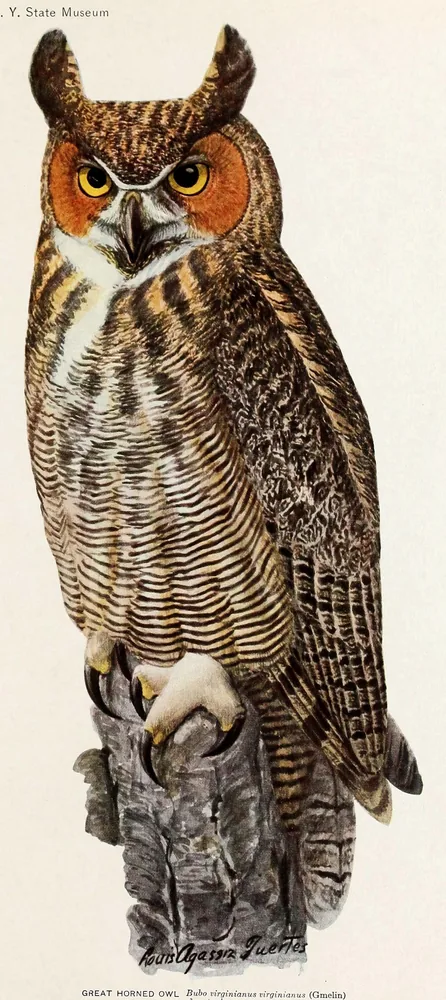
Question 1 of 10: Which owl is this?
Show the answer
Great Horned Owl
Painting: Louis Agassiz Fuertes, Elon H. Eaton's Birds of New York (1910–14)
Great Horned Owls have almost no sense of smell, which comes in handy when dinner is a skunk, Audubon magazine notes. (Audubon magazine, Georgia Good, 21 Jul 2026)
Great Horned Owl painting: Audubon's plate and other classic portraits
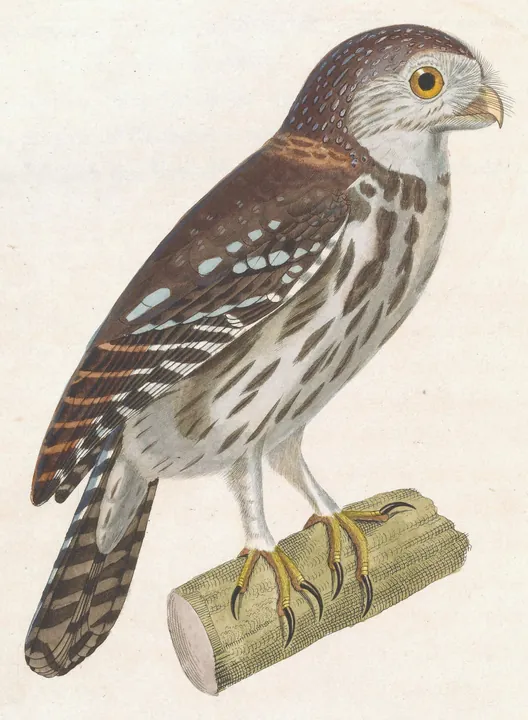
Question 2 of 10: Which owl is this?
Show the answer
Ferruginous Pygmy-Owl
Painting: Nicolas Huet and Jean-Gabriel Prêtre, Temminck and Laugier, Nouveau recueil de planches coloriées d'oiseaux (1820–39)
A 2.2-ounce owl stopped a high school. In 1998 lawsuits on behalf of the endangered pygmy-owl halted work on a new school near Tucson, and a two-year court fight followed, which the school district won, Education Week reported. (Education Week, April 2000)
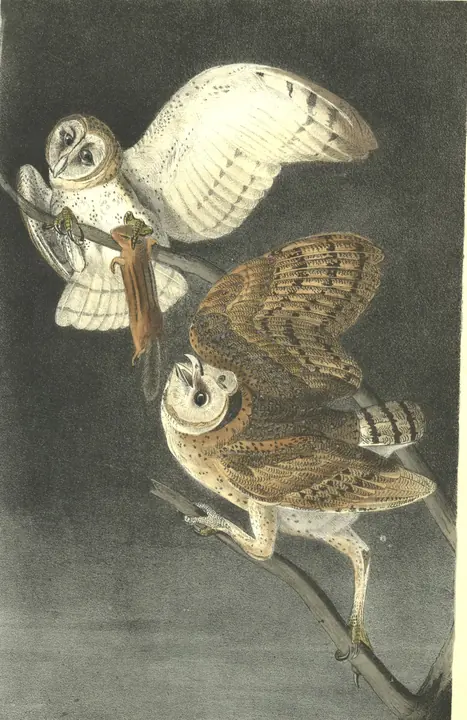
Question 3 of 10: Which owl is this?
Show the answer
American Barn Owl
Painting: John James Audubon, The Birds of America (1840–44)
In totally dark, soundproofed rooms, neurobiologists Marc Konishi and Eric Knudsen showed that Barn Owls can find and catch prey by sound alone, pinpointing a sound to within 1.5 degrees. (Ehrlich, Dobkin and Wheye, 1988; Stanford Birds)
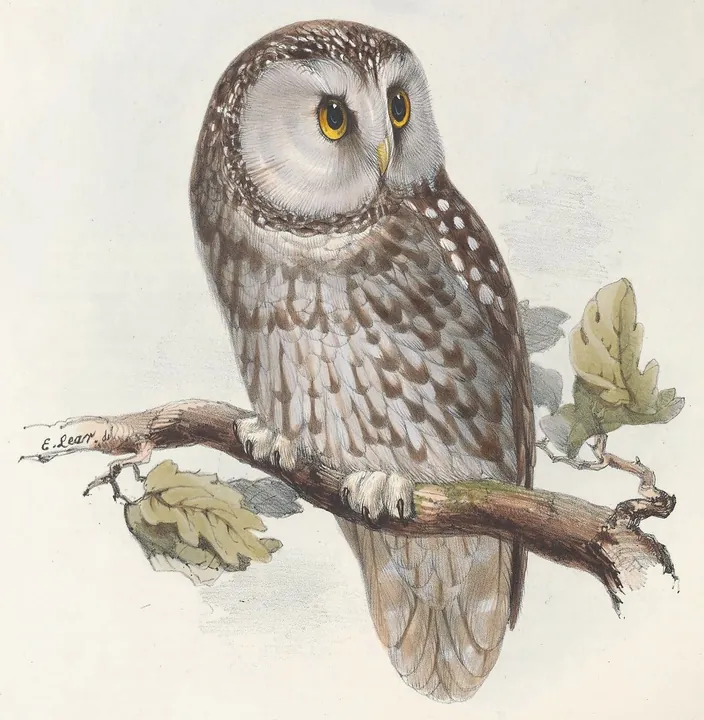
Question 4 of 10: Which owl is this?
Show the answer
Boreal Owl
Painting: Edward Lear, John Gould’s The Birds of Europe (1832–37)
In an Innu (Montagnais) legend, the Boreal Owl tried to drown out a waterfall's roar, so the Great Spirit shrank it and turned its voice into a feeble drip. Naturalist C. Hart Merriam wrote that its call sounds like dripping water. (The Funereal Boreal Owl (J. Stan Rowe, Blue Jay 42(4), December 1984, Nature Saskatchewan))
Question 5 of 10: Which owl is this?
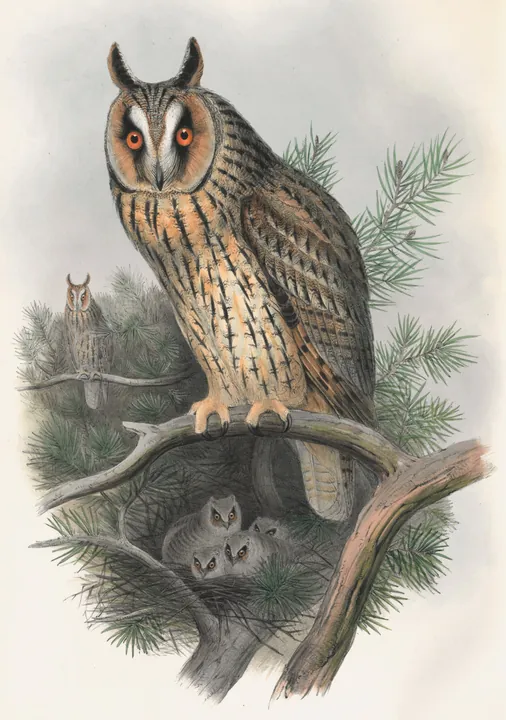
Show the answer
Long-eared Owl
Painting: John Gould, The Birds of Great Britain (1862–73)
In winter, Long-eared Owls may roost together in evergreen stands, up to 100 in one group, each owl pressed close to a tree trunk. (Friends of the Mississippi River)
Question 6 of 10: Which owl is this?
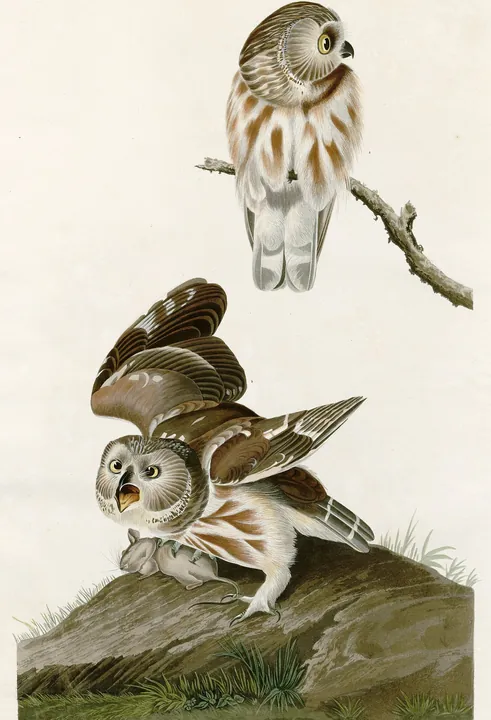
Show the answer
Northern Saw-whet Owl
Painting: John James Audubon, The Birds of America (1827–38)
In 2020 workers found a Northern Saw-whet Owl tucked into the Rockefeller Center Christmas tree, a spruce cut near Oneonta, New York, and trucked to Manhattan. The owl, named Rocky, became famous. (Audubon, Mikko Jimenez, 22 Dec 2020)
Question 7 of 10: Which owl is this?
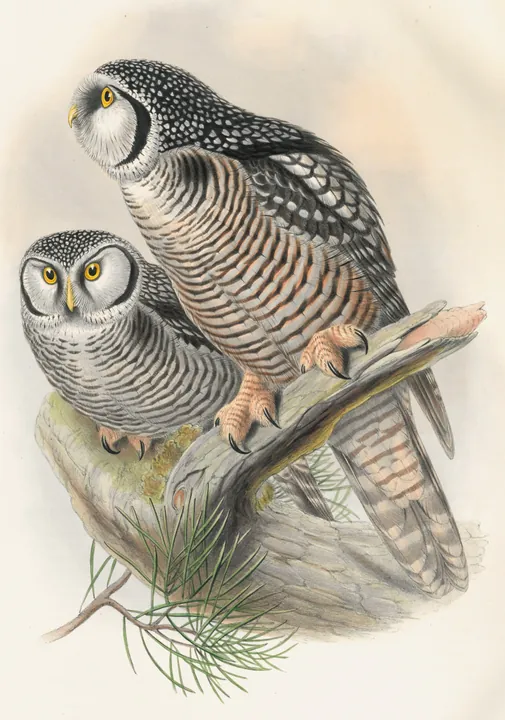
Show the answer
Northern Hawk Owl
Painting: John Gould, The Birds of Great Britain (1862–73)
The Northern Hawk Owl breaks the owl rules. It hunts in daylight, finding prey more by sight than by sound, and some of its calls sound more like a parakeet than an owl, the Alaska Department of Fish and Game says. (Alaska Department of Fish and Game)
Question 8 of 10: Which owl is this?
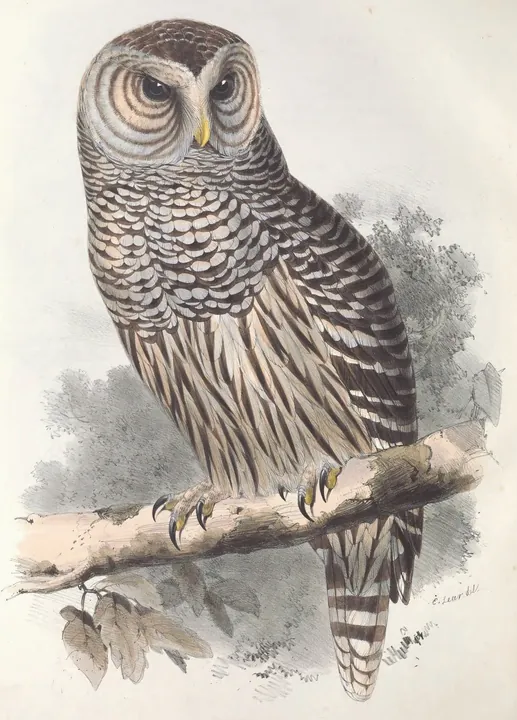
Show the answer
Barred Owl
Painting: Edward Lear, John Gould's The Birds of Europe (1832–37)
Historians believe Harriet Tubman used the Barred Owl's call as a signal on the Underground Railroad, telling freedom-seekers whether it was safe to come out of hiding. (Audubon magazine, Neel Dhanesha, 12 Feb 2021)
Barred Owl painting: Audubon's plate and other classic portraits
Question 9 of 10: Which owl is this?
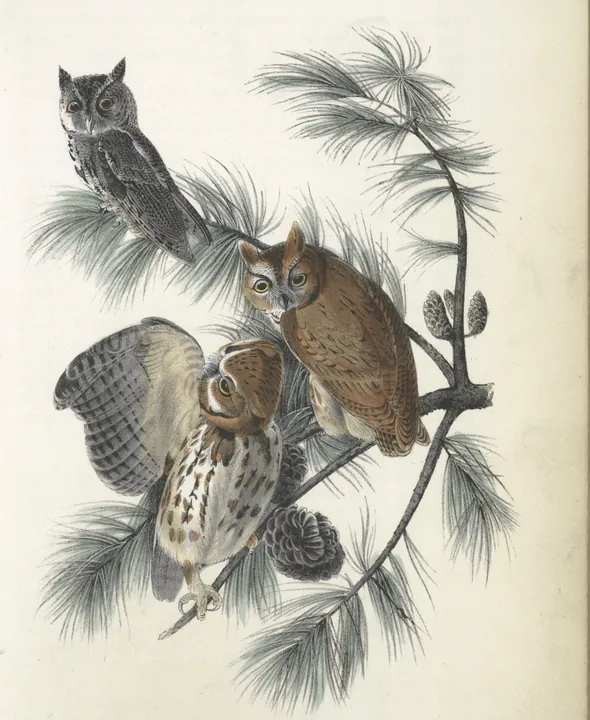
Show the answer
Eastern Screech-Owl
Painting: John James Audubon, The Birds of America (1840–44)
Screech-owls may bring live blind snakes home to the nest. The small, wormlike snakes burrow into the debris and eat insects there, which may help keep the chicks free of pests. (National Audubon Society)
Question 10 of 10: Which owl is this?
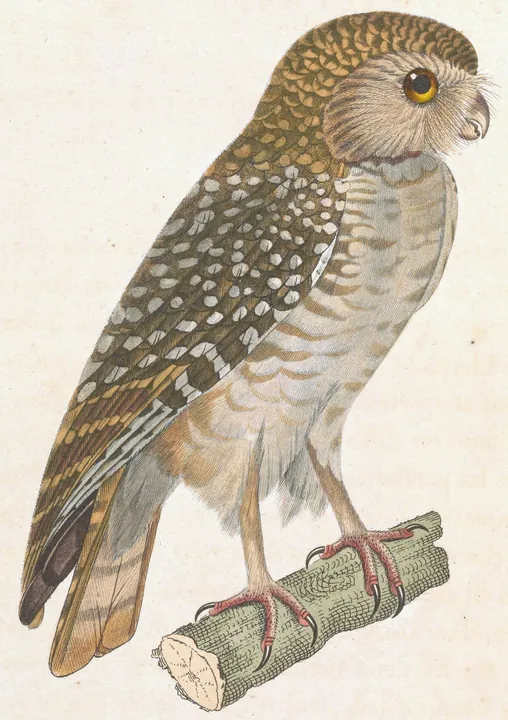
Show the answer
Burrowing Owl
Painting: Nicolas Huet and Jean-Gabriel Prêtre, Temminck and Laugier, Nouveau recueil de planches coloriées d'oiseaux (1820–39)
Burrowing Owls use bait. They collect mammal dung around their burrows to lure dung beetles, a favorite food, a 2004 study in Nature reported: a rare case of a bird using a tool. (Nature, 2004; abstract)
Everything happens in your browser: no account, no cookies, and your score goes nowhere unless you share it. Without JavaScript, open “Show the answer” under each painting.
The 12 owls in the quiz
Twelve owls, from the Barn Owl's heart-shaped face to the Boreal Owl's dripping-water song, each shown with three look-alike names to choose from. Every round draws 10 of them: American Barn Owl, Barred Owl, Boreal Owl, Burrowing Owl, Eastern Screech-Owl, Ferruginous Pygmy-Owl, Great Gray Owl, Great Horned Owl, Long-eared Owl, Northern Hawk Owl, Northern Saw-whet Owl and Snowy Owl.
How many kinds of owls live in North America?
Nineteen kinds of owls can be seen in the United States, Audubon counts, from the Elf Owl, the smallest owl in the world, to the Great Gray Owl, the largest in North America. A few of the nineteen, such as the Northern Hawk Owl, are only occasional visitors from the north. Twelve of them are in this quiz; the other seven sit it out, because our library has only photographs of six (the Western and Whiskered Screech-Owls, the Elf, Northern Pygmy-, Spotted and Flammulated Owls) and the Short-eared Owl's plate has a grouse in the background, which would make the question unfair. (Audubon magazine, Andrew Del-Colle)
How do you tell owls apart?
Start with size, the face and the top of the head. Ear tufts sort owls into groups: the Great Horned Owl has two big tufts, its “horns,” the Eastern Screech-Owl two small ones, and the Northern Saw-whet Owl's round head has none. The American Barn Owl's white, heart-shaped face is unlike any other North American owl's, and among the small owls only the Flammulated Owl has dark eyes, Audubon notes. (Audubon magazine, Andrew Del-Colle)
Owl trivia questions and answers
Thirteen owl trivia questions, five easy, five medium and three hard, each answered with the story behind it and the source we checked.
What is a group of owls called? (easy)
Answer: A parliament. Audubon traces the name to C.S. Lewis, who described a meeting of owls in The Chronicles of Narnia. (Audubon)
About how far can an owl turn its head in either direction? (easy)
Answer: Up to 270 degrees. Johns Hopkins researchers found the blood vessels under an owl's jaw swell as the head turns, pooling blood so the brain keeps its supply. (Johns Hopkins Medicine, via ScienceDaily)
Why do Snowy Owls keep landing at Boston's Logan Airport? (medium)
Answer: It looks like the Arctic tundra. Its 1,800 acres of short-mowed grass look like their Arctic home, says Norman Smith, who has trapped and moved more than 900 owls away from the runways. (NPR via WWNO, Apr. 30, 2025)
Which owl has been the U.S. Forest Service's mascot since 1971, famous for telling children to give a hoot and not pollute? (easy)
Answer: Woodsy Owl. The USDA Forest Service officially introduced Woodsy Owl on Sept. 15, 1971, as a mentor and inspiration for children. His motto, give a hoot, don't pollute, is what he is most famous for. (USDA Forest Service, Inside the FS, 15 Sep 2021)
Which small owl can give a hiss that sounds like a rattlesnake? (easy)
Answer: The Burrowing Owl. Its long, rattling hiss may have evolved to mimic a cornered rattlesnake and warn visitors away from its nest burrow. In one experiment, ground squirrels were nearly as alarmed by the hiss as by a real rattlesnake. (Audubon magazine, by BirdNote, written by Bob Sundstrom, 31 Aug 2015)
Can an owl roll its eyes? (easy)
Answer: No: its eyes can't move in their sockets. An owl's eyes aren't true eyeballs. They are tube-shaped and completely immobile, which gives sharp binocular vision and depth perception, Audubon says. (Audubon magazine, National Audubon Society, 15 Oct 2015)
How did the Northern Saw-whet Owl get its odd name? (medium)
Answer: Its call sounds like a saw being sharpened on a whetstone. Not all owls hoot, Audubon notes: Barn Owls hiss, the Eastern Screech-Owl whinnies like a horse, and the saw-whet sounds like an old whetstone sharpening a saw. Hence the name. (Audubon magazine, National Audubon Society, 15 Oct 2015)
Many owls have one ear opening higher on the head than the other. Why? (medium)
Answer: To pinpoint where a sound comes from. With ears at different heights, an owl can locate a sound up and down as well as left and right, Audubon says: ready, aim, strike. (Audubon magazine, National Audubon Society, 15 Oct 2015)
Ancient Athens' silver coins showed the goddess Athena on one side. What did people call the coins, after the bird on the other side? (medium)
Answer: “Owls”. Athenian “Owls” carried Athena's helmeted head on the front and an owl on the back. First struck at the end of the sixth century BC, they served as an international currency, says the Australian National University's Classics Museum. (Australian National University Classics Museum, entry by Hugh Preston)
In June 1990 one owl was listed as a threatened species and put on the cover of Time magazine, at the heart of a fight over logging. Which owl? (medium)
Answer: The Northern Spotted Owl. The U.S. Fish and Wildlife Service listed it as threatened in June 1990, and Time put it on its cover on June 25, 1990. The fight over old-growth timber ended up shaping the Northwest Forest Plan, the Oregon Encyclopedia says. (The Oregon Encyclopedia, Oregon Historical Society and Portland State University, Janice Reid, last updated 2 Jan 2023)
To quiet Japan's 500 Series bullet train, engineers copied the edges of which bird's feathers onto the part that touches the overhead wires? (hard)
Answer: An owl's. Engineer Eiji Nakatsu, a member of the Wild Bird Society of Japan, learned that owls are the most silent fliers. His team copied the tiny saw-tooth edges of owl wing feathers onto the pantograph, enough to meet the world's strictest noise standards. (Japan for Sustainability, JFS Newsletter No. 31, 31 Mar 2005)
The tiny Northern Saw-whet Owl can cross big stretches of water. How far from shore was one found near Montauk, New York? (hard)
Answer: About 70 miles. Northern Saw-whet Owls can travel long distances over large bodies of water, Audubon says; one showed up 70 miles from shore near Montauk, New York. (Audubon magazine, National Audubon Society, 15 Oct 2015)
An owl has two toes pointing forward and two back. What trick can it do with them that most such birds can't? (hard)
Answer: Swing one back toe forward. Owls are zygodactyl: two toes face forward and two back. Unlike most such birds, an owl can pivot one back toe forward to help it grip and walk, Audubon says. (Audubon magazine, National Audubon Society, 15 Oct 2015)
For 89 more, on every kind of bird, see our bird trivia questions and answers, ranked easy to hard and printable.
In a Birdfolio, the hardcover of your own life list, each owl you have seen sits beside a classic painting like the ones above. Look inside a Birdfolio.