Classic bird paintings
Snowy Owl painting: Audubon's plate and other classic portraits
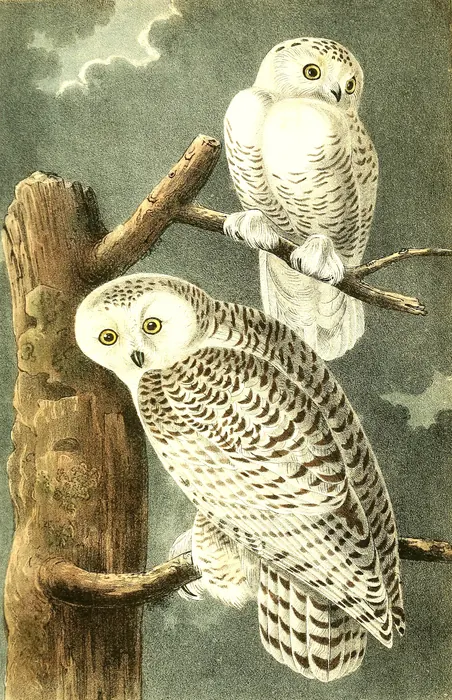
John James Audubon painted the Snowy Owl as plate 121 of The Birds of America (1827–38), a male and a female perched in a dead tree at night, under the same name. A free high-resolution scan is on Audubon.org. The pair shown here is from his smaller octavo edition (1840–44), plate 28.
Updated
About this painting
Shown here: plate 28 of the octavo edition, lettered Snowy Owl, drawn from nature by Audubon and lithographed, printed and colored by J. T. Bowen in Philadelphia. It repeats plate 121 at book size: the nearly white male on a branch above, the barred female below him by the dead trunk, and the edges of the clouds catching light in a dark night sky.
Audubon’s Snowy Owl: plate 121, “Snowy Owl”
Every winter for some twenty years, Audubon wrote, these hardy birds of the north came to the Falls of the Ohio at Louisville. One daybreak, hidden in a pile of driftwood while he waited to shoot wild geese, he watched them fish. Each owl lay flat on the rock along the edge of a hole, head down and turned toward the water, as if “sound asleep.” When a fish rose near the edge, out shot the foot nearest the water, quick as lightning. A big fish got the other foot too, and twice he saw an owl carry its catch across the channel into the woods.
The next morning, after watching the same feats, he killed both owls with one shot. In a winter at Boston, a gunner brought him a live male, hurt only in the wing. It stood upright with its feathers close, watching his every move; when he walked around it, the owl turned its head as far as it could, then opened its wings and hopped off to a corner of the room.
He called the bird merely a winter visitor, seldom seen before November and gone by early February, and far more common in Massachusetts and Maine than anywhere else in the Union. Where and how it nested, he admitted, he did not know: everyone he asked in Labrador knew the bird, but his party never saw one there.
Story: Audubon, Ornithological Biography, vol. 2 (1834), pp. 135–139. See plate 121 free at Audubon.org.
When did Audubon paint the Snowy Owl?
Probably in 1829, somewhere on the East Coast, a 1966 book of his original watercolors says. It is the only night scene he painted for The Birds of America.
He used pencil to imitate the owls' soft, downy feathers, the same book notes, and put the male at the top, the female below him. The plate's lettering says R. Havell of London engraved, printed and colored it, and names the birds: Snowy Owl, Strix nyctea, male 1 and female 2. Audubon's account of the bird came out in 1834, in the second volume of his Ornithological Biography.
Sources: Maryland State Law Library; Audubon.org, plate 121; Audubon, Ornithological Biography, vol. 2 (1834), p. 135.
More classic portraits, free to see
- John James Audubon, The Birds of America, octavo edition (1840–44), plate 28: “Snowy Owl” (the painting shown above). Free scan (New York Public Library Digital Collections)
- John Gould’s The Birds of Europe (1832–37), plate 43: “Snowy Owl” (Surnia nyctea). Free scan (University of Kansas Libraries)
- John Gould’s The Birds of Great Britain (1862–73), vol. 1, plate 34: “Snowy Owl” (Nyctea nivea). Free scan (University of Kansas Libraries)
- Louis Agassiz Fuertes, for Elon H. Eaton’s Birds of New York (1910–14), plate 54: “Snowy Owl”, with Great Gray Owl and Barred Owl. Free scan (Internet Archive)
About the Snowy Owl
- In the Arctic a Snowy Owl may live almost entirely on lemmings, and in years when lemmings are scarce it may not nest at all. (Source: National Audubon Society)
- Otherwise it takes a wide variety of prey: rabbits, hares and voles, and along coasts ducks, geese and grebes. (Source: National Audubon Society)
- Many were once shot when Snowy Owls came south in their winter invasions. (Source: National Audubon Society)
How can you tell a male Snowy Owl from a female?
By the dark bars. Adult males are almost completely white, while females are white with dark bars, says the US Fish and Wildlife Service.
Males lose their barring gradually as they age, and some end up almost entirely white; females always keep some dark markings, the Missouri Department of Conservation says. The National Audubon Society's guide gives the two ends of the range: young females heavily marked, old males almost pure white.
Audubon saw it differently. He believed the rich white came to both sexes with age, and he once shot an old female near Louisville whose plumage was almost pure white. On his plate, all the same, the whiter bird at the top is the male, and the barred one below is the female.
Sources: US Fish and Wildlife Service; Missouri Department of Conservation; National Audubon Society; Audubon, Ornithological Biography, vol. 2 (1834), pp. 136–138; Maryland State Law Library.
What is a Snowy Owl irruption?
A winter when Snowy Owls come south from the Arctic in far greater numbers than usual. Smaller irruptions happen every four or five years on average, Project SNOWstorm says, and once or twice in a lifetime comes a mega-irruption.
The winter of 2013–14 was one, the biggest in the Northeast and Great Lakes in perhaps a century, with owls as far south as Florida and Bermuda. The cause is usually plenty, not hunger: lemmings boomed in northern Quebec that summer, the owls raised big broods, and that autumn thousands of the young moved south. Owls in big irruption years tend to be fatter and heavier than in other years, the project's veterinarians found.
Winter 2025–26 brought a smaller one. From late October, Audubon magazine reported, Snowy Owls turned up across the Great Lakes and in states where few had been seen in years, among them Washington, New York, Ohio, Iowa and Kentucky, catching the experts off guard.
Sources: Project SNOWstorm; Audubon magazine, December 16, 2025.
Where can you see Snowy Owls in winter?
In wide open country: prairies, farmland, coastal marshes, beaches and large airports, says the National Audubon Society's guide.
In Missouri, the state's Department of Conservation says, they are most likely in the northern counties, usually from mid-November through February. At Boston's Logan Airport, Norman Smith began studying Snowy Owls in 1981 and has since banded and relocated more than 800 of them.
Keep your distance, Project SNOWstorm asks: watch from your car if you can, back off if the owl fidgets or keeps staring at you, and never feed one. Its tracking shows the owls are mostly active at night, so one flying from spot to spot by day has usually been disturbed.
Sources: National Audubon Society; Missouri Department of Conservation; Project SNOWstorm, Norman Smith; Project SNOWstorm, Snowy Owl Etiquette.
How big is a Snowy Owl?
About 2 feet long, with wings 4½ to 5 feet across: the Missouri Department of Conservation gives 20 to 27 inches from bill to tail.
Its dense feathers make it one of the heaviest owls in North America, the US Fish and Wildlife Service says. Females are the bigger birds: Audubon put a male at 4 pounds and a female at 4¾, and gave the female as 26 inches long with wings 65 inches across, the male as 21 and 53.
The heaviest of the 120 owls Project SNOWstorm has fitted with transmitters is a female caught near midnight outside Rudyard, Michigan, in March 2026. She weighed 2,699 grams, just under 6 pounds.
Sources: Missouri Department of Conservation; US Fish and Wildlife Service; Audubon, Ornithological Biography, vol. 2 (1834), pp. 136–139; Project SNOWstorm, March 30, 2026.
Is Hedwig a Snowy Owl?
Yes. Harry Potter's owl Hedwig is a Snowy Owl, a female in the story, but the owls that played her in the films were all males.
Seven of them took turns, among them Gizmo, Kasper and Bandit, Laura Erickson, who made a study of the owls in the films, told the science writer Jennifer Ackerman. A female is larger and heavier, with powerful talons, so harder for a young actor to hold, Erickson explained, and an older male's white looks more striking against black wizard robes. Daniel Radcliffe, who played Harry, wore a leather arm guard beneath his cloak.
Could a real one carry Harry's broom? To answer a reader, Erickson weighed a corn broom at a hardware store: a little over a pound, half the weight of a Snowshoe Hare, prey Snowy Owls bring to their chicks. On screen, though, the owl flew through with nothing, and the filmmakers put the broom in digitally.
Source: Jennifer Ackerman, What an Owl Knows (2023), via Literary Hub.
How long does a Snowy Owl live?
Snowy Owls have no typical lifespan in the wildlife-agency guides we read. The oldest known wild Snowy Owl was at least 23 years and 10 months old (USGS Bird Banding Laboratory): it was banded in Massachusetts in 1992 and found there again in 2015.
Source: USGS Bird Banding Laboratory. A banding record is the minimum age of one bird when it was found again, not a typical lifespan. How long do wild birds live?
How can you tell if a plate 121 print is an original?
By its size: an original plate 121 is a hand-colored sheet about 26 by 38 inches; the Snowy Owl’s octavo version, plate 28, is book-size, from 1840–44. Many prints sold today are reproductions: how to tell an original from a reproduction. Modern editions print all 435 plates, from pocket size to coffee-table size: which Birds of America book to buy.
In a Birdfolio hardcover, this painting sits beside the date and place you first saw a Snowy Owl. See your own list as a book, free.