Classic bird paintings
Bald Eagle painting: Audubon's plate and other classic portraits
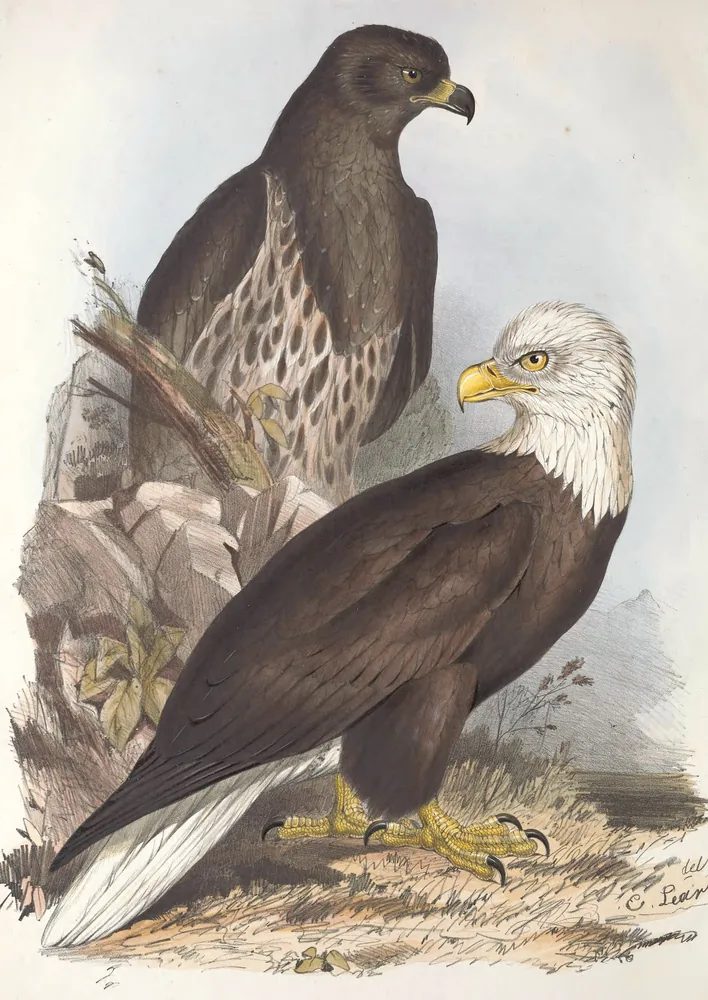
John James Audubon painted the Bald Eagle as plate 31 of The Birds of America (1827–38), under the name White-headed Eagle; his young bird is plate 126. A free high-resolution scan is on Audubon.org. The pair shown here is from John Gould's The Birds of Europe (1832–37), drawn by Edward Lear.
Updated
The story of this painting
The small print under this plate reads “E. Lear del et lithog.”: Edward Lear drew it and put it on the lithographic stone himself, and C. Hullmandel printed it. It is plate 11 of John Gould's The Birds of Europe, completed in 1837. Most of the book's plates, Gould wrote in his preface, were drawn and lithographed by Mrs. Gould from his sketches. “The remainder of the drawings have been made by Mr. Lear,” whose talent, he added, needed no comment from him.
The plate shows an adult male and a brown young bird at a third of life size. Young Bald Eagles, Gould explained, look so much like young White-tailed Eagles, Europe's Sea Eagle, that the two had long been confused. The white head and tail are not complete until the third year, he wrote, and in captivity the change can take three to five.
Gould counted it a bird of both continents, though much more common in America, “where it is adopted as the national standard of the United States.” It prefers fish, he wrote, but seldom catches them itself; it watches the Osprey and makes it give up its catch. He praised Audubon's account of an eagle's attack on a swan, and Audubon was among those he thanked in the preface for their interest in the work.
Story: Gould, The Birds of Europe, vol. 1 (1837), plate 11; vol. 1 (1837), text to plate 11; vol. 1 (1837), pp. vii–viii.
Audubon’s Bald Eagle: plate 31, “White-headed Eagle”
Floating down the Mississippi as winter brings the ducks south, Audubon wrote, you may see a pair of these eagles perched on opposite banks. Ducks pass unheeded; then the trumpeting of a swan is heard. The male launches with a scream, keeps the swan from diving by striking at it from below, and drives it down onto the nearest shore, where his mate joins him to feed.
He admired its power but not its character. He grieved that it had been chosen as the emblem of his country, and quoted Benjamin Franklin, who called it “a bird of bad moral character” for robbing the Osprey of its fish. A man in Charleston, he added, once put a game-cock into a captive eagle's cage, and the cock beat the eagle soundly.
Plate 31 shows an adult male, and plate 126 the brown young bird. In captivity, he noted, it took at least four years for the head and tail to turn fully white, and he knew of two birds whose white heads did not appear until their sixth spring. He also found young brown birds already breeding, paired with white-headed mates.
Story: Audubon, Ornithological Biography, vol. 1 (1831), pp. 160–168; vol. 2 (1834), pp. 160–164. See plate 31 free at Audubon.org. See plate 126 free at Audubon.org.
Why is Audubon's Bald Eagle eating a catfish?
Because he changed its meal. On a flatboat trip down the Mississippi in 1820, Audubon spent four days drawing this eagle feeding on a Canada goose. Eight years later in England, unhappy with the result, he made a new watercolor of it with a catfish copied from another early drawing, a 1966 book of his watercolors says.
The plate's lettering names both: “White-headed Eagle,” Audubon's name for the bird, and “Yellow Cat-fish.” His account of the bird opens with its fame around the world, “emblazoned as it is on our national standard.”
Sources: Maryland State Law Library; Audubon.org, plate 31; Audubon, Ornithological Biography, vol. 1 (1831), p. 160.
What was Audubon's Bird of Washington?
A giant eagle that Audubon published as a new species on plate 11 of The Birds of America, naming it for George Washington. No such bird has been found since.
He first saw one in February 1814 from a trading boat on the Upper Mississippi, he wrote. Years later, near Henderson, Kentucky, he shot one that rose from a yard where hogs had been slaughtered a few days before. He put the male at 14½ pounds and 3 feet 7 inches long, with wings 10 feet 2 inches across, and called it “indisputably the noblest bird of its genus” in the United States.
Plate 11 was the first that Robert Havell Jr. engraved, a 2020 study by Matthew Halley notes.
Sources: Audubon, Ornithological Biography, vol. 1 (1831), pp. 58–62; Halley, 2020.
Was the Bird of Washington a real bird?
Almost certainly not. No specimen matching Audubon's description and plate has ever been found, and most later ornithologists took it for a young Bald Eagle that he misidentified and drew wrong.
Audubon did point to one: in 1831 he wrote that a stuffed male placed in the Philadelphia Academy by his friend Richard Harlan matched his drawing. The naturalist George Ord compared that bird with two Bald Eagle specimens, found no difference, and called Audubon's painting “calculated to mislead,” Distillations magazine reports.
Halley concluded that the picture was “the product of both plagiarism and invention.” Yet in 1834 he told of a big brown captive eagle in Philadelphia that some called “the pretended Bird of Washington.” He had offered to bet $1,000 that it was a young Bald Eagle, and at eight its head and tail turned white.
Sources: Halley, 2020; Halley, BOU blog; Audubon, Ornithological Biography, vol. 1 (1831), p. 62; Distillations, Science History Institute; Audubon, Ornithological Biography, vol. 2 (1834), p. 163.
More classic portraits, free to see
- John James Audubon, The Birds of America, octavo edition (1840–44), plate 14: “White-headed Sea Eagle, or Bald Eagle”. Free scan (New York Public Library Digital Collections)
- Edward Lear, for John Gould’s The Birds of Europe (1832–37), plate 11: “White-headed Eagle” (the painting shown above). Free scan (University of Kansas Libraries)
- Louis Agassiz Fuertes, for Elon H. Eaton’s Birds of New York (1910–14), plate 49: “Bald Eagle”, with the Golden Eagle. Free scan (Internet Archive)
About the Bald Eagle
- Bald Eagles catch live prey, eat carrion, and sometimes steal food from other birds of prey. (Source: National Audubon Society)
- The Bald Eagle has been a national emblem of the United States since 1782. (Source: National Audubon Society)
What is the national bird of the United States?
The Bald Eagle. The section of the US Code that a 2024 law created is one sentence: “The bald eagle (Haliaeetus leucocephalus) is the national bird.”
Among the reasons Congress listed, the bird is “unique to North America” and the leading insignia of every branch of the military, and bald eagles are a historical symbol of “independence, strength, and freedom.”
Source: Public Law 118-206.
When did the Bald Eagle become the national bird?
On December 23, 2024, when a law making it the national bird was approved. It had been on the Great Seal of the United States since June 20, 1782.
The bill, S. 4610, passed the Senate on July 29, 2024, and the House on December 16.
Charles Thomson, the secretary of Congress, chose it for the seal. Wanting the new nation's symbol to be strictly American, he replaced the crested eagle of an earlier design with the native bald eagle, the State Department's booklet on the seal explains.
In his explanation to Congress, the eagle's olive branch and arrows stand for “the power of peace & war,” and it carries the shield on its breast with nothing else holding it up, to show that the United States “ought to rely on their own Virtue.”
Sources: Public Law 118-206; U.S. Department of State.
What was almost America's national bird?
The Wild Turkey, says a popular story that isn't true: Benjamin Franklin never proposed it, the Franklin Institute says. His famous comparison of the two birds came in a private letter of January 1784, when the eagle was already on the Great Seal: what he really wrote.
Sources: The Franklin Institute; Library of Congress.
How did the Bald Eagle come back from DDT?
Through the 1972 ban on DDT and decades of legal protection. The pesticide kept eagles from making strong eggshells, and by 1963 only 417 nesting pairs were known in the lower 48 states, the US Fish and Wildlife Service says.
The Service announced the eagle's recovery on June 28, 2007, and took it off the endangered species list. In 2021 it estimated 316,700 Bald Eagles in the lower 48, with more than 71,400 nesting pairs. Pennsylvania, down to three nests in 1983, brought in eagle chicks from Canada and now has more than 300 nests, its Game Commission says.
Sources: US Fish and Wildlife Service; US Fish and Wildlife Service, A Very American Bird; US Fish and Wildlife Service, March 24, 2021; Pennsylvania Game Commission.
What is the difference between a Bald Eagle and a Golden Eagle?
Look at the legs: a Golden Eagle's are feathered all the way down to its yellow feet, while a Bald Eagle's lower legs are bare, Pennsylvania's Game Commission says.
An adult Golden Eagle, the bird on Mexico's flag, is brown all over, with golden feathers on the back of its head and neck. Young Bald Eagles cause most mix-ups, since they stay mostly brown until about five, but they show white in the wing pits, which Golden Eagles don't. Soaring, a Bald Eagle holds its broad wings flat, a Golden Eagle slightly raised.
Their lives differ too. Fish is a Bald Eagle's staple food; Golden Eagles prefer rabbits, hares, ground squirrels and prairie dogs, mostly in the West. And Bald Eagles far outnumber them: about 316,700 in the lower 48, against roughly 30,000 Golden Eagles in the whole country, by the US Fish and Wildlife Service's estimates.
Sources: Pennsylvania Game Commission; US Fish and Wildlife Service, Golden Eagle; US Fish and Wildlife Service, Bald Eagle; US Fish and Wildlife Service, March 24, 2021.
Can a Bald Eagle pick up a 20-pound dog?
No. An eagle can lift about three or four pounds, more if it swoops down, says the Alaska Department of Fish and Game, and a Bald Eagle itself weighs only 8 to 14 pounds. The department calls accounts of eagles carrying off dogs and cats “unsubstantiated and highly unlikely.”
Source: Alaska Department of Fish and Game.
Why is it illegal to pick up an eagle feather?
Because federal law bans possessing any part of a Bald or Golden Eagle, feathers included, without a permit. The Bald and Golden Eagle Protection Act of 1940 covers the birds “including their parts (including feathers), nests, or eggs,” the US Fish and Wildlife Service says, and a first offense can bring a $100,000 fine, a year in prison, or both.
The Migratory Bird Treaty Act of 1918 protects eagles too. Such rules help keep bird populations healthy and sustainable, the Justice Department says.
The law allows permits for “the religious purposes of American Indian tribes,” and the Service's National Eagle Repository gives the feathers and parts of eagles found dead to enrolled members of federally recognized tribes for spiritual and religious use.
Sources: US Fish and Wildlife Service, Bald and Golden Eagle Protection Act; US Fish and Wildlife Service, Migratory Bird Treaty Act; U.S. Department of Justice, 2012; US Fish and Wildlife Service, National Eagle Repository.
How big is a Bald Eagle nest?
The biggest of any North American bird. An average one is 1.5 to 2 meters across, about 5 to 6½ feet, and about a meter tall, Hinterland Who's Who says; because a pair reuses it and adds to it every year, an old one can grow several meters deep and weigh hundreds of kilograms.
Audubon found the same in the 1830s: sticks three to five feet long, turf, weeds and Spanish moss, five to six feet across and sometimes as deep. To be sure a female sat for days before laying, he climbed to one nest daily while she was away, “a rather perilous undertaking when the bird is sitting.”
The young leave it at 8 to 14 weeks, the National Audubon Society's guide says, and nearly half of those first attempts fail, leaving them on the ground, often still fed by their parents, until they can fly.
Sources: Hinterland Who's Who on the Bald Eagle; Audubon, Ornithological Biography, vol. 1 (1831), p. 166; National Audubon Society guide, Bald Eagle.
How long does a Bald Eagle live?
In the wild, Bald Eagles typically live 15 to 30 years, says the Missouri Department of Conservation; captive ages, the record bird's story and why so many die young are in our Bald Eagle lifespan guide. The oldest known wild Bald Eagle was at least 38 years old (USGS Bird Banding Laboratory): it was banded in New York in 1977 and found there again in 2015.
Sources: Missouri Department of Conservation; USGS Bird Banding Laboratory. A banding record is the minimum age of one bird when it was found again, not a typical lifespan. How long do wild birds live?
How can you tell if a plate 31 print is an original?
By its size: an original plate 31 is a hand-colored sheet about 26 by 38 inches; the Bald Eagle’s octavo version, plate 14, is book-size, from 1840–44. Many prints sold today are reproductions: how to tell an original from a reproduction. For all 435 plates at a fraction of an original’s price, see which edition of The Birds of America to buy.
In a Birdfolio hardcover, this painting sits beside the date and place you first saw a Bald Eagle. See your own list as a book, free.