Texas's official bird list has 17 owls, and the two you're most likely to hear are the Great Horned Owl, found in every part of the state, and the little Eastern Screech-Owl of East and Central Texas towns and woods. Twelve are regulars; five are rare strays.
Owls of Texas at a glance
The Texas Bird Records Committee reviews every sighting of five owls: the Snowy, Northern Pygmy-, Mottled, Stygian and Northern Saw-whet Owls. Of the 12 regulars, ten nest in Texas and are in the table; their ranges and seasons come from the Texas Breeding Bird Atlas, kept by Texas A&M AgriLife Research. The Long-eared and Short-eared Owls don't nest here, so the atlas has no account of them. We tried Texas Parks and Wildlife's owl pages on October 22, 2026; they wouldn't open from where we are. The other 661 species on the state list are counted on our Texas bird list page.
| Owl | Where in Texas | When | How common |
|---|---|---|---|
| Great Horned Owl | Every part of the state | All year; nests from late December | Common |
| Eastern Screech-Owl | East Texas west to the Edwards Plateau and Rolling Plains | All year | Densest in leafy suburbs |
| Western Screech-Owl | Trans-Pecos and the western Edwards Plateau | All year | Outnumbers the Eastern west of the Pecos |
| Barn Owl | Most of Texas, except the eastern forests and high mountains | All year; can nest in any month | Rare to locally common |
| Barred Owl | Pineywoods, Post Oak Savannah, Blackland and Coastal Prairies | All year | Uncommon to common |
| Burrowing Owl | Nests in the Trans-Pecos, Rolling Plains and High Plains | All year; more in winter | Loose colonies in all but the northeast |
| Elf Owl | Big Bend lowlands and deep South Texas | March to early October | Uncommon to locally common |
| Ferruginous Pygmy-Owl | Brooks and Kenedy counties; maybe the lower Rio Grande Valley | All year | Status uncertain |
| Flammulated Owl | Guadalupe, Davis and Chisos mountains | Late March to October | Common high in the Davis Mountains |
| Spotted Owl | Wooded canyons of the Guadalupe and Davis mountains | All year | Rare and local |
What is the most common owl in Texas?
The Great Horned Owl, which the Texas Breeding Bird Atlas calls common throughout the state, from forests and deserts to suburbs with a few trees. It's large, 18 to 24 inches long, and its low hoots carry far on winter nights, says National Audubon's guide. It's one of the earliest nesters of any bird: Texas egg dates start in late December, often in an old Red-tailed Hawk nest. More about it is on our Great Horned Owl painting page.
In town, the owl next door may be an Eastern Screech-Owl. In McLennan County, nesting pairs averaged one per square kilometer in the country and seven in suburban Waco from 1967 to 1991, the atlas says.
Which owls live in my part of Texas?
| Where you live | Owls to listen for |
|---|---|
| East Texas | Barred Owl (Who cooks for you?), Eastern Screech-Owl, Great Horned Owl |
| Dallas-Fort Worth, Austin, San Antonio | Eastern Screech-Owl, Great Horned Owl, Barn Owl; Western Screech-Owl on the western Edwards Plateau |
| Houston and the coast | Eastern Screech-Owl, Great Horned Owl, Barn Owl, Barred Owl |
| South Texas and the Rio Grande Valley | Ferruginous Pygmy-Owl, Elf Owl in summer, a small southern Eastern Screech-Owl, Great Horned and Barn Owls |
| Panhandle and the plains | Burrowing Owl (most nests on the High Plains), Great Horned Owl, Barn Owl |
| Trans-Pecos and Big Bend | Western Screech-Owl, Elf, Flammulated and Spotted Owls; very rarely a Northern Saw-whet Owl in the Guadalupes |
The rows come from each owl's atlas account. The Burrowing Owl breaks the night rule: it's active by day as well as by night, and nests underground, closely tied to prairie dogs and other burrowing mammals.
Which owl did I hear? A night-sound check
| What you heard or saw | Most likely | Where |
|---|---|---|
| Deep, low hoots that carry, on a winter night | Great Horned Owl | Anywhere in Texas |
| Who cooks for you? Who cooks for you-all? | Barred Owl | East Texas woods and bottomlands |
| A soft whinny, a trill or a falling wail | Eastern or Western Screech-Owl | Towns and woods; Western in the far west |
| A harsh scream or a hiss, no hoot | Barn Owl | Fields, barns and towns, except the eastern forests |
| Puppy-like yelps and churrs, dusk to dawn in spring | Elf Owl | Big Bend and deep South Texas |
| A small owl in daylight, jerking its long tail | Ferruginous Pygmy-Owl | South Texas brush and live oak woods |
| A long-legged owl standing by a burrow in daylight | Burrowing Owl | West Texas, the Panhandle, the plains |
| A voice calling chuck-will's-widow | Chuck-will's-widow, a nightjar | East Texas, spring and summer |
| A toad-like trill from a bird on the ground | Lesser Nighthawk | South Texas and along the Rio Grande |
The voices are from National Audubon's guide and the atlas accounts. The Lesser Nighthawk, once called the Texas Nighthawk, trills in bursts that can run for three minutes or more.
What is the small owl in Texas?
The Elf Owl, the smallest owl in the world: about 5 inches long and 1.2 to 2 ounces, here from March into early October in the Big Bend and deep South Texas. You'll hear it before you see it: puppy-like yelps and churrs from dusk to dawn in early spring. It nests in old woodpecker holes, the atlas says.
Texas has three more small owls worth knowing:
- Ferruginous Pygmy-Owl: hunts by day, with a long tail it cocks or jerks side to side and eye-like spots on the back of its head. People take it for a songbird.
- Eastern Screech-Owl: about 10 inches, the size of a robin, gray or reddish, with ear tufts it can raise or flatten. Despite the name it doesn't screech: it whinnies, trills and gives a descending wail.
- Flammulated Owl: the smallest of its group in North America, with a voice far too low for its size, in the high pines of the Trans-Pecos.
The pygmy-owl lost most of its Texas home. Before 1920 it was a common resident of the mesquite, ebony and riverside woods of the lower Rio Grande Valley. Since 1994, researchers in Kenedy County have followed 39 of its nests and banded 145 owls, in old live oak and mesquite woods on ranch land. In 1997 the U.S. Fish and Wildlife Service listed it as endangered in Arizona and held off on Texas until more research was done, the atlas account says.
What is the white owl in Texas?
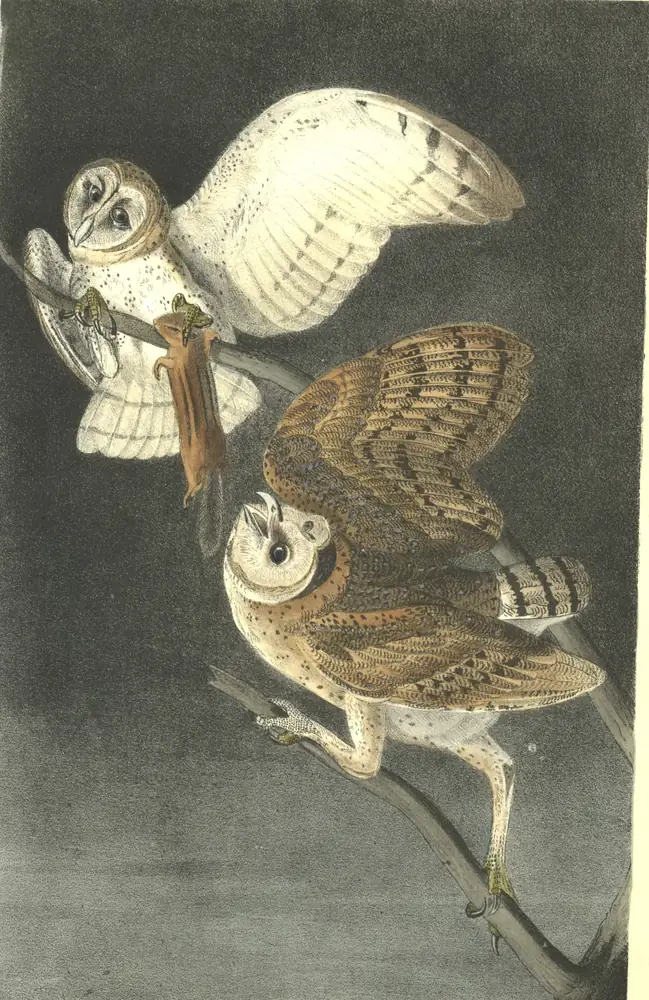
Almost always a Barn Owl, pale below with a heart-shaped face, seen at night over fields and towns; a Snowy Owl in Texas is a great rarity. Barn Owls have whitish underparts and buffy light-brown backs and stand about 16 inches tall, says Indiana's wildlife agency. They don't hoot. They scream and hiss, and the Texas atlas calls the cry weird, drawn-out and startling.
They're more common than people realize, even in cities, because they hunt strictly at night. In Texas they have nested in church steeples, chimneys, barn lofts, haystacks and football stadiums, and they can raise two or even three broods a year. In South Texas, pairs raised about 2.5 young per nest when prey was plentiful and 1.0 when it was scarce. A Snowy Owl in Texas is a review species; see how rare a Snowy Owl is.
What are the night birds in Texas?
Owls are only part of the night: Texas also has nightjars that call their own names, nighthawks and a state bird that sings into the night. The Northern Mockingbird "regularly sings at night," National Audubon's guide says, often all night in nesting season. If one is keeping you up, see the Texas state bird.
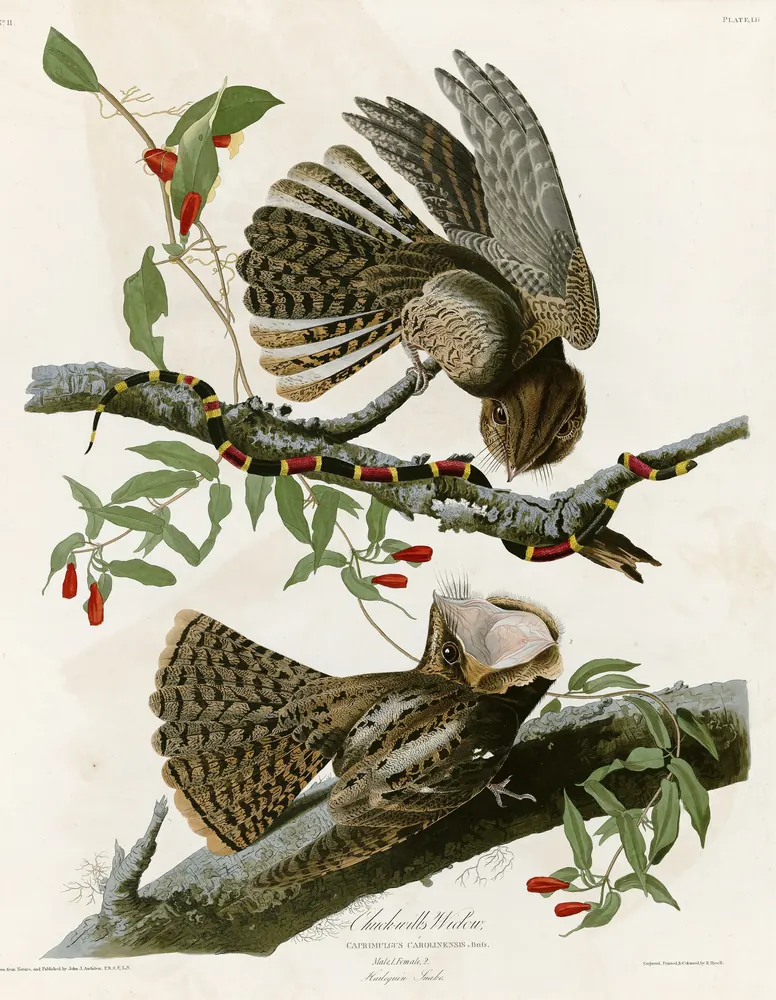
- Chuck-will's-widow: the largest nightjar in North America, common in the eastern third of Texas and along the southern Edwards Plateau. It calls chuck-will's-widow, and many people take it for a Whip-poor-will.
- Whip-poor-will: mostly a migrant here; it nests in pine-oak canyons above 5,500 feet in the Trans-Pecos, and rarely in the east.
- Common Poorwill: the smallest North American nightjar, in rocky brush across the western two-thirds. It can go torpid, and birds' lowest natural body temperatures were measured in poorwills.
- Common Pauraque: a common resident at the southern tip of Texas, catching beetles on quiet roads at night.
- Common Nighthawk: across the state, often nesting on flat gravel roofs; it's declining, perhaps partly because roofs are turning smooth.
Two herons are named for the night as well. Black-crowned Night-Herons are common residents along the coast and Yellow-crowned Night-Herons summer in the eastern third of the state.
What does it mean when an owl hangs around your yard?
In practical terms, that it's finding food or a place to nest: Great Horned Owls and screech-owls both live in Texas towns, and screech-owls nest in boxes, porch columns, even mailboxes. A yard with big trees, cavities and open ground suits them.
In folklore, it meant a death. The bluntest version is in a North Carolina collection that Duke University Press brought out in 1964: "For an owl to cry in your yard is the sign of a death." Other entries make it an owl hooting three times, or near a sick person. To stop it, people turned their pockets inside out, put a shovel in the fire or threw salt on the flames. The editor lists matching beliefs recorded in Texas, among them a screech owl near the house foretelling a death in the family.
South Texas has its own owl story. La Lechuza is "a massive owl usually described with the face of an old woman," says a University of Texas Rio Grande Valley library guide: a witch who sold her soul to the devil and hunts disobedient or unbaptized children. Salt or the Seven Blessed Prayer will turn her back into a woman, some versions say. Audubon magazine notes that in South Texas and Mexico Barn Owls are called lechuza. All of this is folklore; none of it is a fact about owls.
Is it good to have owls in your yard?
For rodent control, usually yes: a pair of Barn Owls may need as many as 1,000 mice and voles in one nesting season, says Indiana's Department of Natural Resources. Even the Great Horned Owl, which can take a skunk, lives mostly on mice and other small rodents, the atlas says. Screech-owls add large insects to the menu.
Screech-owls accept a proper nest box as readily as a tree hole, and like a small entrance and a deep cavity. One caution for pet owners: if a bird takes a small pet, The Nature Conservancy's Matthew L. Miller says the most likely culprit is a Great Horned Owl; our birds of prey guide explains what a raptor can lift.
What is an owl's worst enemy?
In Texas, often a bigger owl: the Great Horned Owl eats Barred Owls of every age, from nestlings to adults, the Texas Breeding Bird Atlas says. National Audubon's guide adds hawks and smaller owls to its prey, and the atlas says it can dominate the other raptors around it. In Texas it was even blamed for slowing the return of the Aplomado Falcon.
The other enemy is lost habitat. By the early 1970s, more than 90% of the brush and riverside woods of the lower Rio Grande Valley, home to the Ferruginous Pygmy-Owl, had been cleared. In East Texas, reservoirs flooded the bottomland forests Barred Owls depend on.
Can you keep an owl feather in Texas?
No: Texas law bars possessing any part of the plumage of a bird that isn't a game bird, and federal law bars possessing any part of a migratory bird without a permit. That covers a feather found on the ground. The fines are set out in the penalty for killing a hawk in Texas; the same laws protect owls.
Audubon's screech-owls
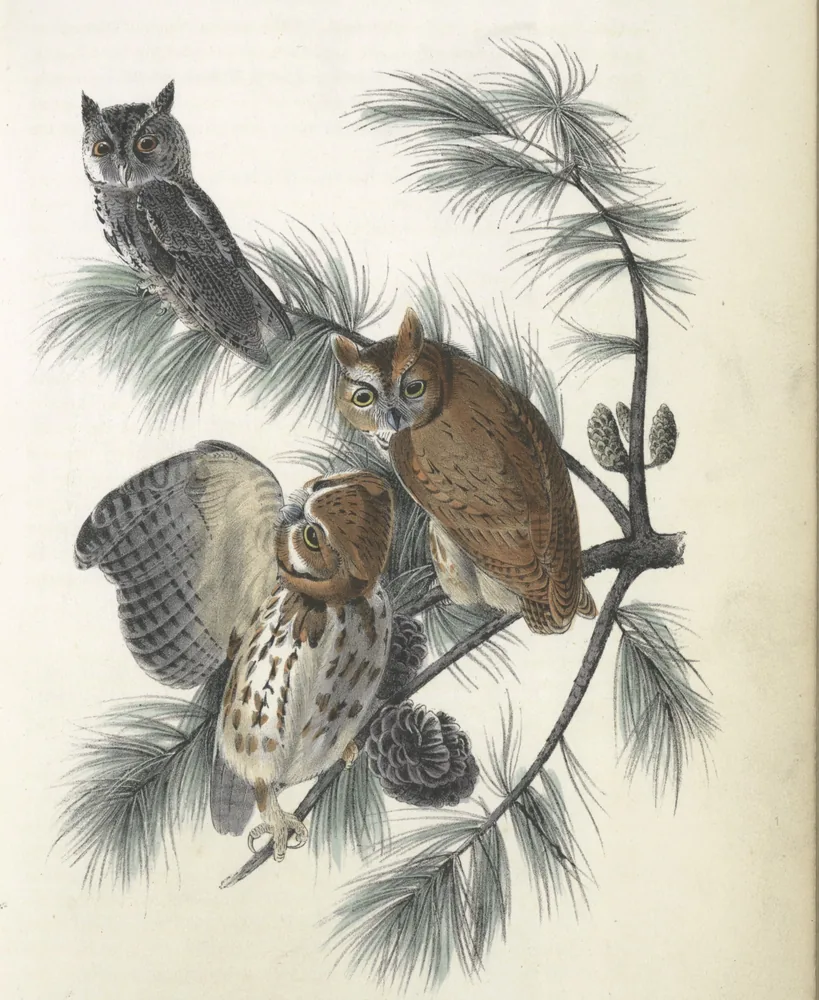
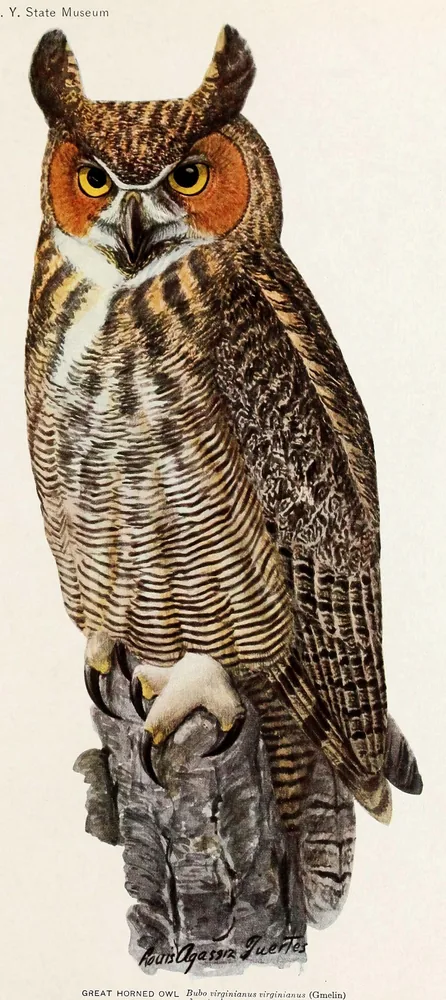
The plate at the top, from John James Audubon's octavo edition, shows one gray screech-owl and two red ones; the Great Horned Owl is by Louis Agassiz Fuertes. Texas has three races of the Eastern Screech-Owl, a small one south of the Nueces River among them. Where Eastern and Western Screech-Owls meet, in the Big Bend and on the Edwards Plateau, each sings the other's song, and pairs of the two have nested together.
Their calendar is moving too. In central Texas, screech-owls lay eggs from early March to early May, and nesting has come 2 to 4 days earlier per decade since the 1960s, as the climate warmed, the atlas says.
An owl you only heard one night still counts on a life list, and a Birdfolio prints each bird on yours with an old painting of it: see inside a printed life list.
Questions people ask
Which Texas owl hoots "who cooks for you"?
The Barred Owl, the hoot owl of East Texas forests. It's also the most vocal owl in North America, with shrieks, screams and trills besides the hoots.
Are there Snowy Owls in Texas?
Very rarely. The Snowy Owl is a review species on the official Texas list, so every sighting needs proof.