2024 split
American Barn Owl: why our Barn Owl has a new name
The American Barn Owl is the Barn Owl of the Americas under a new name: the American Ornithological Society (AOS) split the Barn Owl into three species, one for each part of the world, on July 18, 2024, and eBird followed in October 2024. For birders in the US and Canada it's a new name, not a new bird: your total goes up only if you have also seen a barn owl in Europe, Africa, Asia or Australia.
Updated
What changed
The Barn Owl of North and South America, including the US and Canada.
Europe, Africa and the Middle East.
Southern Asia and Australasia.
What is the difference between a barn owl and an American Barn Owl?
Mostly where it lives, its size and one call. The American Barn Owl is the barn owl of North and South America. The Western Barn Owl lives in Europe, Africa and the Middle East, and the Eastern Barn Owl from India to Australia, according to AviList.
North American birds are bigger. They are around 50 percent heavier than European ones, says the Barn Owl Trust in Britain: males average 474 grams (just over a pound), against 312 grams (11 ounces). Their wings are only 12 percent longer, but their legs are 25 percent longer.
Only the American Barn Owl gives the "kleak-kleak" display call in flight. And some North American barn owls migrate south to escape cold winters, while European ones settle into a home range for life after their first autumn, the Barn Owl Trust notes.
Surprising facts about the American Barn Owl
Audubon saw the split coming, 190 years early. Comparing American and European Barn Owls in 1834, John James Audubon noted that the American bird was much larger, especially in its legs and toes. He wrote that he suspected "they will ultimately be found to be different species," though he could not point to a clear difference.
It can catch prey in total darkness. Barn owls have the greatest ability of any animal tested to find prey by ear, says Audubon magazine. The heart-shaped face funnels sound like a satellite dish, and the ears sit at different heights, which helps the owl pinpoint a sound.
Engineers study its silent flight. Soft, fringed wing feathers and very large wings let a barn owl fly as slowly as 2 miles per hour, almost without a sound. That has made it a model for engineers working on quieter wind turbines and computer fans.
It swallows its prey whole. One estimate says a barn owl can eat 1,000 mice a year, bones and all. It coughs up the bones and fur as pellets, says HawkWatch International.
It may be behind ghost stories. It roosts in old and abandoned buildings, and some have suggested the American Barn Owl explains sightings of the Mothman. In South Texas and Mexico it is called lechuza, after shape-shifting witches of legend, says Audubon magazine.
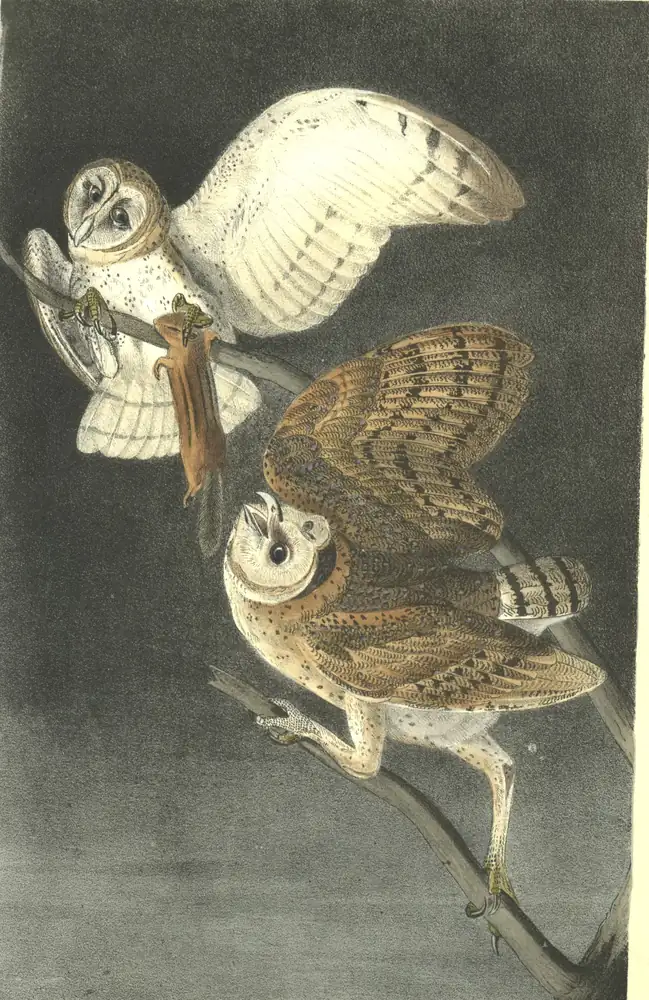
Audubon watched one on his drawing table for six hours. A captive Barn Owl, he wrote, would stand for hours in the same position, often on one leg. He painted the species as plate 171 of The Birds of America; the version at the top of this page is from the smaller edition of 1840–44.
In Hawaii it is an invader. Barn owls were brought to the islands in the late 1950s, and the US Fish and Wildlife Service calls barn owls and cattle egrets “two invasive migratory bird species in Hawaii,” with a control order for both since 2017. More on that in the Cattle Egret split.
Why it changed
Voices tipped the balance. The successful proposal, by Louis Bevier, Carla Cicero, Jon Dunn, Rosa Alicia Jiménez and Oscar Johnson, pointed to a distinctive flight call that American Barn Owls use to attract a mate: a "kleak-kleak" display call that the barn owls of the Old World don't give, the AOS says.
The genes agreed. A 2018 proposal to split the Barn Owl had failed, but its genetic data already showed three separate lineages. Terry Chesser, who chairs the AOS committee, said the new proposal passed because of its emphasis on the calls: together with the genetics, they show that the American Barn Owl is truly reproductively isolated from the others, not just geographically apart.
Who decided, and when
- American Ornithological Society (AOS): the 65th Supplement to its Check-list of North American birds
- eBird and the Clements Checklist: its 2024 taxonomy update
- AviList, the shared world checklist: agrees, with the same names
Are barn owls rare to see?
They are not rare in much of the US, but they are hard to see. They hunt at night, seldom by day, says Audubon's field guide, and spend the day hidden in hollow trees, barns, steeples and old buildings. North Carolina's wildlife agency says they are usually spotted while driving through open country at night.
In some states they are scarce: the Cascades Raptor Center says the barn owl is listed as endangered in many Midwestern and eastern states, and Audubon's field guide says numbers have dropped drastically in the Midwest and Northeast.
Look for clues. A pile of pellets under a cavity is an ideal way to find one, says HawkWatch International, and in the north, during long cold, snowy spells, barn owls may hunt in daylight.
Do barn owls hoot or screech?
They screech. Barn owls don't hoot; they hiss, grunt and scream, says Audubon magazine, and a longer, more forceful scream signals distress or a warning. Their Irish name means "graveyard screecher."
The usual call is a long, harsh scream that lasts about two seconds, says North Carolina's wildlife agency. Adults also snap their bills, and the young give rapid clicks, says Audubon's field guide. A courting female answers the male's display flight with a snore-like call, and hungry chicks snore too.
How long do barn owls live?
Not long, on average: about 4 years, says North Carolina's wildlife agency, though some have lived to 15. In Britain, where most young barn owls die in their first year, the Barn Owl Trust puts average life expectancy at only 18 months, yet the oldest British barn owl reached 18 years and the European record is 30 years.
They also start early: barn owls can breed in their first year, says the Montana Field Guide, and lay 3 to 8 eggs, sometimes 2 to 12 or even more, says Audubon's field guide. More in how long birds live.
Why are barn owls declining?
Mostly because the open farmland and old buildings they need are disappearing. North Carolina's wildlife agency blames most of the recent decline on habitat loss, as farms and open land turn into towns, and on the loss of hollow trees and old buildings to nest in.
Roads kill many. Barn owls fly low and are often hit by cars and trucks at night, says the Cascades Raptor Center. Along a 248-kilometer (about 154-mile) stretch of Interstate 84 in southern Idaho, researchers found 812 dead barn owls in two years, and warned that the local owls may not last at that rate without many newcomers or other help.
Rat poison is another killer: it kills huge numbers of owls, hawks and other birds of prey, says Audubon magazine. In California, the Hungry Owl Project gives vineyards barn owl nest boxes in exchange for a promise to stop using rodent poisons. In Britain, the Barn Owl Trust thinks starvation is the main cause of death, especially for young birds and in hard winters.
Nest boxes help in some areas, says Audubon's field guide. For American birds, the Barn Owl Trust advises boxes about 30 percent deeper and roomier than its European designs, with the same 5-by-5-inch entrance hole.
Which one did you see?
Go by where you saw it: in the Americas, it's American Barn Owl.
The American species also has a call the others lack: a "kleak-kleak" display call it gives in flight to attract a mate.
In the US a barn owl is easy to know: pale overall, with a white heart-shaped face and dark eyes, 13 to 16 inches long, says Audubon's field guide. From below it can look so white that it is sometimes mistaken for a Snowy Owl, says HawkWatch International.
What it does to your list
For birders in the US and Canada it's a new name only: your Barn Owl is now American Barn Owl.
If you have also seen a Barn Owl in Europe, Africa, Asia or Australia, the split adds one (or two) to your total. Birders call a species gained from a split, without a new sighting, an "armchair lifer."
Other familiar birds changed the same year: see the House Wren split and the Herring Gull split. And read more about how bird splits and lumps work.
If you keep your list on paper, the weeks after an eBird update are a good time to print your list again, with American Barn Owl in place of Barn Owl.
Check your own list. Drop your eBird download or type your birds: the free checker shows which of them this and other recent changes touched.
Check my list