Reference
How many bird species are in Oklahoma?
Oklahoma has 488 bird species on its official list (Oklahoma Bird Records Committee, May 2022), the 18th highest count of the 49 states with a verified count. Of these, 421 are backed by a specimen, 52 by photos and 13 by written descriptions alone; 2 are of uncertain origin.
Oklahoma’s state bird is the Scissor-tailed Flycatcher: our Oklahoma state bird page tells how it was chosen.
Updated
What are the most common birds in Oklahoma?
In summer, the 25 most common birds in Oklahoma are led by the Cliff Swallow, at about 602 birds per survey route, then the Dickcissel and the Mourning Dove, by the USGS Breeding Bird Survey’s counts for 2021–2025. Together these 25 made up 70% of all the birds counted on Oklahoma’s 42 survey routes.
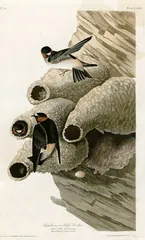
John James Audubon, The Birds of America (1827–38) 1 Cliff Swallowabout 602 per routeon 90% of routesno clear trend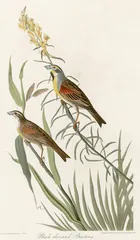
John James Audubon, The Birds of America (1827–38) 2 Dickcisselabout 111 per routeon 100% of routesno clear trend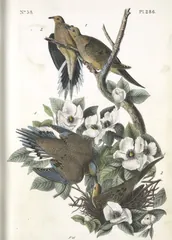
John James Audubon, The Birds of America (1840–44) about 53 per routeon 100% of routesno clear trend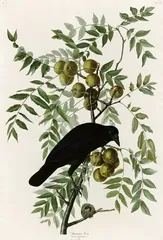
John James Audubon, The Birds of America (1827–38) about 42 per routeon 90% of routesno clear trend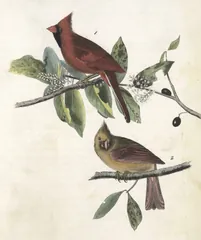
John James Audubon, The Birds of America (1840–44) about 41 per routeon 90% of routesno clear trend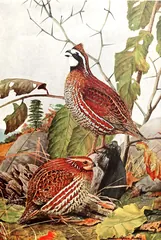
Louis Agassiz Fuertes, Elon H. Eaton’s Birds of New York (1910–14) 6 Northern Bobwhiteabout 35 per routeon 93% of routesno clear trend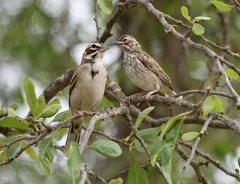
Photo: Cody Stricker, CC BY 4.0 7 Lark Sparrowabout 31 per routeon 93% of routesfalling since 2015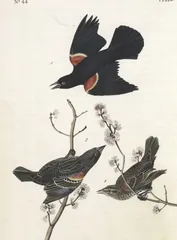
John James Audubon, The Birds of America (1840–44) about 31 per routeon 100% of routesno clear trend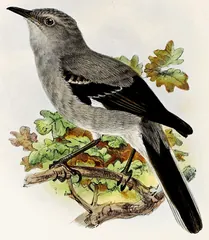
John Gerrard Keulemans, Onze Vogels in Huis en Tuin (1869–76) about 31 per routeon 100% of routesfalling since 2015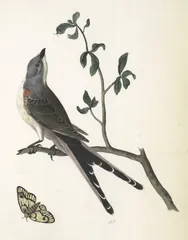
John James Audubon, The Birds of America (1840–44) about 25 per routeon 98% of routesno clear trend
Show all 25
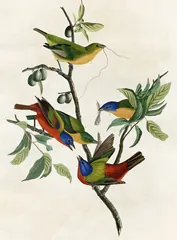
John James Audubon, The Birds of America (1827–38) 11 Painted Buntingabout 24 per routeon 86% of routesno clear trend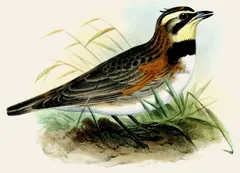
Joseph Wolf, Proceedings of the Zoological Society of London (1855) 12 Horned Larkabout 24 per routeon 52% of routesfalling since 2015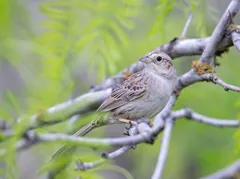
Photo: Karen Szafrajda, CC BY 4.0 13 Cassin's Sparrowabout 22 per routeon 38% of routesno clear trend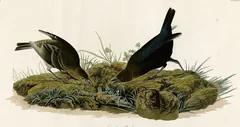
John James Audubon, The Birds of America (1827–38) 14 Brown-headed Cowbirdabout 21 per routeon 100% of routesno clear trend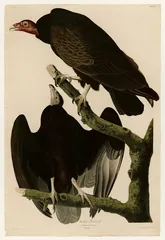
John James Audubon, The Birds of America (1827–38) about 20 per routeon 100% of routesno clear trend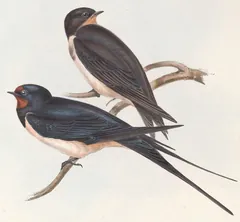
John and Elizabeth Gould, The Birds of Europe (1832–37) 16 Barn Swallowabout 19 per routeon 98% of routesfalling since 2015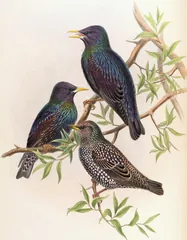
John Gould and Henry Constantine Richter, The Birds of Asia, vol. 5 (1850–83) 17 European Starlingabout 19 per routeon 93% of routesno clear trendintroduced species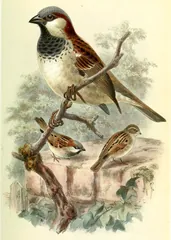
John Gerrard Keulemans, Lord Lilford’s Coloured Figures of the Birds of the British Islands (1885–97) 18 House Sparrowabout 17 per routeon 90% of routesno clear trendintroduced species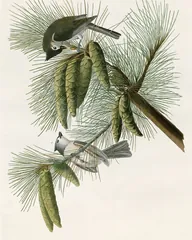
John James Audubon, The Birds of America (1827–38) about 13 per routeon 83% of routesno clear trend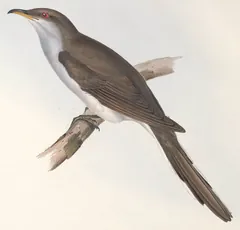
John and Elizabeth Gould, The Birds of Europe (1832–37) 20 Yellow-billed Cuckooabout 12 per routeon 93% of routesno clear trend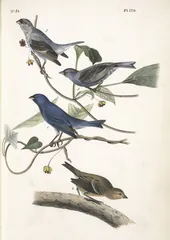
John James Audubon, The Birds of America (1840–44) 21 Indigo Buntingabout 11 per routeon 83% of routesrising since 2015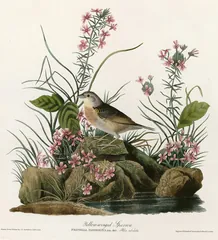
John James Audubon, The Birds of America (1827–38) 22 Grasshopper Sparrowabout 10 per routeon 71% of routesno clear trend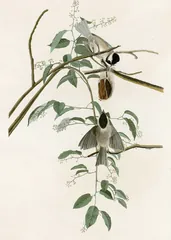
John James Audubon, The Birds of America (1827–38) 23 Carolina Chickadeeabout 8.6 per routeon 88% of routesno clear trend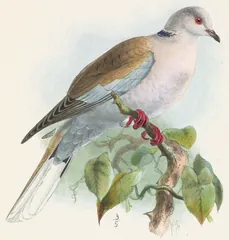
John Gerrard Keulemans, R. B. Sharpe’s Scientific Results of the Second Yarkand Mission (1891) 24 Eurasian Collared-Doveabout 8.6 per routeon 93% of routesno clear trendintroduced species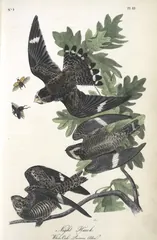
John James Audubon, The Birds of America (1840–44) 25 Common Nighthawkabout 8.1 per routeon 74% of routesno clear trend
Once you know the Cliff Swallow, the Mourning Dove and the rest of these 25, a field guide takes you further into Oklahoma’s list of 488 species; our comparison of the best bird books of 2026 shows which one to start with.
What is the most common bird in Oklahoma?
The Cliff Swallow leads Oklahoma’s summer survey: about 602 a route on average in 2021–2025, more than twice the Dickcissel’s 111, seen on 90% of the 42 routes. USGS finds no clear rise or fall in its Oklahoma numbers since 2015.
The Department of Wildlife Conservation offers a list of birds to look for in each part of the state, from Burrowing Owls and Lark Buntings on the shortgrass prairie in the far west to Painted Buntings and Harris's Sparrows in the Cross Timbers, and Sandhill Cranes and American Avocets on the state's wetlands.
Sources: Official Oklahoma Bird Checklist, with the sixth edition of May 2022 and the fifth of October 2017 (Oklahoma Bird Records Committee); Oklahoma's Bird Life (Oklahoma Department of Wildlife Conservation, Outdoor Oklahoma Journal), read October 8, 2026.
How was this list made?
Each of Oklahoma’s 42 routes is a roadside count, 50 stops along about 25 miles, run once a year in early summer by a volunteer. We took USGS’s yearly estimate for each species in Oklahoma, the number of birds a typical route records, averaged it over the five latest survey years (there was no survey in 2020) and ranked the birds by it. To keep the list to birds you’re likely to meet across Oklahoma, we left out species recorded on fewer than one in five of its routes, and those USGS can only estimate very roughly, which usually means big flocks or colonies on a few routes.
For Oklahoma that left out the Canada Goose and the Ring-necked Pheasant. The survey counts Eastern, Western and Chihuahuan Meadowlarks together in Oklahoma, so none is listed on its own, though as a group they would rank 3rd, at about 84 a route.
The share of routes is our own count from USGS’s route data for Oklahoma, using only counts that met the survey’s standards; “rising” and “falling” are USGS’s trends for the state since 2015, named only where it finds a clear change. Roadside counts on early-summer mornings miss most of Oklahoma’s owls and waterbirds, and its winter visitors aren’t here at all.
Oklahoma’s counts come from two USGS data releases, the North American Breeding Bird Survey Analysis Results 1966–2025 (Hostetler et al., 2026) and its Dataset 1966–2025 (Ziolkowski et al., 2026), gathered by volunteer observers and free for anyone to use; Birdfolio isn’t connected with the USGS.
How many bird species are in Oklahoma?
| Official count | 488 species |
|---|---|
| List’s date | May 2022 |
| Kept by | Oklahoma Bird Records Committee (Oklahoma Ornithological Society) |
| Specimens | 421 species |
| Photos | 52 species |
| Written descriptions only | 13 species |
| Uncertain origin | 2 (Mute Swan, Monk Parakeet) |
| Earlier editions | 480 in October 2017; 473 in December 2011 |
| Among US states | 18th highest of the 49 states with a verified count |
| Official list | Checklist of Oklahoma Birds, Sixth Edition (May 2022) |
What does Oklahoma’s count include?
- 421 species backed by a specimen, 52 by photos and 13 by written descriptions alone.
- 2 species of uncertain origin: the Mute Swan and the Monk Parakeet.
- 2 extinct species and 2 possibly extinct ones, already among the 488: the Passenger Pigeon and Carolina Parakeet, and the Eskimo Curlew and Ivory-billed Woodpecker.
- The sixth edition of the Checklist of Oklahoma Birds (May 2022).
- Among the 13 known only from written descriptions: the Gunnison Sage-Grouse, Northern Gannet, Canada Jay and Golden-cheeked Warbler.
- Names and order from the American Ornithological Society's checklist and its supplements through 2021.
Why do other sources give a different number?
Oklahoma's committee prints a new edition every few years, so each total holds until the next one:
- 480. The fifth edition, October 2017. The sixth added eight species on the strength of photos, from Rivoli's and Costa's Hummingbirds to the Limpkin and Hooded Oriole. Source: Official Oklahoma Bird Checklist, with the sixth edition of May 2022 and the fifth of October 2017 (Oklahoma Bird Records Committee).
- 473. The fourth edition, December 2011, which had just added the Sooty Tern, Long-tailed Jaeger and Hepatic Tanager. Source: The Oklahoma Ornithological Society Checklist of Oklahoma Birds, fourth edition, December 2011 (PDF).
- 488 and counting. The society's newsletters report first state records found since the sixth edition, such as the Elegant Tern described below. The official total stays at 488 until a new edition comes out. Source: Oklahoma Ornithological Society newsletter, Summer 2025, with the spring 2024 seasonal report.
Oklahoma’s list follows its own committee’s rules, and so does every other state’s: see why the counts differ from state to state.
Oklahoma records, from a skua in the Plains to hawks nesting in the Wichitas
- The fifth edition, in 2017, added five species from photos taken in Oklahoma: the Masked Duck, Common Crane, South Polar Skua, Brown Booby and Golden-crowned Sparrow. It also took one off, Thayer's Gull, once the American Ornithological Society made it a form of the Iceland Gull. Source: Official Oklahoma Bird Checklist, with the sixth edition of May 2022 and the fifth of October 2017 (Oklahoma Bird Records Committee), read October 8, 2026.
- Zone-tailed Hawks, first found in Oklahoma in the spring of 2021, have stayed in the Wichita Mountains Wildlife Refuge and nested there again, the society's seasonal report says; the species joined the official list with the sixth edition, from photos. Sources: Oklahoma Ornithological Society newsletter, Summer 2025, with the spring 2024 seasonal report; Official Oklahoma Bird Checklist, with the sixth edition of May 2022 and the fifth of October 2017 (Oklahoma Bird Records Committee), read October 8, 2026.
- In the spring of 2024 an Elegant Tern, a bird of the coasts of southern California and Baja California, gave Oklahoma birders a two-day surprise: the first in the state. Records this far inland are exceptional, the society's newsletter noted. Source: Oklahoma Ornithological Society newsletter, Summer 2025, with the spring 2024 seasonal report, read October 8, 2026.
- The committee can take birds off as well as put them on. When it reviewed old records for the second edition of its Date Guide, in 1992, it dropped several species whose evidence couldn't rule out a similar bird, or whose documentation was lost. The Broad-tailed Hummingbird was one; it is back on today's list, from a photo. Sources: Conceptual Basis for the Operation of the Oklahoma Bird Records Committee (Oklahoma Ornithological Society); The Oklahoma Ornithological Society Checklist of Oklahoma Birds, sixth edition, May 2022 (PDF), read October 8, 2026.
Questions people ask about Oklahoma’s birds
What is the rarest bird to see in Oklahoma?
The rarest on the official list are the Eskimo Curlew and the Ivory-billed Woodpecker, both marked possibly extinct, along with the extinct Passenger Pigeon and Carolina Parakeet. Among living birds, the hardest to pin down are the 13 species seen in the state but backed only by written descriptions, such as the Golden-cheeked Warbler and the Northern Gannet. Any bird with no expected dates in the society's Date Guide goes to the records committee for review.
Sources: Official Oklahoma Bird Checklist, with the sixth edition of May 2022 and the fifth of October 2017 (Oklahoma Bird Records Committee); The Oklahoma Ornithological Society Checklist of Oklahoma Birds, sixth edition, May 2022 (PDF); Official Oklahoma Review List, July 2022 (Oklahoma Bird Records Committee), read October 8, 2026.
Which state has the most species of birds?
California, with 696 species on its official checklist of September 8, 2026. Texas has 682 as of October 24, 2026 (our table); Oklahoma's sixth edition, from May 2022, has 488.
Sources: Official California Checklist, updated 8 September 2026 (California Bird Records Committee); Official Oklahoma Bird Checklist, with the sixth edition of May 2022 and the fifth of October 2017 (Oklahoma Bird Records Committee), read October 8, 2026.
Are there 10,000 species of birds?
Yes, over 11,000 in fact. AviList, the global checklist whose first edition came out on June 11, 2025, lists 11,131 species in 46 orders (our sum); Oklahoma's 488 come to about 4.4 percent.
Sources: AviList: The Global Avian Checklist, v2025, first released June 11, 2025 (AviList Core Team, CC BY 4.0); Official Oklahoma Bird Checklist, with the sixth edition of May 2022 and the fifth of October 2017 (Oklahoma Bird Records Committee), read October 8, 2026.
What is the official bird of Oklahoma?
The Scissor-tailed Flycatcher, the state Department of Wildlife Conservation says. It is a summer bird here: the department lists it with the Purple Martin among the warm-weather species Oklahomans say goodbye to each fall. The law and the year it was chosen are in the state bird section below.
Sources: Oklahoma's Bird Life (Oklahoma Department of Wildlife Conservation, Outdoor Oklahoma Journal); Birds, Outdoor Oklahoma Journal (Oklahoma Department of Wildlife Conservation), read October 8, 2026.
Which birds live in Oklahoma?
Birds of the East and the West at once: the state is an ecological melting pot where eastern species meet western ones, the Department of Wildlife Conservation says. Its guide to the state's bird life names birds to look for in each region. On the dry shortgrass prairie in the far west, around Black Mesa State Park, there are Burrowing Owls, Lark Buntings and Mountain Bluebirds; in the mixed-grass prairie of the Wichita Mountains, Greater Roadrunners and Dickcissels.
The tallgrass prairie supports more bird species than any other part of Oklahoma, with Upland Sandpipers and Scissor-tailed Flycatchers. In the Cross Timbers, where some oaks are more than three centuries old, look for Painted Buntings and Red-headed Woodpeckers; in the Ozark and Ouachita Mountains, for Bald Eagles, Scarlet Tanagers and Yellow-throated Warblers. Oklahoma also has about 3,000 lakes of 10 acres or more, the most man-made lakes of any state, and wetlands such as Salt Plains National Wildlife Refuge draw Sandhill Cranes, American Avocets and Wilson's Phalaropes.
Source: Oklahoma's Bird Life (Oklahoma Department of Wildlife Conservation, Outdoor Oklahoma Journal), read October 8, 2026.
How did a military post help save the Black-capped Vireo?
By managing its land for the bird. The Black-capped Vireo, a songbird of shrublands and open woods, nests only in south-central Oklahoma, Texas and northern Mexico. When it was listed as endangered in 1987, it was known from just 4 Oklahoma counties, and by the 1991 recovery plan the state's population was thought to be fewer than 300 birds.
Two of the four biggest monitored populations are on public land in southwest Oklahoma, the Fort Sill military post and the Wichita Mountains Wildlife Refuge, and like Fort Hood and Kerr Wildlife Management Area in Texas they have been stable or growing since 2005. Prescribed fire keeps the young shrubby growth the vireos need, and trapping Brown-headed Cowbirds, which lay their eggs in vireo nests, was a major reason for the recovery, the U.S. Fish and Wildlife Service found.
The Service took the vireo off the endangered list in 2018, with breeding birds then in 5 Oklahoma counties and at least one Oklahoma population of more than 500 males. Fort Sill's natural resources plan commits it to keep up the work, and the Oklahoma population may need cowbird control for good. Oklahoma's checklist backs the species with a specimen.
Sources: Removing the Black-Capped Vireo From the Federal List of Endangered and Threatened Wildlife, final rule (Federal Register 83:73, April 16, 2018); The Oklahoma Ornithological Society Checklist of Oklahoma Birds, sixth edition, May 2022 (PDF), read October 8, 2026.
Where is the official Oklahoma bird list, and how often is it updated?
On the Oklahoma Ornithological Society's website, under OBRC: the Official Oklahoma Bird Checklist, a web page with the sixth edition's PDF, dated May 2022, and the opening of the fifth edition of October 2017. Marks before each name show the evidence: none for a specimen, an asterisk for a photo, brackets for written documentation or uncertain origin, and an obelisk for extinct or possibly extinct birds. New editions have come every five or six years, in 2011, 2017 and 2022; between them, new state records appear in the society's newsletters.
The Oklahoma Bird Records Committee has worked under formal policies since 1985, with bylaws approved by the society's members in 1990. At least five members evaluate a possible first state record, and a record needs at least 75 percent of the votes in its final round. As the number of reports has grown, the committee has narrowed its review to the exceptional ones: species with no expected dates in the society's Date Guide (seventh edition, 2019), birds far outside their usual side of the state and new state birds.
Sources: Official Oklahoma Bird Checklist, with the sixth edition of May 2022 and the fifth of October 2017 (Oklahoma Bird Records Committee); The Oklahoma Ornithological Society Checklist of Oklahoma Birds, sixth edition, May 2022 (PDF); Conceptual Basis for the Operation of the Oklahoma Bird Records Committee (Oklahoma Ornithological Society); Official Oklahoma Review List, July 2022 (Oklahoma Bird Records Committee), read October 8, 2026.
How do you count your own Oklahoma list?
Your Oklahoma list is every species you’ve seen in Oklahoma. eBird can filter your life list to Oklahoma, and your eBird data download gives the state of every sighting. On paper, count the species you’ve seen in Oklahoma; what is a life list? explains how birders keep their lists.
To print your whole list, Oklahoma birds and all, see how to print your bird life list, or let Birdfolio make it a hardcover book.
Oklahoma’s state bird
Oklahoma’s state bird is the Scissor-tailed Flycatcher (officially, the “scissortail flycatcher”), the state bird since 1951. Its story, the state flower and animal, and a free picture card for a report are on our Oklahoma state bird page.
Christmas Bird Count in Oklahoma
Oklahoma had 24 Christmas Bird Count circles on Audubon’s map last winter, each counted on a single day between December 14 and January 5. Our guide shows where to find Oklahoma’s counts and lists 1 Oklahoma count date already announced for this winter; it’s free, and beginners are welcome.
More about bird counts
- How many bird species are in each state: Oklahoma beside all 50 states, DC and Canada.
- Bird lists of nearby states: Arkansas, Colorado, Kansas, Missouri, New Mexico and Texas.
- State birds of all 50 states, Oklahoma’s Scissor-tailed Flycatcher among them
- How many bird species are in the US and Canada
- Bird splits and lumps
If you’re shopping for a birder in Oklahoma, our gift guide for birders and our pick of coffee table bird books are good places to start.