Classic bird paintings
Brown Pelican painting: Audubon's plate and other classic portraits
John James Audubon painted the Brown Pelican as plate 251 of The Birds of America (1827–38): an adult male on a mangrove branch, under the same name. That plate is the painting shown here, and a free high-resolution scan is on Audubon.org. His young Brown Pelican is plate 421.
Updated
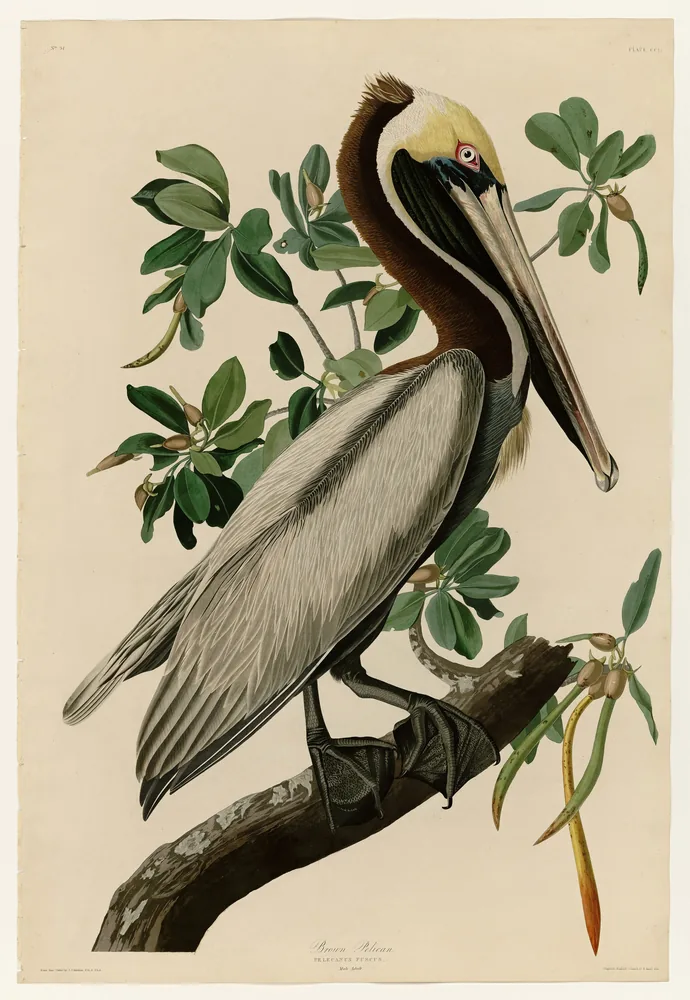
Audubon’s plate: plate 251, “Brown Pelican”
Audubon's first shot at Brown Pelicans went wrong. His friend John Bulow had taken him by barge along the Halifax, in East Florida, and on an inlet they found several dozen asleep in the mangroves. He dropped two with his first barrel, but the second was useless, because the shot had gone in before the powder, and both fallen birds flew off as the servants waded out to them.
He did better at Key West, where the revenue cutter Marion lay at anchor for several days and hardly an hour of daylight passed without pelicans around the ship. He watched gulls land on a pelican's bill or head and snatch the small fish that escaped as it let the water out of its pouch. The pelicans showed no anger at all.
The adult male in the plate was “selected from among a great number,” and its pouch could hold a gallon of water. It stands on a red mangrove, a tree Audubon likened to one turned upside down and standing on its top. Much as he admired the bird, he admitted: “I should be sorry to keep it near me as a pet.”
Years later, on the bays of Texas, he found Brown Pelicans nesting on the ground on small bare islands, and corrected an earlier mistake: the adult female looks just like the male. A young bird is his plate 421.
Story: Audubon, Ornithological Biography, vol. 3 (1835), pp. 376–386; vol. 5 (1839), pp. 212–213. See plate 251 free at Audubon.org. See plate 421 free at Audubon.org.
More classic portraits, free to see
About the Brown Pelican
- Brown Pelicans dive headfirst into the water, then drain the water from their pouch before swallowing the fish. (Source: National Audubon Society)
- Brown Pelicans recovered after the use of DDT and other long-lasting pesticides ended. (Source: National Audubon Society)
How long does a Brown Pelican live?
We found no typical lifespan for the Brown Pelican that we could confirm. The oldest known wild Brown Pelican was at least 27 years and 10 months old (USGS Bird Banding Laboratory): it was banded in South Carolina in 1972 and found in Florida in 2000.
Source: USGS Bird Banding Laboratory. A banding record is the minimum age of one bird when it was found again, not a typical lifespan. How long do wild birds live?
How can you tell if a plate 251 print is an original?
By its size: an original plate 251 is a hand-colored sheet about 26 by 38 inches; the Brown Pelican’s octavo versions, plates 423 and 424, are book-size, from 1840–44. Many prints sold today are reproductions: how to tell an original from a reproduction. For all 435 plates at a fraction of an original’s price, see which edition of The Birds of America to buy.
In a Birdfolio hardcover, this painting sits beside the date and place you first saw a Brown Pelican. See your own list as a book, free.