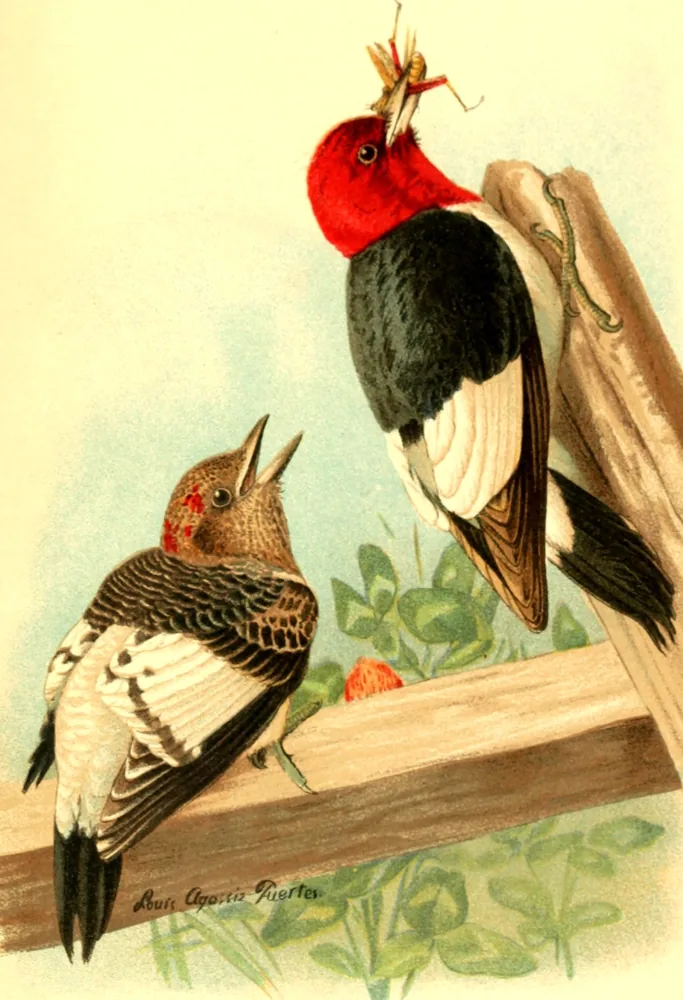
In the US, a bird with an all-red head, a black back and large white wing patches is a Red-headed Woodpecker; a sparrow-sized brown bird with a red forehead, throat and breast is usually a male House Finch; and a red cap above a black-and-white striped back means a Red-bellied Woodpecker. The table below matches other colors, from red chests and red eyes to small yellow, small brown and gray birds, to the bird you most likely saw. Each description comes from National Audubon's online guide, state wildlife agencies and other public sources, all read on November 18, 2026.
What bird is this? Match the colors you saw
| What you saw | Likely bird | Then check |
|---|---|---|
| All-red head, black back, big white wing patches | Red-headed Woodpecker | A young one's head is brown |
| Red cap and nape, black-and-white barred back | Red-bellied Woodpecker | The red belly is hard to see |
| One small red spot at the back of a black-and-white head | Male Downy or Hairy Woodpecker | The Hairy's bill is far longer |
| Red forehead, eyebrow, throat and breast; streaked sides | Male House Finch | Brown cap, square tail |
| Raspberry-red head, red on the back and wings | Male Purple Finch | Notched tail |
| Tiny red forehead, black chin, in winter | Redpoll | Yellow bill |
| Chestnut or rusty cap on a little sparrow | Chipping or American Tree Sparrow | A dark chest spot means Tree Sparrow |
| Red face, yellow body, black wings | Male Western Tanager | Mostly in the West |
| Red all over, with a crest | Male Northern Cardinal | No other red bird has a crest |
| Brick-red chest, gray back | American Robin | Broken white ring around the eye |
| Black or brown hood, red eye, rusty sides | Eastern or Spotted Towhee | White spots on the back mean Spotted |
| Bright yellow, black forehead and wings | Male American Goldfinch, summer | White wing bars |
| Yellow all over, yellow spots in the tail | Northern Yellow Warbler | Reddish streaks on a male's chest |
| Blue above, reddish-brown throat and chest, white belly | Eastern Bluebird | A blue throat means Western Bluebird |
| Gray back, black cap and bib, white cheeks | Black-capped or Carolina Chickadee | Range settles which |
| Dark gray or black hood, white belly, white outer tail | Dark-eyed Junco | Pale pink or yellowish bill |
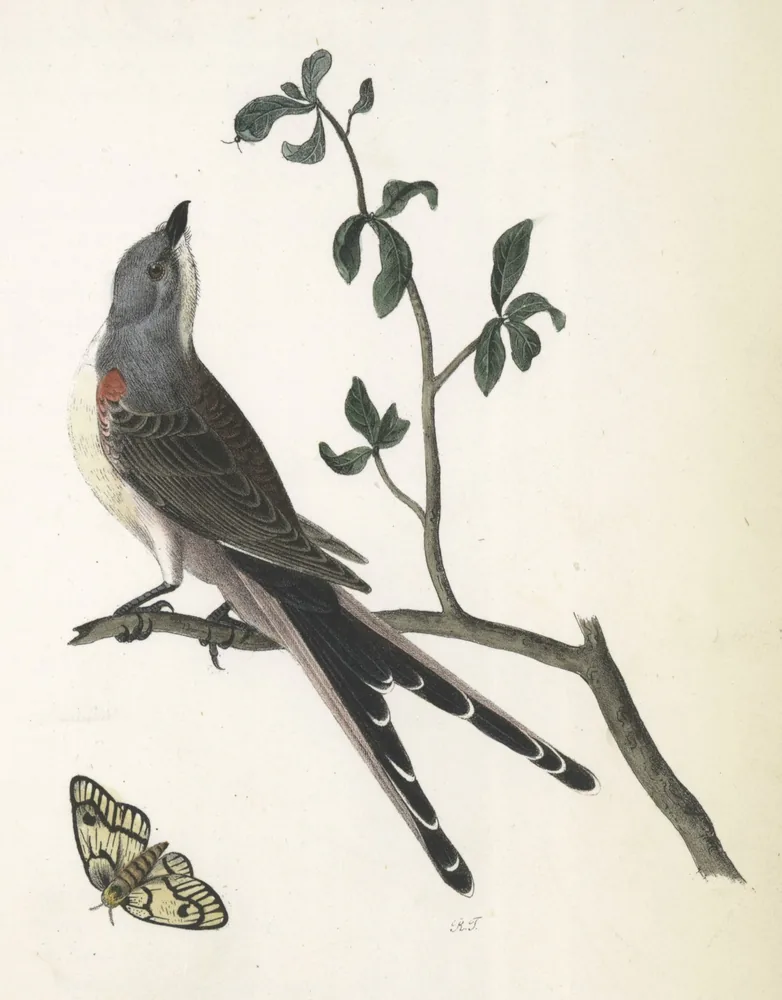
| Very long, forked black-and-white tail | Scissor-tailed Flycatcher | Salmon-pink under the wings |
What is the bird with a red head?
Most often a male House Finch at a feeder or a woodpecker on a tree; the rest of the body tells you which. House Finches live from coast to coast and are "a familiar visitor to backyard feeders," says National Audubon's guide. Black-and-white birds with red heads are woodpeckers, sorted next.
A male Western Tanager has a red face on a yellow body with black wings. It nests in high mountains and the North, but in migration "the bright males often draw attention by pausing in suburban yards in late spring," the guide says. A male Northern Cardinal is red all over, "our only red bird with a crest" (its page). A woodpecker 16 to 19 inches long, "very large, mostly black, with a red crest," is a Pileated, the biggest woodpecker in North America. And a big, dark bird soaring on long wings with a red head is a Turkey Vulture; its "juvenile has gray head, not red." Birds that are mostly black have a guide of their own, sorted by their one striking mark: black bird identification.
What is the bird with a red head and a black and white body?
A Red-headed Woodpecker if the whole head is red, a Red-bellied Woodpecker if only the cap and the back of the neck are, and a male Downy or Hairy Woodpecker if the red is one small patch at the back of the head. On a Red-headed, the red covers its "head, neck, throat, and upper breast," says New York's Department of Environmental Conservation (DEC), above a black back and white wing patches. "The males and females look alike," says the Oklahoma Department of Wildlife Conservation (ODWC). It lives east of the Rockies, and its bright feathers once made it "a popular target for hunters," the DEC notes.
The Red-bellied Woodpecker is the one that fools people. It has a "black and white striped back," ODWC says; a male's red runs from the top of the head down the back of the neck, a female's covers only the nape. Despite the name, "red on belly is usually hard to see," Audubon's guide says. Our woodpecker guide sorts the two names; Audubon's painting is on the Red-bellied Woodpecker page.
Smaller woodpeckers wear less red. On a Downy, the "male has red nape spot"; a male Hairy has a red patch at the back of the crown and is bigger, with "a bill nearly as long as its head" (how to tell them apart). The Yellow-bellied Sapsucker, a woodpecker too, has a bright red forehead cap, and on the Pacific slope the Red-breasted Sapsucker's "head and chest are all red."
What is the bird with a red head and a brown body?
Usually a male House Finch: a brown bird with a red forehead, eyebrow, throat and chest, a brown cap and dark streaks down whitish sides. If the red is spread more evenly and the sides are plain, it may be a male Purple Finch, "not really purple, more of an old-rose color," as Audubon's guide puts it. ODWC adds that his red runs onto the wings and sides, and his tail is notched where a House Finch's is square.
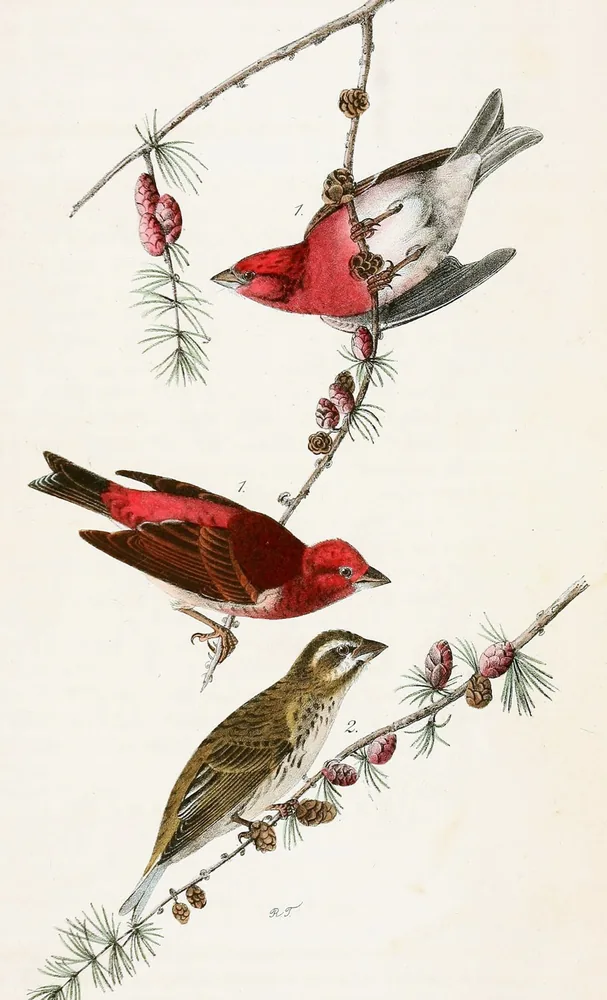
Purple Finches are common in the North and East and along the Pacific coast but very rare in much of the Rockies, where Audubon's guide points to a look-alike, Cassin's Finch. In the Northeast, competition with House Sparrows and then House Finches "may have driven them back into the woods." The House Finch was a bird of the Southwest until cage birds were set free in New York in 1940, and some males are orange or yellow; our House Finch page explains why.
What is the small brown bird with a red head?
A male House Finch most of the year; in a northern winter it may be a redpoll, with only a small red forehead and a black chin; and a little sparrow with a chestnut cap is a Chipping Sparrow. A redpoll has "a red forehead, a black chin, and a yellow bill," Audubon's guide says. It nests in the far north and wanders south in winter, "probably moving only as far south as necessary to find food." Our redpoll page shows how to tell a redpoll from a House Finch.
The Chipping Sparrow wears a chestnut cap over a white eyebrow and a black eye line, sharpest in summer. It was once the commonest sparrow in towns, until the House Sparrow, brought from Europe, "took over its place as our number one city" sparrow, the guide says. In winter, the American Tree Sparrow has a rusty cap too, with a two-toned bill and a dark spot in the middle of its chest. Female and young House Finches have no red at all.
What is the bird with a red chest?
In most yards, an American Robin, whose "red" chest is really brick-red to orange; a smaller bird with a truly red chest is likely a male House Finch, a Northern Cardinal or, in eastern woods, a Rose-breasted Grosbeak. ODWC calls the robin's chest and belly "orangish-red (males) to reddish-orange (females)." Some robins winter as far north as Canada, so the "first robin of spring" in the North "may be a bird that has wintered only a few miles away," Audubon's guide says. More is on our American Robin page.
Other red chests:
- Rose-breasted Grosbeak: a rosy triangle on a male's white chest, a black head and big white wing spots. Its song is "like an improved version of the American Robin's voice."
- Painted Bunting: a male has a blue head, a green back and a red throat, chest and rump; common in the Southeast.
- Scarlet Tanager: a summer male is brilliant red with black wings. "In late summer he molts into winter plumage, greenish with black wings."
- Red-breasted Nuthatch: the name misleads. It has "buffy-orange underparts and a blue-gray back," and creeps headfirst down trunks.
What is the bird with red eyes?
In a backyard, most likely an Eastern Towhee, or a Spotted Towhee in the West: a bird a little smaller than a robin, with a black or brown hood, rusty sides, a white belly and a red eye. That red is "an unusual color among sparrow-like birds," ODWC notes. Males are black above, females brown, and both scratch in dead leaves under thickets. A Spotted Towhee has white spots on its back and wings, and the National Park Service describes its "black head with eyes that are red." Not every Eastern Towhee has them: "In parts of the Southeast and Florida, the towhees have white eyes," says Audubon's guide.
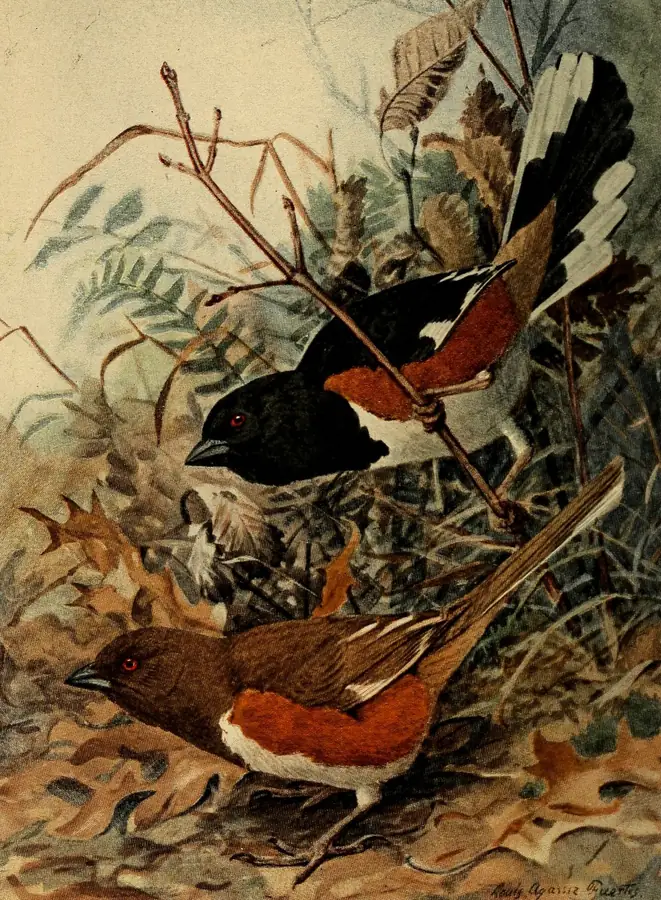
The eye once named the bird. Before 1957 the eastern one was the Red-eyed Towhee; that year it and the Spotted were merged as the Rufous-sided Towhee, and they were split again after 1992, the Texas Breeding Bird Atlas recounts. Towhees are often taken for robins, but a robin has a narrow, yellowish bill and much more orange-red below, ODWC points out.
Two more red-eyed birds are hard to see well. The Red-eyed Vireo is "one of the most numerous summer birds in eastern woods," yet it keeps to leafy treetops, and "the red eye (brown on young birds) can be hard to see." Its song sounds "as if it were endlessly asking and answering the same question." On water, the Horned Grebe wears buffy-gold "horns" on a black head in summer, and, says the Chesapeake Bay Program, "They have red eyes."
What is the small yellow bird?
In summer, usually a male American Goldfinch: bright yellow, with a black forehead, black wings marked with white bars and a black tail; a bird yellow all over, with yellow spots in its tail, is a Northern Yellow Warbler. The goldfinch is "smaller than a house sparrow," ODWC says, and in winter both sexes turn olive-brown; see the olive-brown winter goldfinch. It nests late, in midsummer, "perhaps to assure a peak supply of late-summer seeds," Audubon's guide says.
In Texas and the West, the even smaller Lesser Goldfinch is common; its males have black backs from Colorado to Texas and mostly green backs farther west.
Warblers are the other small yellow birds:
- Northern Yellow Warbler: a plain yellow face that makes the dark eye stand out, and yellow tail spots where "most warblers have white spots." A male has reddish streaks on his chest. The name is new since the Yellow Warbler was split.
- Common Yellowthroat: a male has a black bandit mask over a yellow throat; it lives in marshes and wet thickets.
- Wilson's Warbler: all yellow or yellow-green, with a round black cap on the males.
Bigger yellow-breasted birds, from kingbirds to meadowlarks and orioles, are in our yellow birds of Texas.
What is the blue bird with an orange chest?
Usually an Eastern Bluebird, "the most widespread of the three bluebirds": bright blue above, with a reddish-brown throat and chest and a white belly. A female has a blue-gray head and back and a "dull orange" breast, ODWC says. Her mate's blue is no pigment: it is "simply a result of light interacting with the structure of individual feathers," so a bluebird looks brighter or duller as the light changes. Many nest in boxes along "bluebird trails," Audubon's guide notes; see bluebird nest boxes and the three bluebirds.
In the West, check the throat. A male Western Bluebird is deep purplish blue on its upperparts and throat, with a reddish-brown chest and a gray belly. The Mountain Bluebird is sky-blue with no orange at all. Two more fit the description:
- Lazuli Bunting: a sky-blue western male with a rusty chest and white wing bars, which bluebirds lack.
- Barn Swallow: a steel-blue back, a chestnut throat and a long forked tail; its chest runs from deep buff to white (Barn Swallow page).
What is the small brown bird?
Usually a House Sparrow, a female House Finch, a native sparrow or a wren; look at the chest first, since a plain chest, blurry stripes and one central spot each point to a different bird. Audubon's guide puts it simply: House Sparrows lack the House Finch's stripes, and "native sparrows all have different patterns, and most are more secretive."
| Small brown bird | Look for |
|---|---|
| House Sparrow, female | Pale buff eyebrow, plain gray chest, black-and-buff stripes on the back |
| House Finch, female | Plain brown face, blurry stripes all over the underparts |
| Song Sparrow | Striped face; chest streaks joining in a central spot; a tail it pumps in flight |
| Chipping Sparrow | Chestnut cap, white eyebrow, black line through the eye |
| White-throated Sparrow | White throat, a yellow spot in front of the eye |
| Carolina Wren | Chestnut above, butterscotch below, a bold white eyebrow |
| Northern House Wren | Small and plain, a thin bill, a faint eyebrow, barred wings and tail |
Place matters too. The House Sparrow lives around buildings, "never in unaltered natural habitats," so a small brown bird deep in the woods is something else. Our painting pages tell the stories of the Song Sparrow, Carolina Wren and White-throated Sparrow.
What is the bird with a long tail?
Around houses and towns, usually a Northern Mockingbird: a slim, pale gray bird with white wing patches and a long dark tail with white outer feathers. ODWC says it is common in towns but hard to draw to feeders. Our Northern Mockingbird page has Audubon's painting.
On the southern Great Plains, the champion is the Scissor-tailed Flycatcher, 14 to 15 inches long counting the tail. Perched far off, it can pass for "a slim, long-tailed Mockingbird" until it flies and flashes salmon-pink under the wings, Audubon's guide says. Females have long tails too, so the tail doesn't seem to be for attracting a mate; "the purpose of these long feathers is not clear," says the Texas Breeding Bird Atlas. Its length is on our Oklahoma state bird page.
Other long tails:
- Mourning Dove: a long, pointed tail with white spots along the edge in flight (Mourning Dove page).
- Brown Thrasher: rufous-brown above, striped below, with yellow eyes, 11½ inches long.
- Gray Catbird: slim and gray, often flipping its tail about.
What is the gray bird with a black head?
At a winter feeder, often a Dark-eyed Junco: a small sparrow, dark gray to black above and white below, with white outer tail feathers and a pale pink or yellowish bill. Some have "a black or dark gray head that is darker than the rest of the body," ODWC says; in Oklahoma juncos are among the commonest winter birds, from early October to early April. East of the Great Plains they are all gray and white; in the West, the "Oregon Junco" male has a black hood and a chestnut back, and some western forms "were once regarded as different species," Audubon's guide says. Audubon himself called the bird the Snow Bird, plate 13.
A gray bird with a black cap and bib and white cheeks is a chickadee. The Black-capped and the Carolina are best told apart by range, the Carolina being the southern one; see Carolina or Black-capped. Audubon's guide adds: "The male House Sparrow is sometimes misidentified as a chickadee."
Three more:
- Gray Catbird: "smooth gray all over, with a black cap," and rusty under the tail; it mews from shrubs, "the catlike mewing responsible for its name."
- Eastern Kingbird: a blackish head and back over white underparts, and a white band across the tip of its tail; it winters in South America.
- Loggerhead Shrike: gray with a black mask and black wings, often confused with the mockingbird, which lacks the mask, ODWC says. Its old name is the butcher bird, for the prey it hangs on thorns.
How do you identify a bird by its colors?
Note where each color sits, how big the bird is next to one you know, and its bill and tail, because color alone changes with age, season and even the light. Remember the changes above: goldfinches turn olive-brown in winter, Scarlet Tanagers go green, a young Red-headed Woodpecker's head is brown, some House Finches are orange, and a bluebird's blue shifts with the light. Write down what you saw, where and when; a birding log book keeps those notes together, so the next sighting is easier to check.
The paintings on this page
Louis Agassiz Fuertes painted the Red-headed Woodpeckers for Food of the Woodpeckers of the United States (1911) and the towhees for True Bird Stories from My Note-Books (1903). The Purple Finches and the Scissor-tailed Flycatcher (Audubon's Swallow-tailed Flycatcher) are from John James Audubon's octavo The Birds of America (1840–44).
Seen a towhee, a bluebird or a Scissor-tailed Flycatcher this year? In a Birdfolio, every bird you've seen sits beside a classic painting like these: see how the pages of one look.