The ostrich is the biggest bird in the world, up to 9 feet tall and 287 pounds; a diving Peregrine Falcon is the fastest, at over 200 mph; Cuba's Bee Hummingbird, about 2¼ inches long, is the smallest; and the loudest on record is the White Bellbird of the Amazon, at about 125 decibels. For the smartest, the tests point to crows and parrots. Below is each record, how it was measured, and the US bird that comes closest.
Bird world records at a glance
| Record | Bird | The figure | Who measured or lists it |
|---|---|---|---|
| Biggest | Ostrich | Males 6.9–9 ft tall, 220–287 lb | San Diego Zoo Wildlife Alliance |
| Heaviest that can fly | Kori Bustard | 40 lb, a male shot in South Africa in 1936 | Guinness World Records |
| Widest wings | Wandering Albatross | 11 ft 11 in, a male caught in 1965 | Guinness World Records |
| Fastest in a dive | Peregrine Falcon | Over 200 mph | The Peregrine Fund |
| Fastest in level flight, filmed | Common Swift | 31.1 meters a second, about 70 mph | Lund University study, 2010 |
| Fastest runner | Ostrich | Up to 43 mph in short bursts | San Diego Zoo Wildlife Alliance |
| Smallest | Bee Hummingbird | About 2¼ in, under 2 grams | BirdNote, on Audubon's site |
| Loudest | White Bellbird | About 125 decibels | Podos and Cohn-Haft, 2019 |
| Highest flier | Rüppell's Vulture | 37,000 ft, struck by an airliner in 1973 | Guinness World Records |
| Longest without landing | Common Swift | Ten months | Lund University study, 2016 |
| Oldest known wild bird | Laysan Albatross | About 75 years | US Fish and Wildlife Service, 2026 |
Each figure is the source's own; where two sources disagree, both are named below, and our own unit conversions are marked. These are the birds' records. The birders' records, the longest life lists and the biggest Big Years, are in our guide to birding records.
What is the biggest bird in the world?
The ostrich, "the largest and heaviest living bird," says San Diego Zoo Wildlife Alliance: a male stands 6.9 to 9 feet tall and weighs 220 to 287 pounds.
Females are smaller, 5.7 to 6.2 feet and 198 to 242 pounds. An ostrich egg averages 6 by 5 inches and weighs about 3 pounds, the zoo says. The ostrich can't fly, so the birds that can have records of their own, below.
What was the biggest bird ever?
An elephant bird of Madagascar, named Vorombe titan in 2018, with a mean body mass of "almost 650 kg," about 1,430 pounds (our conversion). James Hansford and Samuel Turvey sorted the island's extinct elephant birds by their limb bones and found that the biggest had never been recognized as a genus of its own (Royal Society Open Science).
What is the heaviest bird that can fly?
The Kori Bustard of Africa, says Guinness World Records: its largest confirmed specimen, a male shot in South Africa in 1936, weighed 40 pounds.
The Smithsonian's National Zoo gives male Kori Bustards 24 to 42 pounds, with females roughly half their size; it calls them the world's heaviest flying birds on one line and "one of" them on another. The heaviest single flying bird ever weighed wasn't a bustard at all. A wild male Mute Swan in Poland reached 22.5 kilograms, 49 pounds 10 ounces, "the heaviest verified for a specimen belonging to any species of flying bird," Guinness says, though it treats him as an exception and keeps the bustard as the heaviest species.
Which bird has the largest wingspan?
The Wandering Albatross: Guinness World Records lists a male caught in the Tasman Sea in 1965 whose wings measured 11 feet 11 inches (3.63 meters) from tip to tip.
He was caught on September 18, 1965, by the crew of the US research ship Eltanin. That's the longest on record, not the usual size: BirdLife Australia gives the species "almost 3.5 m," about 11½ feet (our conversion).
The biggest wings that ever flew turned up in South Carolina. Fossils of Pelagornis sandersi were "unearthed near Charleston International Airport," Science News reported in 2014, from a bird that soared about 28 million years ago. Daniel Ksepka's conservative estimate of its wingspan, about 6.4 meters or roughly 21 feet (our conversion), would "exceed theoretical maximums based on extant soaring birds," his paper says (PNAS).
What is the biggest bird in the US?
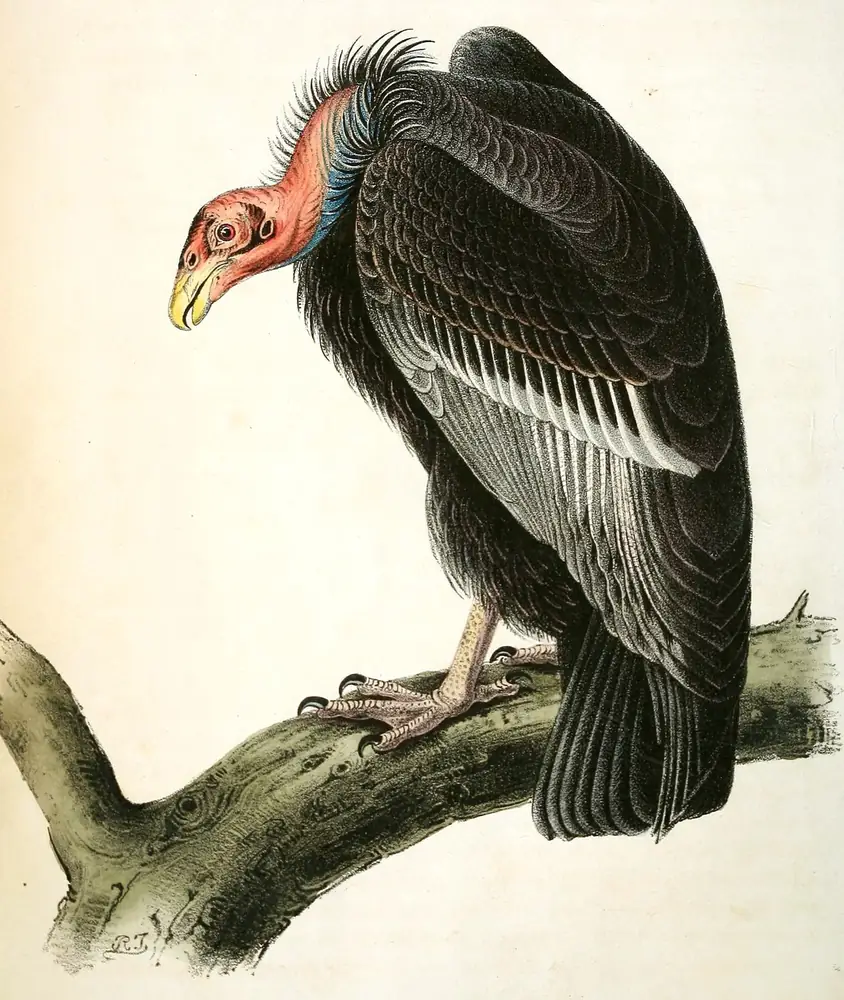
The California Condor, with wings about 9.5 feet across and a weight of up to 25 pounds: "the largest land bird in North America," says the US Fish and Wildlife Service.
It nearly didn't make the list. In 1982 only 23 condors were left in the world; captive breeding and releases since 1992 have brought the wild and captive birds to "more than 500," the Service says. Two other US birds rival it on one measure each (their figures from National Audubon's guide, the condor's from the Service):
| Bird | Wingspan | Weight |
|---|---|---|
| California Condor | About 9.5 ft | 17–25 lb |
| American White Pelican | 8 ft–9 ft 6 in | 9 lb 4 oz–17 lb 10 oz |
| Trumpeter Swan | 6 ft 6 in–8 ft | 15–30 lb |
The Trumpeter Swan is the heaviest of the three at its top weight; Audubon's guide calls it the "largest of the native waterfowl in North America." The pelican has the wings but not the weight; its story is on our American White Pelican page. Audubon painted both giants at life size, the condor as plate 426 and the swan as plate 376. For the biggest bird in one state, see our state pages, such as Ohio, Oregon or Pennsylvania.
What is the fastest bird?
The Peregrine Falcon, in a dive: The Peregrine Fund puts its stoop, the steep dive it hunts with, at over 200 mph. No bird comes near that in level flight, and how each speed was measured matters as much as the number.
The famous 242 mph comes from one falconer's experiment. In 1999 Ken Franklin of Friday Harbor, Washington, released his Peregrine, Frightful, from a Cessna at 17,000 feet while a cameraman skydived beside her, and she "was reportedly clocked at 242 mph (389.46 km/h)," says Guinness World Records. Guinness's own record line is more cautious: about 320 km/h, 200 mph, an estimated top speed "in ideal conditions." Filmed experiments get far lower numbers. When Benjamin Ponitz and colleagues filmed trained falcons stooping past a 60-meter dam with high-speed stereo cameras, the best was 22.5 meters a second, about 50 mph, because the drop was too short for a long dive (PLOS ONE, 2014). Our hawk vs falcon guide sets the dive beside the hawks'.
The record books themselves began with this question. At a shooting party in County Wexford in the early 1950s, Sir Hugh Beaver, managing director of the Guinness Brewery, and his hosts "argued about the fastest game bird," the company's history says, and in 1954, recalling that argument, he had the idea that became the book. Guinness's answer today is the Red-breasted Merganser. In May 1960 an aircraft flushed six of them from the Kukpuk River in Alaska, and one kept up an airspeed of 80 mph for about 1,500 feet, about 100 mph over the ground with a 20 mph wind behind it.
What is the fastest bird in level flight?
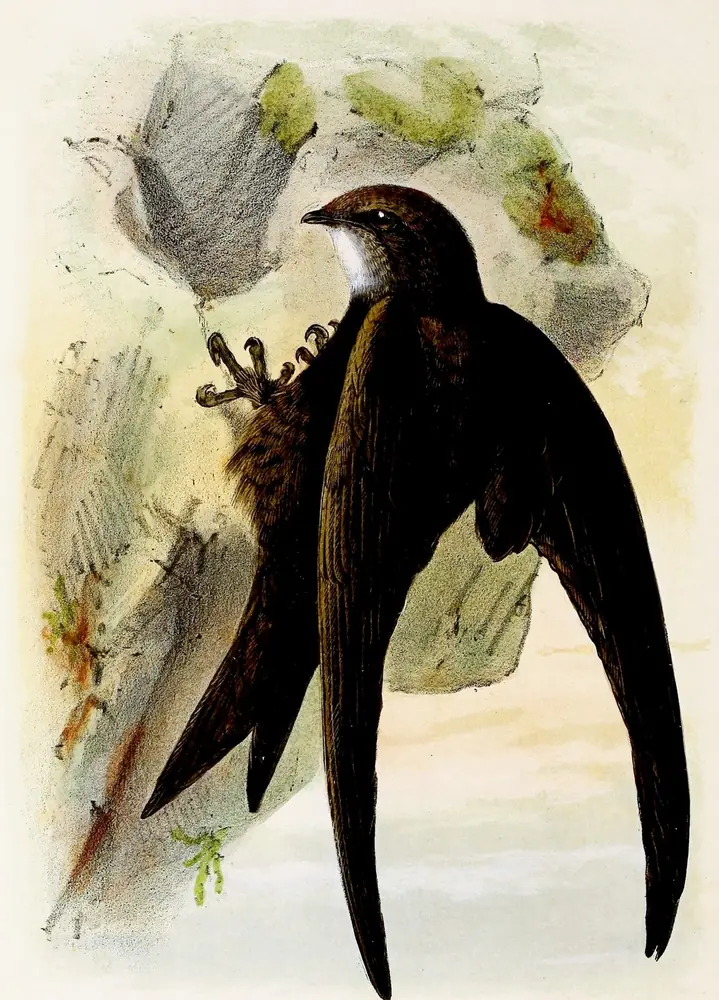
Measured with cameras in calm air, the Common Swift: researchers at Lund University in Sweden filmed swifts at up to 31.1 meters a second, about 70 mph (our conversion).
They filmed the birds in their "screaming parties," when swifts fly much faster than on migration; the average there was 20.9 meters a second, about 47 mph (Journal of Avian Biology, 2010). Guinness World Records lists a faster bird with a caveat: a satellite-tagged Gray-headed Albatross held 127 km/h, 78.9 mph, for over eight hours on March 15, 2003, flying home to South Georgia through an Antarctic storm. Guinness itself says much of that speed was probably tailwind.
The swift holds a stranger record too. Lund University researchers fitted 13 Common Swifts with tiny data loggers and found that the species "flies ten months on end without landing." A few landed briefly, yet even they spent more than 99.5 percent of those ten months in the air (Current Biology, 2016).
What is the fastest bird on land?
The ostrich, which can sprint at up to 43 mph in short bursts and hold 31 mph, says San Diego Zoo Wildlife Alliance. Among birds that can also fly, Guinness World Records names the Greater Roadrunner of the Southwest, clocked at 26 mph while "pursued by a car."
What is the smallest bird in the world?
The Bee Hummingbird, found only in Cuba: about 2¼ inches long and lighter than two grams, about seven-hundredths of an ounce (our conversion), by BirdNote's figures on Audubon's site.
What is the smallest bird in the US?
The Calliope Hummingbird, 3.1 to 3.5 inches long and about a tenth of an ounce: "the smallest bird in North America," says National Audubon's guide. Our guide to the types of hummingbirds follows its 5,000-mile year and compares it with the other US hummingbirds, from the Ruby-throated Hummingbird to Anna's Hummingbird.
What is the smartest bird?
No single bird holds the title, because no study has given every species the same tests; on the puzzles scientists have set, crows, magpies and their relatives and the bigger parrots score highest, each at different things.
The brains explain part of it. Parrot and songbird brains hold "on average twice as many neurons as primate brains of the same mass," a 2016 study in PNAS found, and crows and parrots pack an especially large share of them into the forebrain. These are study findings, each from one kind of test:
| Bird | The test | What the study found |
|---|---|---|
| Eurasian Magpie | The mirror mark test | Five hand-raised magpies went for a mark they could see only in the mirror: the "first evidence of mirror self-recognition in a non-mammalian species" (PLOS Biology, 2008) |
| Kea, a New Zealand parrot | Predicting what a blind draw would bring | It used the share of each kind, a barrier and an experimenter's bias, showing "true statistical inference" outside the great apes (Nature Communications, 2020) |
| African Gray Parrot (Griffin) | Finding a reward under one of two cups | Griffin "outperformed even 5-year-olds," Harvard reported in 2019; children fail similar tasks until about 2½ |
| African Gray Parrot (Alex) | Thirty years of word and number lessons | More than 100 spoken labels for objects, actions and colors, and counting sets of up to six (The Alex Foundation) |
| American Crow and Common Raven | Faces, planning, tools | See our crow vs raven guide |
Alex was the famous one. Irene Pepperberg bought him as a year-old bird; his name stood for Avian Learning EXperiment, and he died unexpectedly on September 6, 2007, at 31, after three decades of work with her (Harvard Gazette; The Alex Foundation).
Are crows smarter than parrots?
There's no verdict: we found no study that has given crows and parrots the same full set of tests. Each wins on its own ground: crows at remembering human faces for years, parrots at learning human words. The corvid side of the question is in our crow vs raven guide, and the American Crow page has the bird you can watch from a kitchen window.
What is the loudest bird?
The White Bellbird of the Amazon: at the loudest point of one of its songs it reaches about 125 decibels on average, Science News reported of the 2019 study that measured it.
Jeff Podos of UMass Amherst and Mario Cohn-Haft of Brazil's national Amazon research institute measured eight bellbirds and three Screaming Pihas, the previous record-holders, with sound-level meters and laser rangefinders, then worked out each song's loudness at a distance of one meter. The pihas topped out around 116 decibels; the bellbird's call had about three times their sound pressure, the university said. The singer weighs about half a pound, and Guinness World Records later confirmed the record.
The strangest part is who hears it. When a female joins a male on his display perch, he sings only his loudest song and swivels "to blast the song's final note directly at the females," Podos said; he would love to know why females stay so close.
The record has new challengers. In a study published in Evolution, Podos and João Menezes measured 123 species in Massachusetts and Brazil and found two more birds "above 120 peak decibels": the Bare-throated Bellbird and the Red-legged Seriema. The quietest they measured, a hummingbird, made 64 decibels, about the level of a normal conversation (UMass Amherst, September 29, 2026).
Which bird sounds like a car alarm?
In the US, probably a Northern Mockingbird: the National Park Service says mockingbirds have been known to copy car alarms. Starlings are gifted mimics too, and in Australia the Superb Lyrebird is famous for it.
A male mockingbird "can learn around 200 different songs throughout its life," says the National Park Service at Harpers Ferry, most of them other birds' songs. Our Northern Mockingbird page has the bird and its paintings. European Starlings beat parrots at one machine sound in a 2025 study: the beeps of R2-D2 from Star Wars. Researchers from the Universities of Amsterdam and Leiden tested nine kinds of parrots and the starlings on the droid's sounds, and the starlings did best with the multi-tone ones, because their voice box "has two sound sources" (Scientific Reports).
The lyrebird's fame needs a footnote. About 80 percent of its song is mimicry, says the Australian Museum, including "chainsaws, car engines, dog barks and local native birds." The film everyone remembers, of a lyrebird copying a camera's motor drive, a car alarm and a chainsaw, came from David Attenborough, and two of his three lyrebirds were captives, Hollis Taylor wrote in The Conversation in 2014. One was Chook of Adelaide Zoo, known for hammers, drills and saws he reputedly picked up while the zoo built its panda enclosure.
Which birds sing at night?
In the US, Northern Mockingbirds, Eastern Whip-poor-wills and owls; in Europe, the Common Nightingale. Among mockingbirds and nightingales, the night singers are mostly males still looking for a mate.
- Northern Mockingbird. "Most of the night singers are males that don't have mates," says the National Park Service, and they sing at night more often around the full moon. Texas, where the mockingbird is the state bird, says the same.
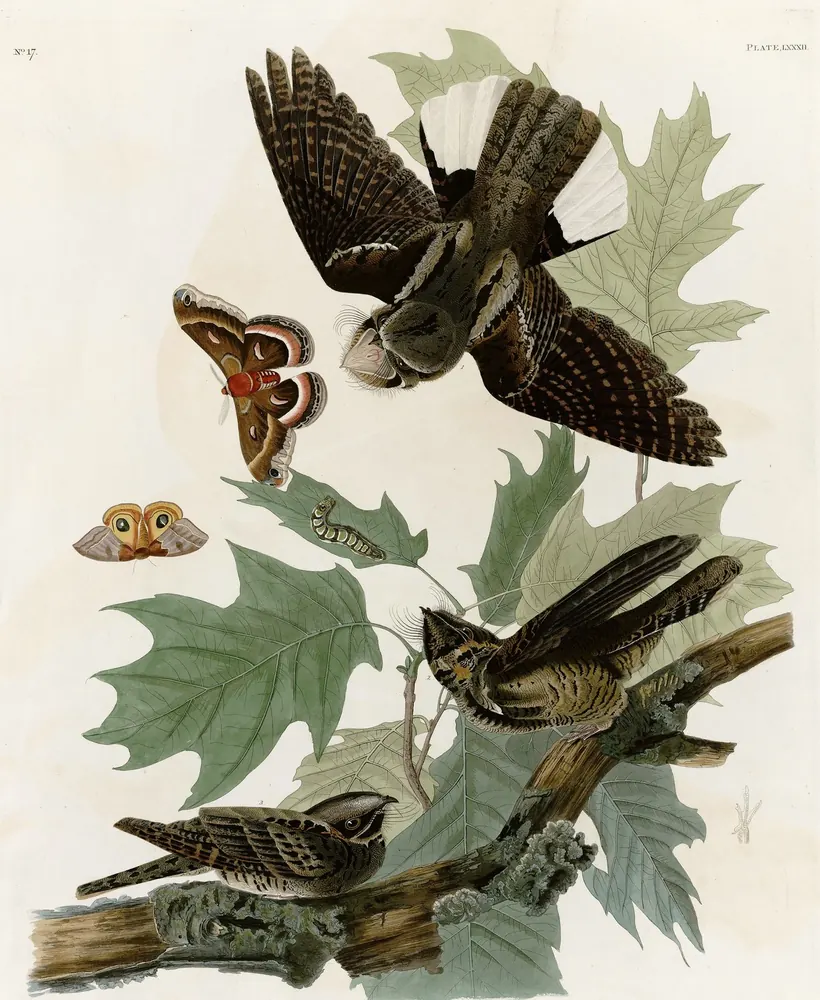
- Eastern Whip-poor-will. Strictly nocturnal and tireless: "A whip-poor-will at fever pitch might produce 59 songs a minute," says Ohio's Division of Wildlife, and one has been known to sing a thousand times without stopping. Audubon painted three on plate 82, below.
- Owls. They call through the night, from the Great Horned Owl's deep hoots to the Barred Owl's "who cooks for you"; our owl sounds table matches the sound to the bird, and the Great Horned Owl and Barred Owl pages have their stories.
- Common Nightingale. A study that followed nightingales through a whole breeding season found that "nocturnal song was sung mostly by unmated males"; once a male paired, he stopped singing at night, and started again if his mate left (Valentin Amrhein and colleagues, Animal Behaviour, 2002). The RSPB adds that it sings by day too, and spends the winter in Africa.
Our state pages answer the question where you live, for example Virginia, Ohio and Oregon.
Which bird is closest to a dinosaur?
Every bird is a dinosaur, the one branch of the family still alive; and in the 2008 study of proteins from a Tyrannosaurus rex bone, the living birds that came out closest to T. rex were the chicken and the ostrich.
"Birds that fill the world's skies today are living dinosaurs," says the Natural History Museum in London, descended from the theropods, the two-legged dinosaurs that include T. rex. The Australian Museum puts it more bluntly: "Parrots, eagles, penguins, chickens … they're all dinosaurs."
The protein evidence came from a 68-million-year-old T. rex bone. In 2007 John Asara, Mary Schweitzer and colleagues read short protein sequences from it by mass spectrometry (Science). A year later they compared that collagen with other animals', and T. rex "grouped with birds," the Harvard Gazette reported: with the ostrich and the chicken better than with any other animal studied, alligators and anole lizards included. The team had only six fragments of protein, 89 amino acids in all, so the evidence is thin. Still, the closest living relative of T. rex in that test was the bird on the dinner plate, and why every bird counts as a dinosaur has a guide of its own.
Which bird lives the longest?
The oldest known wild bird is Wisdom, a Laysan Albatross who nests on Midway Atoll in the Pacific, about 75 years old in April 2026, says the US Fish and Wildlife Service. She is estimated to have laid 50 to 60 eggs and fledged about 30 chicks. On Midway her kind are still called gooney birds. Her record and those of hundreds of other species, by the bands scientists put on their legs, are listed on our oldest wild birds page; typical lifespans, which are far shorter, are in how long birds live.
Which bird flies the highest?
A Rüppell's Vulture holds the record: it struck an airliner at 37,000 feet over Abidjan, Ivory Coast, on November 29, 1973, says Guinness World Records. One engine shut down and the plane landed safely; the bird was identified from its feather remains by the American Museum of Natural History.
The paintings on this page
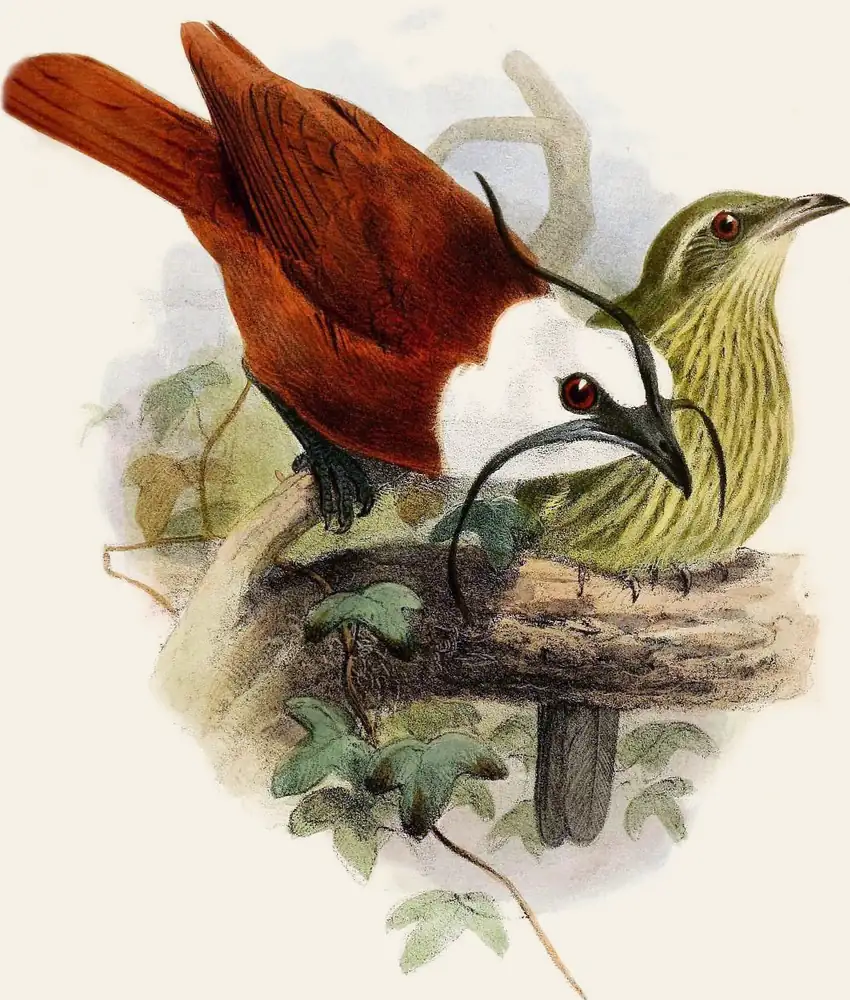
John James Audubon's condor at the top is plate 1 of the small octavo edition of The Birds of America; his life-size Whip-poor-wills of plate 82 come from the big edition, as our guide to Audubon explains. The swift is by John Gerrard Keulemans, from his Dutch book on birds of house and garden, and the Three-wattled Bellbirds by Joseph Wolf, from the journal The Ibis. Only the swift and the condor hold records here; the bellbirds stand in for their louder cousin. A Birdfolio prints every bird on your list beside a painting like these, from the first bird to the latest.