2024 lump
Common and Hoary Redpoll are now one species
Hoary Redpoll is no longer a species of its own: the American Ornithological Society (AOS) merged Common, Hoary and Lesser Redpoll into one species, called simply Redpoll, on July 18, 2024, and eBird followed in October 2024. If you had counted both Common and Hoary Redpoll, your life list is one species shorter, but every sighting is kept.
Updated
What changed
Nests across the far north, in Alaska and northern Canada and across northern Europe and Asia. In some winters it comes south to southern Canada and the northern US.
Is Hoary Redpoll still a species?
No. Since July 18, 2024, the Hoary Redpoll has been part of one species, Redpoll, together with the Common Redpoll of North America and the Lesser Redpoll of Europe. The AOS made the change in the 65th Supplement to its official Check-list of North American birds. The species keeps the Common Redpoll's scientific name, Acanthis flammea.
The other checklists agree. The American Birding Association (ABA) took Hoary Redpoll off its list of the birds of the US and Canada on September 6, 2024, eBird followed in its October 2024 update, and the AviList world checklist did the same in June 2025.
The birds haven't changed: Audubon's field guide still labels its photos "Redpoll (Hoary)" and "Redpoll (Common)." They just no longer count as two species.
Surprising facts about the redpoll
Neighbors are closer kin than namesakes. Scott Taylor, who led the genetic work, put it this way: a Common Redpoll from Russia and one from the US differ more in their genes than a Common and a Hoary Redpoll from the US do. Redpolls that live near each other are more alike in their genes, whatever they look like.
It carries a lunch bag in its throat. A redpoll has a pouch in its throat where it can store food for up to several hours, says Audubon's field guide. On bitterly cold days it can feed fast out in the open, then digest slowly while it rests somewhere sheltered.
Hunger drives it south, not cold. For its size, it is remarkably good at surviving cold. When redpolls pour south, it is because seeds have run short in the north, Audubon's field guide says.
It lines its nest with ptarmigan feathers. The nest is a cup of fine twigs, grass and moss, hidden low in a dense shrub and lined with feathers (especially ptarmigan feathers), plant down or animal hair.
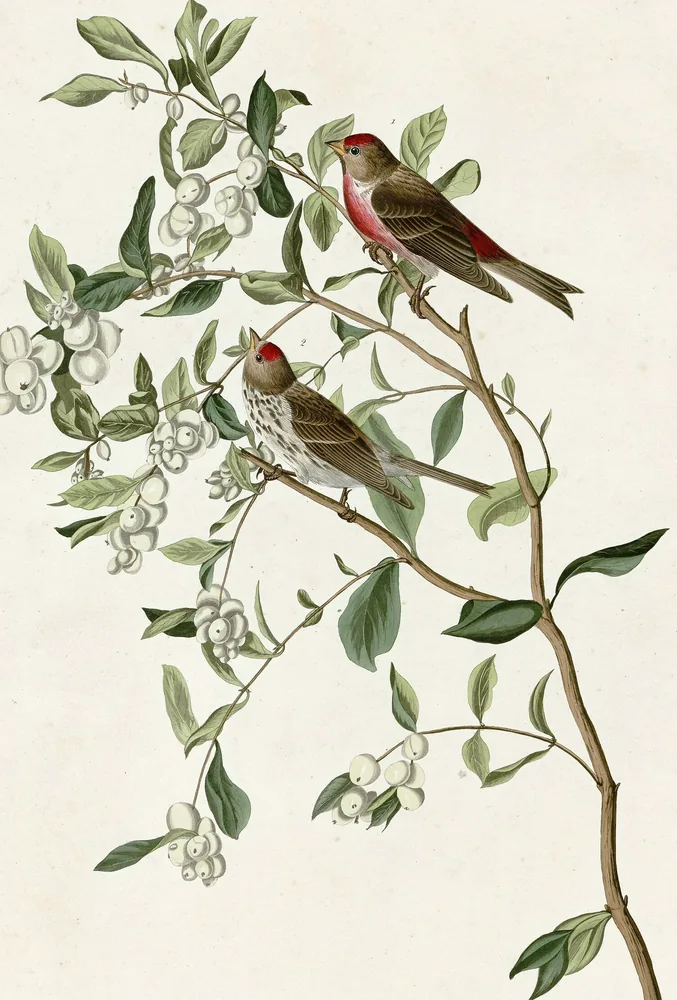
Audubon called it a "Lesser Red-Poll." The painting at the top of this page is plate 375 of The Birds of America, which John James Audubon titled "Lesser Red-Poll." Until 2024, Lesser Redpoll was the name of a separate European species. Now they are all one Redpoll anyway.
Why it changed
Redpolls have puzzled experts for nearly two centuries. Carl Peter Holbøll first described the Hoary Redpoll in 1843, from Greenland, and some experts have counted as many as six redpoll species, the Finch Research Network notes.
The genes left no line to draw. In a study published in 2021, a team led from the University of Colorado Boulder, including Scott Taylor and Erik Funk, read the genes of 73 redpolls from around the world. Common and Hoary Redpolls turned out to be nearly identical, except for one small stretch of one chromosome.
That stretch is a "supergene." In Hoary-type birds, a piece of the chromosome was cut out, turned around and put back, the AOS explains, and its genes travel together as one package that shapes the bill and the plumage. Birds that inherit it look small-billed and frosty. Either way, the birds interbreed freely.
The AOS had said no before. A 2017 proposal failed, partly because no birds from Greenland and Iceland had been sampled, and partly because of reports that each kind paired mostly with its own kind. The new study included Greenland and Iceland, and the AOS found the evidence for choosy pairing rather weak.
Who decided, and when
- American Ornithological Society (AOS): the 65th Supplement to its Check-list of North American birds
- American Birding Association (ABA): took Hoary Redpoll off the ABA Checklist
- eBird and the Clements Checklist: its 2024 taxonomy update
- AviList, the shared world checklist: agrees
What is a redpoll, and is it a finch?
Yes, a redpoll is a finch: a tiny, streaky bird of the finch family, named for the red patch on its forehead. It is one of the "winter finches" that nest in the far north and sometimes come south in winter, says Audubon's field guide.
It is 4.5 to 5.5 inches long and weighs 0.3 to 0.7 ounces. Look for the red forehead, a black chin and a yellow bill. Males have a variable pink wash on the chest. At feeders in winter, redpolls are often remarkably tame.
How do you tell a redpoll from a House Finch?
Look at where the red is. A redpoll has a small red cap on its forehead and a black chin, says Audubon's field guide. A male House Finch has a brown cap and a bright red forehead, eyebrows, throat and breast, with white sides heavily streaked, says the Oklahoma Department of Wildlife Conservation. So where a redpoll's chin is black, a House Finch's throat is red.
Size won't settle it: a House Finch is about 5.1 to 5.5 inches long, much like a redpoll.
Think about where you are, too. House Finches live in cities, towns and farm country and visit feeders in small flocks. Redpolls nest in the far north and reach southern Canada and the northern states only in some winters.
How rare are redpolls?
Redpolls are not rare: Audubon's field guide puts their population at 275 million and calls them still widespread and abundant. But in most of the US you see them only in some winters.
They come south irregularly, probably only as far as they must to find food. In 2013, a boom in redpoll numbers sent many as far south as Colorado and Utah, the University of Colorado Boulder reported.
This winter may be quiet. The Finch Research Network's Winter Finch Forecast for 2026–27, posted September 25, 2026, expects birch seed crops, quite good in parts of Quebec and the Maritimes, to hold most redpolls in Canada, with perhaps a small flight into the western Great Lakes. One theory for recent quiet winters: with less snow cover, many stop in the snowless weedy fields of Canada instead of coming farther south. More in our guide to the forecast.
Where do redpolls live?
Redpolls nest across the far north: in Alaska and northern Canada, and across northern Europe and Asia. They breed in shrubby places: birch or spruce clearings, willow and alder thickets and bushy tundra, says Audubon's field guide. In winter they move to woodland edges and weedy fields.
To find one, the Finch Research Network suggests checking birches (in towns, too), weedy fields and feeders with Nyjer and black oil sunflower seed. In a big flight, look through large flocks for a few frosty "Hoaries." If redpolls visit your feeder, you can count them for Project FeederWatch.
What is the difference between a Lesser Redpoll and a Common Redpoll?
Today, none that counts: since 2024 the Lesser Redpoll and the Common Redpoll are the same species, Redpoll. Before that, the Lesser Redpoll was a species of western Europe.
In Britain, the Lesser Redpoll is the redpoll that nests there all year, says the British Trust for Ornithology. A larger, paler kind, the Mealy Redpoll, once counted as a species of its own, visits Britain in winter from Scandinavia, says the RSPB.
So European birders lost even more: with the Lesser Redpoll lumped too, many lost two species, the Finch Research Network notes.
Which bird is it now?
You don't need to any more. All redpolls count as one species, Redpoll.
The pale, frosty birds once called Hoary Redpolls are still worth a look: Kenn Kaufman notes in Audubon magazine that they probably came from extremely far north. But there were always borderline birds that defied easy identification.
What it does to your list
If you had both Common and Hoary Redpoll on your list, your total went down by one.
If you had only one of them, your count stays the same; the bird is now just Redpoll. Your sightings themselves are all kept.
If you also counted a Lesser Redpoll on a trip to Britain or Europe, all three names now make one species, so your total went down by two.
Other lumps went the same way: see the Western Flycatcher lump and the Northwestern Crow lump. And read more about how bird splits and lumps work.
Lost a species to the lump? Your redpoll sightings are all still in your records, and a fresh eBird download has every one, with its date and place.
Check your own list. Drop your eBird download or type your birds: the free checker shows which of them this and other recent changes touched.
Check my list