Classic bird paintings
Barn Swallow painting: Audubon's plate and other classic portraits
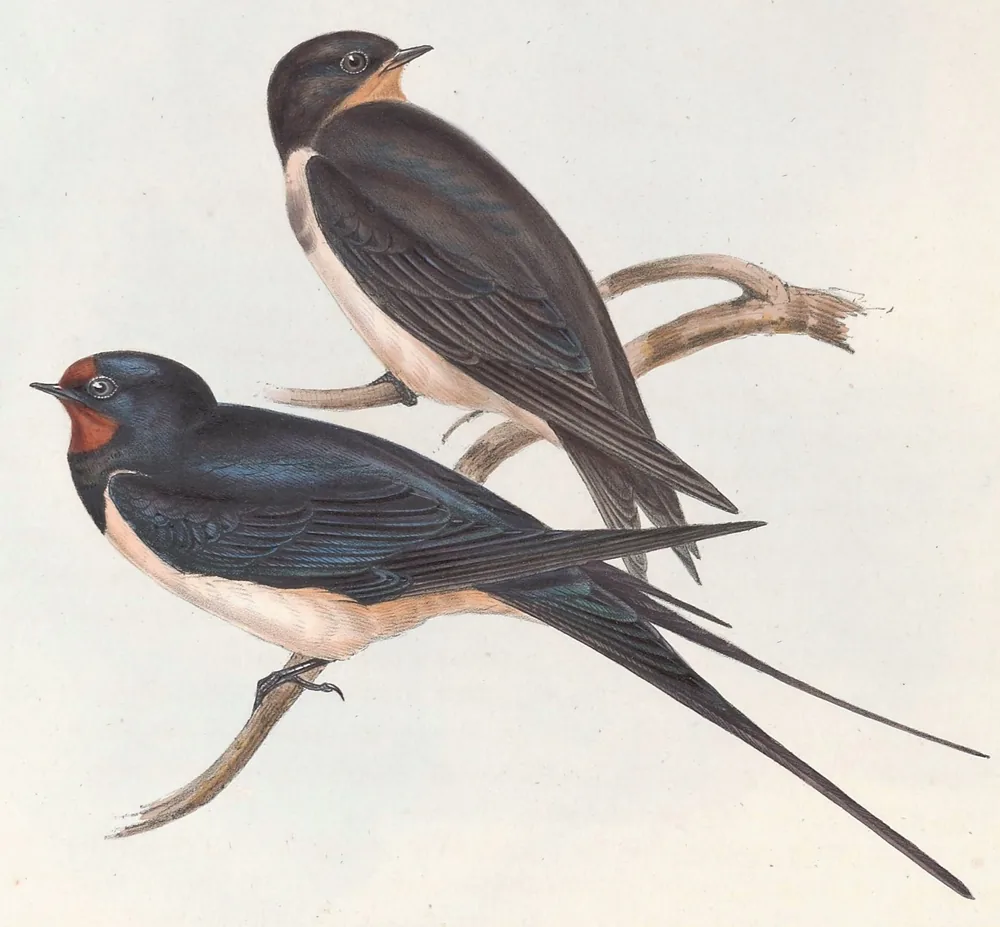
John James Audubon painted the Barn Swallow as plate 173 of The Birds of America (1827–38), a pair with their nest, under the same name. A free high-resolution scan is on Audubon.org. The swallows shown here are from John Gould's The Birds of Europe (1832–37), where he called them Chimney Swallows.
Updated
The story of this painting
John Gould and Audubon disagreed about this bird. In The Birds of Europe the pair is the Chimney Swallow, plate 54, and Gould wrote that the American Barn Swallow was by then generally held to be “quite distinct from the British species,” so his bird's range stopped at the edge of the Old World. Today they count as one species: AviList, the shared world checklist, calls them all the Barn Swallow.
In Britain, he wrote, it nests inside chimneys and down coal pits, and on the Continent on church towers, old ruins, eaves and barns. The first few arrive between the fifth and tenth of April, two broods follow, and in autumn the swallows gather in flocks and leave for Africa, the adults, he believed, ahead of their young.
The plate shows an adult and a young bird at life size; the young one lacks the long outer tail feathers, which it grows at its first molt. The lettering reads “Drawn from Nature & on stone by J. & E. Gould”: John Gould and his wife, Elizabeth.
Story: Gould, The Birds of Europe, vol. 2 (1837), plate 54; vol. 2 (1837), text to plate 54.
Audubon’s Barn Swallow: plate 173, “Barn Swallow”
On a summer afternoon, Audubon wrote, he liked to follow a swallow into a barn, lie down on the new-mown hay and watch: a nest on every rafter, a female on her eggs taking insects from her mate, a pair rebuilding a fallen nest with pellets of damp earth. Counting the young and doubling the nests for their parents, he made it more than a hundred birds.
They were hardy. Near Eastport, Maine, on May 7, 1833, he saw them hunting beside Cliff Swallows while ice still hung from the cliffs, and that June on the Magdalen Islands they were building in the open cupola of a church. In all his travels he never saw one nest in a chimney; the American Swift, today's Chimney Swift, he thought, kept them out.
To his ear the American bird sang exactly like the Chimney Swallow of England, down to the tweet it gives when flying off, and in 1839 he was still sure they were one species. His plate shows a pair in their best spring plumage with a nest taken from a rafter of a New Jersey barn that held at least twenty.
Story: Audubon, Ornithological Biography, vol. 2 (1834), pp. 413–419; vol. 5 (1839), p. 411. See plate 173 free at Audubon.org.
More classic portraits, free to see
- John James Audubon, The Birds of America, octavo edition (1840–44), plate 48: “Barn or Chimney Swallow”. Free scan (New York Public Library Digital Collections)
- John and Elizabeth Gould, The Birds of Europe (1832–37), plate 54: “Chimney Swallow” (the painting shown above). Free scan (University of Kansas Libraries)
- John Gould’s The Birds of Great Britain (1862–73), vol. 2, plate 5: “Swallow”. Free scan (University of Kansas Libraries)
- Louis Agassiz Fuertes, for Elon H. Eaton’s Birds of New York (1910–14), plate 88: “Barn Swallow”, with 5 other birds. Free scan (Internet Archive)
About the Barn Swallow
- Barn Swallows usually catch and eat their food on the wing. (Source: National Audubon Society)
When do Barn Swallows nest in Texas?
From late March to mid-August, and two or more broods are common. In a two-year study in Brazos County the first eggs were laid on March 27 and the last on July 20, and by August 8 no nest held eggs, the Texas Breeding Bird Atlas says.
Males arrive before the females and claim small territories with perches and places for a nest; then each male tries to lead a female to them in flight. Over 80% of the pairs in that study that raised a second brood used the same nest again, but the nests don't last until the next breeding season.
Why do Barn Swallows nest under bridges?
Because roads gave them places to build. Most of the Barn Swallow nests found for the Texas Breeding Bird Atlas were in highway culverts or under bridges, and the bird spread across Texas from the 1960s, a spread the atlas ties closely to road building. A map of its nests, it says, might easily pass for a road map.
In wilder places Barn Swallows once nested in shallow caves and on rock ledges, but the atlas's fieldworkers found no such nests. The mud cup is lined with horse hair, white chicken feathers or even nylon fishing line. Today the bird turns up in almost every part of the state.
Which other swallows nest under Texas bridges?
Cave and Cliff Swallows, which spread across Texas with the roads from the 1960s just as Barn Swallows did. Before the mid-1960s the Cave Swallow nested in Texas only in sinkholes on the Edwards Plateau and in caves in the Guadalupe Mountains; now most of its nests are in culverts and under bridges, the Texas Breeding Bird Atlas says.
The three can share a culvert, but they build differently. Cave and Cliff Swallows nest close together in colonies, and Cliff Swallows stack their nests on top of one another. Barn Swallows keep apart: where a culvert or a building holds several of their nests, they are spaced at regular intervals.
Sources: Texas Breeding Bird Atlas (Arnold, about 1993); Texas Breeding Bird Atlas (Arnold, about 1995).
How long does a Barn Swallow live?
Barn Swallows live 4 years on average, according to the Tennessee Wildlife Resources Agency. The oldest known wild Barn Swallow was at least 10 years old (USGS Bird Banding Laboratory): it was banded in Maryland in 2006 and found there again in 2015.
Sources: Tennessee Wildlife Resources Agency; USGS Bird Banding Laboratory. A banding record is the minimum age of one bird when it was found again, not a typical lifespan. How long do wild birds live?
How can you tell if a plate 173 print is an original?
By its size: an original plate 173 is a hand-colored sheet about 26 by 38 inches; the Barn Swallow’s octavo version, plate 48, is book-size, from 1840–44. Many prints sold today are reproductions: how to tell an original from a reproduction. Plate 173 and the other 434 also come bound in one modern book: which Birds of America book to buy.
In a Birdfolio hardcover, this painting sits beside the date and place you first saw a Barn Swallow. See your own list as a book, free.