The common black birds of US yards and towns are six: a European Starling (yellow bill in spring, white spots in winter), a Common Grackle (long tail, yellow eyes, blue-glossed head), a Brown-headed Cowbird (brown head), a Red-winged Blackbird (red shoulders), Brewer's Blackbird in the West (pale eyes) and the American Crow (big, all black). Below, each field mark people search for, and the bird it usually points to.
Black birds by field mark at a glance
Find the one thing you noticed, then read that bird's section below. Each bird is described in National Audubon's online guide, which gives every length on this page; the Pennsylvania Game Commission, the Montana Field Guide and the Texas Breeding Bird Atlas add the rest.
| Your black bird has… | It's usually a… | Where and when |
|---|---|---|
| A blue or purple sheen on the head, a long tail | Common Grackle | East and Midwest; all year in much of the East |
| A violet sheen on the head, whitish eyes, a shorter tail | Brewer's Blackbird (male) | The West; in winter also the Southeast |
| A brown head | Brown-headed Cowbird (male) | Coast to coast |
| A yellow bill and a short tail | European Starling | Most of the continent; the bill is yellow in the breeding season |
| White spots all over | European Starling | Fall and winter |
| An orange-yellow bill and a yellow eye-ring | Eurasian Blackbird | Europe; almost never in North America |
| An all-red head and white wing patches | Red-headed Woodpecker | Eastern North America |
| A bare red head; it soars with wings in a V | Turkey Vulture (adult) | Much of North America |
| A white belly and a white band at the tail tip | Eastern Kingbird | Summer; winters in South America |
| A white belly; it wags its tail by water | Black Phoebe | The Southwest and California |
| White wing patches, a spiky crest, red eyes | Phainopepla (male) | The desert Southwest |
| White wing patches; it sings in flight over grass | Lark Bunting (male) | The western plains in summer |
| Yellow eyes and a very long tail | Great-tailed or Boat-tailed Grackle | Texas and the Southwest; the Atlantic and Gulf coasts |
| Red shoulders | Red-winged Blackbird | Coast to coast |
What is the black bird with a blue head?
Usually a Common Grackle: the male is glossy black with "an iridescent bluish or purplish head, neck, and breast," says National Audubon's guide. At 11 to 13.4 inches it is a big blackbird, with whitish-yellow eyes and a long tail creased down the middle, and it strides about suburban lawns all over the East and Midwest. In the widespread form, the Bronzed Grackle, a "bronzy body contrasts with blue-black head." The Purple Grackle of the Southeast is glossed purple and green, with less contrast, and the female is less glossy than the male. How a grackle differs from a crow is laid out in grackle vs crow.
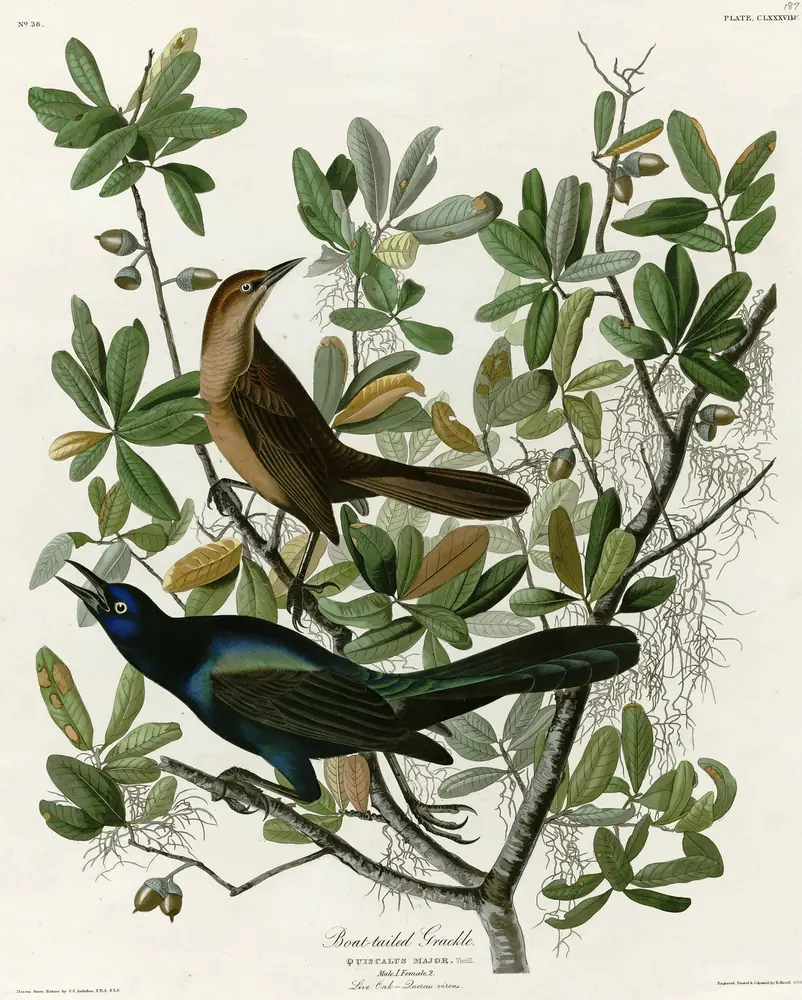
In the West, the blue-headed bird may be a male Brewer's Blackbird. In strong light he shows "violet iridescence on head and neck," the Montana Field Guide says, and looks "dusky-brown in duller lighting." Along the Atlantic and Gulf coasts there is a bigger one, the Boat-tailed Grackle, whose male reaches 15 to almost 20 inches; Audubon painted him with a deep blue head. Even a spring starling has a purple and green gloss.
Common Grackle or Brewer's Blackbird?
Look at the tail: Brewer's Blackbird is "shorter-tailed than Common Grackles," and smaller, 8.3 to 9.8 inches against 11 to 13.4. Both males have pale eyes, but the female Brewer's is "a dull gray-brown, with dark eyes." Brewer's walks with short forward jerks of its head and is, in Audubon's guide, "the common blackbird of open country in the West." In fall it spreads east, and its winter range takes in much of the Southeast.
What is the black bird with a yellow beak?
Most likely a European Starling in spring or summer: its bill is "bright yellow in breeding season," National Audubon's guide says. Up close, the base of the lower bill tells the sexes apart: blue in males, pink in females. Look also for the short tail, the thin, straight bill and a purple and green gloss on a bird 8.1 to 9.1 inches long. The bill turns duller in fall and winter, and the young starlings of summer are "all dusty gray, with dark bills."
Starlings aren't native here. Audubon's guide says they were brought to North America in 1890, and the Pennsylvania Game Commission traces today's population, more than 200 million, to 100 birds released in New York City's Central Park in the 1890s.
Two rarer yellow-billed birds keep to small corners of the country. In southern Florida, the Common Myna, a cage bird from southern Asia that now thrives in cities and suburbs there, is dark brown with a black hood, a yellow bill and bare yellow skin on the face. And in California's central valleys, the long-tailed, black-and-white Yellow-billed Magpie has "a bright yellow bill"; it lives only in California.
What is the black bird with an orange beak?
In a US yard, most likely a starling in spring, whose bill is bright yellow; an all-black bird with an orange-yellow beak is Europe's Blackbird, which almost never reaches North America. "Male Blackbirds are black with a bright orange-yellow beak and yellow eye-ring," says Britain's Royal Society for the Protection of Birds. The female is brown, often spotted and streaked on the breast. It's a thrush, and with over 5 million pairs breeding in the UK it is one of the commonest birds there. If you saw yours on a trip to Europe, that's your bird.
On this side of the Atlantic it's an accident. The American Birding Association's checklist gives the Eurasian Blackbird code 5, accidental: five or fewer records in its area, or fewer than three in the past 30 years. America's own blackbirds belong to another family, the Icteridae, "a group found only in the Americas," the Pennsylvania Game Commission notes. Of the six common black birds above, only the starling has a yellow bill (our reading of their descriptions).
Two all-black US birds do have orange or red on the bill, both by the sea. On bays and coasts in winter, the male Black Scoter, a 19- to 23-inch duck, is "all black except for the orange bill knob." And on rocky Pacific shores, the Black Oystercatcher is all black with an "oversized, bladelike red bill" and yellow eyes.
What is the black bird with white spots?
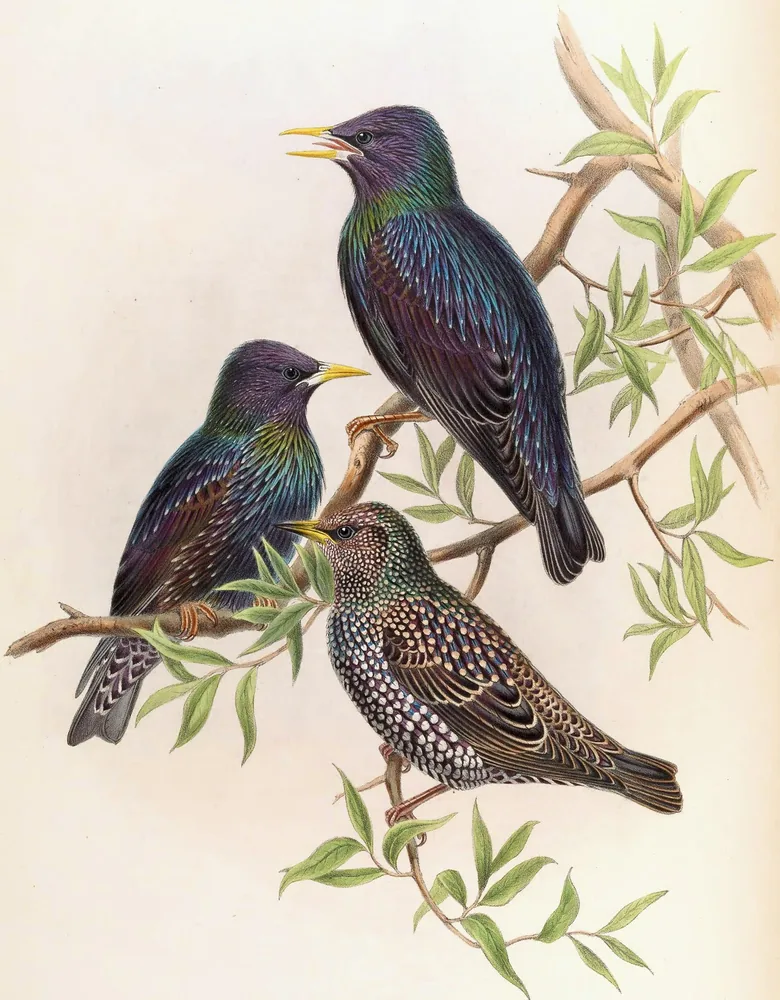
In fall and winter, a European Starling: in fresh fall feathers it is "heavily marked with white spots, which gradually wear off during winter," says National Audubon's guide. So the speckled bird at the feeder in November and the glossy, yellow-billed one singing in April are the same bird, as in the painting at the top. Starlings gather in immense flocks in fall and winter; in spring the males sing wheezing, sputtering songs laced with "perfect imitations of other birds."
In the West, a bird with a black hood, rusty sides and "bold white spots on back, wings, and tail corners," scratching under shrubs, is a Spotted Towhee, about 8¼ inches long. It used to be lumped with the Eastern Towhee as the Rufous-sided Towhee; here is what the western towhee is called now.
What is the black bird with a red head?
A black-and-white bird with an all-red head is a Red-headed Woodpecker; a huge black bird with a bare red head, soaring on wings held in a shallow V, is an adult Turkey Vulture.
The Red-headed Woodpecker is about 10 inches long and "patterned in solid black, white, and red, with big white wing patches," says National Audubon's guide. A young one has a brown head that turns red during its first winter. Our woodpecker guide sorts out Red-headed or Red-bellied and explains why it's now hard to find.
A Turkey Vulture is 25 to 32 inches long with a 6-foot wingspan, and a young one has a gray head, not a red one. The big black birds circling overhead are sorted out on our Turkey Vulture page, and the gray-headed look-alike on our Black Vulture page.
A crow-sized black woodpecker with a red crest and a white stripe down its neck is a Pileated Woodpecker, 16 to 19 inches. The male's forehead and mustache are red too; the female's are black.
What is the black bird with a white belly?
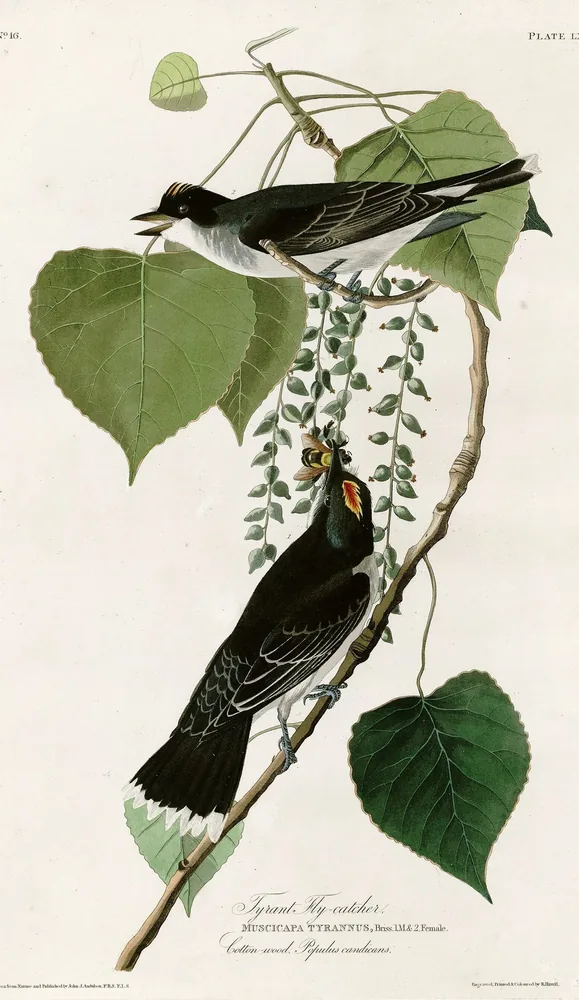
Often an Eastern Kingbird: blackish above, with "bright white underparts across the throat, chest, and belly" and a white band at the tip of its black tail. It perches on treetops and fence wires in summer and flies out to snatch insects. At 7.5 to 9.1 inches, it's the only widespread kingbird in the East, and its red, orange or yellow crown patch is "present but almost always concealed." It winters entirely in South America, so a black-and-white bird on a wire in December is something else.
Four more, by where you are:
- Near water in the Southwest and California: the Black Phoebe, "mostly dark charcoal gray, blacker on head, with white belly," 6.3 to 7.1 inches. It dips its tail down and up while perched.
- In eastern thickets: a male Eastern Towhee, black above with "rusty sides set off by white stripe down center of belly" and red eyes (white eyes in Florida). You'll often hear it scratching in dead leaves before you see it.
- Under the feeder in winter: the Dark-eyed Junco. East of the Plains they are "all gray and white," 6 inches long, flashing white outer tail feathers as they fly up.
- Over ponds and fields: the Tree Swallow, "dark above, clean white below," glossy blue or green on the back.
A small black-and-white bird climbing a trunk is a woodpecker: see the tiny black-and-white woodpecker.
What is the black bird with a white stripe on its wing?
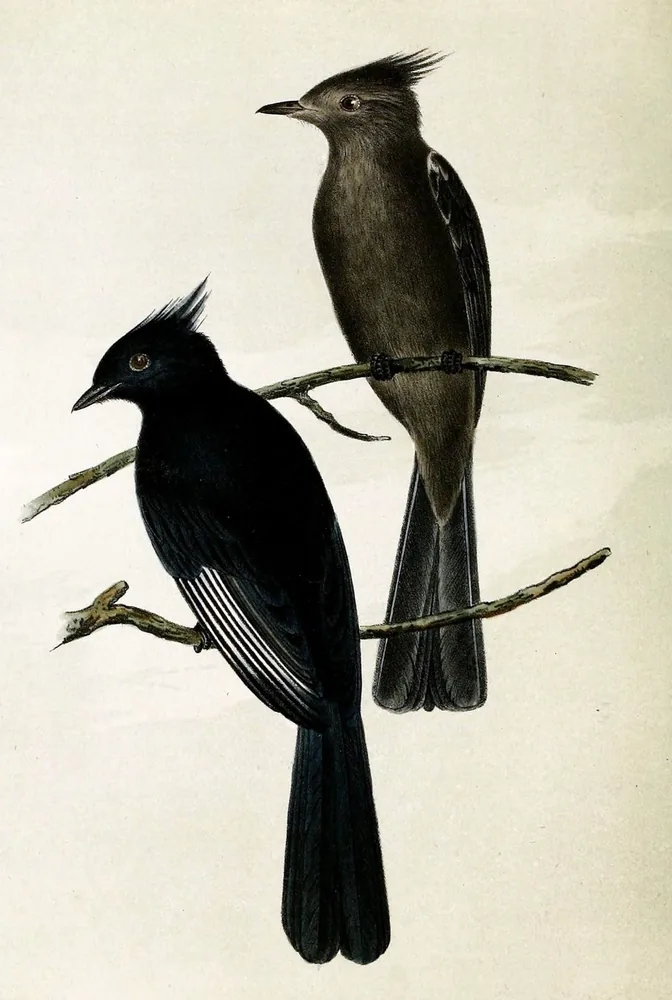
On a black-and-white woodpecker, the stripe is the Red-headed's big white wing patch; on a slim, crested black bird of the desert Southwest, it's a male Phainopepla, whose white wing patches are "visible mainly in flight."
The Phainopepla is 7.1 to 8.3 inches, with a spiky crest and red eyes; the female is gray. "In the desert southwest, Phainopeplas and mistletoe rely on each other," Audubon's guide says. The bird feeds heavily on mistletoe berries, and the seeds that pass through it often stick to branches of mesquite and other trees, where they can sprout new mistletoe.
Four others carry white on black wings:
- Lark Bunting. On the western plains in early summer the male is black with white wing patches and flutters up from the grass to sing. In winter both sexes look like chunky, big-billed sparrows. It has been Colorado's state bird since April 29, 1931.
- Bobolink. In spring the male is black below with much white on the back and a yellow nape. His plumage "looks like a tuxedo being worn backwards," the Pennsylvania Game Commission says, which earned him the nickname "skunk blackbird." Before fall migration he molts into streaky brown, then flies to southern South America for the winter.
- Black-billed Magpie. A long-tailed bird of the West, 18 to 24 inches, glossed green and blue, whose "big white wing patches flash out in flight."
- Rose-breasted Grosbeak. In eastern woods, a male with a black head, a rosy triangle on the chest and "big white spots in wings."
What is the black bird with yellow eyes?
Usually a grackle: Common, Great-tailed and most Boat-tailed Grackles have yellow eyes, as do Rusty Blackbirds, while a male Brewer's Blackbird's are whitish and a Red-winged Blackbird's dark.
- Common Grackle. "Whitish-yellow eyes," in Audubon's guide; young birds have dark eyes. The Texas Breeding Bird Atlas picks it out by "all-black plumage, yellow eye, and longer, but not conspicuously long tail."
- Great-tailed Grackle. "Very long tail, yellow eyes": the male is 18 to 23 inches, the female smaller and buff below. It is still spreading north. Why they crowd into Texas towns at night is on our Red-winged Blackbird page.
- Boat-tailed Grackle. From northeast Florida north, its eyes are yellow. Where it meets the Great-tailed on the Texas and Louisiana coast, it has dark eyes; in Texas most males are brown-eyed, the atlas says. Until the 1970s the two were counted as one species, and they share that coast without interbreeding. Except in Florida, it is seldom found far from tidewater.
- Rusty Blackbird. Dull black in the male, slaty in the female, with yellow eyes; in fall its feathers are edged rusty. It winters around wooded swamps, and some scientists believe it "may have declined by more than 80 percent in recent decades," Audubon's guide says.
What is the black bird with red wings?
Almost always a male Red-winged Blackbird, whose red shoulder patches are usually bordered with yellow. Our Red-winged Blackbird page also covers the look-alike of the Pacific states, the Tricolored Blackbird.
What is the black bird with orange on its wings?
Often a male American Redstart, a small warbler; a bigger black bird with color only at the shoulder is a Red-winged Blackbird. Sizes and the redstart's other patches are in the black bird with orange on its wings.
What is the black bird with red and yellow wings?
A male Red-winged Blackbird: on each shoulder he wears "a vivid red patch, or epaulet, bordered below by a stripe of yellow," the Pennsylvania Game Commission says. The female is streaky brown and looks nothing like him.
Crow, grackle or blackbird: how big was it?
Size sorts most black birds: an American Crow is 16 to 21 inches and "entirely black," a Common Grackle 11 to 13.4, a starling or Brewer's Blackbird about 8 to 10, and a male cowbird 7.5 to 8.7. The one surprise is the male Great-tailed Grackle, 18 to 23 inches, as long as a crow with its very long tail. For anything bigger than a crow, see crow vs raven; for the small black birds of Texas, our Red-winged Blackbird page.
What is the black bird with a brown head?
A male Brown-headed Cowbird, "glossy black, with contrasting brown head." The female is "plain dusty brown with dark, sparrowlike bill." Cowbirds build no nest: the female lays her eggs in other birds' nests, and Audubon's guide counts over 220 species she has used.
The paintings
The starlings at the top were drawn by John Gould and Henry Constantine Richter for Gould's The Birds of Asia (1850–83); the spotted bird in front shows a starling in fresh fall feathers. John James Audubon painted the Boat-tailed Grackles as plate 187 of The Birds of America and the Eastern Kingbirds, which he called the Tyrant Fly-catcher, as plate 79, catching a bee. William E. Hitchcock drew the Phainopeplas for John Cassin's book on the birds of California, Texas and the West (1853–56).
Once you've named it, a grackle counts as much as an eagle on a life list. A Birdfolio prints every bird you've seen, starlings included, beside a classic painting like these: here is what the pages look like.
Questions people ask
Is a starling a blackbird?
No. The blackbirds are the family Icteridae, found only in the Americas; the Pennsylvania Game Commission covers the starling alongside them because starlings often join their feeding flocks.
What are the huge flocks of black birds in winter?
Usually mixed flocks: in fall, grackles roost "along with starlings, red-winged blackbirds, and cowbirds," the Pennsylvania Game Commission says, and in southeastern Pennsylvania such winter flocks "may reach hundreds of thousands of birds." American Crows gather in winter roosts too, sometimes tens of thousands in one grove, says National Audubon's guide.
Is a black bird with a red eye a cowbird?
In Texas and the Southwest it may be: the Bronzed Cowbird has red eyes, "hard to see," in Audubon's words. Elsewhere, a black-hooded bird with red eyes scratching in leaves is more likely an Eastern Towhee, and a crested one in the desert a Phainopepla.