Yes. Birds are dinosaurs: they descend from small, feathered, meat-eating theropods, the group that also holds Tyrannosaurus rex and Velociraptor, and they are the only dinosaurs that lived through the asteroid strike of 66 million years ago. "Strictly speaking, all birds are dinosaurs," in the words of London's Natural History Museum. Below: the evidence, the dinosaurs birds came from, why no living bird is "closest," and how a few of them outlasted the rest.
Are birds dinosaurs?
Yes: by the way scientists classify animals today, a bird is a dinosaur just as a person is a mammal. The Australian Museum gives the logic in one line: people came from a mammal ancestor and are mammals, and birds "evolved from a dinosaur ancestor and are dinosaurs."
So the dinosaurs never fully died out. The ones that vanished are now called non-avian dinosaurs, which only means the dinosaurs that weren't birds, and the London museum counts "at least 11,000 bird species" alive today. Between the two it sees "no clear line," because bird features turned up one at a time in animals nobody would call a bird.
The case rests on several kinds of evidence, gathered over more than 160 years:
| Evidence | What was found | Reported by |
|---|---|---|
| Skeleton | Wishbones and hollow bones in theropods that were not birds | Australian Museum |
| Feathers | Sinosauropteryx, found in China in 1996, with a coat of simple feathers | Natural History Museum; Nature, 1998 |
| Nesting | An oviraptorid fossil in the Gobi Desert, sitting on its own eggs | Nature, 1995 |
| Sleep | Mei long, a small dinosaur preserved with its head tucked under a forelimb | Australian Museum |
| Reproduction | A bone tissue in a T. rex like one found only in female birds | Science, 2005 |
| Protein | T. rex collagen that grouped with a chicken's and an ostrich's | Science, 2008 |
The nesting fossil is the easiest to picture. The animal sat over its clutch "in the same posture taken by many living birds when brooding," Mark Norell and his colleagues wrote.
What dinosaur did birds evolve from?
From small meat-eating theropods, and within the theropods from the maniraptorans, the branch that also holds Velociraptor and Deinonychus.
Theropods walked on two legs, with three toes pointing forward on each foot. T. rex was one, but it was not an ancestor: the Natural History Museum says birds came "from small theropods, not huge ones like T. rex." A 2014 review in Science by Xing Xu and colleagues names the branch more exactly: the fossils "overwhelmingly support" a descent from maniraptoran theropods. The sickle-clawed dromaeosaurs, Velociraptor among them, sit on that branch close to the birds, the Australian Museum notes.
The change took a long time and ran in one direction: smaller. The London museum dates its start to "about 160 million years ago." A second 2014 study in Science, led by Michael Lee, followed body size down the line that leads to birds and found it shrinking "across 50 million years," through at least 12 steps in a row, while its skeleton changed four times faster than other dinosaurs' did. A small body, the authors wrote, made room for other novelties: bigger eyes, bigger brains and more ability in the air.
Along the way the bird features arrived separately. Feathers came early, in dinosaurs that lived long before the first birds. A toothless beak came late, about 120 million years ago by the London museum's reckoning.
Was Archaeopteryx the first bird?
It was the first one found, in Germany in 1861, but it is probably not the oldest, and many scientists now class it as a bird-like dinosaur.
Archaeopteryx lived about 150 million years ago and was about the size of a magpie. It had broad feathered wings and a wishbone, and also small sharp teeth, a long bony tail and claws on its hands. Nothing like it was known in 1861. "Some people even thought it might be an angel," the Natural History Museum writes; the museum bought the first full skeleton in 1862 and still shows it.
The timing mattered. Charles Darwin had published On the Origin of Species two years before the find, and here was an animal halfway between two groups. The idea that birds came from dinosaurs was first put forward in that decade, the Australian Museum says, then slowly fell out of favor.
Two discoveries brought it back. In 1964 John Ostrom and Grant Meyer found Deinonychus in southern Montana: an athletic hunter, nothing like the slow, lumbering reptiles of the older picture. And in the 1990s the feathered dinosaurs of China began to come out of the ground. Older bird-like animals have turned up since, among them Aurornis and Anchiornis from about 160 million years ago. Of Archaeopteryx, the paleontologist Daniel Field says only that "it is unambiguously a dinosaur."
Did dinosaurs have feathers?
Many did. The first was found in China in 1996: Sinosauropteryx, a small meat-eater with a coat of thin, hair-like feathers.
A fossil hunter named Li Yumin found it and sold his finds to two Chinese museums, the Natural History Museum relates. The scientists who described it in Nature in 1998 were careful, writing only of structures that "could provide information about the origin of feathers." Some researchers argued the fuzz was frayed collagen from under the skin.
Color settled it. In 2010 a team reported in Nature that the filaments hold melanosomes, the tiny packets of pigment that give feathers their color, which collagen fibers would not. From their shapes the team read the animal's colors: the dark bands on its tail were "chestnut to reddish-brown." Sinosauropteryx was the first dinosaur whose color pattern anyone worked out. It had a striped tail.
Feathers were not only for small dinosaurs. Yutyrannus, described in Nature in 2012, was an early tyrannosaur about 7.5 meters long, roughly 25 feet (our conversion), and bore "long filamentous feathers." It is "the biggest dinosaur that we're certain had feathers," says the London museum. Its name mixes Mandarin and Latin and means feathered tyrant.
Did T. rex have feathers?
Nobody knows: the patches of T. rex skin found so far show scales, and the Natural History Museum says there is "no direct evidence" of feathers. The museum leaves two doors open. A young T. rex may have had some, and the adult's back is the one place where no skin has been found. Yutyrannus lived where the yearly average was about 10 degrees Celsius, 50 degrees Fahrenheit (our conversion). T. rex lived in warm, humid country and was far bigger, so it may have had no use for a coat.
Did Velociraptor have feathers?
Yes, on its arms at least. In 2007 Alan Turner and two colleagues reported "quill knobs on the posterior forearm" of a Velociraptor from Mongolia (Science), and called them direct evidence of feathers. The animal was also smaller than its movie double. The Jurassic Park version was made at "twice its actual size" and modeled on Deinonychus, says the Natural History Museum.
Which bird is closest to a dinosaur?
No living bird is closer than another: all of them descend from one shared ancestor, so a hummingbird is as much a dinosaur as an ostrich or a chicken.
The dates show why. The most recent ancestor shared by every living bird probably lived "around 100 to 85 million years ago," says the Natural History Museum. T. rex lived 68 to 66 million years ago, by the same museum's dates. It was a late cousin on a side branch, and every bird alive stands at the same distance from it, the way you and your sister are equally related to a great-aunt.
The two famous answers, the chicken and the cassowary, come from two different kinds of evidence. Our page of bird world records has the short version.
Is a chicken really related to T. rex?
Yes, and so is every other bird; the chicken is the famous one because it was in the first protein test.
The test began with a T. rex thigh bone that John Horner of the Museum of the Rockies found in 2003. Two years later Mary Schweitzer reported soft tissue inside it, including "transparent, flexible, hollow blood vessels" (Science, 2005). In 2007 John Asara's team used mass spectrometry to read short stretches of protein from the 68-million-year-old bone. In 2008 Chris Organ compared them with the same protein in 21 living species, the Harvard Gazette reported, and "the T. rex groups with birds," his paper says. It matched the chicken and the ostrich better than the alligator or a lizard.
The limits are plain. "We only had six peptides," Organ told the Gazette, 89 amino acids in all, and no DNA could be recovered. Organ expected that more data would put T. rex on a branch between the alligators and the two birds, a position six fragments could not settle.
The same skeleton gave up one more secret. Lining its leg bones was a tissue that Schweitzer's team matched to the medullary bone of birds. "Medullary bone is unique to female birds," they wrote in 2005, so this T. rex was very likely a female.
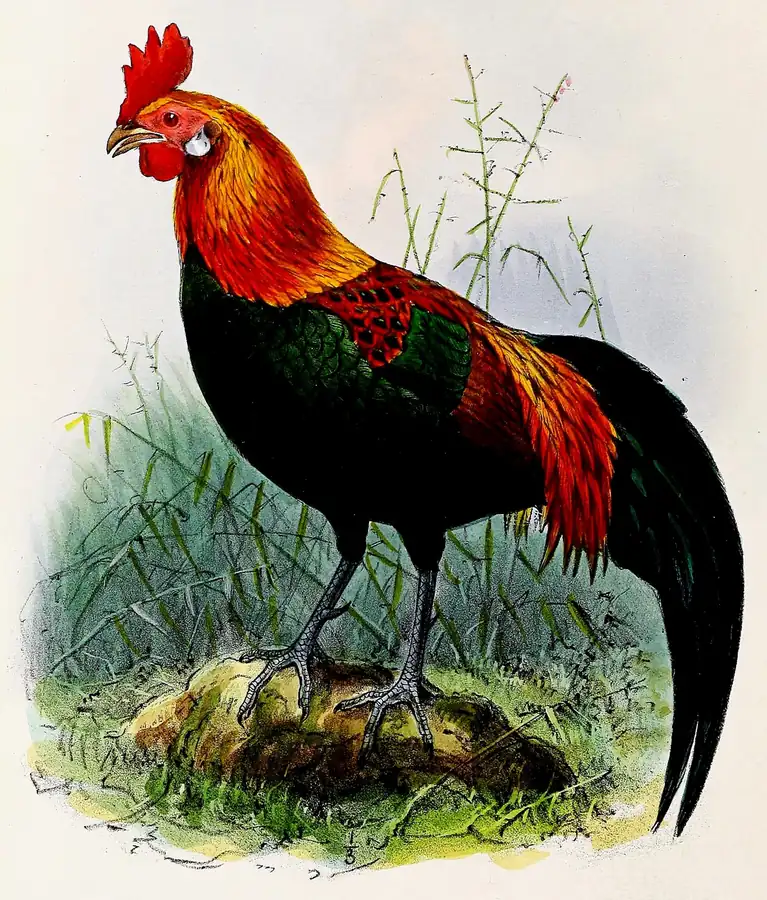
As for the chicken itself, a 2020 genome study in BMC Biology calls the Red Junglefowl "the main ancestral species." Two US states have picked a chicken as their official bird, Delaware and Rhode Island.
Is the cassowary the closest thing to a living dinosaur?
It looks the part, but it is no nearer to the extinct dinosaurs than a sparrow is.
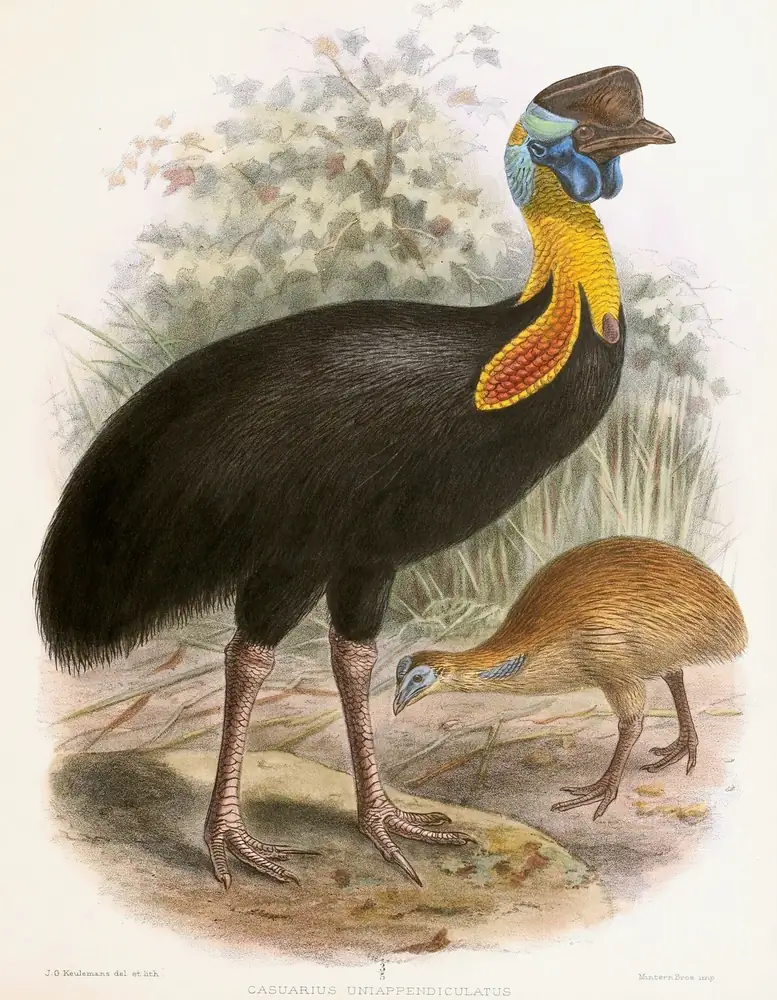
The looks are real enough. A Southern Cassowary has a tall helmet called a casque, black feathers that the Australian Museum describes as "hair-like," and on each foot an inner claw that is "elongated and very sharp." In 2017 a team naming a new dinosaur from Ganzhou in China, Corythoraptor, wrote that it had "a distinct cassowary-like crest on the skull" (Scientific Reports). They cut into the helmets of modern cassowaries, the Northern Cassowary at the top of this page among them, to work out how the dinosaur's crest was built and what it was for: display and communication, they proposed.
But Corythoraptor was an oviraptorid, not an ancestor of cassowaries. The paper calls the likeness "convergent," meaning the two animals arrived at the same shape separately.
How did birds survive the asteroid?
Barely, and partly by luck: the asteroid that struck 66 million years ago brought down the world's forests, the tree-dwelling birds died out with them, and the few lines that came through were small ground-dwellers.
The asteroid was 10 to 15 kilometers wide, about 6 to 9 miles (our conversion), and left a crater 150 kilometers across off the coast of Mexico, says the Natural History Museum. About three-quarters of all animals died out.
What it did to birds was worked out in 2018, from pollen. A team led by Daniel Field looked at rock laid down just after the impact in New Zealand, Japan, Europe and North America. First comes charcoal from burnt trees. Then come fern spores in huge numbers, the mark of ground with no forest left on it. "Perching birds went extinct because there were no more perches," said Regan Dunn of the Field Museum in Chicago, one of the authors.
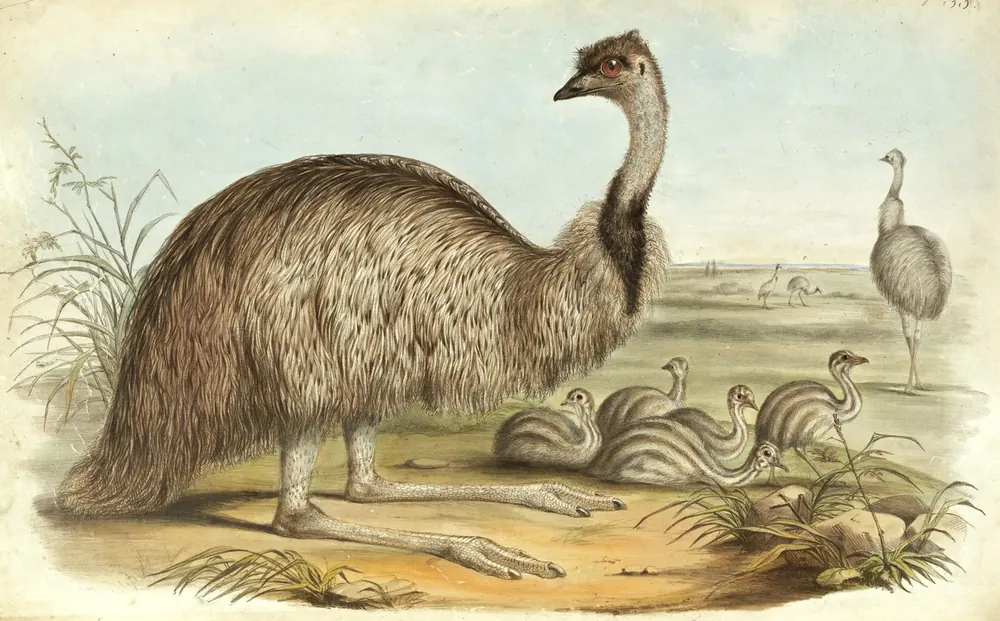
The survivors were ground birds, with "longer, sturdier legs" of the kind kiwis and emus have now, the museum's account of the study says. The ancestors of today's tree birds went back up only once the forests had regrown. So the robin on a branch descends from birds that, for a while, had no branches to sit on.
Three lines made it, by the London museum's count: the landfowl and waterfowl, the ostrich's kin, and one more that now holds "almost 95% of all living birds." Small bodies, a wide diet and flight all helped, the museum says. Field adds a fourth cause: "I think luck is a really important part of the story."
What is the wonderchicken?
Asteriornis maastrichtensis, a 66.7-million-year-old bird from Belgium and the oldest fossil of a modern bird found so far (Nature, 2020).
It did not look like much: a few leg bones poking out of a rock "the size of a deck of cards," the University of Cambridge reported. A CT scan showed a nearly complete skull lying a millimeter under the surface. Field called it "the most exciting moment of my scientific career."
The skull is a "mash-up" of a chicken and a duck, he said, which places the bird near the common ancestor of both; our guide to the types of ducks covers the living half of that family. It was small, it lived on the ground near a seashore, and it lived, the London museum notes, "just 700,000 years before" the impact. The team named it for Asteria, the Greek goddess of falling stars, who in the myth turns herself into a quail.
Are crocodiles related to birds?
Yes: crocodiles and alligators are the closest living relatives of birds, and both belong to the archosaurs.
A 2014 genome study in Science defines the archosaurs as "the group that includes crocodilians, dinosaurs, and birds." Lizards, snakes and turtles split away earlier, so a crocodile is nearer kin to a robin than to a lizard, as Arizona State University's Ask A Biologist explains. The T. rex protein agreed: it sat with the birds first and the alligator second.
The two lines have moved at very different speeds. That genome study found crocodilians changing at "an exceptionally slow rate," and judged the fast pace of birds to be the newer habit.
Why aren't birds called reptiles?
Habit, mostly: the everyday word comes from an older system that sorted animals by what they are like, scaly and cold-blooded, and under it a warm, feathered bird is no reptile; sorted by ancestry, it is one.
Ask A Biologist sets the two systems side by side. Linnaeus, in the 1730s, grouped animals by their features. In the 1940s Willi Hennig proposed grouping them only by descent, and on that plan the answer is short: "Yes, birds are reptiles."
Neither system is wrong, the same page argues, and it borrows a kitchen to show why. Sort a pantry by ancestry and everything made from peanuts shares a shelf. Sort it for cooking and the oils go together. Scientists tracing relationships use the first. The rest of us, wondering what an animal is like to meet, mostly use the second. The Natural History Museum does both at once, calling the dinosaurs reptiles and the birds dinosaurs.
When did scientists work out that birds are dinosaurs?
The idea dates from the 1860s, but it was the fossils found from 1964 onward, the feathered ones above all, that brought it back.
| Year | What happened |
|---|---|
| 1861 | Archaeopteryx is found in Germany |
| 1860s | Scientists first suggest that birds came from dinosaurs |
| 1964 | Deinonychus is found in Montana; it is named in 1969 |
| 1995 | A dinosaur is reported sitting on its nest (Nature) |
| 1996 | Sinosauropteryx, the first feathered dinosaur, is found in China |
| 2005 | A bone tissue known only from female birds is reported in a T. rex (Science) |
| 2007 | Protein is read from a T. rex bone; Velociraptor's quill knobs are reported (Science) |
| 2008 | The T. rex protein is placed beside the chicken's and the ostrich's (Science) |
| 2012 | Yutyrannus, a 25-foot feathered tyrannosaur, is named (Nature) |
| 2018 | The forest-collapse study explains which birds survived (Current Biology) |
| 2020 | The wonderchicken is described (Nature) |
For the whole story at book length, the paleontologist Steve Brusatte's The Story of Birds is on our list of the best bird books.
The paintings on this page
All three plates are older than the first feathered dinosaur fossil. John Gerrard Keulemans drew the Northern Cassowary for Walter Rothschild's monograph on the cassowaries, printed in 1900, and the Red Junglefowl for his own Dutch book on the birds of house and garden. The Emu is by Benjamin Waterhouse Hawkins, drawn on the printing stone for John Gould's The Birds of Australia. More plates by these and other painters are on our bird paintings pages. A Birdfolio prints the birds you have seen yourself beside art of this kind: a book of your own living dinosaurs.