This is a plain-English dictionary of birding terms and slang, from lifer, a bird you see for the first time, to nemesis bird, the one that keeps getting away. First come the questions people ask most, then 80 words from A to Z, each with a short meaning and, where a good source records it, where the word came from.
Key facts
- "Birder" is American and "twitcher" is British. The Oxford English Dictionary's earliest "birder" is from Audubon Magazine in 1945; its earliest "twitcher" is from The Guardian in 1974 (as reported by Wordnik).
- "Life list" goes back to 1900, "lifer" to 1958 and "tick" to 1975, by the same dictionary's dates.
- Audubon magazine's dictionary for birders (2015) defines a nemesis bird as "a species that constantly eludes a birder."
- The American Birding Association rates every bird on its list from Code 1 to Code 6, from widespread to no longer found.
- "Lifer Pie" was named in a small-town Ohio restaurant, by Kimberly Kaufman, a co-founder of the Biggest Week in American Birding festival (Audubon magazine, 2019).
Facts checked: November 19, 2026.
What is a lifer in birding?
A lifer is a species of bird you see, or hear and identify, for the first time in your life. It goes onto your life list, and it usually makes the day. Audubon magazine's dictionary for birders puts it simply: "a first-time sighting for a birder." Birders also call it a life bird.
The word is older than most people guess. According to Wordnik, which quotes the Oxford English Dictionary, "life list" dates to 1900 and "lifer" to 1958.
Some birders celebrate on the spot. Madison Audubon's 2020 guide to birding lingo says the lifer dance is real, and that its writer has one.
What counts as a lifer?
That's up to you, but many birders in the US and Canada use the American Birding Association's rules: the bird was alive, wild and unrestrained, and you saw or heard enough of it to be sure which species it was. A bird in a zoo or a cage doesn't count, and neither does a hybrid. More in what counts on a life list.
What is a nemesis bird?
A nemesis bird is a species you have looked for again and again without ever seeing it, often while everyone around you seems to find it easily. Audubon's dictionary calls it "a species that constantly eludes a birder." It needn't be rare; it just has to keep slipping away from you.
How many misses make a nemesis? Nobody agrees. When Nicholas Lund, who writes Audubon's Birdist column, asked birders in 2016, most said a few failed tries were enough, and about a quarter judged by the miles they had driven. His own first nemesis was the Peregrine Falcon, which took him a full year of searching. In the same column, the birder and author Noah Strycker named the Common Grackle. Across most of the United States, he wrote, grackles may be "trash birds," but they are "very rare" in his home state of Oregon.
British birders have their own word: a bogey bird (the Fatbirder glossary spells it "boggie"), a bird that isn't especially rare but that you've never managed to see, usually after missing it many times.
What does "dip" mean in birding?
To dip is to go looking for a particular bird and miss it. Audubon's dictionary defines it as "to miss out on a high-priority bird." You'll also hear "dipped out" or "dipped on," and the bird you missed can itself be called a dip, according to Wordnik's guide to birding words.
Dipping usually comes with a chase. You hear about a rare bird, you drive for hours, and it left ten minutes before you got there. Lund describes the dread of every rarity chase: birds, he writes, "don't leave itineraries." Madison Audubon takes the gentler view that it happens to every birder, and it gives you stories to swap.
If someone else saw the bird you dipped, a British birder would say they gripped you off.
What is a twitcher?
A twitcher is a birder who travels, often far and at short notice, to see a rare bird that someone else has found, mostly to add it to a list. The word is British. The Oxford English Dictionary's first example is a 1974 article in The Guardian about Britain's "tick-hunters" or "twitchers," and Wordnik's guide says the word may come from "the nervous excitement of a birdwatcher." Other origin stories go around; we found none in a source we could check.
The trip itself is a twitch. Audubon's Birdist column calls it "a rarity chase, aka a 'twitch,'" and says a true twitch means a long trip on short notice. Many American birders simply say they're going to chase a bird.
Twitcher vs birder: what's the difference?
A birder is anyone who enjoys watching wild birds; a twitcher is a birder who chases rare birds for a list. So every twitcher is a birder, but most birders aren't twitchers.
"Birder" is the American word. The Oxford English Dictionary's earliest example comes from Audubon Magazine in 1945: "As a birder and a soldier, I've wandered up and down the country." "Twitcher" came later, and from Britain (Wordnik).
Some people draw a second line, between "birders" and "birdwatchers." Freya McGregor, writing in Audubon magazine in 2021, notes that "birding" caught on in North America in the 1970s along with listing and Big Years, citing Scott Weidensaul's history of American birding, which is why it can sound more competitive. Her suggestion is to define birding as "the act of enjoying wild birds" and call everyone who does it a birder. Britain's Fatbirder glossary places the birder between the obsessive twitcher and the easygoing dude.
What is patch birding?
Patch birding means birding one place near home over and over: a town park, a pond, a bend of a river, or just your street. That place is your patch, and the species you've seen there make up your patch list. It's about knowing one place well through every season, rather than traveling for new birds.
How to choose a patch, what to note on each visit and how to read your records over the years: see our local patch guide.
What is a lifer pie?
A lifer pie is a slice of pie eaten to celebrate a lifer. Any flavor counts. What makes it lifer pie is the reason you're eating it.
The custom started at Blackberry Corners, a family restaurant in Martin, Ohio, near Magee Marsh, where birders gather each May for the Biggest Week in American Birding festival. Audubon magazine traced the name to Kimberly Kaufman, a co-founder of the festival and then director of the nearby Black Swamp Bird Observatory. Meeting a friend there who was eating pie after a good day of birding, she said: "It's like, life-bird pie." The owner, Brenda Lowe, once baked more than 300 pies in a single Biggest Week, each one from scratch. According to Kenn Kaufman's book A Season on the Wind, birders as far away as Australia now mark new birds with a slice of lifer pie.
What is an armchair lifer?
An armchair lifer is a new species on your life list that you gain without going anywhere, because scientists split a bird you had already seen into two or more species. In Britain it's an armchair tick.
Kate St. John, who writes the Pittsburgh blog Outside My Window, checked her list at the end of October 2025 and found it had grown from 1,569 to 1,574 species: five armchair lifers from eBird's yearly update. Among them were the Whimbrel, the Warbling Vireo and the Yellow Warbler.
It can work the other way, too: when two species are lumped into one, a bird can drop off your list. Why lists change, and what happens to your records: bird splits and lumps, with every recent change on our splits and lumps page.
What do the ABA codes mean?
They are the American Birding Association's rating of how hard each bird on its list is to find in the US and Canada, from Code 1, the most widespread, to Code 6, birds that can no longer be found there. They appear on the ABA Checklist, the official list of birds recorded in the region.
| Code | What it means (the ABA's words, shortened) | The ABA's example |
|---|---|---|
| 1 | Regular: widespread and usually numerous | American Robin |
| 2 | Regular, but with a restricted range, in low numbers, or secretive | Spectacled Eider |
| 3 | Rare: very low numbers, but every year | Ferruginous Pygmy-Owl |
| 4 | Casual: not every year, but six or more records, three or more of them in the past 30 years | Black-tailed Gull |
| 5 | Accidental: five records at most, or fewer than three in the last 30 years | Amazon Kingfisher |
| 6 | Cannot be found: probably or actually extinct or gone from the region, or only in captivity | none given |
Birders call a Code 4 or 5 bird a mega. When Oregon State University researchers studied rarity-chasing in 2021, the "mega-rarities" they followed were exactly those: 81 species rated 4 or 5. How many species the whole list holds, and why other sources give other totals: how many species the US and Canada have.
Birding words from A to Z
Each word in a line or two; the longer stories are linked. Old country names for birds, such as fish hawk, mud hen and timberdoodle, have their own page: bird nicknames.
A
- ABA: the American Birding Association, the organization that keeps the official list of birds for the US and Canada, the ABA Checklist, and the listing rules many birders follow.
- ABA Area: the region those lists cover: the lower 48 states and Alaska, Hawaii, Canada, St. Pierre and Miquelon (two small islands that belong to France), plus the ocean out to 200 miles, or to the halfway line where a neighbor is nearer (ABA Recording Rules).
- Accidental: a bird far from its usual range that has turned up only a handful of times; on the ABA Checklist, Code 5 (the codes).
- Alpha code: a four-letter short form of a bird's English name, such as AMRO for American Robin and NOCA for Northern Cardinal. Bird banders have long used them, and the Institute for Bird Populations publishes the list and updates it every year. Also called a banding code.
- Armchair lifer: a species added to your list by a split, not by a sighting; in Britain, an armchair tick (see above).
B
- Big Day: a try at finding as many species as possible in one day. The records are in birding records, and a day anyone can join is October Big Day.
- Big Sit: a day's count of all the birds seen or heard from one small circle. How it works: The Big Sit!
- Big Year: a year-long try at the most species you can find, January to December, in an area you choose. The rules and records: Big Year birding.
- Bins: short for binoculars; you'll also hear "binos" and "binocs" (Madison Audubon).
- Birdathon: a Big Day that raises money: teams count birds and collect pledges for conservation (US Fish and Wildlife Service).
- Birder: someone who enjoys watching wild birds. American English, first recorded in 1945 (see above).
- Birding by ear: finding and naming birds by their songs and calls. For some look-alikes, such as the empids below, it's the surest way.
- Blocker: British slang for a bird that has turned up in the country only once, or not for many years, so anyone who missed it has little hope of adding it. When it finally comes back, it's "unblocked" (Fatbirder).
- Bogey bird: the British nemesis bird (see above).
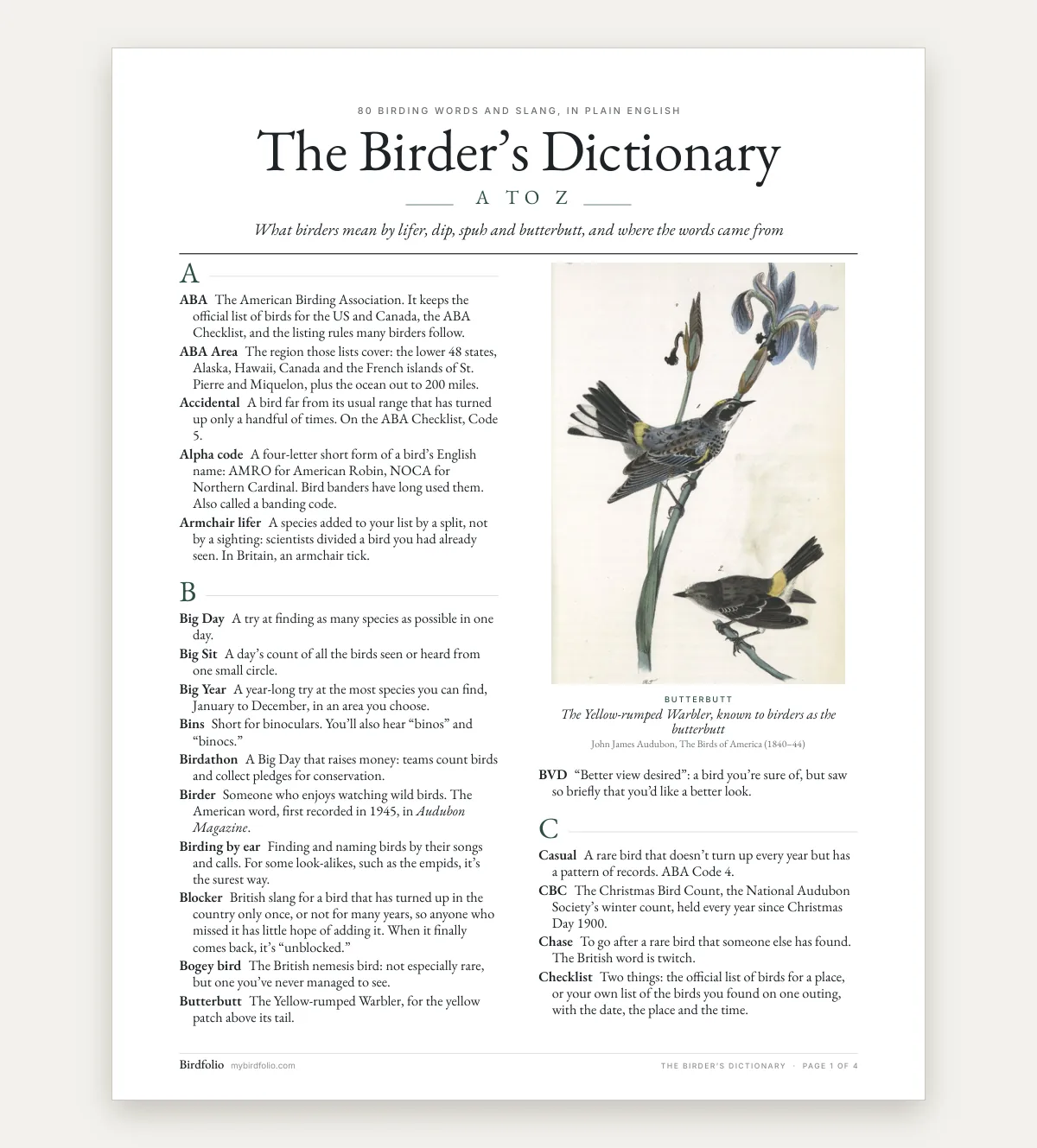
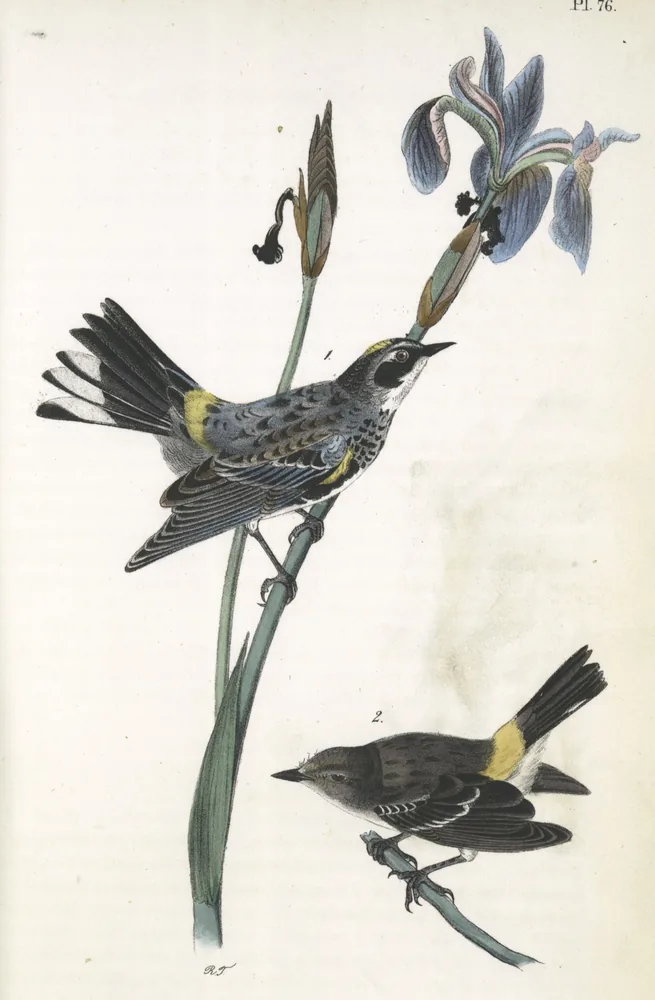
- Butterbutt: the Yellow-rumped Warbler, for the yellow patch above its tail (Audubon; BirdNote). Here is Audubon's painting of it.
- BVD: "better view desired": a bird you're sure of, but saw so briefly that you'd like a better look (Fatbirder).
C
- Casual: a rare bird that doesn't turn up every year but has a pattern of records; ABA Code 4.
- CBC: the Christmas Bird Count, the National Audubon Society's winter count, held every year since Christmas Day 1900.
- Chase: to go after a rare bird that someone else has found. The British word is twitch.
- Checklist: two things. The official list of birds for a place, such as the ABA Checklist; or your own list of the birds you found on one outing, with the date, the place and the time.
- Code 1 to Code 6: the ABA's rarity codes (the table above).
- Confusing fall warblers: warblers in their duller autumn feathers. The phrase is Roger Tory Peterson's: his first field guide, in 1934, gave them pages of their own, with 27 birds he called confusing (Bob Duchesne, Bangor Daily News, 2012). The Yellow-rumped Warbler is one of the worst offenders.
- Countable: allowed on your list under the rules you follow. Under the ABA's, the bird has to be alive, wild and unrestrained, and named to species by sight or sound. Hybrids don't count, and neither do birds brought or released by people, unless they belong to a population the ABA accepts as established.
- County list: every species you've seen in one county. Lists for a yard, a patch, a county or a state are all in year list birding.
- Crippler: British slang for a rare bird so beautiful, or so big, that it leaves you weak at the knees (Fatbirder).
D
- Dip, dipped out: to miss the bird you went to see (see above).
- Dirty bird: in New Jersey's World Series of Birding, a bird that not every team member saw or heard. At least 95 percent of a team's birds must be identified by everyone (Audubon magazine, 2018).
- Dude: a British twitchers' word, said "dood," for a casual birder who likes fine weather and pleasant places and is happy with common birds (Fatbirder).
E
- Empid: any of the small olive flycatchers in the genus Empidonax, "called empids out of either affection or frustration" (10,000 Birds). They look so alike that voice is the best clue. The Willow and Alder Flycatchers were counted as one species, "Traill's Flycatcher," until 1973 (Kenn Kaufman, Audubon magazine, 2024).
- Endemic: found in one region and nowhere else (Audubon's dictionary).
- Escape: a cage or zoo bird living loose. It isn't "wild" under the ABA's rules, so it doesn't count.
F
- Fallout: when bad weather forces a flood of migrating birds to land all at once. Fallouts happen with some regularity on the Gulf coast, the first land many tired migrants reach, and High Island, Texas, is famous for them (Nicholas Lund, Audubon, 2017).
- Field mark: a feature that sets a bird apart from its look-alikes: a wing bar, an eye-ring, a tail pattern.
- FOY, FOS: first of year and first of season, the first time this year, or this season, that you see a species. "FOY" fills birders' reports each spring (David Spector, Hitchcock Center for the Environment, 2016), and "FOS" is common on birders' blogs (Golden Gate Bird Alliance). The very first bird of all: first bird of the year.
G
- GBBC: the Great Backyard Bird Count, held every February since 1998.
- GISS, or jizz: a bird's overall look, its shape, size, posture and way of moving, that lets you name it at a glance before you see any detail. Many birders write it GISS and read it as "general impression of size and shape," but the word was in print by 1922, in T. A. Coward's Bird Haunts and Nature Memories, which credits an Irishman from the west coast who named wild creatures "by their 'jizz'." Coward later suggested it came from old spellings of "guise" (10,000 Birds, 2011).
- Gripped off: British slang for being beaten to a bird: someone grips you off when they see the bird you missed (Wordnik; Fatbirder).
H
- Hawk watch: a lookout, often on a ridge or a coast, where people count migrating hawks, eagles and falcons. Pennsylvania's Hawk Mountain, founded in 1934 by Rosalie Edge after she saw what heavy hawk shooting was doing on the Kittatinny Ridge, calls itself the first refuge for birds of prey. Its counts are on our Pennsylvania birds page.
- Heard-only: a bird you identified by its voice alone. Under the ABA's rules it counts; some birders mark these birds on their lists (does a heard-only bird count?).
- Hotspot: a place known for good birding, which many birders visit and report from.
I
- Irruption: a winter when northern birds, such as finches, come south in large numbers, usually because their food ran short up north. See this year's Winter Finch Forecast.
K
- Kettle: a flock of hawks circling together in the sky on migration. Broad-winged Hawks pour south in kettles each fall (hawk vs falcon).
L
- LBJ: "little brown job": any small, streaky brown bird that's hard to tell from the others, often a sparrow. Audubon's dictionary calls it "a blanket term for drab songbirds that are difficult to distinguish"; BirdNote also uses LBB, "little brown bird."
- Life bird: another word for a lifer.
- Life list: every species you've ever identified, by sight or sound, each counted once. The full story: what is a life list?, and life list vs year list.
- Lifer: your first sighting of a species (see above).
- Lifer dance: a small celebration on the spot when you see a lifer. Madison Audubon says it's a real thing.
- Lifer pie: a slice of pie for a new bird (see above).
- Lister: a birder who keeps lists and enjoys watching them grow: life, year, state, county or yard. Some chase hard; others simply like keeping count.
- Lump: when scientists merge two or more species into one. See bird splits and lumps.
M
- Mega: a very rare bird, the kind that sends birders running; also a mega-rarity or a mega-tick (Wordnik). Fatbirder calls it a good tick "not just for you, but also for any birder."
- Migrant trap: a patch of trees or shrubs, often on a coast, where tired migrants drop in to rest and feed. Lund calls High Island "a migrant magnet on the coast of Texas."
N
- Nemesis bird: the bird that keeps getting away (see above).
O
- Owling: going out at night to look and listen for owls.
P
- Patagonia Picnic Table Effect: the belief that one rare bird draws so many birders that they find more rare birds nearby (Audubon's dictionary). It's named for a rest area near Patagonia, Arizona, where a rarity found in the 1960s or 1970s brought birders who went on to find more. In 2021, Oregon State University researchers checked it against 273 discoveries of very rare birds over ten years, found "little support," and called it "a really fun myth."
- Patch: the place near home you bird again and again (see above).
- Peeps: the small sandpipers (BirdNote).
- Pelagic: of the open ocean (Audubon's dictionary). As a noun, a boat trip far offshore to see seabirds.
- Pish, pishing: a hushing "psssh, psssh" sound birders make to draw small birds out of cover. It copies the harsh scolding calls songbirds give when they spot an owl or hawk, so curious birds come to look. Lund names warblers, wrens, sparrows, kinglets and nuthatches as the birds most likely to answer, and his rule of thumb is to stop once you've identified the bird (Audubon, 2016).
- Playback: playing a recording of a bird's song or call to draw it in. Madison Audubon's guide says never to use it in the breeding and nesting season, and to use it sparingly at other times.
R
- Raptor: a bird of prey: hawks, eagles, falcons, kites, the Osprey and owls. Some birders write BOP, "bird of prey" (Wordnik).
- Rare bird alert: a list, page or group where birders report rare birds as they're found. Where to find your state's: rare bird alerts.
- Review species: a bird so rare in a state that its records committee asks for a description or photos before accepting a report. Each committee keeps a review list; see rare bird alerts.
S
- Seawatch: watching the sea from land, often for hours, as seabirds fly past.
- Siesta time: the middle of the afternoon, when most birds go quiet and out of sight (Audubon's dictionary).
- Slash: a record of a bird that was one of two species, without knowing which, written with a slash: "Greater/Lesser Yellowlegs."
- SOB: "spouse of birder." Audubon's dictionary, tongue in cheek, defines it as someone who has had "the misfortune of pledging their life to a birder."
- Spark bird: the bird that got you hooked on birding. The full story: what is a spark bird?
- Split: one species divided into two or more by the scientists who keep the lists. See bird splits and lumps.
- Spuh: a bird you could name only to its group, such as "gull sp." or "duck sp." The "sp." is short for species, and said aloud it becomes "spuh." It doesn't add a species to your list; in a Birdfolio, spuhs and slashes go on an "also recorded" page.
- Stakeout: a rare bird that stays in one known place for days or weeks, so birders can come and see it.
- Stringer: a birder who reports rare birds they didn't really see, or keeps mistaking common birds for rarities. Wordnik calls it possibly "the worst insult in birding," and says nobody is sure where the word came from. Fatbirder calls a doubtful claim "stringy."
T
- Tick: a species added to a list; to tick a bird is to see it and count it. The Oxford English Dictionary dates this sense to 1975 (Wordnik).
- Trash bird: some birders' name for a species so common where they live that they stop looking at it. Many now avoid the term. Writing for The Nature Conservancy in 2022, Lauren Pharr noted that the birds called "trash" include the Northern Cardinal and the House Sparrow, and that a beginner's excitement over a common bird is worth encouraging. One birder's trash bird can be another's nemesis: see the grackle above.
- Twitch, twitcher: a long trip at short notice for a rare bird, and the birder who makes it (see above).
V
- Vagrant: a bird far outside its normal range, "straying well outside of the regular ecological range," in Audubon's words. Madison Audubon's examples from Wisconsin in 2020: a Mexican Violetear, a hummingbird that belongs far to the south, and a Ruff, a shorebird from Eurasia.
W
- Warbler neck: the sore neck you get from staring up into the treetops for warblers. Christian Cooper describes it in his memoir Better Living Through Birding (A Way with Words, 2024).
- World Series of Birding: New Jersey Audubon's 24-hour birding contest and fundraiser. It began at midnight on May 19, 1984, with 13 teams.
Y
- Yard list: every species you've seen from your home and yard. A yard is one kind of patch (local patch).
- Year list: the species you find between January 1 and December 31; it starts from zero each new year. See year list birding.
Every lifer, in one book
Most of these words lead back to a life list: the lifers, the nemesis birds you finally found, the rarities you chased. A Birdfolio binds that list as a hardcover, with a classic bird painting next to each of your species: find out what goes in the book.
Birdfolio is not affiliated with eBird, the Cornell Lab of Ornithology or iNaturalist.