Guide
What is a life list?
A life list is every species of bird you have ever seen or heard and identified, each counted once. A new species on it is a lifer. Most birders note three things for each one: the species, the date and the place. You can keep yours in an app, a notebook or a spreadsheet.
Updated
The words birders use
- Life list
- Every species of bird you have ever seen, each counted once. A species on it is sometimes called a life bird.
- Lifer
- A species you see for the first time. It goes straight onto your life list, and it usually makes the day.
- Spark bird
- The bird that got someone hooked on birding. Ask a birder about theirs: most remember it well.
- Year list
- The species you see in one calendar year. It starts again on January 1; the life list never does.
- First seen
- The date and place you first saw a species. It's what turns a list of names into a list of memories.
- Tick
- Birders' slang for adding a species to a list. To tick a bird is to see it and count it.
- Nemesis bird
- A species that keeps getting away: you've looked for it many times and still haven't seen it.
- Big Year
- A year list taken as a challenge: as many species as you can see between January 1 and December 31.
More on the difference: life list vs year list.
What counts on a life list?
It’s your list, so you set the rules. Most people start with a few simple ones:
- Count each species once, however often you see it.
- Count wild birds, not birds in a zoo, a cage or an aviary.
- Count only what you’re sure of. If you couldn’t tell which species it was, leave it off.
Want a shared standard, for example to compare lists with other birders? The American Birding Association publishes Recording Rules for listers. In short: the bird was alive, wild and free when you found it, and you identified it to species, by sight or by sound. So under those rules a bird you only heard still counts, and a hybrid doesn’t count as a species.
Your total can also change without a new sighting, when scientists split one species into two or merge two into one: see bird splits and lumps.
Many birders keep more than one list: a life list, a year list, a list for their home state, even a list of the birds seen from their own yard.
How birders keep a life list
- In an app or on a website
- eBird, run by the Cornell Lab of Ornithology, builds your life list from the checklists you enter: what you saw, where and when. iNaturalist works from your photos and sound recordings, which other people help identify. Both let you download your own records as a file. Here’s how to download your eBird data.
- In a notebook
- A field notebook or a printed checklist, ticked off by hand. Easy to start and lovely to look back on; harder to search.
- In a spreadsheet
- One row per species, with its name, the date and the place. Simple to sort, and simple to copy somewhere safe. How to type up a paper list.
How to start a life list and record your sightings
Pick one place to keep it
An app, a notebook or a spreadsheet: whichever you’ll actually use. You can always move it later.
Write down each new species
Note its name, the date and the place. Those three things are what make a list worth looking back on.
Add the birds you've already seen
Go back through old notes, photos and trip memories, and add the species you’re sure of. If you only remember the year, write the year.
Keep a copy safe
If your list lives in an app, download a copy now and then. If it’s on paper, photograph the pages or type them up (how to back up your records).
Free printable life list
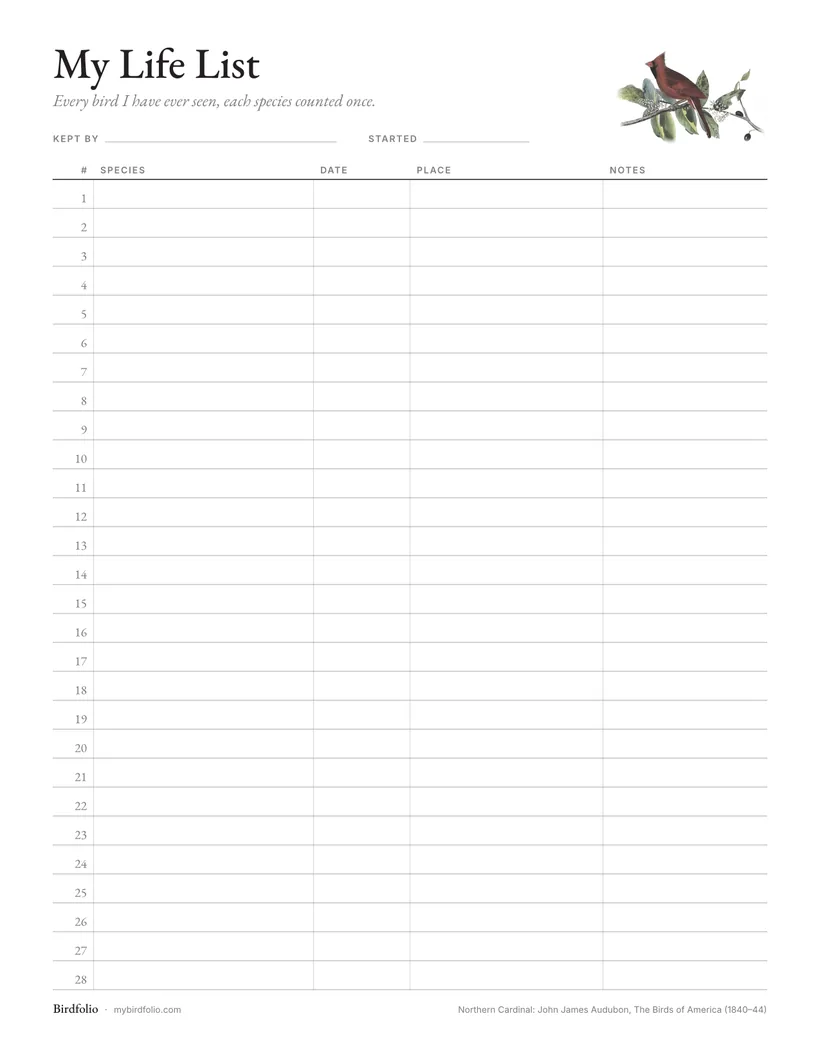
Rather keep your list on paper? Print this life list at home: one line for each new species, with the date and the place. Print the second page as often as you need.
Download the life list (PDF)Year list version (PDF)
US Letter, two pages. No sign-up needed.
Already keep your list in eBird? See it as a book.
Milestones worth marking
Round numbers are big moments: the 100th species, the 250th, the 500th. So are the firsts: your first owl, your first warbler, your first bird in a new state or country. Write down the date. You’ll be glad you did.
For scale, the American Birding Association’s checklist lists 1,161 species for the US, Canada and Hawaii (January 2026), rare strays included. More in how many bird species are in the US and Canada.
From a list to a book
A life list holds years of mornings outdoors. Birdfolio turns it into a hardcover book:
- Every species beside a classic painting by the great bird painters (Fuertes, Audubon, Gould and more), or a credited photograph where no painting exists.
- The date and place you first saw each one.
- Your milestones, your first of each kind, and a map of where you’ve birded.
- Records that aren’t a full species, like a “gull sp.” or a hybrid, on an “Also recorded” page, so nothing is lost.
Bring your eBird download or iNaturalist export, or type a list with one bird per line. Look inside a Birdfolio, or if it’s for someone else, see gifts for birders.