Classic bird paintings
American Crow painting: Audubon's plate and other classic portraits
John James Audubon painted the American Crow as plate 156 of The Birds of America (1827–38), under the same name: one male crow on a black walnut branch heavy with nuts, with a hummingbird's nest on a twig below. That plate is the painting shown here, and a free high-resolution scan is on Audubon.org.
Updated
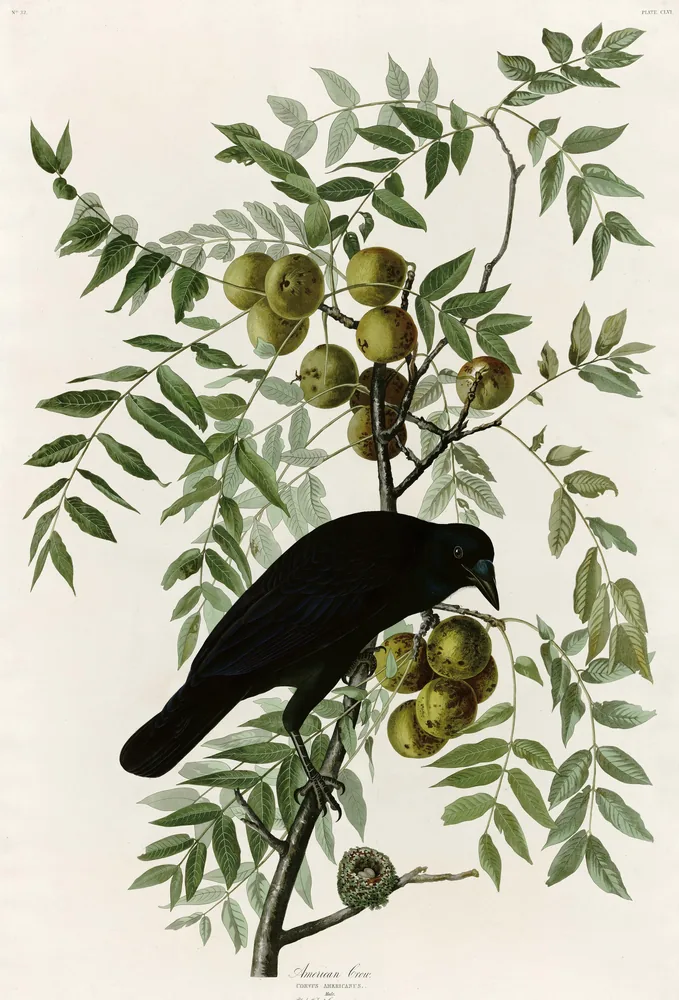
Audubon’s plate: plate 156, “American Crow”
“It is nothing but a crow,” says the hunter in Audubon's account, who shoots one and walks on, leaving it to die. Audubon wrote the crow's defense. Where laws paid a bounty for each crow's head, he reported, 40,000 were shot in one state in a single season, besides the young killed in their nests, and more were poisoned with grain laid along the fields.
He argued the farmer's side for the bird. Crows ate myriads of grubs, and without them, he wrote, thousands of cornstalks would fall every year to cutworms. In winter they followed grass fires to pick up the mice, lizards and snakes caught by the flames, and before sunset they flew in long, silent lines to roost among the cattails.
He gave it a name of its own, Corvus americanus, because its voice and its tongue differed from those of Europe's Carrion Crow; its call, he wrote, is like the distant bark of a small dog. He owned its faults too: he once watched a crow pierce and carry off, one after another, every egg in a wild turkey's nest.
Story: Audubon, Ornithological Biography, vol. 2 (1834), pp. 317–322. See plate 156 free at Audubon.org.
Why is there a hummingbird nest in Audubon's crow painting?
To keep a promise. In 1831, near the end of his account of the Ruby-throated Hummingbird in his first volume, Audubon told readers: “A figure of the nest you will find elsewhere.”
Three years later he kept his word. He set the crow, which he called pensive and oppressed, on a branch of black walnut loaded with nuts, and on its lower twig he painted the hummingbird's delicate nest “to fulfil the promise,” he wrote in 1834.
Sources: Audubon, Ornithological Biography, vol. 2 (1834), p. 322; vol. 1 (1831), p. 253.
More classic portraits, free to see
About the American Crow
- Crows hold grudges. University of Washington researchers caught crows on campus while wearing a caveman mask, and more than 10 years after just seven birds were caught, more than half the campus crows still raised the alarm at the sight of that mask. (Source: National Audubon Society)
- In the 1930s a man in Tulsa, Oklahoma, held crow banquets to show the birds were good to eat, and Oklahoma's governor, apparently impressed, set up a Statehouse Crow Meat Lovers Association. The fad faded by the early 1940s. (Source: National Audubon Society)
- When a crow finds a dead crow, it calls out, and others gather and make a ruckus; researchers think these funerals teach the flock which places and predators to avoid. (Source: National Audubon Society)
- A family can span up to five generations, and yearlings and two-year-olds help their parents build the nest and feed the mother while she sits on the eggs. (Source: National Audubon Society)
- Winter roosts range from hundreds of crows to as many as two million. (Source: National Audubon Society)
What crows live in Texas?
Five members of the crow family: the American Crow, the Fish Crow, the Tamaulipas Crow, the Chihuahuan Raven and the Common Raven. Roughly, American Crows keep to the moister northeast, Fish Crows to the coast and up the big northeastern rivers, Chihuahuan Ravens to the dry west and south, Common Ravens to higher ground in the west, and the Tamaulipas Crow to the far south, the Texas Breeding Bird Atlas says. Common Ravens nest mainly in the Trans-Pecos and on the Edwards Plateau.
American Crows are permanent residents across eastern Texas and the Panhandle, nesting from early February to June, and crows from the north join them in winter. The Fish Crow is best told by its voice, like an American Crow with a “bad cold.” The small, shiny Tamaulipas Crow was first found in the United States in 1968, in extreme south Texas; at its peak it wintered at the Brownsville landfill, and its last reported nesting was in 2001.
Sources: Texas Breeding Bird Atlas, Chihuahuan Raven (Tweit, 2005); Common Raven account (Tweit, 2006); American Crow account (Tweit, 2006); Fish Crow account (Tweit, 2005); Tamaulipas Crow account by Robert C. Tweit.
How long does an American Crow live?
On average a wild American Crow lives 4 to 6 years, Indiana's Department of Natural Resources says, though some have been documented into their teens. The oldest known wild American Crow was at least 18 years and 4 months old (USGS Bird Banding Laboratory): it was banded in Washington in 2006 and found there again in 2022.
Sources: Indiana Department of Natural Resources; USGS Bird Banding Laboratory. A banding record is the minimum age of one bird when it was found again, not a typical lifespan. How long do wild birds live?
How can you tell if a plate 156 print is an original?
By its size: an original plate 156 is a hand-colored sheet about 26 by 38 inches; the American Crow’s octavo version, plate 225, is book-size, from 1840–44. Many prints sold today are reproductions: how to tell an original from a reproduction. Modern editions print all 435 plates, from pocket size to coffee-table size: which Birds of America book to buy.
In a Birdfolio hardcover, this painting sits beside the date and place you first saw a American Crow. See your own list as a book, free.