Reference
How many bird species are in Delaware?
Delaware has 432 bird species on its official list (Delaware Bird Records Committee, July 2025), tied for the 38th highest count of the 49 states with a verified count. Four more species, among them a Slaty-backed Gull, are still under review and not counted yet, and neither is one gull accepted only as a Common or Short-billed Gull.
Delaware’s state bird is the blue hen chicken: our Delaware state bird page tells how it was chosen.
Updated
What are the most common birds in Delaware?
In summer, the 25 most common birds in Delaware are led by the European Starling, at about 274 birds per survey route, then the Common Grackle and the American Robin, by the USGS Breeding Bird Survey’s counts for 2021–2025. Together these 25 made up 72% of all the birds counted on Delaware’s 8 survey routes. USGS rates most of these Delaware estimates as less precise, so read the order as a rough guide.
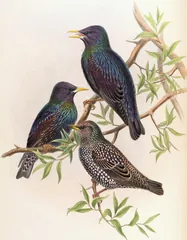
John Gould and Henry Constantine Richter, The Birds of Asia, vol. 5 (1850–83) 1 European Starlingabout 274 per routeon 100% of routesno clear trendintroduced species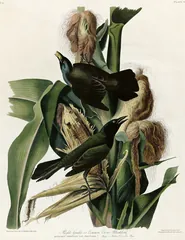
John James Audubon, The Birds of America (1827–38) 2 Common Grackleabout 129 per routeon 100% of routesno clear trend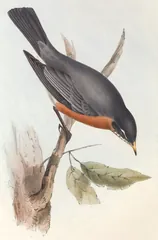
John and Elizabeth Gould, The Birds of Europe (1832–37) about 75 per routeon 100% of routesno clear trend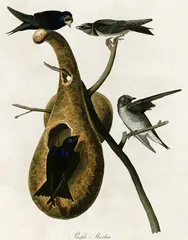
John James Audubon, The Birds of America (1827–38) 4 Purple Martinabout 72 per routeon 100% of routesno clear trend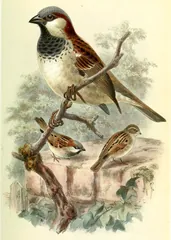
John Gerrard Keulemans, Lord Lilford’s Coloured Figures of the Birds of the British Islands (1885–97) 5 House Sparrowabout 62 per routeon 100% of routesno clear trendintroduced species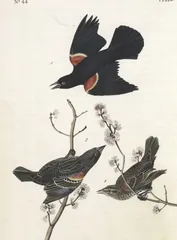
John James Audubon, The Birds of America (1840–44) about 60 per routeon 100% of routesno clear trend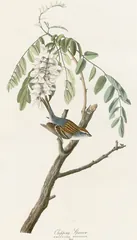
John James Audubon, The Birds of America (1827–38) 7 Chipping Sparrowabout 48 per routeon 100% of routesno clear trend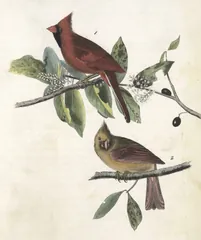
John James Audubon, The Birds of America (1840–44) about 42 per routeon 100% of routesno clear trend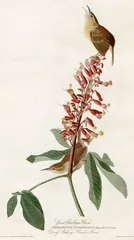
John James Audubon, The Birds of America (1827–38) about 42 per routeon 100% of routesno clear trend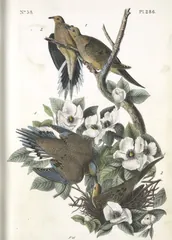
John James Audubon, The Birds of America (1840–44) about 40 per routeon 100% of routesno clear trend
Show all 25
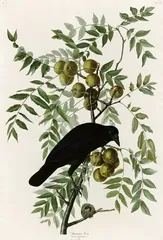
John James Audubon, The Birds of America (1827–38) about 37 per routeon 100% of routesno clear trend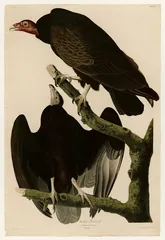
John James Audubon, The Birds of America (1827–38) about 37 per routeon 100% of routesno clear trend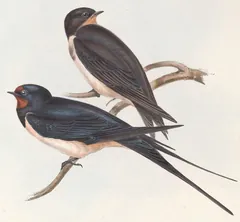
John and Elizabeth Gould, The Birds of Europe (1832–37) 13 Barn Swallowabout 36 per routeon 100% of routesno clear trend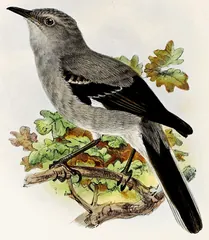
John Gerrard Keulemans, Onze Vogels in Huis en Tuin (1869–76) about 35 per routeon 100% of routesno clear trend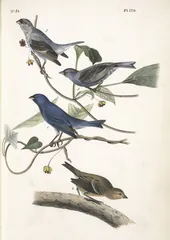
John James Audubon, The Birds of America (1840–44) 15 Indigo Buntingabout 29 per routeon 100% of routesfalling since 2015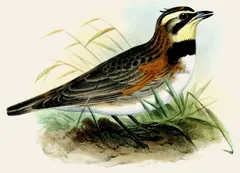
Joseph Wolf, Proceedings of the Zoological Society of London (1855) 16 Horned Larkabout 24 per routeon 100% of routesno clear trend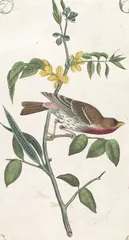
John James Audubon, The Birds of America (1840–44) 17 House Finchabout 20 per routeon 100% of routesno clear trend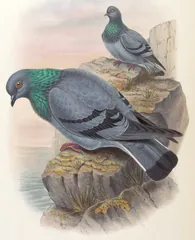
John Gould and William Matthew Hart, The Birds of Asia (1850–83) 18 Rock Pigeonabout 19 per routeon 100% of routesno clear trendintroduced species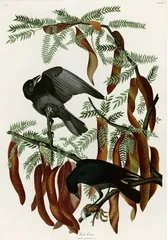
John James Audubon, The Birds of America (1827–38) 19 Fish Crowabout 19 per routeon 100% of routesno clear trend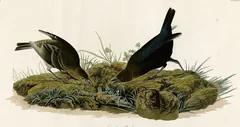
John James Audubon, The Birds of America (1827–38) 20 Brown-headed Cowbirdabout 18 per routeon 100% of routesno clear trend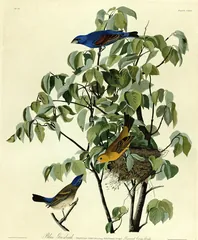
John James Audubon, The Birds of America (1827–38) 21 Blue Grosbeakabout 17 per routeon 100% of routesno clear trend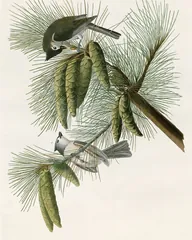
John James Audubon, The Birds of America (1827–38) about 15 per routeon 100% of routesno clear trend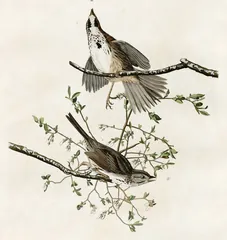
John James Audubon, The Birds of America (1827–38) 23 Song Sparrowabout 13 per routeon 100% of routesfalling since 2015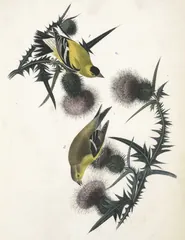
John James Audubon, The Birds of America (1840–44) about 13 per routeon 100% of routesno clear trend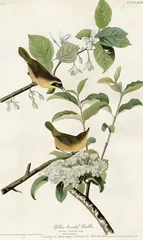
John James Audubon, The Birds of America (1827–38) 25 Common Yellowthroatabout 12 per routeon 100% of routesno clear trend
From the European Starling to the Common Yellowthroat, these are Delaware’s common summer birds; for the rest of its 432 species, our guide to the best bird books of 2026 compares the five big North American guides, Sibley’s and Peterson’s among them.
What is the most common bird in Delaware?
The European Starling, a bird people brought to North America, leads Delaware’s summer survey: about 274 a route on average in 2021–2025, more than twice the Common Grackle’s 129, seen on every one of the 8 routes. USGS finds no clear rise or fall in its Delaware numbers since 2015.
How was this list made?
Each of Delaware’s 8 routes is a roadside count, 50 stops along about 25 miles, run once a year in early summer by a volunteer. We took USGS’s yearly estimate for each species in Delaware, the number of birds a typical route records, averaged it over the five latest survey years (there was no survey in 2020) and ranked the birds by it. To keep the list to birds you’re likely to meet across Delaware, we left out species recorded on fewer than one in five of its routes, and those USGS can only estimate very roughly, which usually means big flocks or colonies on a few routes.
For Delaware that left out the Laughing Gull and the Canada Goose.
The share of routes is our own count from USGS’s route data for Delaware, using only counts that met the survey’s standards; “rising” and “falling” are USGS’s trends for the state since 2015, named only where it finds a clear change. Roadside counts on early-summer mornings miss most of Delaware’s owls and waterbirds, and its winter visitors aren’t here at all.
Delaware’s counts come from two USGS data releases, the North American Breeding Bird Survey Analysis Results 1966–2025 (Hostetler et al., 2026) and its Dataset 1966–2025 (Ziolkowski et al., 2026), gathered by volunteer observers and free for anyone to use; Birdfolio isn’t connected with the USGS.
How many bird species are in Delaware?
| Official count | 432 species |
|---|---|
| List’s date | July 2025 |
| Kept by | Delaware Bird Records Committee (Delaware Ornithological Society) |
| Under review | 4 species, not counted yet |
| Added in 2025 | American Flamingo, Common Ringed Plover, Townsend's Warbler, Lazuli Bunting |
| Records committee | Re-established 1995; five reviewers |
| Among US states | Tied for 38th highest of the 49 states with a verified count, alongside Idaho and Iowa |
| Official list | Delaware State List of Bird Species |
What does Delaware’s count include?
- Every species the Delaware Bird Records Committee had accepted by July 2025, named as in the American Ornithological Society's 65th supplement (2024).
- Introduced species living wild, such as the Mute Swan.
- The 2025 additions, the American Flamingo, Common Ringed Plover, Townsend's Warbler and Lazuli Bunting. The Broad-tailed Hummingbird came off the list that year.
- Not counted yet: 4 species awaiting the committee's review, the Bar-tailed Godwit, Slaty-backed Gull, Scopoli's Shearwater and Spotted Towhee.
- Not counted: one gull the committee accepted as one of two look-alike species without saying which, and the subspecies listed in an addendum, such as the European form of the Whimbrel.
Why do other sources give a different number?
Delaware's total has climbed a few species at a time, so older figures are still around:
- 429. The count on the state natural resources department's wildlife action plan page, as of 2024: before the four species added in 2025 and the one removed (our arithmetic). Source: Birds, Delaware Wildlife Action Plan (Delaware Department of Natural Resources and Environmental Control).
- 428. The list after the committee's 2022-2023 report, which added the Townsend's Solitaire and the Masked Booby. Source: Delaware Bird Records Committee 2022-2023 Annual Report (Delaware Ornithologist 52, 2023).
- 427. The list after the 2021 report, which added the Black-chinned Hummingbird, Ancient Murrelet and Bell's Vireo. Source: Delaware Bird Records Committee Annual Report for 2021 (Delaware Ornithological Society).
Delaware’s list follows its own committee’s rules, and so does every other state’s: see why the counts differ from state to state.
Delaware records, from a Pacific seabird on a bay beach to a dove colony that came and went
- On June 24, 2021, an Ancient Murrelet, a seabird that nests in Alaska, turned up at the north end of Slaughter Beach on Delaware Bay. "This record is so insane that it had to be true," the committee wrote; it was only the second of its kind on salt water on the East Coast, after one in Massachusetts. Source: Delaware Bird Records Committee Annual Report for 2021 (Delaware Ornithological Society), read October 8, 2026.
- A single photograph was enough to add Bell's Vireo to the list: a bright bird of the eastern form, photographed on East Lake Drive in Rehoboth Beach on October 5, 2020. Source: Delaware Bird Records Committee Annual Report for 2021 (Delaware Ornithological Society), read October 8, 2026.
- Delaware's first Townsend's Solitaire stayed at Cape Henlopen State Park from December 2020 until April 2021. It had been photographed on December 8, but the picture didn't reach the committee until January, after others had reported the bird. Source: Delaware Bird Records Committee 2022-2023 Annual Report (Delaware Ornithologist 52, 2023), read October 8, 2026.
- Introduced birds can vanish too. A colony of Eurasian Collared-Doves at Selbyville began with 2 birds in 1997, grew to 19 by 2004, fell to 1 in 2020 and was gone in 2021, the committee reported. Source: Delaware Bird Records Committee Annual Report for 2021 (Delaware Ornithological Society), read October 8, 2026.
Questions people ask about Delaware’s birds
Which state has the most species of birds?
California, with 696 species on its official checklist of September 8, 2026, ahead of Texas with 682 (our table). Delaware's list has 432, plus 4 species still under review.
Sources: Official California Checklist, updated 8 September 2026 (California Bird Records Committee); Delaware State Bird List and Delaware Review List, updated July 2025 (Delaware Bird Records Committee, Delaware Ornithological Society), read October 8, 2026.
What birds are common in Delaware?
Shorebirds, in sheer numbers: each May as many as 30 kinds stop to feed on Delaware Bay, most of them Red Knots, Ruddy Turnstones, Semipalmated Sandpipers, Sanderlings and Dunlins, the state's natural resources department says. In summer the woods belong to songbirds that winter in the tropics: in the Great Cypress Swamp, the state's largest remaining forest, a survey published in 2000 found 73 species, and 7 of the 10 most abundant were forest birds of that kind. The second breeding bird atlas, from 2008 to 2012, found signs of nesting for 171 species and confirmed 147.
Sources: Delaware Bay Ecology (Delaware Department of Natural Resources and Environmental Control); Landbirds, Delaware Wildlife Action Plan (Delaware Department of Natural Resources and Environmental Control); Birds, Delaware Wildlife Action Plan (Delaware Department of Natural Resources and Environmental Control), read October 8, 2026.
What is the rarest bird in Delaware?
No official ranking exists, but Delaware's rarest birds include its recent firsts, such as the Ancient Murrelet of 2021 and the Masked Booby of 2022. Rarer still in a sense are the four species that birders have reported but the committee hasn't yet accepted, from a Bar-tailed Godwit to a Scopoli's Shearwater. Every species printed in bold on the list is rare enough that the committee wants a report of each sighting.
Sources: Delaware Bird Records Committee Annual Report for 2021 (Delaware Ornithological Society); Delaware Bird Records Committee 2022-2023 Annual Report (Delaware Ornithologist 52, 2023); Delaware State Bird List and Delaware Review List, updated July 2025 (Delaware Bird Records Committee, Delaware Ornithological Society), read October 8, 2026.
What is the official bird of Delaware?
The Blue Hen chicken, adopted on April 14, 1939, the state's facts page says; as a chicken rather than a wild bird, it isn't on Delaware's official bird list. The name goes back to the Revolutionary War, when the men of Captain Jonathan Caldwell's company, recruited in Kent County, carried game chickens said to be of the brood of a famous Blue Hen, and fought so bravely that they were compared to those fighting cocks.
Sources: Facts & Symbols (State of Delaware); Delaware State Bird List and Delaware Review List, updated July 2025 (Delaware Bird Records Committee, Delaware Ornithological Society), read October 8, 2026.
What three birds are not protected?
The House Sparrow, European Starling and Rock Pigeon aren't protected by the federal Migratory Bird Treaty Act, and all three are on Delaware's bird list. The act applies only to native species: the Rock Pigeon is on the U.S. Fish and Wildlife Service's 2020 list of 122 introduced birds it doesn't cover, and the families of the House Sparrow and the starling aren't among those the law covers. Two more birds on Delaware's list are on that federal list as well, the Mute Swan and the Eurasian Collared-Dove.
Sources: List of Bird Species To Which the Migratory Bird Treaty Act Does Not Apply (U.S. Fish and Wildlife Service, Federal Register 85:74, April 16, 2020); Delaware State Bird List and Delaware Review List, updated July 2025 (Delaware Bird Records Committee, Delaware Ornithological Society), read October 8, 2026.
Are there 10,000 species of birds?
There are more than 11,000: the 2025 edition of AviList, the world checklist, counts 11,131 species in 46 orders (our sum). Delaware's 432 make up about 3.9 percent of them.
Sources: AviList: The Global Avian Checklist, v2025, first released June 11, 2025 (AviList Core Team, CC BY 4.0); Delaware State Bird List and Delaware Review List, updated July 2025 (Delaware Bird Records Committee, Delaware Ornithological Society), read October 8, 2026.
Which birds live in Delaware?
Birds of beaches, marshes, farmland and woods, with the bay at the center. Three beach-nesting birds are listed as endangered in the state, the Piping Plover, American Oystercatcher and Least Tern, and the Point at Cape Henlopen State Park is closed from March through September each year to protect them.
Away from the shore, the state's wildlife plan says Delaware has a particularly high responsibility in its region for songbirds stopping over on migration, for migrating and wintering birds of prey, and for farmland nesters such as the Horned Lark and Grasshopper Sparrow. Grassland birds are in trouble: the Eastern Meadowlark was found in only 30 percent of survey blocks in the second breeding bird atlas, down from 78 percent in the first.
Sources: Beach-Nesting Birds (Delaware Department of Natural Resources and Environmental Control); Landbirds, Delaware Wildlife Action Plan (Delaware Department of Natural Resources and Environmental Control), read October 8, 2026.
Why do Red Knots stop in Delaware Bay?
To eat horseshoe crab eggs. Red Knots fly from as far as the southern tip of South America to nest in the Arctic, some legs as long as 5,000 miles without stopping, and Delaware Bay, home to the largest population of North America's horseshoe crab, is their final and most critical stop. They arrive thin, and while their muscle and fat grow, their stomachs and gizzards shrink, which makes the soft, easily digested eggs a crucial food. In about two weeks they can double their weight.
Their numbers have fallen: where nearly 100,000 once stopped each spring, about 40,000 came in 2019. The spring of 2026 was better. Counters found nearly 2,000 at Mispillion Harbor on May 11 and 3,000 on May 20, and some birds weighed more than 180 grams, the estimated minimum for leaving on the last 2,000-mile leg to the Arctic.
Sources: The Delaware Shorebird Project (Delaware Department of Natural Resources and Environmental Control); Delaware Bay Ecology (Delaware Department of Natural Resources and Environmental Control); Horseshoe Crabs, Shorebirds and the Delaware Bay (Delaware Department of Natural Resources and Environmental Control); Red Knot Numbers Increase on Delaware's Bayshore During Spring Migration (State of Delaware News, July 27, 2026), read October 8, 2026.
How did a beach visitor who wasn't a birder add a species to Delaware's list?
By taking a picture. In July 2022 someone visiting Fenwick Island who wasn't a birder found an odd bird on the beach, photographed it and sent the photo to an experienced birder, who passed it on. It was a Masked Booby, a first for Delaware. The single photo showed every mark the committee needed: clean white underparts that ruled out other young boobies, where a young Northern Gannet would have been all dark.
The bird was taken in for care but died, and it is now a specimen in the Delaware Museum of Nature and Science. The anonymous finder, the committee wrote, may never have known how unusual the bird was.
Source: Delaware Bird Records Committee 2022-2023 Annual Report (Delaware Ornithologist 52, 2023), read October 8, 2026.
Where is the official Delaware bird list, and how often is it updated?
On the Delaware Ornithological Society's website, dosbirds.org: the Delaware State Bird List, updated July 2025, with the review species printed in bold, a short list of pending additions under review, and an addendum of subspecies. The committee's own page lists each year's changes and posts its annual reports, which also appear in the society's journal, the Delaware Ornithologist.
The committee was re-established in 1995 by the society's council. It has five reviewers, a president and a secretary; each reviewer serves five years, then must take a year off. As its 2022-2023 report describes, a subcommittee of three now fast-tracks well-documented records, and anything not unanimous, any possible first state record and any difficult record goes to the full committee. Paper and photo files of every record are kept at the Delaware Museum of Natural History.
Sources: Delaware State Bird List and Delaware Review List, updated July 2025 (Delaware Bird Records Committee, Delaware Ornithological Society); Bird Records Committee (Delaware Ornithological Society); Delaware Bird Records Committee 2022-2023 Annual Report (Delaware Ornithologist 52, 2023), read October 8, 2026.
How do you count your own Delaware list?
Your Delaware list is every species you’ve seen in Delaware. eBird can filter your life list to Delaware, and your eBird data download gives the state of every sighting. On paper, count the species you’ve seen in Delaware; what is a life list? explains how birders keep their lists.
To print your whole list, Delaware birds and all, see how to print your bird life list, or let Birdfolio make it a hardcover book.
Delaware’s state bird
Delaware’s state bird is the blue hen chicken, the state bird since 1939. Its story, the state flower and animal, and a free picture card for a report are on our Delaware state bird page.
Christmas Bird Count in Delaware
Delaware had 7 Christmas Bird Count circles on Audubon’s map last winter, each counted on a single day between December 14 and January 5. Our guide shows where to find Delaware’s counts and how to join one; it’s free, and beginners are welcome.
More about bird counts
- How many bird species are in each state: Delaware beside all 50 states, DC and Canada.
- Bird lists of nearby states: Maryland and Pennsylvania.
- State birds of all 50 states, Delaware’s blue hen chicken among them
- How many bird species are in the US and Canada
- Bird splits and lumps
If you’re shopping for a birder in Delaware, our gift guide for birders and our pick of coffee table bird books are good places to start.