Classic bird paintings
Tufted Titmouse painting: Audubon's plate and other classic portraits
John James Audubon painted the Tufted Titmouse as plate 39 of The Birds of America (1827–38), under the name Crested Titmouse: a male and a female on a branch of white pine. That plate is the painting shown here, and a free high-resolution scan is on Audubon.org.
Updated
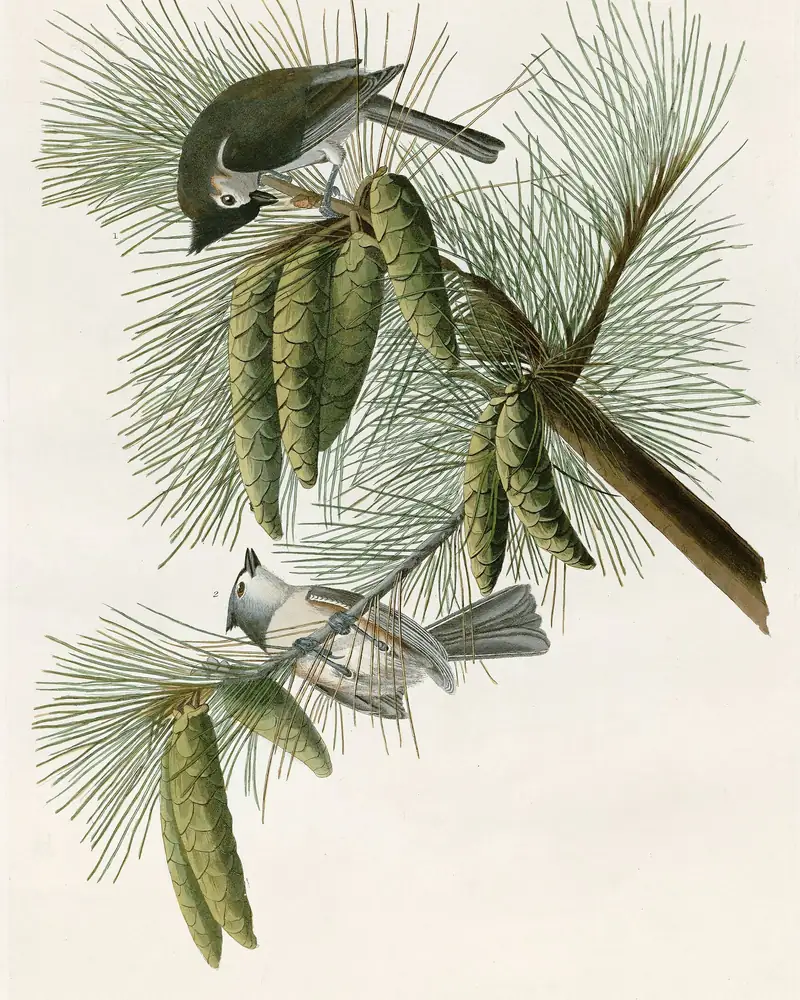
Audubon’s plate: plate 39, “Crested Titmouse”
A titmouse, Audubon noticed, would rather drink by leaning down from the tip of a twig over a stream than land at the water's edge, and it liked to sip raindrops and dew from the ends of leaves. Small family parties of eight or ten moved through the woods, often with a nuthatch or a Downy Woodpecker, carrying beech nuts, acorns and chinquapins to a big branch. There a bird wedges the nut in a crack, holds it with both feet and breaks the shell with blows of its bill, a tapping you can hear twenty or thirty yards away on a calm day.
Its many calls, a whistle or a loud murmur, seem to come from a bird much farther off, and often disappointed a listener who went looking for something else. He also found it vicious: it would attack smaller birds and kill them by hammering on their heads. His friend John Bachman kept one in a cage that hid its food in a crevice, and at night crept into a small box and slept “doubled up like a ball” until first light.
Plate 39 shows a male and a female on white pine, Pinus strobus, a tree that had been measured, he wrote, at 180 feet. In all his travels he had met only two kinds of titmice, and he was sure that more would be found.
Story: Audubon, Ornithological Biography, vol. 1 (1831), pp. 199–201; vol. 5 (1839), p. 472. See plate 39 free at Audubon.org.
Did Audubon paint the Black-crested Titmouse?
No, but his son found it. John Woodhouse Audubon discovered the bird in Texas, on the Rio Grande, and John Cassin described it as a new species in the October 1850 Proceedings of the Academy of Natural Sciences of Philadelphia, from a specimen in the Academy's collection.
Cassin's specimen was not yet in adult plumage, but he wrote that “It may be easily recognized by its black pointed crest and white front.” That came too late for The Birds of America, finished in 1838, and for the octavo edition of 1840–44: Audubon's own plate 39 shows the Tufted Titmouse.
Source: Cassin, Proceedings of the Academy of Natural Sciences of Philadelphia, vol. 5 (1850), p. 103.
More classic portraits, free to see
- John James Audubon, The Birds of America, octavo edition (1840–44), plate 125: “Crested Titmouse”. Free scan (New York Public Library Digital Collections)
- John Gould’s The Birds of Europe (1832–37), plate 152: “Toupet Tit” (Parus bicolor). Free scan (University of Kansas Libraries)
- Louis Agassiz Fuertes, for Elon H. Eaton’s Birds of New York (1910–14), plate 103: “Tufted Titmouse”, with 4 other birds. Free scan (Internet Archive)
About the Tufted Titmouse
- A Tufted Titmouse holds a seed or an acorn with its feet and hammers it open with its bill. (Source: National Audubon Society)
Titmice that visit your yard between November 1, 2026 and April 30, 2027 can be part of Project FeederWatch, a winter count of the birds at feeders across the US and Canada. Sign up and count with FeederWatch.
Which titmouse lives in Texas?
Two do. The Tufted Titmouse lives in the eastern third of the state, and the Black-crested Titmouse mainly on the Edwards Plateau and on through the Rolling Plains, the South Texas Brush Country and the Coastal Sand Plain, the Texas Breeding Bird Atlas says. Black-crests also nest on mountain ranges in the Trans-Pecos.
Both stay all year. On the Edwards Plateau, Breeding Bird Survey routes suggest the Black-crested population has held steady since 1980. And titmice have spread north and west from the plateau: by the early 1990s they were found all along the Caprock Escarpment toward the Panhandle, where older accounts had them only in Palo Duro Canyon.
Sources: Texas Breeding Bird Atlas (Coldren, about 1993); Texas Breeding Bird Atlas (Tweit, 2009).
Are Black-crested and Tufted Titmice the same species?
Not today, though they were counted as one for a time. Their genes, songs and plumage differ, but because the two interbreed in central Texas they were not separated again until 2002, the Texas Breeding Bird Atlas says. Its own fieldwork, from 1987 to 1992, fell in the years they were lumped, so it never counted them apart.
They meet and interbreed in a belt from Palo Pinto County south to eastern Travis County and on to Refugio County. Elsewhere, look at the head: a Tufted Titmouse has a gray crest and a black forehead, a Black-crested Titmouse a black crest and a whitish forehead. Out West the Plain Titmouse was split too, in 1997, into the Oak Titmouse and the Juniper Titmouse.
Sources: Texas Breeding Bird Atlas (Tweit, 2009); Texas Breeding Bird Atlas (Coldren, about 1993).
How long does a Tufted Titmouse live?
No state agency or federal guide we read gives a typical lifespan for the Tufted Titmouse. The oldest known wild Tufted Titmouse was at least 12 years and 5 months old (USGS Bird Banding Laboratory): it was banded in Virginia in 1962 and found there again in 1974.
Source: USGS Bird Banding Laboratory. A banding record is the minimum age of one bird when it was found again, not a typical lifespan. How long do wild birds live?
How can you tell if a plate 39 print is an original?
By its size: an original plate 39 is a hand-colored sheet about 26 by 38 inches; the Tufted Titmouse’s octavo version, plate 125, is book-size, from 1840–44. Many prints sold today are reproductions: how to tell an original from a reproduction. For all 435 plates at a fraction of an original’s price, see which edition of The Birds of America to buy.
In a Birdfolio hardcover, this painting sits beside the date and place you first saw a Tufted Titmouse. See your own list as a book, free.