Classic bird paintings
White Ibis painting: Audubon's plate and other classic portraits
John James Audubon painted the White Ibis as plate 222 of The Birds of America (1827–38), under the same name: a white adult male and a brown young bird, with a crayfish at their feet. A free high-resolution scan is on Audubon.org. Shown here is his smaller octavo plate 360 (1840–44).
Updated
About this painting
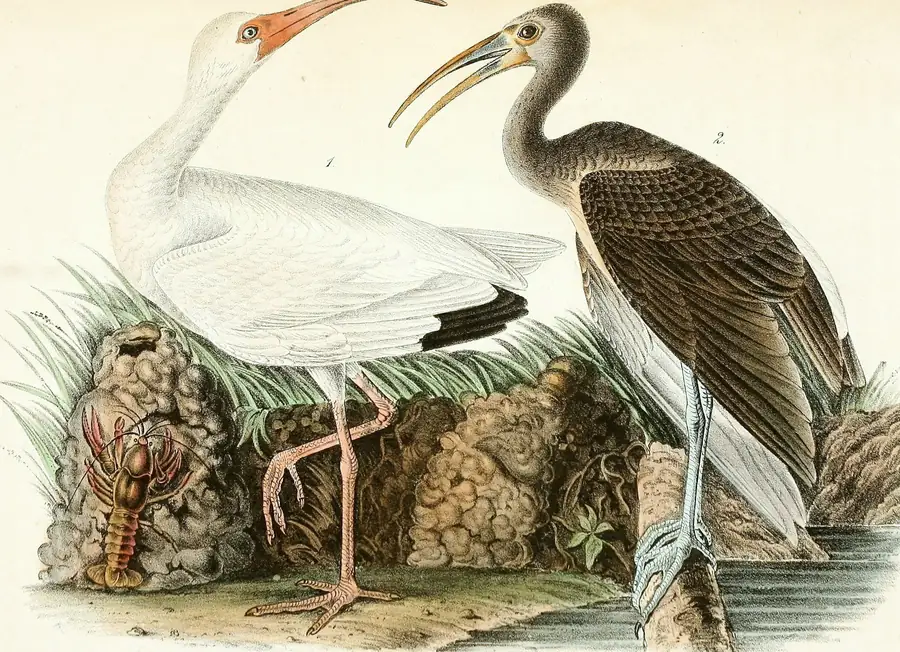
Shown here: plate 360 of the octavo edition, White Ibis, the big plate's scene at book size. The adult, white with black wingtips and a red face and bill, stands on one leg by the water; the young bird beside it is a dull brown. At the left a crayfish crawls at the foot of the mud mounds its burrow throws up.
Audubon’s White Ibis: plate 222, “White Ibis”
Sandy Island, six miles off Cape Sable, Florida, was a horseshoe of mangroves, wild plums and cactus, and when Audubon forced his way through it, White Ibises were nesting there in thousands. Nests sat on every bush; he counted 47 on a single plum tree. At each low tide the parents not sitting on eggs flew off in silent lines, often a mile long, to mud flats twenty or thirty miles away, and came back when the tide turned.
In the heat of summer, he wrote, the ibis catches crayfish by cunning. It breaks the top off the mud mound over a burrow, drops the pieces down the hole, steps back a single pace and waits; when the crayfish climbs up to clear its doorway, the ibis seizes it. He later sent readers to plate 222 to see how a crayfish heaps up its mud, with “a tolerable portrait of one of these creatures.”
Near Bayou Sara, Louisiana, at the end of one summer, his party broke the wing of a White Ibis on a cypress pool. Three alligators rose from the mud and gave chase, but the bird swam faster, straight toward the men, and as the last alligator lunged, three guns fired into its throat. The ibis walked to their feet and lay down. Audubon kept it through the winter and set it free in the spring, its wing mended. Plate 222 shows an adult male and a young bird.
Story: Audubon, Ornithological Biography, vol. 3 (1835), pp. 173–178; vol. 3 (1835), p. 200. See plate 222 free at Audubon.org.
Why are some White Ibises brown?
They are young birds. A young White Ibis is mostly brown with a white belly and a pink curved bill, and turns patchy as it matures, the National Audubon Society's guide says. Audubon's plate 222 shows one beside the white adult male. He described the first plumage as dull brown all over but for a whitish rump, with the breast and belly turning white after the first molt. Adults change color too: in the breeding season, he wrote, their bill and legs turn a bright carmine.
Sources: National Audubon Society; Audubon, Ornithological Biography, vol. 3 (1835), p. 180.
More classic portraits, free to see
- John James Audubon, The Birds of America, octavo edition (1840–44), plate 360: “White Ibis” (the painting shown above). Free scan (New York Public Library Digital Collections)
About the White Ibis
- One of the most numerous wading birds in Florida, the White Ibis feeds, roosts and nests in flocks, and egrets often follow a wading group to catch the prey its probing bills stir up. (Source: National Audubon Society)
- It feeds by sweeping its curved bill from side to side and probing the bottom, finding food by touch; crayfish and crabs are major items. (Source: National Audubon Society)
Why is the ibis the University of Miami's mascot?
Because of a storm legend. University of Miami folklore holds that the ibis is “the last sign of wildlife to take shelter before a hurricane” and the first to reappear after it, a symbol of resilience, the university says.
The bird became the school's unofficial mascot in 1926, when the yearbook took the name Ibis. Sebastian the Ibis was born in 1957, when a residence hall, San Sebastian Hall, sponsored an ibis entry at Homecoming; the next year a student, John Stormont, performed at games in a homemade ibis costume. The ibis was later adopted as the official mascot of the university's athletic teams.
Sources: University of Miami News, 2023; University of Miami News, 2019.
How long does a White Ibis live?
Wildlife agencies we read give no typical lifespan for the White Ibis. Young birds face the worst odds: in a study published by the U.S. Fish and Wildlife Service, only about a third of satellite-tagged juveniles in coastal Alabama lived through a year, against about four in five adults. The oldest known wild White Ibis was at least 19 years and 11 months old (USGS Bird Banding Laboratory): it was banded in Florida in 2006 and found there again in 2024.
Sources: U.S. Fish and Wildlife Service; USGS Bird Banding Laboratory. A banding record is the minimum age of one bird when it was found again, not a typical lifespan. How long do wild birds live?
How can you tell if a plate 222 print is an original?
By its size: an original plate 222 is a hand-colored sheet about 26 by 38 inches; the White Ibis’s octavo version, plate 360, is book-size, from 1840–44. Many prints sold today are reproductions: how to tell an original from a reproduction. Plate 222 and the other 434 also come bound in one modern book: which Birds of America book to buy.
In a Birdfolio hardcover, this painting sits beside the date and place you first saw a White Ibis. See your own list as a book, free.