Reference
How many bird species are in Alabama?
Alabama has 455 bird species on its official list (Alabama Ornithological Society Bird Records Committee, September 2025), the 28th highest count of the 49 states with a verified count. The total includes 11 species known only from sight records and 4 that are extinct or no longer found in Alabama.
Alabama’s state bird is the Northern Flicker: our Alabama state bird page tells how it was chosen.
Updated
What are the most common birds in Alabama?
In summer, the 25 most common birds in Alabama are led by the Cliff Swallow, at about 115 birds per survey route, then the Northern Cardinal and the Northern Mockingbird, by the USGS Breeding Bird Survey’s counts for 2021–2025. Together these 25 made up 69% of all the birds counted on Alabama’s 83 survey routes.
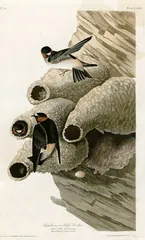
John James Audubon, The Birds of America (1827–38) 1 Cliff Swallowabout 115 per routeon 54% of routesno clear trend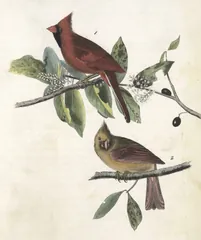
John James Audubon, The Birds of America (1840–44) about 52 per routeon 100% of routesno clear trend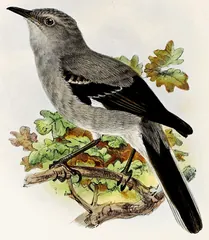
John Gerrard Keulemans, Onze Vogels in Huis en Tuin (1869–76) about 51 per routeon 100% of routesno clear trend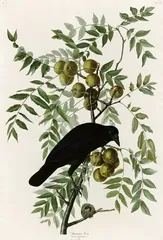
John James Audubon, The Birds of America (1827–38) about 47 per routeon 99% of routesfalling since 2015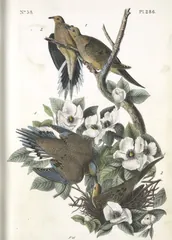
John James Audubon, The Birds of America (1840–44) about 31 per routeon 100% of routesno clear trend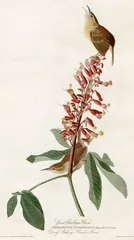
John James Audubon, The Birds of America (1827–38) about 30 per routeon 100% of routesrising since 2015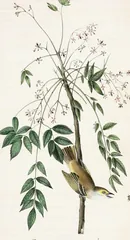
John James Audubon, The Birds of America (1840–44) 7 White-eyed Vireoabout 24 per routeon 100% of routesrising since 2015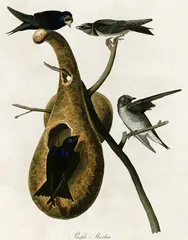
John James Audubon, The Birds of America (1827–38) 8 Purple Martinabout 24 per routeon 93% of routesno clear trend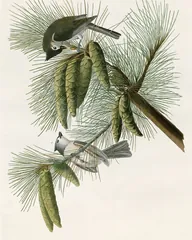
John James Audubon, The Birds of America (1827–38) about 21 per routeon 100% of routesno clear trend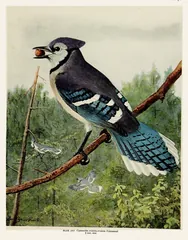
Louis Agassiz Fuertes, Elon H. Eaton's Birds of New York (1910–14) 10 Blue Jayabout 20 per routeon 100% of routesfalling since 2015
Show all 25
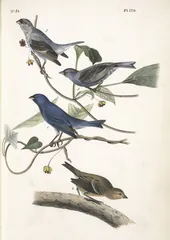
John James Audubon, The Birds of America (1840–44) 11 Indigo Buntingabout 20 per routeon 99% of routesfalling since 2015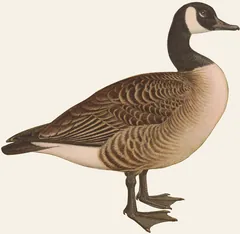
Marinus Adrianus Koekkoek, E. D. van Oort's Ornithologia Neerlandica (1922) 12 Canada Gooseabout 19 per routeon 54% of routesno clear trend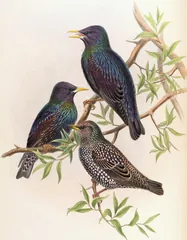
John Gould and Henry Constantine Richter, The Birds of Asia, vol. 5 (1850–83) 13 European Starlingabout 19 per routeon 82% of routesno clear trendintroduced species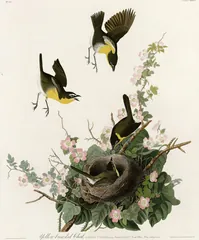
John James Audubon, The Birds of America (1827–38) 14 Yellow-breasted Chatabout 17 per routeon 98% of routesfalling since 2015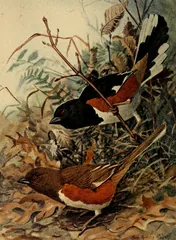
Louis Agassiz Fuertes, True Bird Stories from My Note-Books (1903) 15 Eastern Towheeabout 17 per routeon 100% of routesfalling since 2015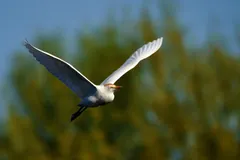
Photo: Bill Levine, CC BY 4.0 16 Western Cattle-Egretabout 16 per routeon 48% of routesno clear trend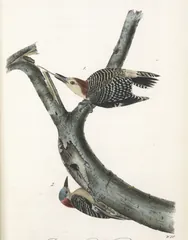
John James Audubon, The Birds of America (1840–44) about 15 per routeon 100% of routesno clear trend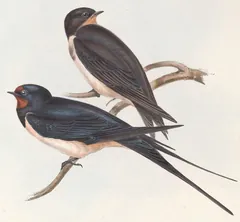
John and Elizabeth Gould, The Birds of Europe (1832–37) 18 Barn Swallowabout 14 per routeon 100% of routesfalling since 2015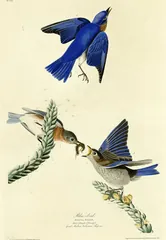
John James Audubon, The Birds of America (1827–38) about 13 per routeon 99% of routesno clear trend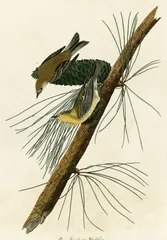
John James Audubon, The Birds of America (1827–38) 20 Pine Warblerabout 12 per routeon 100% of routesfalling since 2015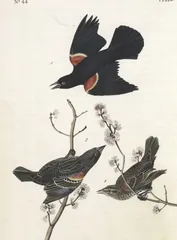
John James Audubon, The Birds of America (1840–44) about 11 per routeon 87% of routesno clear trend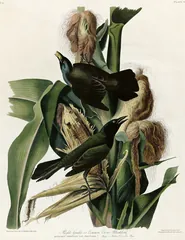
John James Audubon, The Birds of America (1827–38) 22 Common Grackleabout 9.2 per routeon 90% of routesno clear trend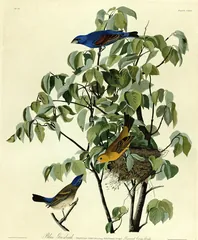
John James Audubon, The Birds of America (1827–38) 23 Blue Grosbeakabout 9.1 per routeon 99% of routesno clear trend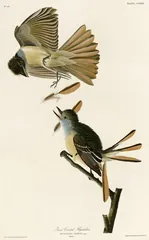
John James Audubon, The Birds of America (1827–38) 24 Great Crested Flycatcherabout 8.8 per routeon 100% of routesno clear trend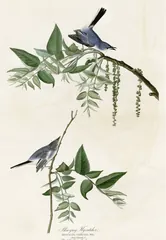
John James Audubon, The Birds of America (1827–38) 25 Blue-gray Gnatcatcherabout 8.5 per routeon 100% of routesno clear trend
From the Cliff Swallow to the Blue-gray Gnatcatcher, these are Alabama’s common summer birds; for the rest of its 455 species, our guide to the best bird books of 2026 compares the five big North American guides, Sibley’s and Peterson’s among them.
What is the most common bird in Alabama?
The Cliff Swallow leads Alabama’s summer survey: about 115 a route on average in 2021–2025, more than twice the Northern Cardinal’s 52, seen on 54% of the 83 routes. USGS finds no clear rise or fall in its Alabama numbers since 2015.
By how widespread it is, the Northern Cardinal: the state's 2000-2006 Breeding Bird Atlas found it nesting or present in 3,445 of 5,087 survey blocks, more than any other bird, ahead of the Carolina Wren, Northern Mockingbird, Mourning Dove and Indigo Bunting (our ranking of the atlas tables).
An earlier atlas of the north Alabama counties along the Tennessee River, from 1994 to 1997, found the same picture there: the cardinal, Indigo Bunting, Mourning Dove, Eastern Meadowlark, Northern Mockingbird and Northern Bobwhite turned up in more than 97 percent of its blocks.
Sources: Statistics from the Alabama Breeding Bird Atlas, 2000-2006 (Alabama Department of Conservation and Natural Resources), the Internet Archive's copy of August 2, 2021; Northern Alabama Breeding Bird Atlas Results, 1994-1997 (Alabama Birdlife 48:1, 2002), read October 10, 2026.
How was this list made?
Each of Alabama’s 83 routes is a roadside count, 50 stops along about 25 miles, run once a year in early summer by a volunteer. We took USGS’s yearly estimate for each species in Alabama, the number of birds a typical route records, averaged it over the five latest survey years (there was no survey in 2020) and ranked the birds by it. To keep the list to birds you’re likely to meet across Alabama, we left out species recorded on fewer than one in five of its routes, and those USGS can only estimate very roughly, which usually means big flocks or colonies on a few routes.
For Alabama that left out the Laughing Gull.
The share of routes is our own count from USGS’s route data for Alabama, using only counts that met the survey’s standards; “rising” and “falling” are USGS’s trends for the state since 2015, named only where it finds a clear change. Roadside counts on early-summer mornings miss most of Alabama’s owls and waterbirds, and its winter visitors aren’t here at all.
Alabama’s counts come from two USGS data releases, the North American Breeding Bird Survey Analysis Results 1966–2025 (Hostetler et al., 2026) and its Dataset 1966–2025 (Ziolkowski et al., 2026), gathered by volunteer observers and free for anyone to use; Birdfolio isn’t connected with the USGS.
How many bird species are in Alabama?
| Official count | 455 species |
|---|---|
| List’s date | September 2025 |
| Kept by | Alabama Ornithological Society Bird Records Committee |
| Sight records only | 11 species (the list's Category B) |
| Extinct or gone | 4 species |
| Review list | 92 species and 1 species pair (April 2026) |
| Records committee since | September 20, 1987 |
| Among US states | 28th highest of the 49 states with a verified count |
| Official list | Field Checklist of Alabama Birds (September 2025) |
What does Alabama’s count include?
- 11 species accepted on sight records alone, without the physical evidence or second observers the main list asks for (the list calls them Category B).
- 4 species that are extinct or no longer found in Alabama.
Why do other sources give a different number?
Alabama's total has grown report by report, so older pages and books give smaller numbers:
- 420. The total on the Alabama Department of Conservation and Natural Resources' bird page, which calls it the society's official list. The page carries no date and the list has grown since; it splits those 420 into 178 nesting species, 38 accidental visitors, 3 extinct, 2 extirpated and 4 introduced ones. Source: Birds (Alabama Department of Conservation and Natural Resources, Outdoor Alabama).
- 446. Where the committee's 2011-2013 report left the list, after adding the Razorbill. Source: Report of the Alabama Bird Records Committee, 2011-2013 (Alabama Birdlife 59:2, December 2013).
- 447. The total after the 2015 report, whose only new species was the White-eared Hummingbird. Each annual report brings the list up to date, so every report's number was right on its day. Source: Report of the Alabama Bird Records Committee, 2015 (Alabama Birdlife 63:2).
Alabama’s list follows its own committee’s rules, and so does every other state’s: see why the counts differ from state to state.
Firsts and one-time visitors on Alabama's list
- Alabama's first Ivory Gull spent January 25-29, 2010, on the Georgia side of West Point Lake, then was found ill on the shore in Chambers County on January 29. It died, and its specimen went to the University of Georgia. Source: Winter Sightings, December 2009 to February 2010 (Alabama Birdlife 56:1, July 2010), read October 4, 2026.
- Two days later, on January 31, 2010, an immature male Lazuli Bunting at Fort Morgan in Baldwin County became the state's first of its kind. Source: Winter Sightings, December 2009 to February 2010 (Alabama Birdlife 56:1, July 2010), read October 4, 2026.
- In spring 2024 the society's newsletter reported a first state record of White-tailed Hawk and a second of La Sagra's Flycatcher among the committee's latest decisions. Source: The Yellowhammer, Spring 2024 (Alabama Ornithological Society newsletter), read October 4, 2026.
- The April 2026 review list shows a single accepted Alabama record each for Gray Gull and White Wagtail (both 2023) and for Great Kiskadee and Thick-billed Longspur (both 2025). Source: Alabama Bird Records Committee Review List, revised April 2026 (Alabama Ornithological Society), read October 4, 2026.
- Kirtland's Warbler is on the list from sight records alone: 2 Category B records, the last of them in 1936. Source: Alabama Bird Records Committee Review List, revised April 2026 (Alabama Ornithological Society), read October 4, 2026.
Questions people ask about Alabama’s birds
Which US state has the most bird species?
California, with 696 species, has the most (its official list, updated September 8, 2026); Texas has 682 (our table). Alabama's September 2025 checklist counts 455, 11 of them accepted on sight records alone.
Sources: Official California Checklist, updated 8 September 2026 (California Bird Records Committee, Western Field Ornithologists); Field Checklist of Alabama Birds, September 2025 (Alabama Ornithological Society), read October 4, 2026.
What is the rarest bird in Alabama?
Thirty entries on the records committee's April 2026 review list have just one accepted Alabama record each, among them a King Eider in 1964 and a Manx Shearwater in 2024, and 8 of those rest on a sight record alone (our count). Four birds on the checklist are extinct or gone from the state, from the Passenger Pigeon to the Ivory-billed Woodpecker.
Sources: Alabama Bird Records Committee Review List, revised April 2026 (Alabama Ornithological Society); Field Checklist of Alabama Birds, September 2025 (Alabama Ornithological Society), read October 4, 2026.
What are common birds in Alabama?
The Northern Cardinal, Mourning Dove, Carolina Chickadee, Tufted Titmouse, Blue Jay, Red-bellied Woodpecker, Northern Mockingbird, Eastern Bluebird and Downy Woodpecker are all rated common in every season and every part of the state by the Alabama Birding Trails. Winter feeders add goldfinches, Purple Finches, juncos and White-throated Sparrows, and Pine Siskins in most winters, Alabama Extension says, while Ruby-throated Hummingbirds spend the summer.
Sources: Common Birds of Alabama (Alabama Birding Trails); Feeding Birds, ANR-0554 (Alabama Cooperative Extension System, Alabama A&M and Auburn Universities, 2020), read October 10, 2026.
Where can I find a list of Alabama birds?
On the Alabama Ornithological Society's website, as a printable PDF: the Checklist of Alabama Birds, updated as of September 2025, is the state's official list, and the society's records committee decides what goes on it. For places to see them, the Alabama Birding Trails, run with the state conservation department and Alabama Audubon, map 280 public birding sites from the mountains to the Gulf.
Sources: Checklist of Alabama Birds (Alabama Ornithological Society); Alabama Birding Trails, home page (with the Alabama Department of Conservation and Natural Resources and Alabama Audubon), read October 10, 2026.
Which birds live in Alabama?
Birds of the Gulf Coast, the longleaf pine forests, the farmland of the Black Belt, the Tennessee Valley and the southern end of the Appalachians. Alabama's specialties are three birds of open pine woods, the Red-cockaded Woodpecker, Brown-headed Nuthatch and Bachman's Sparrow, which visiting birders come looking for, Audubon says.
Gulf Coast: Dauphin Island, a barrier island in the far southwest, is one of the classic spring stopovers where songbirds land worn out from crossing the Gulf of Mexico; its bird list passes 320 species. Bon Secour National Wildlife Refuge, on the Fort Morgan peninsula, is known for nesting Snowy Plovers.
Pine forests: most of the state's endangered Red-cockaded Woodpeckers live in the Oakmulgee, Talladega and Conecuh National Forests, in longleaf pines 80 to 120 years old, the state wildlife agency says; the Oakmulgee District holds the largest colony. Conecuh's longleaf is also home to large numbers of Bachman's Sparrows and Brown-headed Nuthatches.
Black Belt: in late summer, Swallow-tailed and Mississippi Kites and Scissor-tailed Flycatchers hunt over the open pastures of this rural farm belt, and hundreds of Wood Storks feed at its catfish ponds.
Tennessee Valley and the mountains: Wheeler National Wildlife Refuge, near Decatur, has a list of more than 260 species, with geese and cranes in its fields in winter, and Guntersville Lake is known for nesting and wintering Bald Eagles. On Cheaha Mountain, at 2,411 feet the state's highest point, Blue-headed Vireos and Black-throated Green Warblers nest near the edge of their range.
Sources: Birding in Alabama (Audubon magazine, National Audubon Society, April 28, 2016); Red-cockaded Woodpecker (Alabama Department of Conservation and Natural Resources, Outdoor Alabama); Conecuh National Forest (Alabama Birding Trails); Birding in the Black Belt (Alabama Birding Trails, March 16, 2025), read October 10, 2026.
Did the extinct Bachman's Warbler ever nest in Alabama?
Yes. The official checklist keeps Bachman's Warbler among Alabama's 4 extinct or extirpated species and marks it N, for a species known to have tried to nest in the state. The Alabama Ornithological Society's 50-year history records a nest found on May 1, 1937, in Moody Swamp, Tuscaloosa County, as the last Bachman's Warbler nest known to science.
In October 2023 the U.S. Fish and Wildlife Service took the warbler off the endangered species list because it is extinct, giving the 1980s as its last confirmed sighting. It still counts toward Alabama's 455. The Ivory-billed Woodpecker, which the checklist marks N too, counts as well; the committee's 2015 report called it extirpated from Alabama rather than extinct.
Sources: Field Checklist of Alabama Birds, September 2025 (Alabama Ornithological Society); A Fifty Year History of the Alabama Ornithological Society, 1952-2002 (Alabama Ornithological Society); 21 Species Delisted from the Endangered Species Act due to Extinction (U.S. Fish and Wildlife Service, October 16, 2023); Report of the Alabama Bird Records Committee, 2015 (Alabama Birdlife 63:2), read October 4, 2026.
How has Alabama's bird list grown since the 1920s?
From 274 species to 455 in about a century. Arthur Howell's Birds of Alabama, published in 1924 and 1928, totaled 274. Thomas Imhof's Alabama Birds came out in 1962, after seven years of work, with accounts of 319 species, and a second edition followed in 1976. When the society turned 50 in 2002, the total stood at 414.
For most of that time no committee decided what counted. A small group met a few times in 1983 to review the list before a 1984 supplement, and the Alabama Bird Records Committee was formed on September 20, 1987, with bylaws adapted from California's committee. The newest additions are strays it has accepted, such as the White-tailed Hawk.
Sources: A Fifty Year History of the Alabama Ornithological Society, 1952-2002 (Alabama Ornithological Society); Bylaws of the Alabama Bird Records Committee, revised February 17, 2024 (Alabama Ornithological Society); The Yellowhammer, Spring 2024 (Alabama Ornithological Society newsletter), read October 4, 2026.
What does Category B mean on the Alabama checklist?
Category B is Alabama's name, since 2020, for what the committee used to call hypothetical species: birds with sightings it accepted but no specimen or photograph, or not enough experienced observers to verify them. The September 2025 checklist has 11, Garganey, Vaux's Swift and Kirtland's Warbler among them, and they count toward the 455.
Such a species moves onto the main list once someone provides acceptable physical evidence, or a sighting is witnessed by three or more qualified observers.
Sources: Field Checklist of Alabama Birds, September 2025 (Alabama Ornithological Society); Bylaws of the Alabama Bird Records Committee, revised February 17, 2024 (Alabama Ornithological Society), read October 4, 2026.
Where is the official Alabama bird list, and how often is it updated?
On the Alabama Ornithological Society's website, as a PDF field checklist: the Checklist of Alabama Birds, updated as of September 2025, with every species the records committee had accepted by then and names through the American Ornithological Society's 66th supplement (July 2025). The society says a new checklist comes out each fall to take in newly approved records.
The committee's 7 members vote on every record of a review species: a unanimous vote accepts it, and 4 or more votes against reject it. Review species are, in general, those with fewer than 10 Alabama records or fewer than 2 in the last 10 years. Its decisions appear once a year in a report in Alabama Birdlife, the society's journal since 1953, with a section that brings the state list up to date. In spring 2026 the committee was working through a large batch of reports that included potential first state records.
Sources: Checklist of Alabama Birds (Alabama Ornithological Society); The Yellowhammer, Fall 2026 (Alabama Ornithological Society newsletter); Bylaws of the Alabama Bird Records Committee, revised February 17, 2024 (Alabama Ornithological Society); A Fifty Year History of the Alabama Ornithological Society, 1952-2002 (Alabama Ornithological Society); The Yellowhammer, Spring 2026 (Alabama Ornithological Society newsletter), read October 4, 2026.
How do you count your own Alabama list?
Your Alabama list is every species you’ve seen in Alabama. eBird can filter your life list to Alabama, and your eBird data download gives the state of every sighting. On paper, count the species you’ve seen in Alabama; what is a life list? explains how birders keep their lists.
To print your whole list, Alabama birds and all, see how to print your bird life list, or let Birdfolio make it a hardcover book.
Alabama’s state bird
Alabama’s state bird is the Northern Flicker (officially, the “yellowhammer”), the state bird since 1927. Its story, the state flower and animal, and a free picture card for a report are on our Alabama state bird page.
Birding festivals in Alabama
Our birding festivals calendar lists 3 in Alabama, with dates from each festival’s own website:
- Festival of the Cranes at Wheeler National Wildlife Refuge, Decatur: January 8–10, 2027
- Alabama Coastal BirdFest, Alabama Coast: April 22–25, 2027
- Black Belt Birding Festival, Black Belt region: July 30 – August 1, 2027
Christmas Bird Count in Alabama
Alabama had 13 Christmas Bird Count circles on Audubon’s map last winter, each counted on a single day between December 14 and January 5. Our guide shows where to find Alabama’s counts and lists 1 Alabama count date already announced for this winter; it’s free, and beginners are welcome.
More about bird counts
- How many bird species are in each state: Alabama beside all 50 states, DC and Canada.
- Bird lists of nearby states: Florida, Georgia, Mississippi and Tennessee.
- State birds of all 50 states, Alabama’s Northern Flicker among them
- How many bird species are in the US and Canada
- Bird splits and lumps
If you’re shopping for a birder in Alabama, our gift guide for birders and our pick of coffee table bird books are good places to start.