Classic bird paintings
Baltimore Oriole painting: Audubon's plate and other classic portraits
John James Audubon painted the Baltimore Oriole as plate 12 of The Birds of America (1827–38), under the same name: males of three ages with their hanging nest. A free high-resolution scan is on Audubon.org. The orioles shown here were painted by Louis Agassiz Fuertes for the bird magazine Bird-Lore in 1922.
Updated
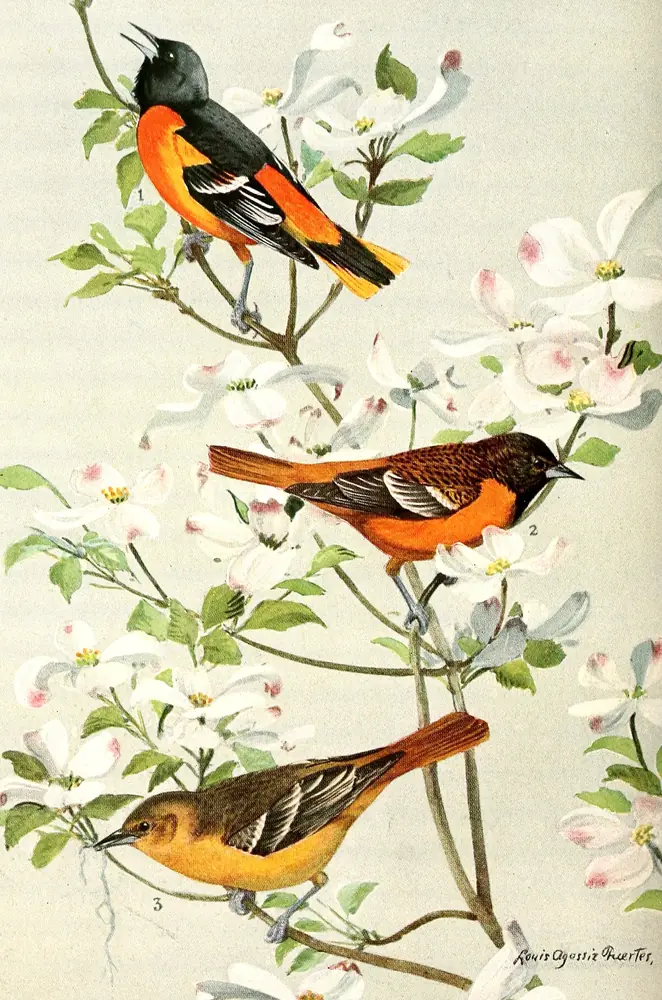
About this painting
Louis Agassiz Fuertes signed this plate of three orioles on flowering dogwood, numbered 1 to 3, for the bird magazine Bird-Lore (1922). In his plates for Elon H. Eaton's Birds of New York (1910–14), the Baltimore Oriole is plate 75, with the Orchard Oriole and the Eastern Meadowlark. More in our guide to Louis Agassiz Fuertes.
Audubon’s Baltimore Oriole: plate 12, “Baltimore Oriole”
Audubon's plate shows males in their first, second and third years, because the male, he wrote, needs until its third spring to reach full color. While he was away, his engraver took the first-year male for a female and labeled it so; Audubon had some of the plates corrected as soon as he saw the mistake.
He took the hanging twig in the drawing from a tree in Louisiana. There, he wrote, the male fastens threads of Spanish moss between twigs “with as much art as a sailor might do,” and the female weaves more threads across them. Louisiana nests were airy and hung on the northeast side of the tree, away from the heat, while nests farther north were made of the warmest, softest materials.
Story: Audubon’s Ornithological Biography, vol. 1 (1831). See plate 12 free at Audubon.org.
More classic portraits, free to see
- John James Audubon, The Birds of America, octavo edition (1840–44), plate 217: “Baltimore Oriole, or Hang-nest”. Free scan (New York Public Library Digital Collections)
- Louis Agassiz Fuertes, for Elon H. Eaton’s Birds of New York (1910–14), plate 75: “Baltimore Oriole”, with Orchard Oriole and Eastern Meadowlark. Free scan (Internet Archive)
About the Baltimore Oriole
- Baltimore Orioles search leaves for insects, and also visit flowers for nectar. (Source: National Audubon Society)
- The Baltimore Oriole and Bullock's Oriole were once counted as one species, the Northern Oriole. (Source: National Audubon Society)
The oldest known wild Baltimore Oriole lived at least 12 years: it was banded in Minnesota in 1996 and found there again in 2007. That is a record from bird banding, not a typical lifespan. (Source: USGS Bird Banding Laboratory, 2025 longevity table.) How long do wild birds live?
Buying a print?
An original plate 12 is a hand-colored sheet about 26 by 38 inches, printed in Britain in 1827–38; many prints sold today are reproductions or small 1840s octavo prints. How to tell an original from a reproduction.
In a Birdfolio, the hardcover book of your own life list, this painting sits beside the Baltimore Oriole with the date and place you first saw one. See your own list as a book, free.