Classic bird paintings
Sandhill Crane painting: Audubon's plate and other classic portraits
John James Audubon painted the Sandhill Crane as plate 261 of The Birds of America (1827–38), but titled it Hooping Crane: he believed gray Sandhills were young Whooping Cranes. That plate is the painting shown here, and a free high-resolution scan is on Audubon.org. His adult Whooping Crane is plate 226.
Updated
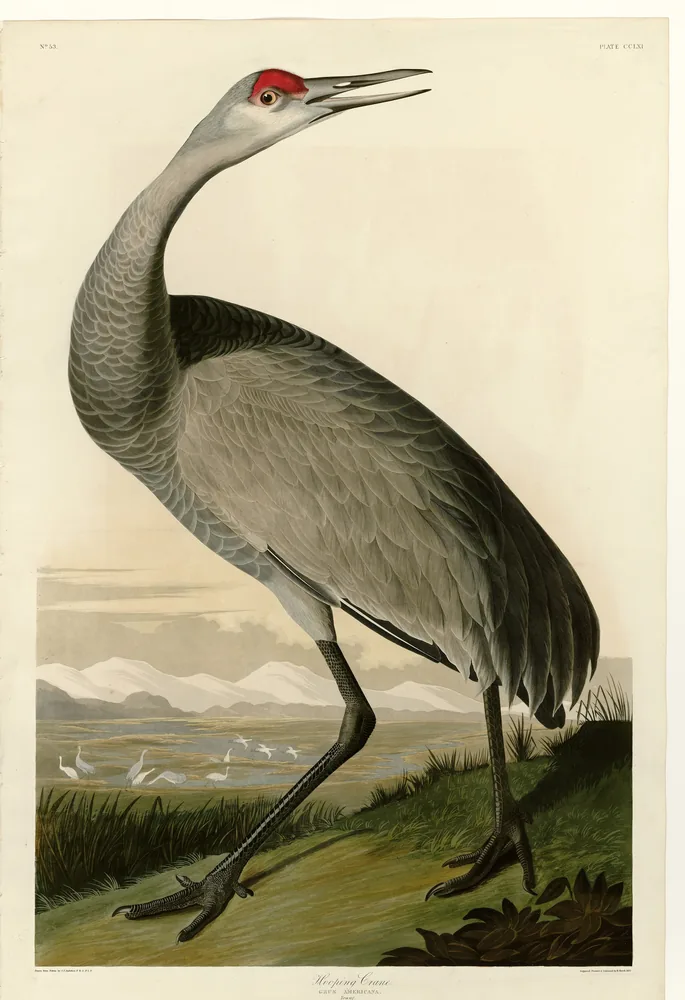
Audubon’s plate: plate 261, “Hooping Crane”
Audubon once ran from a crane. Coming down the Mississippi toward Natchez one winter afternoon, he paddled to a sandbar, crawled up behind a stranded tree and fired at a group of cranes. One, winged, ran off “with the speed of an ostrich,” and he chased it to a pile of driftwood. There it turned, stretched to its full height, raised its feathers and came at him with open bill. He backed away, then ran, and plunged into the river up to his neck, while the crane stood in the water a few yards off, thrusting at him, until his boatmen arrived and struck it with an oar.
He believed the gray cranes were the young of the white Whooping Crane, and that naturalists had named them a separate species, the Canada Crane, only because the gray birds far outnumbered the white ones. In March 1810, near Louisville, he showed Alexander Wilson a flock and told him the white birds were adults and the gray ones young.
So the plate's lettering reads Hooping Crane, young, with a view of the interior of Florida and sand hills in the distance. His text describes the bird: red skin on the head and bluish-gray feathers tipped with brown. Today the gray birds count as a species of their own, the Sandhill Crane.
Story: Audubon, Ornithological Biography, vol. 3 (1835), pp. 202–213. See plate 261 free at Audubon.org.
How do you tell a Sandhill Crane from a Whooping Crane?
By color first: a Sandhill Crane is gray, often stained rusty, with bare red skin on the crown, while an adult Whooping Crane is snowy white with black wingtips. Whoopers are a little taller too, about 5 feet standing, with wings more than 7 feet across, the U.S. Fish and Wildlife Service says; Sherburne refuge in Minnesota gives its Sandhills 4½ to 5 feet and a 6-foot wingspan.
And Whooping Cranes are rare. Only 15 were left in 1941, wintering at Aransas National Wildlife Refuge on the Texas coast. Their one natural, self-sustaining flock still nests in and around Wood Buffalo National Park in Canada and winters at Aransas, where the Service estimated about 540 in the winter of 2025–26, at least 57 of them young.
Sources: Sherburne National Wildlife Refuge, 2022; U.S. Fish and Wildlife Service; U.S. Fish and Wildlife Service, June 17, 2026.
More classic portraits, free to see
- John James Audubon, The Birds of America, octavo edition (1840–44), plate 314: “Whooping Crane”. Free scan (New York Public Library Digital Collections)
- Louis Agassiz Fuertes, for Elon H. Eaton’s Birds of New York (1910–14), plate 24: “Sandhill Crane”, with Great Egret, Black-crowned Night Heron and Great Blue Heron. Free scan (Internet Archive)
About the Sandhill Crane
- Sandhill Cranes usually feed on land or in shallow marshes, and gather in feeding flocks outside the nesting season. (Source: National Audubon Society)
Do Sandhill Cranes paint themselves?
In a way, yes: they preen iron-rich mud into their feathers. At Sherburne National Wildlife Refuge in Minnesota this turns their white to pale gray plumage a rusty brown over the summer, the U.S. Fish and Wildlife Service says.
A University of Florida extension profile of the Florida Sandhill Crane says the same: the plumage is mostly gray but may look rusty brown from iron staining picked up while preening with muddy water. Young cranes in their first fall are rustier than their parents and lack the bright red crown; theirs is rusty brown and turns red as they mature.
Sources: Sherburne National Wildlife Refuge, 2022; UF/IFAS Extension, September 13, 2024.
When do Sandhill Cranes come to Texas?
In fall, for the winter, and by late March most have flown north again to the Platte River in Nebraska. Texas is part of the winter range of the Mid-continent population, the most numerous of North America's cranes, with western Oklahoma, New Mexico, southeastern Arizona and northern Mexico, the U.S. Fish and Wildlife Service's 2026 status report says. In spring 2026 it estimated 527,440 of them along Nebraska's Central Platte River.
Many spend nearly the whole winter in Texas. Of 153 cranes a U.S. Geological Survey study tracked by satellite from Nebraska in 1998–2003, those from northern Canada and Nunavut spent 99% of the winter in western Texas, and those from east-central Canada and Minnesota 83% on the Texas Gulf Coast. On the High Plains, Muleshoe National Wildlife Refuge, the state's oldest, set up in 1935, hosts one of North America's largest gatherings of lesser Sandhill Cranes.
Sources: U.S. Fish and Wildlife Service, September 2026; U.S. Geological Survey, Krapu and others, 2011; Muleshoe National Wildlife Refuge.
How long does a Sandhill Crane live?
No confirmed typical lifespan for the Sandhill Crane turned up in our search. A female lays one to three eggs a year, and usually only one chick survives, the National Park Service says. The oldest known wild Sandhill Crane was at least 38 years old (USGS Bird Banding Laboratory): it was banded in Florida in 1982 and found in Wisconsin in 2019.
Sources: National Park Service; USGS Bird Banding Laboratory. A banding record is the minimum age of one bird when it was found again, not a typical lifespan. How long do wild birds live?
How can you tell if a plate 261 print is an original?
By its size: an original plate 261 is a hand-colored sheet about 26 by 38 inches, dated 1835; the Sandhill Crane’s octavo version, plate 314, is book-size, from 1840–44. Many prints sold today are reproductions: how to tell an original from a reproduction. Plate 261 and the other 434 also come bound in one modern book: which Birds of America book to buy.
In a Birdfolio hardcover, this painting sits beside the date and place you first saw a Sandhill Crane. See your own list as a book, free.