2019 split
White-winged Scoter split into three species
White-winged Scoter is now three species, one for each continent: eBird split off the Velvet Scoter of Europe in August 2018, the American Ornithological Society (AOS) recognized all three on June 24, 2019, and eBird split off the Asian bird in August 2019. In North America your bird keeps its name, White-winged Scoter; Stejneger's Scoter lives in Asia and strays to Alaska, and Velvet Scoter lives in Europe. Your list changes only if you have seen one of those two as well.
Updated
What changed
Nests in Alaska and northern Canada, east to James Bay. Winters on the Pacific coast from the Aleutians to central California, on the Atlantic coast from the Gulf of St. Lawrence to New Jersey, and on the Great Lakes.
Nests in Siberia and Mongolia, and winters off Japan and Korea. A rare late-spring visitor to the Bering Sea off western Alaska.
Nests from Norway across northern Russia to central Siberia, and winters mostly on the Baltic Sea.
Is the White-winged Scoter still a species?
Yes. The North American bird keeps its English name, White-winged Scoter, but its scientific name changed from Melanitta fusca to Melanitta deglandi, Kaufman notes. The old name fusca stays with the Velvet Scoter of Europe.
The third species, Stejneger's Scoter, Melanitta stejnegeri, nests from central Siberia to Kamchatka and in Mongolia, and winters off Japan and Korea, according to AviList, the shared world checklist. In North America it is a rare spring visitor to western Alaska.
Surprising facts about the White-winged, Stejneger's and Velvet Scoters
Its namesake wrote the sea cow's obituary. Stejneger's Scoter was described in 1887 from winter birds of the Commander Islands, off Kamchatka, notes a 2012 paper in Western Birds. Leonhard Stejneger of the US National Museum knew those islands well: in his report on them for the US Fish Commission he told how the Steller's sea cow had been wiped out by man there in 1768, 27 years after its discovery.
Two strays were found later in old photos. After the split, the American Birding Association (ABA) re-examined a scoter photographed in Santa Cruz County, California, on January 15, 2014, and one seen in Montana in 2015, and found both were Stejneger's Scoters. California's records committee added the species to the state list on August 23, 2025.
All three met in one Scottish firth. Britain's first Stejneger's Scoter was found among wintering Velvet Scoters in Lothian in December 2022; later, in Fife, it was seen “alongside up to four White-winged Scoters,” the British Ornithologists' Union reported.
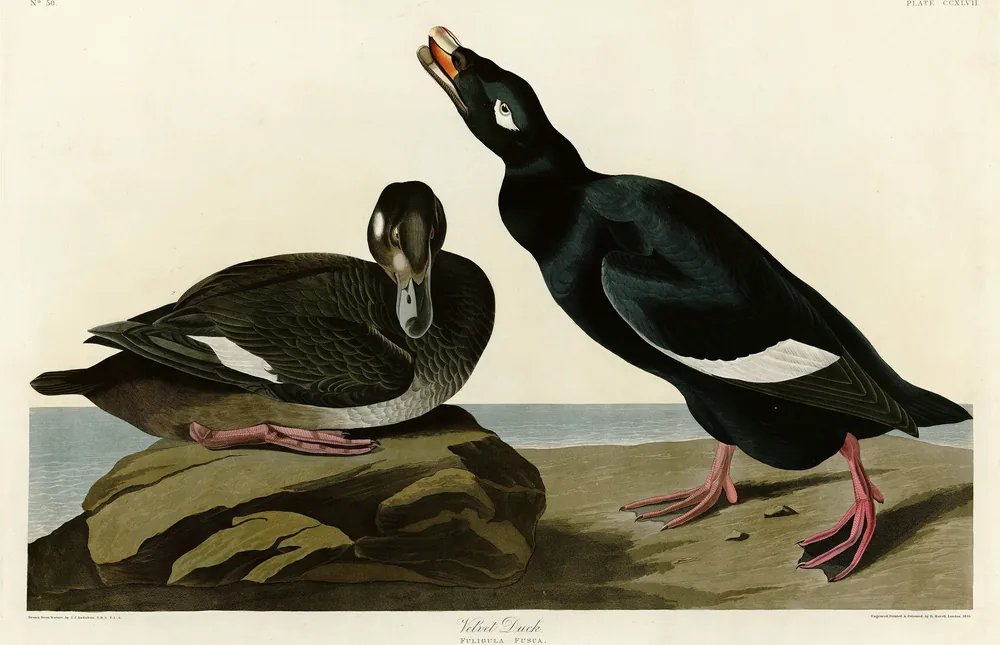
Audubon saw them pass by the thousands. Off Labrador one June, so many flew by that “we could not help imagining that all the Velvet Ducks in the world were passing before us,” he wrote in 1835.
The European one is in trouble. The Velvet Scoter is listed as Vulnerable on the IUCN Red List, while the White-winged and Stejneger's Scoters are of Least Concern, AviList shows.
Why it changed
Mostly the males' bills and flanks, and the lack of hybrids. The AOS proposal, written by Jon Dunn and dated September 17, 2018, pointed to differences in bill shape and color, flank color and plumage, and admitted that more genetic study was needed. “The absence of known hybrids is telling, especially in a group as hybrid-prone as waterfowl,” one committee member wrote.
It undid an old lump. The Check-list of North American birds kept the White-winged and Velvet Scoters apart in every edition from 1886 to 1957 and merged them only in 1983. The original merger, by the ornithologist Hartert in 1920, came with no reason given: it “was done strictly by fiat,” Dunn wrote. The split was “more an acknowledgment that the lumping back in 1920 wasn't based on any particular evidence,” Kenn Kaufman explained for Audubon.
Who decided, and when
- eBird and the Clements Checklist: its 2018 update split off Velvet Scoter, the bird of Europe
- American Ornithological Society (AOS): the 60th Supplement to its Check-list, which made all three species at once
- eBird and the Clements Checklist: its 2019 update split off Stejneger's Scoter, the bird of Asia
- American Birding Association (ABA): added Stejneger's Scoter to the ABA Checklist, as a very rare visitor
- AviList, the shared world checklist: agrees, with the same names
What are the three types of scoters?
In North America: the Black, Surf and White-winged Scoters. The White-winged is the largest of the three, says the Sea Duck Joint Venture. Worldwide there are now six, AviList shows: add the Common Scoter of Europe, the Velvet Scoter and Stejneger's Scoter.
The males are easy to tell apart. The Black Scoter is all black except for an orange knob on its bill. The Surf Scoter has white patches on its head, which earned it the hunters' nickname “skunk-head coot,” says Audubon's field guide. The White-winged has a white patch on the wing, obvious in flight.
What kind of duck is a scoter?
A sea duck: one of 15 species of sea ducks, a group that includes the eiders, goldeneyes and mergansers, says the Sea Duck Joint Venture. Scoters are diving ducks. On the coast the White-winged usually feeds in water less than 16 feet (5 meters) deep but can go down to 60 feet, mostly on clams, mussels and crabs; it swallows small items underwater and brings big shellfish to the surface to swallow whole.
Are scoters bigger than mallards?
About the same size, and the White-winged can be heavier. Audubon's field guide calls it about the size of a Mallard: 19 to 23 inches long, but weighing up to 4 pounds 13 ounces (2.2 kilograms). The Surf Scoter weighs up to about 4½ pounds and the Black Scoter up to 3½.
Are White-winged Scoters rare?
No, but they are declining. There are about 400,000 worldwide. Christmas Bird Counts show a fairly steady decline since 1970, amounting to a 44 percent drop, says The State of Canada's Birds. A survey of the Atlantic coast counted an average of 58,600 from 2008 to 2011, the Sea Duck Joint Venture reports.
Are Surf Scoters rare?
No. The Surf Scoter is common in winter on both coasts, and on the Pacific it is often seen around fishing piers and harbors, says Audubon's field guide.
Are White-winged Scoters good to eat?
Opinions differ, but they are legal game. In the Atlantic Flyway in 2025–26, a hunter's daily bag could include four sea ducks, no more than three of them scoters; in Alaska the sea duck limit was 10 a day, says the US Fish and Wildlife Service. US hunters took about 8,527 White-winged Scoters a year from 1999 to 2008, two-thirds of them in the Atlantic Flyway.
Audubon found the flesh “extremely dark,” fishy and “very unpalatable,” yet he saw people of great judgment eat it eagerly and praise it like venison.
Where can you see a White-winged Scoter?
In winter, on both coasts and the Great Lakes. Of the birds fitted with satellite tags on the Atlantic coast, three-quarters wintered between Massachusetts and Long Island, the Sea Duck Joint Venture found. Large numbers winter on the Great Lakes, where invasive zebra mussels are a major food, says The State of Canada's Birds.
Stejneger's Scoter has turned up at Gambell and Northwest Cape, on St. Lawrence Island, and near Nome, Alaska, mostly in late May and June. At Gambell, as many as half a dozen have been picked out among flocks of White-winged Scoters, Kaufman wrote. Gambell adds species to the official list of Alaska's birds too, such as a Pallas's Grasshopper-Warbler in 2019.
Which one did you see?
Go by where you saw it. Anywhere in North America away from western Alaska, it's White-winged Scoter.
Adult males differ the most. Only the White-winged has brownish flanks; the other two have black ones. Stejneger's has a big knob that often makes a hooked tip on the bill: its Russian name means “hook-nosed scoter.” The Velvet has the least white under the eye and the smallest knob, on a largely yellow bill, says the 2012 Western Birds paper.
Females are very hard: the differences are subtle and need very close views.
What it does to your list
For birders in the US and Canada nothing changes: White-winged Scoter keeps its name.
If you have also seen Velvet Scoter in Europe, or Stejneger's Scoter in Asia or Alaska, your total goes up by one (or two). Birders call a species gained from a split, without a new sighting, an “armchair lifer.”
The painting at the top is Audubon's plate 247, which he called the Velvet Duck. A gull was split from its Old World relative two years later: see the Mew Gull split.
If Velvet or Stejneger's Scoter added to your total, here's how to print the longer list.
Check your own list. Drop your eBird download or type your birds: the free checker shows which of them this and other recent changes touched.
Check my list