2000 new name
Oldsquaw: the duck now called the Long-tailed Duck
Oldsquaw is the old North American name of the Long-tailed Duck. The American Ornithologists' Union, the forerunner of today's American Ornithological Society (AOS), changed it in July 2000 to the name the rest of the world already used. It is the same duck, so nothing on your list changes but the name.
Updated
What changed
A sea duck that spends about nine months of the year on coastal salt water. In winter: the Pacific coast from the Bering Sea to California, the East from Labrador south to North Carolina, Hudson Bay and the Great Lakes.
What does Oldsquaw mean?
Oldsquaw is the old North American name for the Long-tailed Duck (Clangula hyemalis), a sea duck. It began as a folk name, one of several for a very noisy bird. “Owing to their reiterated cries these birds are named ‘Noisy Ducks,’” John James Audubon wrote in 1838, and he listed “old wives” and “old squaws” among their other names.
The union's check-list took the name up: it printed “Old-squaw” in 1886 and 1931, and “Oldsquaw,” as one word, by the 1957 edition. It stayed until July 2000.
Surprising facts about the Oldsquaw
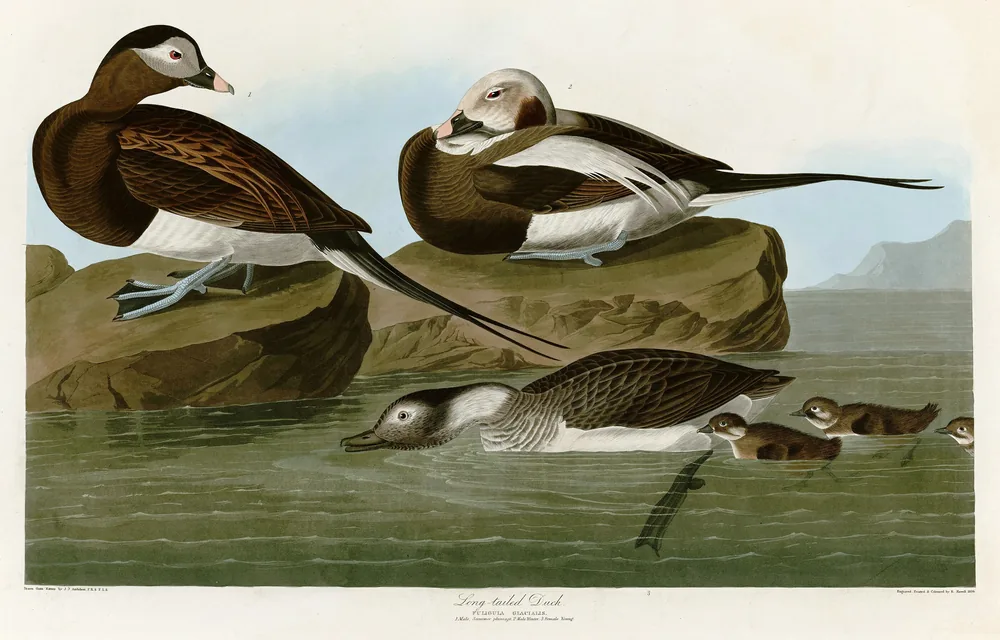
Audubon already called it the Long-tailed Duck. His plate 312 of The Birds of America and his 1838 chapter on the bird both carry that title. In 2000 the committee came back to the name he had put in print 162 years earlier.
It dives deeper than any other duck. It has been recorded more than 200 feet (60 m) down, says the Sea Duck Joint Venture's fact sheet on the species. Most of its feeding is far shallower.
Market sellers hid what it was. Audubon found the meat “dark, generally tough, and to the taste fishy.” The ducks came to market plucked, with head and feet cut off, he wrote, and were “called by the venders by all names excepting old wives, squaws, noisy ducks, or south-southerlies.”
It wears three sets of feathers a year. That is the most complex molt of any waterfowl, the Sea Duck Joint Venture says, and it is why a summer bird and a winter bird look so little alike.
No sea duck has more to say. The same fact sheet calls it the most vocal sea duck, the males yodeling a melodious ow ow owoolett.
Why the name changed
Biologists in Alaska asked for it. A group from the US Fish and Wildlife Service there petitioned the committee: the duck was declining in Alaska, plans to protect it needed “the help and cooperation of Native Americans,” and the biologists were concerned that the name Oldsquaw would offend them.
They were not the first to ask. Requests had come in earlier years, the committee wrote, from people who consider the word “squaw” offensive.
The committee gave a reason of its own. It “declines to consider political correctness alone in changing long-standing English names of birds,” it wrote, “but is willing in this instance to adopt an alternative name that is in use in much of the world.” The formal line says the change was made “to conform with English usage in other parts of the world.”
The other name was no stranger in America. The union's own 1983 check-list noted that the bird was “Known in Old World literature as LONG-TAILED DUCK,” and it gave as the main basis of the scientific name a plate in Edwards's Natural History of Birds titled “The Long-tailed Duck from Hudson's-Bay.”
Who decided, and when
- American Ornithological Society (AOS): the 42nd Supplement to its Check-list, the first after the seventh edition of 1998, issued under the society's older name, the American Ornithologists' Union (AOU)
When did the Oldsquaw become the Long-tailed Duck?
In July 2000. That month the American Ornithologists' Union (AOU), today's AOS, published the 42nd Supplement to its Check-list of North American Birds in its journal, The Auk. Its summary gives the change one line: “one English name is changed to conform to worldwide use (Long-tailed Duck).”
The supplement covers decisions made between late 1998, when the committee was re-formed, and January 31, 2000. From then on the check-list's note on the species was to read: “Formerly known as Oldsquaw in North America.”
How deep can a Long-tailed Duck dive?
More than 200 feet (60 m), deeper than any other duck, according to the Sea Duck Joint Venture's fact sheet. Most of its feeding is done in water less than 30 feet (9 m) deep.
Audubon's field guide gives the same two figures with a word of caution: the duck is “supposedly” able to dive below 200 feet.
What does a female Long-tailed Duck look like?
Mostly white in fall and winter, and brown in spring and early summer, says the Sea Duck Joint Venture. She has no long tail: only the male grows the two slim, stretched-out middle tail feathers.
Audubon's field guide describes females and young males as pale overall, with less contrast, a squarish head and a stubby bill. In flight every plumage shows solidly dark wings. On Audubon's plate she is the mottled bird on the water with her ducklings.
How big is a Long-tailed Duck?
Males are 16 to 21 inches (40–53 cm) long, not counting the long tail, and females 15 to 17 inches (38–43 cm), says the Sea Duck Joint Venture. They weigh 1.6 to 2.2 pounds (715–1,000 g).
How many eggs does a Long-tailed Duck lay?
Six to eight, and they hatch after 24 to 29 days of incubation, says the Sea Duck Joint Venture. Audubon's field guide gives their color as olive-buff to olive-gray.
Where can you see a Long-tailed Duck?
On salt water in winter, and on the Great Lakes. On the Pacific coast it winters from the Bering Sea to California. In the East it winters from Labrador south to North Carolina, and on Hudson Bay and the Great Lakes, says the Sea Duck Joint Venture.
It spends about nine months of the year on coastal waters. It is one of the sea ducks in our guide to the types of ducks.
How many Long-tailed Ducks are there?
At least one million, about 200,000 of them breeding in Alaska, the Sea Duck Joint Venture wrote in 2003. One long-running survey of breeding ducks showed a fall of about 80 percent since 1957, but it covers only a small part of Alaska and northwestern Canada, and the numbers seemed to have steadied since the early 1990s.
Audubon's field guide shows its conservation status as Vulnerable.
Which bird is it?
Nothing to sort out here: an Oldsquaw in an old book and a Long-tailed Duck in a new one are the same bird.
Summer and winter birds look very different. On Audubon's plate the summer male is dark brown with a pale patch on the face, and the winter male has a white head. Both carry the long, thin tail.
In flight, look at the wings: they are solidly dark in every plumage, says Audubon's field guide.
Females are paler, with a squarish head and a stubby bill, and have no long tail feathers.
What it does to your list
Only the name is different: an Oldsquaw on your list is a Long-tailed Duck, and your total stays as it was.
In a Birdfolio, a duck entered as Oldsquaw, Old-squaw or Old Squaw is filed as Long-tailed Duck, with a note that your list used the former name.
Read more about how bird splits and lumps work, and why names change.
A checklist that still says Oldsquaw is worth keeping. For a clean copy with today's names, see the ways to print a life list.
Check your own list. Drop your eBird download or type your birds: the free checker shows which of them the changes since 2018 touched.
Check my list