Free duck quiz
Duck Quiz: Name the Duck from Its Classic Painting
This duck quiz shows you a classic painting of a North American duck, by John James Audubon, John Gould, Louis Agassiz Fuertes or another master, and asks which duck it is. Pick one of four names, and the answer opens with the painter and one true story about the duck. There are 28 ducks at three levels: all of them mixed, the ten dabbling ducks, and eighteen diving and sea ducks. It's free, with nothing to sign up for.
Updated . 28 ducks in classic paintings and 12 duck trivia questions.
Play the duck quiz
All 28 ducks: 10 paintings. Tap the name you think is right; the answer and the bird’s story open under it.
Question 1 of 10: Which duck is this?
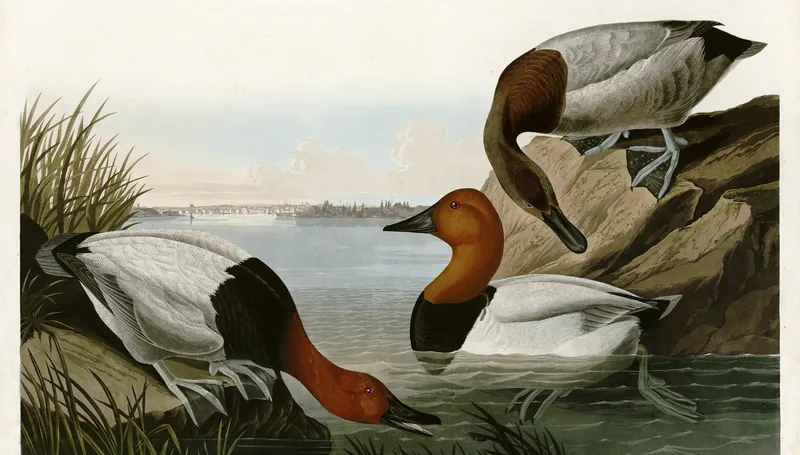
Show the answer
Canvasback
Painting: John James Audubon, The Birds of America (1827–38)
A Canvasback clocked at 72 mph once held the duck speed record. It lost the title to a Red-breasted Merganser timed at 100 mph while being chased by an airplane, Ducks Unlimited says. (Ducks Unlimited)
Question 2 of 10: Which duck is this?
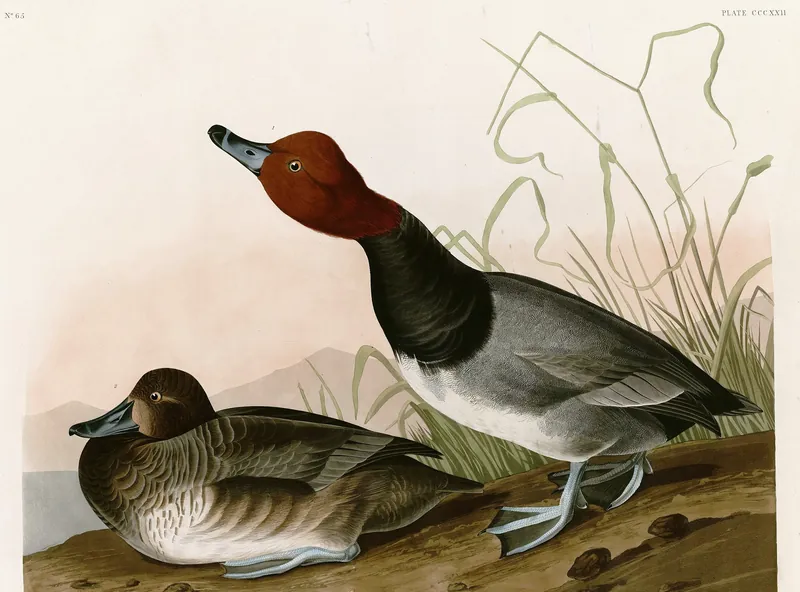
Show the answer
Redhead
Painting: John James Audubon, The Birds of America (1827–38)
Redheads often slip their eggs into other ducks' nests. In one Manitoba study, more than 90 percent of Canvasback nests held Redhead eggs, Ducks Unlimited reports. (Ducks Unlimited)
Question 3 of 10: Which duck is this?
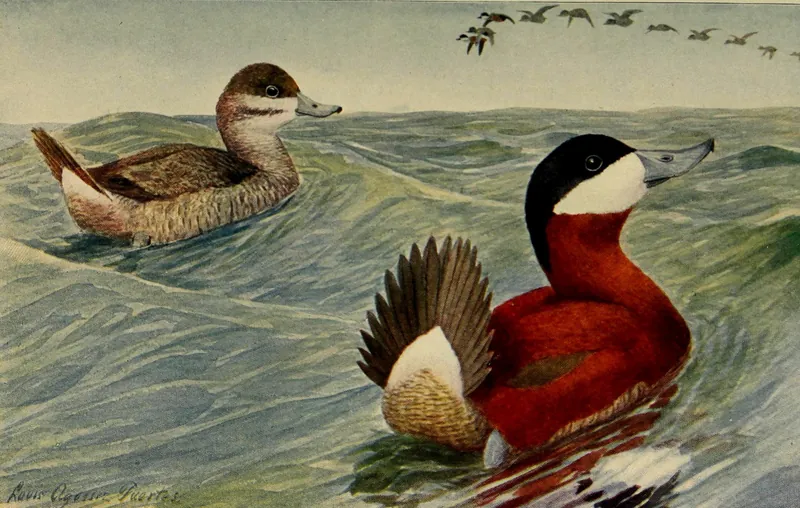
Show the answer
Ruddy Duck
Painting: Louis Agassiz Fuertes, Birds of the Rockies (1902)
Ruddy Ducks lay huge eggs for their size. A full clutch can weigh more than the hen that laid it, Ducks Unlimited says. (Ducks Unlimited)
Question 4 of 10: Which duck is this?
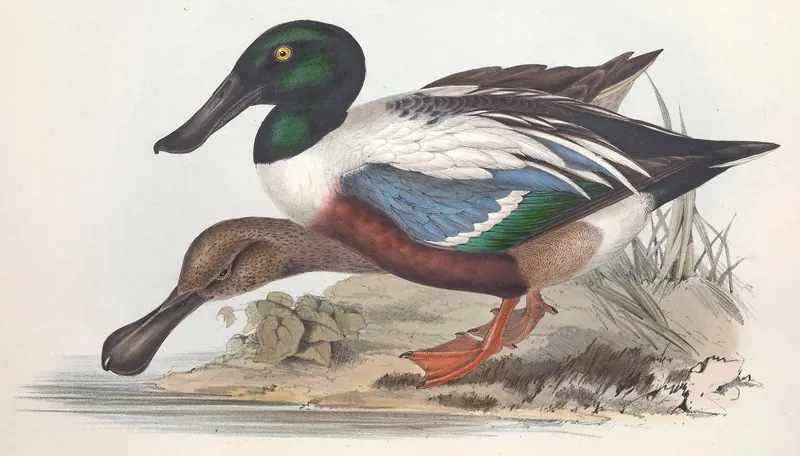
Show the answer
Northern Shoveler
Painting: John and Elizabeth Gould, The Birds of Europe (1832–37)
Northern Shovelers sometimes feed by swimming in tight circles as a group, which stirs up a whirlpool that brings food to the surface, the U.S. Fish and Wildlife Service says. (U.S. Fish & Wildlife Service)
Northern Shoveler painting: Audubon's plate and other classic portraits
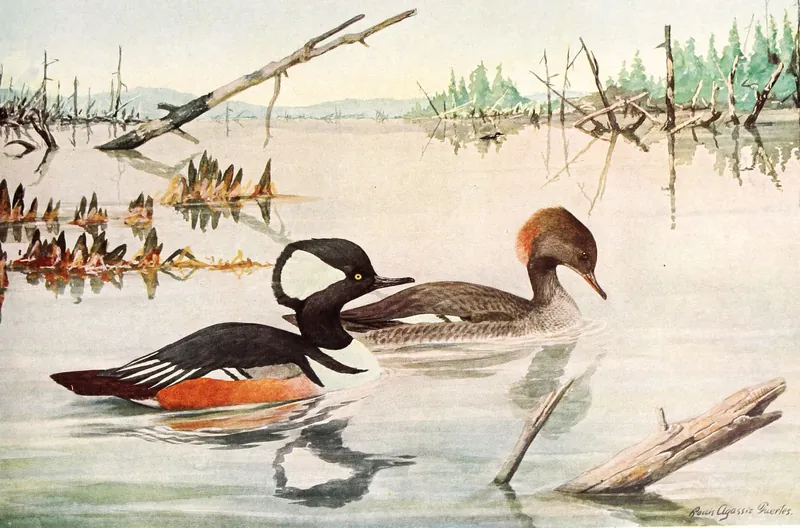
Question 5 of 10: Which duck is this?
Show the answer
Hooded Merganser
Painting: Louis Agassiz Fuertes, Elon H. Eaton's Birds of New York (1910–14)
Hooded Merganser ducklings leave home within a day of hatching. They climb to the entrance of their tree hole and jump to the ground while their mother calls from below. (National Audubon Society)
Hooded Merganser painting: Audubon's plate and other classic portraits
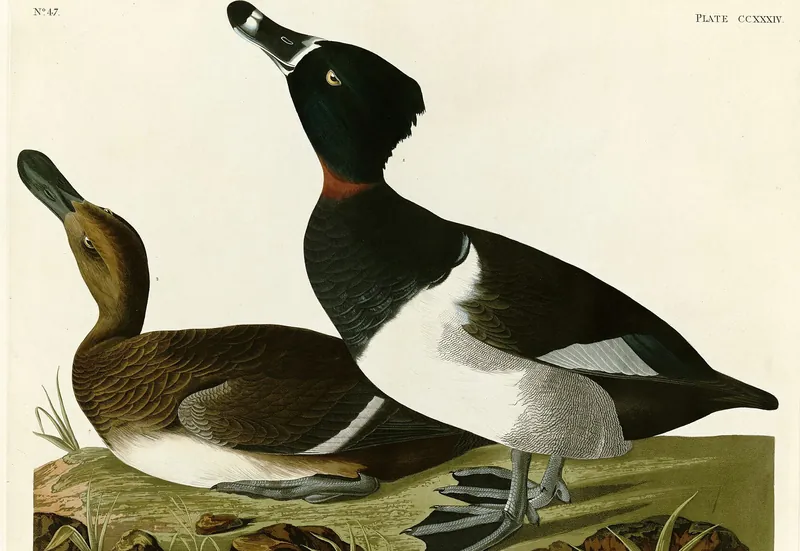
Question 6 of 10: Which duck is this?
Show the answer
Ring-necked Duck
Painting: John James Audubon, The Birds of America (1827–38)
The Ring-necked Duck is badly named. Its faint neck ring is hard to see, but a bold white ring circles its bill, which is why hunters call it the “ringbill.” (Audubon magazine, 4 Nov 2016)
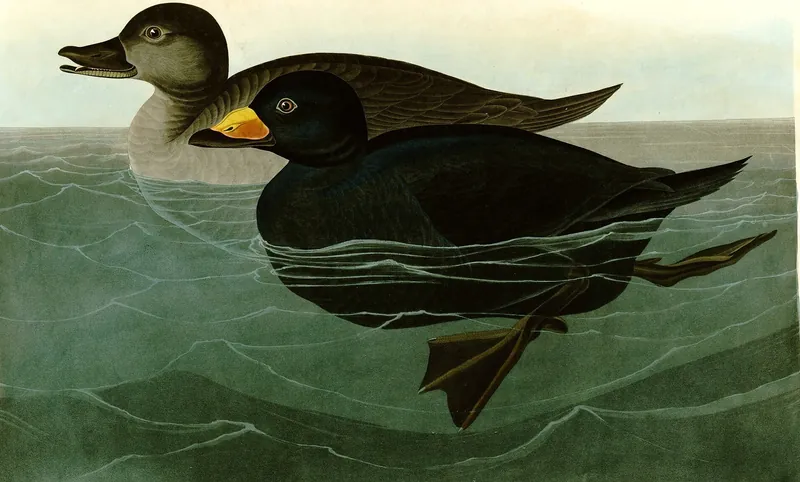
Question 7 of 10: Which duck is this?
Show the answer
Black Scoter
Painting: John James Audubon, The Birds of America (1827–38)
As late as 2003 the Black Scoter was the least common and least studied of North America's three scoters, a U.S. Geological Survey summary says, so scientists set out to follow birds from New Brunswick with satellite transmitters. (Keith McAloney and Matthew Perry, Birdscapes, 2003; U.S. Geological Survey publications)
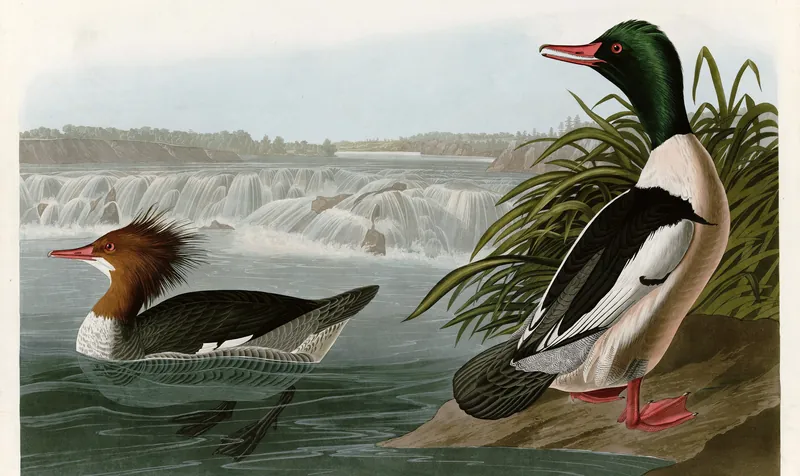
Question 8 of 10: Which duck is this?
Show the answer
Common Merganser
Painting: John James Audubon, The Birds of America (1827–38)
In 2018 a photographer on Lake Bemidji, Minnesota, found one female Common Merganser leading more than 50 ducklings. He later counted 76 with her. (Audubon magazine, 13 July 2018)
Question 9 of 10: Which duck is this?
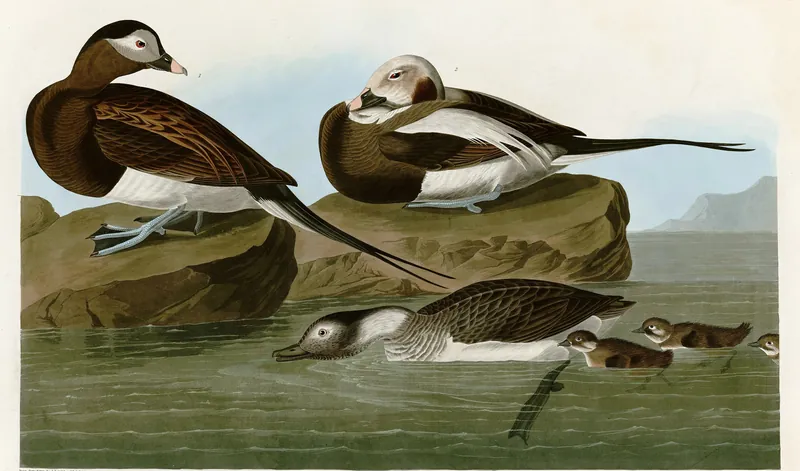
Show the answer
Long-tailed Duck
Painting: John James Audubon, The Birds of America (1827–38)
Long-tailed Ducks dive deep. More than 80 were reportedly caught in fishing nets 240 feet down off Wolfe Island in Lake Ontario, Ducks Unlimited says. (Ducks Unlimited)
Question 10 of 10: Which duck is this?
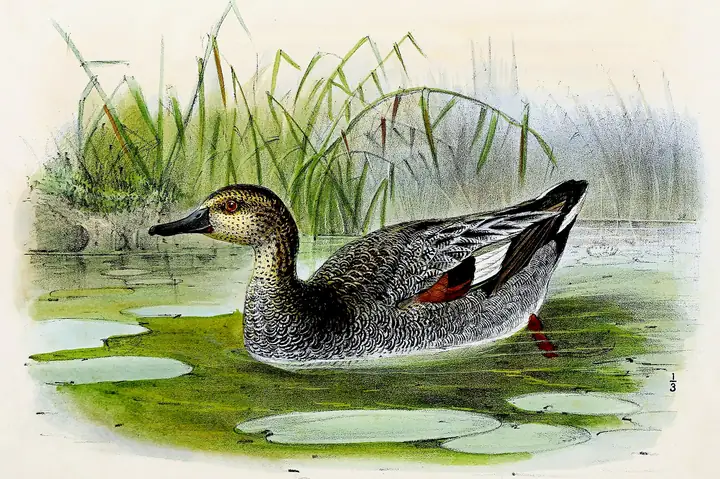
Show the answer
Gadwall
Painting: John Gerrard Keulemans, Onze Vogels in Huis en Tuin (1869–76)
Gadwalls are known thieves: the U.S. Fish and Wildlife Service says they are “well-known for stealing food from American coots.” (U.S. Fish & Wildlife Service)
Everything happens in your browser: no account, no cookies, and your score goes nowhere unless you share it. Without JavaScript, open “Show the answer” under each painting.
Three levels: every duck, the dabblers, the divers
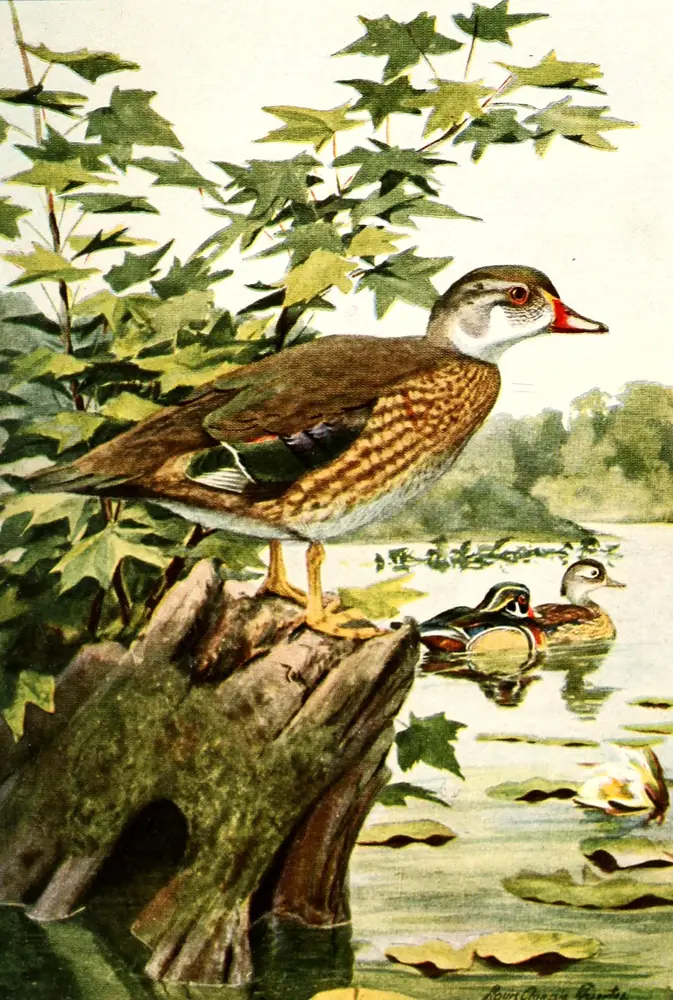
All 28 ducks (medium)
Ten ducks a round, drawn from all 28, dabblers and divers mixed. Start here. Play this level.
Dabbling ducks (medium)
The ten puddle ducks, from the Mallard and the American Black Duck to all three teal: the ducks of marshes and small rivers that tip up to feed. Telling the hens apart is the hard part. Play this level.
The 10 ducks: American Black Duck, American Wigeon, Blue-winged Teal, Cinnamon Teal, Gadwall, Green-winged Teal, Mallard, Northern Pintail, Northern Shoveler, Wood Duck.
Diving and sea ducks (hard)
Eighteen diving and sea ducks: Canvasback and Redhead, the scaup and the Ring-necked Duck, both goldeneyes, three mergansers, three scoters and two eiders. These are the look-alikes a hunter has to call in a second. Play this level.
The 18 ducks: Barrow's Goldeneye, Black Scoter, Bufflehead, Canvasback, Common Eider, Common Goldeneye, Common Merganser, Greater Scaup, Harlequin Duck, Hooded Merganser, King Eider, Long-tailed Duck, Red-breasted Merganser, Redhead, Ring-necked Duck, Ruddy Duck, Surf Scoter, White-winged Scoter.
How do you tell dabbling ducks from diving ducks?
Watch how a duck feeds and how it takes off. Dabbling ducks, also called puddle ducks (Mallards, black ducks, Wood Ducks, teal and pintails), feed at or just below the surface, often tipping up with the rump in the air; they sit high on the water, can take off straight from it, and like shallow marshes and small rivers. Diving ducks swim underwater for their food. Their legs sit far back on the body, so they walk poorly on land, and most have to run along the water to take off; look for them on bigger lakes, rivers and bays. That is how the New York State Department of Environmental Conservation teaches waterfowl identification. (New York State Department of Environmental Conservation, PDF)
Why do duck hunters need to identify ducks?
Because the rules differ by species, and sometimes by sex. Season lengths and bag limits follow each species' numbers, so a duck that has declined may get a smaller limit or fewer days, Ducks Unlimited explains, and Mallard limits have allowed more drakes than hens. That is hard in practice: one species can look a lot like another, and the drake and hen of the same duck can look like two different birds. Check your own state's current regulations before every season; they change from year to year. (Ducks Unlimited, Teresa Milner, 22 Jul 2024)
Which ducks are most common in North America?
The Mallard, by a wide margin. The 2026 spring breeding survey counted about 5.9 million Mallards in its traditional survey area, ahead of the scaup at 4.2 million, though that was 11% fewer Mallards than in 2025 and the fewest since 1993. All ducks together came to about 33.4 million. The survey is the U.S. Fish and Wildlife Service’s, run with the Canadian Wildlife Service and state and provincial partners; the table is Ducks Unlimited’s summary of its report.
| Duck | 2026 | 2025 | Against the long-term average |
|---|---|---|---|
| Mallard | 5.9 million | 6.6 million | −26% |
| Scaup (Greater and Lesser) | 4.2 million | 3.7 million | −15% |
| Blue-winged Teal | 4.0 million | 4.4 million | −22% |
| Northern Shoveler | 3.3 million | 2.8 million | +24% |
| American Wigeon | 2.9 million | 3.2 million | +12% |
| Gadwall | 2.4 million | 2.4 million | +13% |
| Green-winged Teal | 2.3 million | 2.5 million | +6% |
| Northern Pintail | 2.0 million | 2.2 million | −48% |
| Redhead | 0.9 million | 0.9 million | +26% |
| Canvasback | 0.8 million | 0.7 million | +32% |
Source: Ducks Unlimited, on the U.S. Fish and Wildlife Service's 2026 Waterfowl Population Status Report; table: traditional survey area, read October 22, 2026. The long-term average runs from 1955.
Duck trivia questions and answers
Twelve duck trivia questions, from a 2003 echo test to a gold rush in Nebraska, each with its answer and the page we checked it against.
True or false: a duck's quack doesn't echo, and nobody knows why. (easy)
Answer: False: it does echo. In 2003 acoustics professor Trevor Cox of the University of Salford tested a duck named Daisy in an echo chamber. The quack echoes; it's just quiet, so the echo is hard to hear, PolitiFact reports. (PolitiFact, Ciara O'Rourke, 10 Sep 2019)
Which picture book, winner of the 1942 Caldecott Medal, follows a family of ducklings through Boston traffic? (easy)
Answer: Make Way for Ducklings, by Robert McCloskey. The American Library Association sums it up as the story of ducklings with “a fine disregard for the problems of Boston traffic and the feelings of Boston policemen.” It won the 1942 Caldecott Medal for the best American picture book. (American Library Association, award winner page: Randolph Caldecott Medal, 1942)
Most farm and backyard duck breeds descend from which wild duck? (easy)
Answer: The Mallard. Most domestic ducks descend from the Mallard; the Muscovy is the other common one. In 1873 one Pekin drake and three hens were imported from China to Long Island, once the center of U.S. duck farming, the University of Wisconsin Extension says. (University of Wisconsin–Madison Division of Extension, Livestock, David R. Laatsch)
When ducks sleep in a row, what do the birds at the two ends do differently? (medium)
Answer: They sleep with one eye open. In a 1999 study, ducks at the ends of a row slept with one eye open 150% more than ducks in the middle, mostly facing the open eye away from the group. Half of the brain slept while the other half stayed awake. (Neuroscience for Kids, Eric H. Chudler, University of Washington; on Rattenborg, Lima and Amlaner, Nature 397:397-398, 4 Feb 1999)
The University of Oregon's duck mascot traces back to a 1947 handshake with which famous cartoonist? (medium)
Answer: Walt Disney: the duck is based on Donald Duck. Athletic director Leo Harris and Walt Disney shook on it in 1947: Oregon could use Donald's likeness for free if it was used in a reputable manner. Nobody wrote it down until after Disney's death; a contract followed in 1973, the university's archives say. (Unbound, University of Oregon Libraries Special Collections and University Archives, Zach Bigalke, 31 Dec 2014)
In 1911, what did duck hunters in western Nebraska find inside the ducks they shot that started a gold rush? (medium)
Answer: Small gold nuggets, in the ducks' gizzards. Ducks swallow grit and keep it in the gizzard to grind hard food. Hunters found gold nuggets among it and set off a gold rush, but the source of the gold was never discovered, Ducks Unlimited says. (Ducks Unlimited, compiled by Mike Checkett and Matt Young, 1 Aug 2008)
How can a duck stand on an icy pond without its feet freezing? (medium)
Answer: Warm and cold blood swap heat in its legs. The arteries carrying warm blood into the legs lie against the veins bringing cold blood back, so heat passes across. The feet stay near the outside temperature and lose little heat; they are mostly bone, sinew and scale, with very few nerves, BirdNote says. (BirdNote, adapted from a script by Frances Wood; aired Dec 2013, 2017, 2020, Nov 2022)
Duck hunters call a male Northern Pintail a “sprig.” Why? (medium)
Answer: His long, spiky tail looks like a twig. Hunters' nicknames describe what they saw: “sprig” for the pintail's spike of a tail, “bluebill” for a scaup's bill, “sawbill” for a merganser. In the 1880s ornithologist Gurdon Trumbull collected such names from hunters along the Atlantic flyway, BirdNote says. (BirdNote, Todd Peterson; aired Nov 2012, 2017)
The first Federal Duck Stamp went on sale in 1934. Which Pulitzer Prize-winning newspaper cartoonist drew it? (medium)
Answer: Jay N. “Ding” Darling. Darling dashed off six quick sketches as drafts, meaning to redraw the chosen one. Instead the government engraved one of the rough sketches as it was, to Darling's fury, and the original sketch has never been found, Ducks Unlimited says. (Ducks Unlimited, Chris Madson; written for the stamp program's 85th year, 2019)
What is the highest documented flight by a North American duck, goose or swan? (hard)
Answer: A Mallard hit by a jet at 21,000 feet over Nevada. Ducks usually migrate at 200 to 4,000 feet, Ducks Unlimited says, but a jet plane over Nevada struck a Mallard at 21,000 feet, the highest documented flight by North American waterfowl. (Ducks Unlimited, compiled by Mike Checkett and Matt Young, 1 Aug 2008)
A Blue-winged Teal banded in Manitoba was later found near Lima, Peru. About how far south had it flown? (hard)
Answer: More than 4,000 miles. Blue-winged Teal migrate farther south than any other North American waterfowl, Ducks Unlimited says. The Manitoba bird turned up near Lima, Peru, more than 4,000 miles away. (Ducks Unlimited, compiled by Mike Checkett and Matt Young, 1 Aug 2008)
In January 1940 a federal biologist looked down on Louisiana's Catahoula Lake from the air. How many ducks did he think might be on it? (hard)
Answer: As many as 8 million. Far too many to count, but U.S. Fish and Wildlife Service biologist Johnny Lynch claimed as many as 8 million ducks could have been there: one of the largest concentrations ever surveyed from the air in the United States, Ducks Unlimited says. (Ducks Unlimited, compiled by Mike Checkett and Matt Young, 1 Aug 2008)
For 89 more, on every kind of bird, see our bird trivia questions and answers, ranked easy to hard and printable.
Every duck you have ever seen can sit beside a painting like these in a Birdfolio, the hardcover book of your own life list. Look inside a Birdfolio.