Classic bird paintings
Mallard painting: Audubon's plate and other classic portraits
John James Audubon painted the Mallard as plate 221 of The Birds of America (1827–38), under the name Mallard Duck. A free high-resolution scan is on Audubon.org. The pair shown here is from John Gould's The Birds of Europe (1832–37), where the bird is called the Common Wild Duck.
Updated
The story of this painting
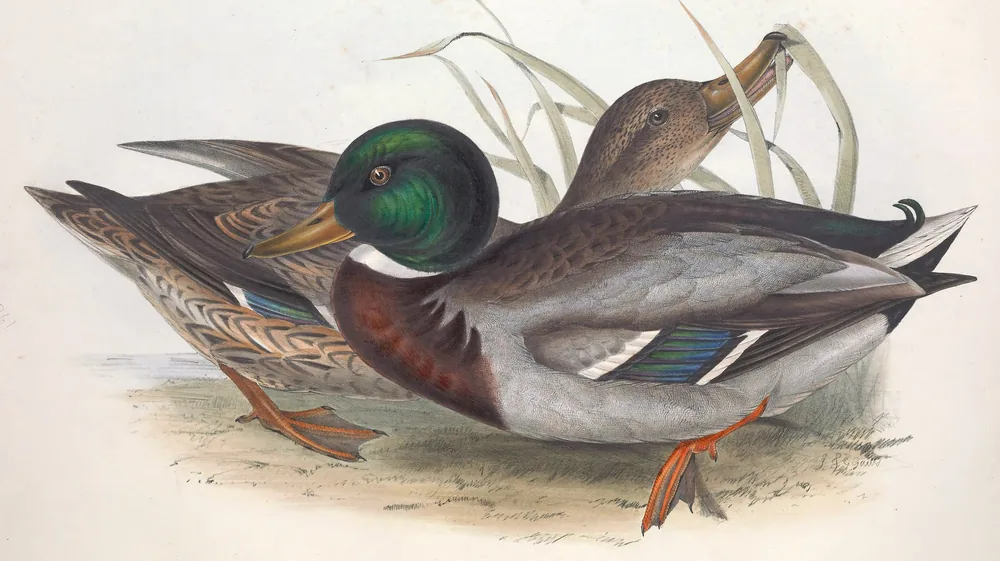
John Gould opened his account of the Common Wild Duck with a question he could not answer: when, and why, people first tamed it. Of one thing he was sure: this is the wild ancestor of our many farmyard ducks. In his text the word mallard means the drake alone: he writes of “the adult male, or mallard,” and calls its coloring peculiarly elegant.
In Britain, he wrote, many stay to breed, and more pass through each spring and fall. Young birds whose flight feathers had not yet grown were called flappers, and were in great demand for their rich flesh. The pairs form in February and March, and once the young can fend for themselves, the parents leave them and join flocks of their own.
This plate, number 361, shows a drake and a duck a little under life size, drawn from nature and put on stone by John and Elizabeth Gould. Decades later his The Birds of Great Britain (1862–73) gave the Mallard, or Wild Duck, a new plate, drawn by Joseph Wolf and Henry Constantine Richter, with more mallards flying in the distance.
Story: Gould, The Birds of Europe, vol. 5 (1837), plate 361; vol. 5 (1837), text to plate 361; Gould, The Birds of Great Britain, vol. 5 (1873), plate 15.
Audubon’s Mallard: plate 221, “Mallard Duck”
Once in the woods Audubon came on a mother Mallard leading her brood, no doubt toward the Ohio. She hissed at him like a goose while the ducklings scattered, and as his dog brought them to him one by one, she rolled and tumbled on the ground in such despair that he called off the dog, gave her back the whole brood and walked away. In all his rambles, he wrote, “a happier moment I never felt.”
Readers might be startled, he wrote, to learn how many Mallards bred inland, around lakes near the Mississippi and on small ponds in Kentucky, Indiana and Illinois. He also scolded authors who called the wild bird common everywhere: near Boston it was extremely rare, and beyond Portland, Maine, he saw none. In the Floridas they sometimes rose in such numbers they darkened the air, with a noise like rumbling thunder.
The farmyard duck, he wrote, had lost its native spirit and could hardly lift itself off the ground, while the wild drake of the swamps springs into the air and is away over the woods. Plate 221 shows males and females.
Story: Audubon, Ornithological Biography, vol. 3 (1835), pp. 164–169. See plate 221 free at Audubon.org.
More classic portraits, free to see
- John James Audubon, The Birds of America, octavo edition (1840–44), plate 385: “Mallard”. Free scan (New York Public Library Digital Collections)
- John and Elizabeth Gould, The Birds of Europe (1832–37), plate 361: “Common Wild Duck” (Anas boschas) (the painting shown above). Free scan (University of Kansas Libraries)
- Joseph Wolf and Henry Constantine Richter, for John Gould’s The Birds of Great Britain (1862–73), vol. 5, plate 15: “Mallard, or Wild Duck” (Anas boschas). Free scan (University of Kansas Libraries)
- Louis Agassiz Fuertes, for Elon H. Eaton’s Birds of New York (1910–14), plate 12: “Mallard”, with Gadwall and American Black Duck. Free scan (Internet Archive)
About the Mallard
- Mallards feed by tipping forward in the water, and also gather plant food on land. (Source: National Audubon Society)
- Mallards are the ancestors of most breeds of farmyard duck. (Source: National Audubon Society)
What does a female Mallard look like?
Mottled brown, with an orange bill smudged with black. She has the drake's blue wing patch, the speculum, with white borders, the National Audubon Society's guide says, and Hinterland Who's Who calls that white-edged patch the best way to know her. Her breast is heavily streaked with buff and darker brown, her legs and feet are orange, and the loud quack-quack is hers; the drake's call is a softer, lower rhab-rhab.
She also does nearly all the work. With the drake alongside, she picks the nest site, usually a hollow on the ground in thick cover, and lines it with down from her own belly. When she leaves to feed she pulls that down over the eggs, which keeps them warm and hides them from crows and magpies. The drake stays for about the first ten days of the sitting, then leaves to molt; the rest of the roughly 28 days, and the ducklings, are hers.
Sources: National Audubon Society guide, Mallard; Hinterland Who's Who on the Mallard.
Can mallard ducks be female?
Yes: the brown bird beside the green-headed drake is a female Mallard, a hen. The doubt has old roots. When John Gould wrote about the bird in the 1830s, mallard meant the drake alone, as his text above shows; today the name covers the whole species, hens included.
Sources: National Audubon Society guide, Mallard; Gould, The Birds of Europe, vol. 5 (1837), text to plate 361.
Which ducks look like a female Mallard?
Three close relatives, and the wing patch sorts them out. The American Black Duck is much darker, with a gray head, and its purple patch lacks the Mallard's bold white edges; in flight its white underwings flash against the dark body. The Mottled Duck of Florida and the Gulf Coast looks like a darker hen Mallard with a yellow bill, dull in the female, and its blue patch has no broad white borders. In the Southwest the third is the Mexican Duck: the Mexican Duck split explains how to tell it.
In the Northeast, Mallards and Black Ducks often interbreed, so in-between birds turn up, the Audubon guide adds. Audubon saw tame Mallards cross with both the Black Duck and the Gadwall, and called the Gadwall cross “a very handsome hybrid” with the Mallard's green head.
Sources: National Audubon Society guide, American Black Duck; National Audubon Society guide, Mottled Duck; National Audubon Society guide, Mallard; Audubon, Ornithological Biography, vol. 3 (1835), pp. 168–169.
How long does a Mallard live?
More than half of wild Mallards die before they reach two years of age, Pennsylvania's Game Commission says. The same agency puts the typical maximum in the wild at seven to nine years. Predators, accidents, hunting and diseases such as botulism and fowl cholera account for the losses. The oldest known wild Mallard was at least 27 years and 7 months old (USGS Bird Banding Laboratory): it was banded in Louisiana in 1981 and found in Arkansas in 2008.
Even fish hunt ducklings: largemouth bass and muskellunge take them, as do snakes, foxes and snapping turtles, the Game Commission notes.
Sources: Pennsylvania Game Commission; USGS Bird Banding Laboratory. A banding record is the minimum age of one bird when it was found again, not a typical lifespan. How long do wild birds live?
How can you tell if a plate 221 print is an original?
By its size: an original plate 221 is a hand-colored sheet about 26 by 38 inches; the Mallard’s octavo version, plate 385, is book-size, from 1840–44. Many prints sold today are reproductions: how to tell an original from a reproduction. Plate 221 and the other 434 also come bound in one modern book: which Birds of America book to buy.
In a Birdfolio hardcover, this painting sits beside the date and place you first saw a Mallard. See your own list as a book, free.