Classic bird paintings
Anna's Hummingbird painting: Audubon's plate and other classic portraits
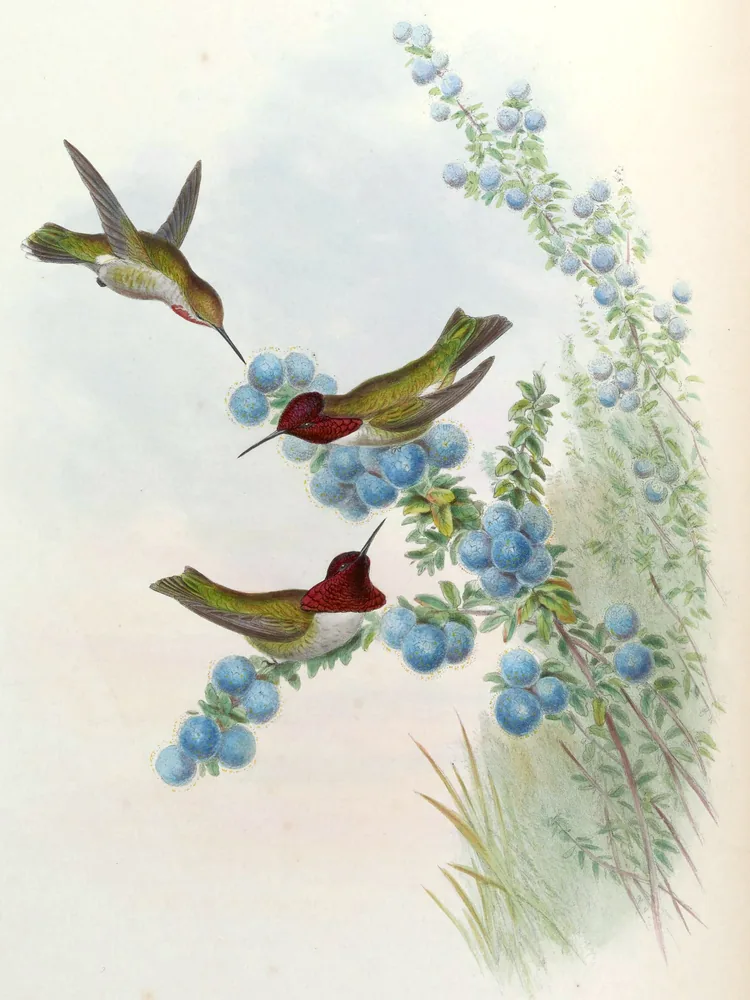
John James Audubon painted Anna's Hummingbird as plate 425 of The Birds of America (1827–38): four males and a female at her nest, under the name Columbian Humming Bird. A free high-resolution scan is on Audubon.org. The three birds shown here are from John Gould's A Monograph of the Trochilidae (1849–61), plate 135.
Updated
The story of this painting
John Gould had a theory about this bird's shine. Hummingbirds from country rich in metal ores, he noticed, glitter more than most, and Mexico and California had three species unmatched for brilliance. Two of them, Costa's and this one, wear it over the whole head, not just the throat, “as if they had been dipped in molten metal.” Whether the ground could have such an effect on a bird was an enigma, he admitted, and it might be only a coincidence.
The bird had been named in honor of Anna, Duchess of Rivoli. For its habits Gould turned to Dr. Gambel of Philadelphia, who had watched it in California and cleared up an old mistake. Thomas Nuttall, who brought the species back from California without a male, had thought the male had a yellow spot on its crown. It was sticky pollen from a tubular flower, Gambel found, caught in the stiff crown feathers.
The plate, number 135 in the third volume (1861), shows two males and a female at life size among the blossoms of a ceanothus. Its lettering, “J. Gould and H. C. Richter, del. et lith.,” credits the two men with both the drawing and the lithograph.
Story: Gould, A Monograph of the Trochilidae, vol. 3 (1861), plate 135; vol. 3 (1861), text to plate 135.
Audubon’s Anna's Hummingbird: plate 425, “Columbian Humming Bird”
Thomas Nuttall, traveling from the Rocky Mountains toward California, spotted a hummingbird sitting on her nest in a low oak bush, crept up and caught her with his hat. The male fluttered angrily around him, but Nuttall had no gun and could not collect it. He gave Audubon the female and the nest: a cone of willow down, catkin scales and a few feathers, an inch and a half deep, with two pure white eggs.
So the female and the nest on plate 425 are Nuttall's. Audubon drew the males from specimens lent by Mr. Loddiges of London, “whose collection of Humming Birds is unrivalled,” and counted the bird as the fourth hummingbird known within the United States.
His plate calls it the Columbian Humming Bird, but his text follows Lesson, who had named it for Anna: Anna Humming Bird, Trochilus Anna. His octavo edition, plate 252, uses the same name.
Story: Audubon, Ornithological Biography, vol. 5 (1839), pp. 238–239. See plate 425 free at Audubon.org.
More classic portraits, free to see
- John James Audubon, The Birds of America, octavo edition (1840–44), plate 252: “Anna Humming bird”. Free scan (New York Public Library Digital Collections)
About the Anna's Hummingbird
- Anna's Hummingbird stays through the winter along the Pacific Coast, in many places where no other hummingbird is present. (Source: National Audubon Society)
- Since the 1950s it has spread north and east, probably helped by garden flowers and feeders, and it now nests north to British Columbia and east to Arizona. (Source: National Audubon Society)
- In courtship the male climbs high, then dives steeply toward the female and makes a loud popping sound at the bottom of the dive. (Source: National Audubon Society)
How long does an Anna's Hummingbird live?
No agency page we read gives a typical lifespan for Anna's Hummingbird that we could confirm. The oldest known wild Anna's Hummingbird was at least 9 years and 5 months old (USGS Bird Banding Laboratory): it was banded in California in 2016 and found there again in 2024.
Source: USGS Bird Banding Laboratory. A banding record is the minimum age of one bird when it was found again, not a typical lifespan. How long do wild birds live?
How can you tell if a plate 425 print is an original?
By its size: an original plate 425 is a hand-colored sheet about 26 by 38 inches; the Anna's Hummingbird’s octavo version, plate 252, is book-size, from 1840–44. Many prints sold today are reproductions: how to tell an original from a reproduction. Modern editions print all 435 plates, from pocket size to coffee-table size: which Birds of America book to buy.
In a Birdfolio hardcover, this painting sits beside the date and place you first saw a Anna's Hummingbird. See your own list as a book, free.