Classic bird paintings
Ruby-throated Hummingbird painting: Audubon's plate and other classic portraits
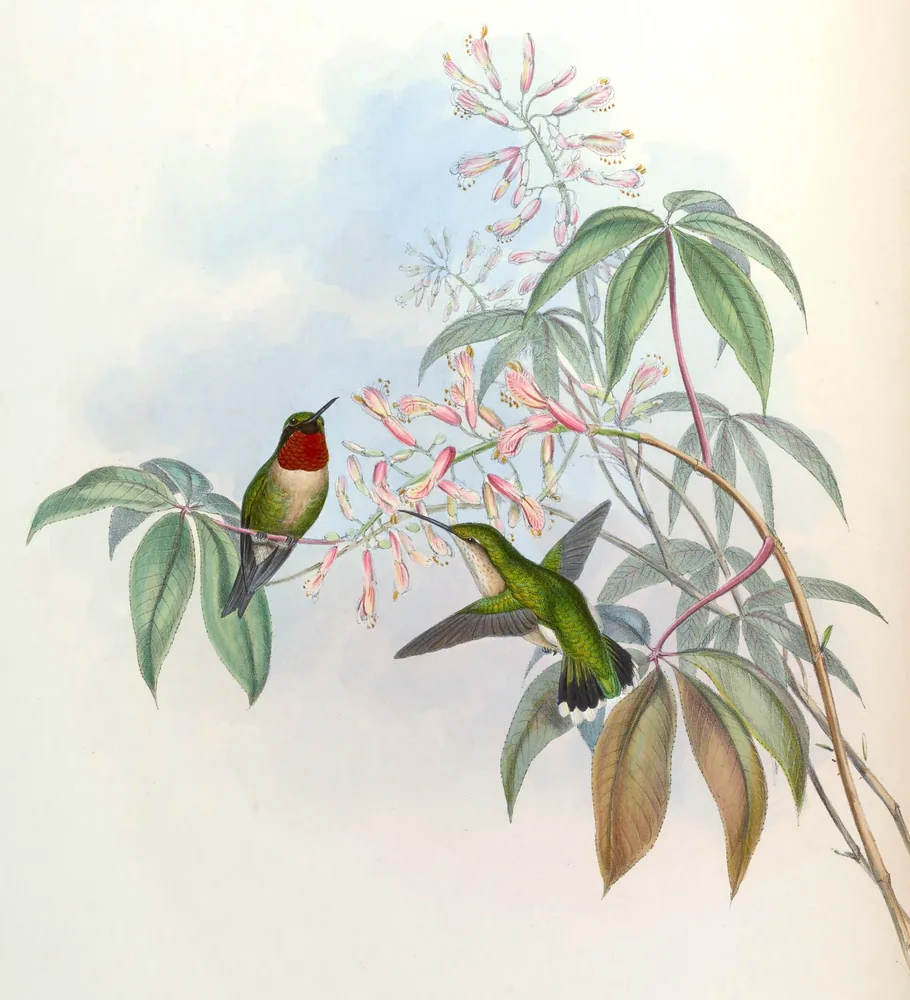
John James Audubon painted the Ruby-throated Hummingbird as plate 47 of The Birds of America (1827–38): males, females and young on a trumpet creeper, under the name Ruby-throated Humming Bird. A free high-resolution scan is on Audubon.org. The pair shown here is from John Gould's A Monograph of the Trochilidae (1849–61).
Updated
The story of this painting
“It was on the 21st of May, 1857,” John Gould wrote, that thirty years of “day-thoughts and not unfrequent night-dreams” ended with the sight of a living hummingbird: a single male in Bartram's garden in Philadelphia, among the blossoms of a tall chestnut. In Washington, in the gardens of the Capitol, he found fifty or sixty in one tree, a buckeye in flower.
A bird caught for him there took sugar water from a spoon within an hour. He hung it from a coat button in a small gauze net and fed it every half hour across the Allegheny Mountains, until, after a dusty, jolting ride, he gave it a bath, and it sickened and died. Of a pair he carried home across the Atlantic on sugar syrup and a little raw egg yolk, one died in the English Channel; the other lived two days at his house in London.
On one point he sided against Audubon: he believed the bird migrates in broad daylight, not by night as Audubon suspected. The plate, number 131 in the third volume of his A Monograph of the Trochilidae, shows a male and a female; its lettering credits Gould and Henry Constantine Richter, who drew it and put it on the stone.
Story: Gould, A Monograph of the Trochilidae, vol. 3 (1861), plate 131; vol. 3 (1861), text to plate 131; Audubon, Ornithological Biography, vol. 1 (1831), p. 250.
Audubon’s Ruby-throated Hummingbird: plate 47, “Ruby-throated Humming Bird”
Watching a pair court, Audubon saw the male swell his throat and dance on the wing around the female, then dive to a flower and bring back an insect and nectar for her bill. Once they had paired, the male grew bold enough to chase the Tyrant Flycatcher, today's Eastern Kingbird, and hurry bluebirds and martins back into their boxes. He called the bird “this glittering fragment of the rainbow.” What people have read into it since, from Aztec warriors to a loved one's visit, is in hummingbird meaning.
He thought hummingbirds lived mainly on small insects taken inside flowers, and drank the nectar more to quench their thirst. Birds kept on sweetened water in artificial flowers seldom lived many months; but a keeper in Lower Louisiana who brought fresh flowers twice a day into a warm room with gauze windows, where small insects could get in, kept some for twelve months and then let them go.
His plate 47 shows ten hummingbirds flitting, feeding, courting and preening on the slender stalks of a trumpet flower. To collect them he usually used very fine shot or sand. Told that water did less harm to the feathers, he tried shooting it instead, seldom brought a bird down, and had to clean his gun after every shot. A figure of the nest, he promised, would come elsewhere: three years later he painted it on a twig below his American Crow.
Story: Audubon, Ornithological Biography, vol. 1 (1831), pp. 248–253; vol. 2 (1834), p. 322. See plate 47 free at Audubon.org.
More classic portraits, free to see
- John James Audubon, The Birds of America, octavo edition (1840–44), plate 253: “Ruby-throated Humming bird”. Free scan (New York Public Library Digital Collections)
- Louis Agassiz Fuertes, for Elon H. Eaton’s Birds of New York (1910–14), plate 66: “Ruby-throated Hummingbird”. Free scan (Internet Archive)
About the Ruby-throated Hummingbird
- Besides drinking nectar, Ruby-throated Hummingbirds take insects and spiders, even from spider webs. (Source: National Audubon Society)
How long does a Ruby-throated Hummingbird live?
A hummingbird typically lives 3 to 5 years, the Missouri Department of Conservation says on its Ruby-throated Hummingbird page. Accidents probably kill more of them than predators do: Pennsylvania's Game Commission names crashes into windows, cars and telecommunications towers. The oldest known wild Ruby-throated Hummingbird was at least 11 years and 1 month old (USGS Bird Banding Laboratory): it was banded in Illinois in 2014 and found there again in 2024.
Sources: Missouri Department of Conservation; Pennsylvania Game Commission; USGS Bird Banding Laboratory. A banding record is the minimum age of one bird when it was found again, not a typical lifespan. How long do wild birds live?
How can you tell if a plate 47 print is an original?
By its size: an original plate 47 is a hand-colored sheet about 26 by 38 inches; the Ruby-throated Hummingbird’s octavo version, plate 253, is book-size, from 1840–44. Many prints sold today are reproductions: how to tell an original from a reproduction. Modern editions print all 435 plates, from pocket size to coffee-table size: which Birds of America book to buy.
In a Birdfolio hardcover, this painting sits beside the date and place you first saw a Ruby-throated Hummingbird. See your own list as a book, free.