Classic bird paintings
Snowy Egret painting: Audubon's plate and other classic portraits
John James Audubon painted the Snowy Egret as plate 242 of The Birds of America (1827–38), titled Snowy Heron or White Egret: a male in spring plumes, with a South Carolina rice plantation behind. That plate is the painting shown here, and a free high-resolution scan is on Audubon.org.
Updated
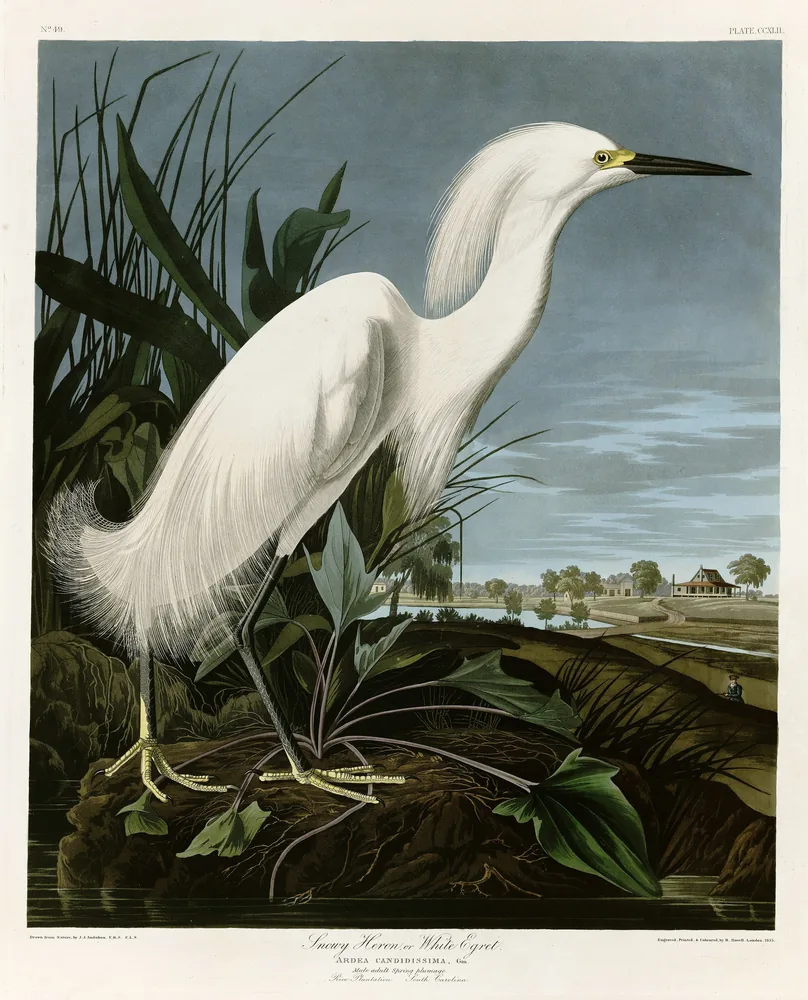
Audubon’s plate: plate 242, “Snowy Heron or White Egret”
At Charleston in March 1831, Audubon found few Snowy Herons by the 18th; a week later thousands stood in the marshes and rice fields, all in full plumage. In April in the Carolinas, he wrote, they ate almost nothing but shrimp, and on the Mississippi he watched them pick shrimp off floating logs, their pure white plumage bright against the water.
Before nesting they perch in low trees over the water and now and then give “a rough guttural sort of sigh,” raising the crest and the loose, curving plumes of the back and rising to their full height. Disturbed while courting, they tumble over and over in the air like Tumbler Pigeons. A wounded one, he noticed, swims for shore and hides by a log, or climbs a tree to its very top.
The lettering under plate 242 calls the bird an adult male in spring plumage and names the scene, a rice plantation in South Carolina. Those long back plumes, Audubon wrote, grow each spring and fall off once the young have hatched. He doubted Alexander Wilson's claim that the bird reached the Gulf of St. Lawrence; in his experience it rarely went farther than Long Island.
Story: Audubon, Ornithological Biography, vol. 3 (1835), pp. 317–321. See plate 242 free at Audubon.org.
More classic portraits, free to see
- John James Audubon, The Birds of America, octavo edition (1840–44), plate 374: “Snowy Heron”. Free scan (New York Public Library Digital Collections)
About the Snowy Egret
- A Snowy Egret may stir the bottom with its feet to scare up prey in shallow water. (Source: National Audubon Society)
- Snowy Egrets came back once they were protected from the plume hunting of the 1800s. (Source: National Audubon Society)
When can you see Snowy Egrets in Texas?
All year near the coast, and in summer over most of the state. They are uncommon to common from the Rolling Plains to the Lower Rio Grande Valley in summer, and in winter some stay along the coastal prairies, the Texas Breeding Bird Atlas says. Most nest east of the 98th meridian, and in most years the bulk of the nesting birds are on the coast.
They nest in colonies with other waterbirds from early March to late August, on wooded islands, in swamps and on islands built from dredged material, and statewide counts from 1972 to 1990 found between 4,371 and 13,084 pairs a year. Inland, nesting probably follows the crayfish: they make up about 39% of what the chicks are fed, and they are most plentiful after the spring rains, just when the chicks are growing.
Source: Texas Breeding Bird Atlas, Snowy Egret (Telfair, 2007).
What's the difference between a Snowy Egret and a Great Egret?
Look at the bill and the feet. A Snowy Egret has a black bill and black legs with bright yellow feet, its “golden slippers,” National Audubon's guide says. The Great Egret is the bigger bird, about 39 inches tall, with a long yellow bill and black legs and feet, the Chesapeake Bay Program says.
Plume hunters told them apart too. In the hat trade the Snowy's curving back plumes were “short whites” and the Great Egret's were “long whites,” the Texas Breeding Bird Atlas says. In Texas, plumes were sold from about 1869 to 1907, with reports from Eagle Lake and Corpus Christi and from inland along the Neches, Angelina, Sabine and Trinity rivers. Hunted nearly to extinction for its plumes in the 1800s, the Great Egret became the symbol of the National Audubon Society.
Sources: National Audubon Society, Snowy Egret; Chesapeake Bay Program, Great Egret; Texas Breeding Bird Atlas, Snowy Egret (Telfair, 2007).
Is there a gray egret in Texas?
Yes: the dark form of the Reddish Egret, slate gray and reddish brown, with shaggy neck feathers. Each bird is dark or white for life, and a pair can be one of each, National Audubon's guide says; look for one running and staggering through the shallows with its wings raised.
It is the rarest heron in North America, and Texas holds a large share of its world range, the Texas Breeding Bird Atlas says. It nests along the whole Texas coast, most thickly on the southern half, and a 1990 survey counted about 1,500 pairs in the state.
Audubon met it on the Florida Keys, where the birds his party shot were “as white as driven snow” or purplish gray with reddish heads and necks, and he painted it as his plate 256. His pilot assured him they were one kind that bred before turning their adult colors. One kind, yes, but the white birds never turn.
Sources: National Audubon Society, Reddish Egret; Texas Breeding Bird Atlas, Reddish Egret (Jones, about 1998); Audubon, Ornithological Biography, vol. 3 (1835), pp. 411–412.
How long does a Snowy Egret live?
Only maximum ages are published for the Snowy Egret in the guides we checked, not a typical lifespan. Owls, hawks, raccoons and poisonous snakes prey on Snowy Egrets and their young. The oldest known wild Snowy Egret was at least 17 years and 6 months old (USGS Bird Banding Laboratory): it was banded in Colorado in 1970 and found in Mexico in 1988.
Sources: Chesapeake Bay Program; USGS Bird Banding Laboratory. A banding record is the minimum age of one bird when it was found again, not a typical lifespan. How long do wild birds live?
How can you tell if a plate 242 print is an original?
By its size: an original plate 242 is a hand-colored sheet about 26 by 38 inches, dated 1835; the Snowy Egret’s octavo version, plate 374, is book-size, from 1840–44. Many prints sold today are reproductions: how to tell an original from a reproduction. For all 435 plates at a fraction of an original’s price, see which edition of The Birds of America to buy.
In a Birdfolio hardcover, this painting sits beside the date and place you first saw a Snowy Egret. See your own list as a book, free.