Classic bird paintings
Great Egret painting: Audubon's plate and other classic portraits
John James Audubon painted the Great Egret as plate 386 of The Birds of America (1827–38), titled White Heron: a male in summer plumes, its long train sweeping past the tail. That plate is the painting shown here, and a free high-resolution scan is on Audubon.org.
Updated
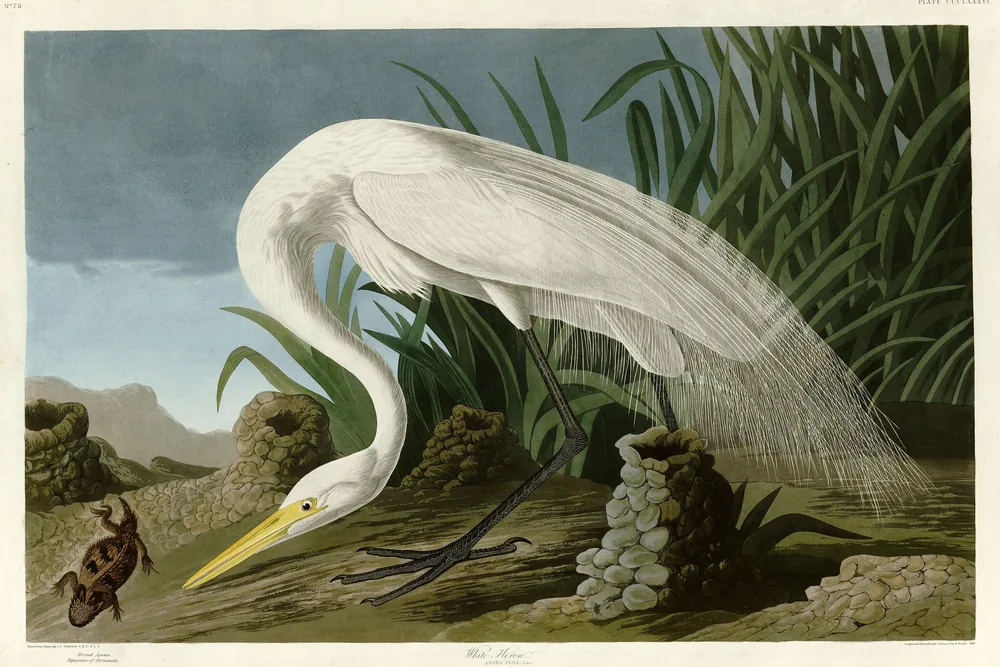
Audubon’s plate: plate 386, “White Heron”
Near John Bulow's plantation in East Florida, hidden about a hundred yards away, Audubon watched what he called a “tournament or dress-ball.” From as early as December, Great Egrets gathered on a clear sandbar to choose partners. The males swelled their throats, made gurgling sounds and raised their long plumes almost upright as they paced before the females, with less fighting than he had expected. The meetings began about ten in the morning, after a good breakfast, and broke up near three, for nearly a week.
He admired the bird on foot: measured steps, the neck gracefully curved, the silky train like “the flowing robes of the noble ladies of Europe.” Both sexes grow that train a few weeks before courtship, and it wears away by the time the young leave the nest.
The train was also the egret's danger. Because the plumes were wanted as ornaments, he wrote in 1838, the birds were shot in great numbers on their eggs; one man near Charleston offered a double-barreled gun for a hundred White Herons fresh killed and had them, and more, the next day. His friend John Bachman told of a day at the Round O plantation when his party brought home forty-six and stopped only because they grew tired of shooting. Bachman also helped Audubon collect the birds when he wanted a new drawing of this one.
Story: Audubon, Ornithological Biography, vol. 4 (1838), pp. 600–604. See plate 386 free at Audubon.org.
What made the Great Egret the Audubon Society's symbol?
Because the Audubon societies began as a fight to stop the slaughter of birds like it. Plume hunters nearly wiped out Great Egrets in the United States in the late 1800s; they came back after early conservationists stopped the slaughter and protected their colonies, and so the egret became the National Audubon Society's emblem, its guide says. The society declared it its symbol in 1953, Audubon magazine notes.
The trade ran on huge numbers. One 1902 record from a London auction house showed 48,240 ounces of plumes sold, the feathers of nearly 200,000 egrets, the U.S. Fish and Wildlife Service says. In Boston, Harriet Hemenway and her cousin Minna Hall held tea parties to talk friends out of feathered hats; 900 women agreed to the boycott, and the Massachusetts Audubon Society grew from it.
In New York in 1886, the ornithologist Frank Chapman counted 40 kinds of birds on the hats of 542 women, Audubon magazine says.
Sources: Audubon.org, plate 386; Audubon magazine, September 5, 2024; U.S. Fish and Wildlife Service, March 6, 2020; Audubon magazine, June 8, 2018.
More classic portraits, free to see
- John James Audubon, The Birds of America, octavo edition (1840–44), plate 370: “Great American White Egret”. Free scan (New York Public Library Digital Collections)
About the Great Egret
- At the height of the plume trade, an ounce of egret feathers was worth more than an ounce of gold. (Source: National Audubon Society)
- Since its first issue in 1899, Audubon's magazine has put the Great Egret on its cover 12 times, more than any other bird. (Source: National Audubon Society)
- A tall white wader of quiet waters, it is common especially in the South and may wander far to the north in late summer. (Source: National Audubon Society)
Do Great Egrets stay in Texas all year?
On the coast, yes; inland, mostly in summer. They are common residents of the Coastal Prairies and locally common summer residents in eastern and central Texas north to Oklahoma, the Texas Breeding Bird Atlas says.
Their colonies are mostly in the wooded east, and 45 to 87% of the state's nesting birds are on the coast, though a few have nested as far west as El Paso. They breed from early March to early August, and censuses from 1973 to 1990 counted 2,445 to 12,332 pairs a year. In recent years some have wintered inland as far north as Dallas–Fort Worth, where they are becoming more common. The small Green Heron is the other way around: unlike most Texas herons, it is commoner inland than on the coast.
Audubon met them there himself. On his way to Texas in the spring of 1837 he found them along the Gulf coast and on the islands around Galveston, where he was told they spent the winter.
Sources: Telfair, Texas Breeding Bird Atlas, egret account (2007); Telfair, Texas Breeding Bird Atlas, small heron account (2007); Audubon, Ornithological Biography, vol. 4 (1838), p. 600.
How long does a Great Egret live?
Approximately 15 years is the usual life of a wild Great Egret, the Chesapeake Bay Program says. The oldest known wild Great Egret was at least 22 years and 10 months old (USGS Bird Banding Laboratory): it was banded in Ohio in 1947 and found there again in 1970.
Sources: Chesapeake Bay Program; USGS Bird Banding Laboratory. A banding record is the minimum age of one bird when it was found again, not a typical lifespan. How long do wild birds live?
How can you tell if a plate 386 print is an original?
By its size: an original plate 386 is a hand-colored sheet about 26 by 38 inches, dated 1837; the Great Egret’s octavo version, plate 370, is book-size, from 1840–44. Many prints sold today are reproductions: how to tell an original from a reproduction. Plate 386 and the other 434 also come bound in one modern book: which Birds of America book to buy.
In a Birdfolio hardcover, this painting sits beside the date and place you first saw a Great Egret. See your own list as a book, free.