Classic bird paintings
Osprey painting: Audubon's plate and other classic portraits
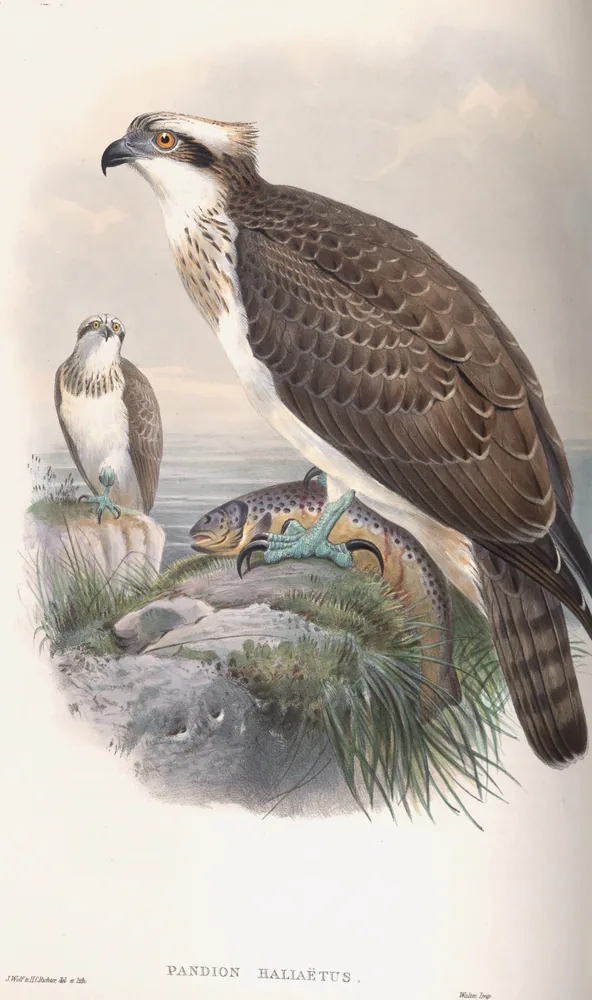
John James Audubon painted the Osprey as plate 81 of The Birds of America (1827–38), under the name Fish Hawk: a male carrying a fish. A free high-resolution scan is on Audubon.org. The Ospreys shown here were drawn by Joseph Wolf and Henry Constantine Richter for John Gould's The Birds of Great Britain (1862–73).
Updated
The story of this painting
At the head of Loch Assynt, in Scotland, stands the ruined castle of Ardvreck, where Ospreys once raised their young on the turrets. By the time John Gould wrote about the bird for The Birds of Great Britain (1862–73), the last pair there had been “ruthlessly killed about 1860,” according to the landlord of the Tourist's Inn, and Lochs Lomond, Maree, Awe and Fyne had lost theirs too.
Gould was sorry to write it. Ospreys still passed along British rivers in autumn, but those, he thought, were mostly young birds bred in Norway or elsewhere on the Continent and driven off course. In June 1863 the Duke of Argyll wrote to him of one hovering like a kestrel over the Dee near Balmoral, the first he had ever seen alive, until a heron came screaming down at it and it wheeled up in circles and soared away over the hills.
The front bird in the plate, about half life size, grips a Scottish trout and was drawn from a sketch by Joseph Wolf. The lettering credits Wolf and Henry Constantine Richter, who drew the plate and put it on the stone; it is plate 5 of the first volume.
Story: Gould, The Birds of Great Britain, vol. 1 (1873), plate 5; vol. 1 (1873), text to plate 5.
Audubon’s Osprey: plate 81, “Fish Hawk”
Were he not a member of a republic, Audubon wrote, he might call this bird the Imperial Fisher, a better name for so large and able a hunter than Fish Hawk. Yet he found it mild and sociable. It never chased another bird, gave up its catch to the Bald Eagle rather than fight, and let Fish Crows and grackles raise their families among the outer sticks of its huge nest.
He spent weeks on the Gulf of Mexico watching it fish while flying fish leaped from the sea to escape dolphins. The Osprey never tried to take one in the air; it plunged for them only once they were swimming again near the surface.
Fishermen along the coast welcomed it each spring as the sign that the fish were coming, and believed its nest kept other hawks from their poultry. Wrong, he thought, but useful, since it made the fishermen protect the bird. Plate 81 shows a male carrying a fish, held just as he saw it rise from the water.
Story: Audubon, Ornithological Biography, vol. 1 (1831), pp. 415–421. See plate 81 free at Audubon.org.
More classic portraits, free to see
- John James Audubon, The Birds of America, octavo edition (1840–44), plate 15: “Common Osprey, Fish Hawk”. Free scan (New York Public Library Digital Collections)
- John Gould’s The Birds of Europe (1832–37), plate 12: “Osprey” (Pandion haliaeetus). Free scan (University of Kansas Libraries)
- Joseph Wolf and Henry Constantine Richter, for John Gould’s The Birds of Great Britain (1862–73), vol. 1, plate 5: “Osprey” (Pandion haliaëtus) (the painting shown above). Free scan (University of Kansas Libraries)
About the Osprey
- An Osprey plunges feet first into the water to catch fish in its talons. (Source: National Audubon Society)
- Ospreys were once grouped with the other hawks, but now have a family of their own. (Source: National Audubon Society)
How long does an Osprey live?
Ospreys live about 7 to 10 years, the Missouri Department of Conservation says. Sources differ: Audubon puts the average Osprey lifespan higher, at about 15 to 20 years. About half of young Ospreys die in their first year, Hinterland Who's Who reports, and after that between 16 and 19% die each year. The oldest known wild Osprey was at least 25 years and 2 months old (USGS Bird Banding Laboratory): it was banded in Virginia in 1973 and found there again in 1998.
Sources: Missouri Department of Conservation; Audubon Magazine; Hinterland Who's Who; USGS Bird Banding Laboratory. A banding record is the minimum age of one bird when it was found again, not a typical lifespan. How long do wild birds live?
How can you tell if a plate 81 print is an original?
By its size: an original plate 81 is a hand-colored sheet about 26 by 38 inches; the Osprey’s octavo version, plate 15, is book-size, from 1840–44. Many prints sold today are reproductions: how to tell an original from a reproduction. Modern editions print all 435 plates, from pocket size to coffee-table size: which Birds of America book to buy.
In a Birdfolio hardcover, this painting sits beside the date and place you first saw a Osprey. See your own list as a book, free.