Bald Eagles typically live 15 to 30 years in the wild, the Missouri Department of Conservation says, and more than 40 years in captivity. The oldest known wild Bald Eagle was at least 38 years old when a car hit it in New York in 2015. Many die young: about 3 in 10 eaglets don't survive their first year.
That record eagle lived a life worth retelling. He hatched beside a lake in northern Minnesota in the summer of 1977. At a few weeks old he was taken to New York, a state with only one wild breeding pair left, to help bring the species back. He grew up to take the place of the male in that last pair, fathered many young over the next decades, and died by a road at 38, probably while feeding on a dead rabbit.
Key facts
- Typical life in the wild: 15 to 30 years (Missouri Department of Conservation). The Smithsonian's National Zoo says they can live 20 to 30 years, and the US Fish and Wildlife Service says up to about 30.
- In captivity: more than 40 years (Missouri Department of Conservation), or up to 50 (Smithsonian's National Zoo). The AnAge database of animal life spans gives a record of 48 years.
- Oldest known wild Bald Eagle: at least 38 years old. It was banded in New York on August 5, 1977, and found dead there on June 2, 2015, after a collision with a vehicle (USGS Bird Banding Laboratory).
- The first year is the hardest: about 70% of eaglets survive it (US Fish and Wildlife Service).
- The white head and tail come at about 4 to 5 years, about when most Bald Eagles can start to breed.
- Bald Eagles mate for life, but if one of a pair dies, the survivor takes a new mate.
- The comeback: 417 known nesting pairs in 1963; by 2018 to 2019, about 316,700 Bald Eagles in the lower 48 states, including 71,467 breeding pairs. The Bald Eagle came off the endangered species list in 2007.
Facts checked: October 12, 2026.
How long do Bald Eagles live in the wild?
A wild Bald Eagle typically lives 15 to 30 years, the Missouri Department of Conservation says. Other trusted sources give slightly different numbers, partly because some give a typical range and others a top age. Here they are side by side:
| Source | In the wild | In captivity |
|---|---|---|
| Missouri Department of Conservation | Typically 15 to 30 years | More than 40 years |
| Smithsonian's National Zoo (2021) | Can live 20 to 30 years | Up to 50 years |
| US Fish and Wildlife Service | Up to about 30 years | "Even longer" |
| Audubon magazine (2025) | Up to 25 years | 50 years |
| USGS Bird Banding Laboratory | Record: at least 38 years, one bird | Not counted |
| AnAge database | Not given | Record: 48 years |
Each figure as its source words it, all read on October 12, 2026.
Two of those numbers are records, not life spans. The 38 years belongs to one remarkable bird, the oldest that anyone has banded and later found again. The USGS Bird Banding Laboratory, which keeps the records, points out that a record can't be longer than the time researchers have been studying the species.
Notice something else: the record eagle outlived the top ages most of these sources give by 8 to 13 years. A top age in a field guide is a rough guide, not a ceiling. The fairest short answer for a wild Bald Eagle is the Missouri range, 15 to 30 years, with the warning that many never reach 15, and a lucky few pass 30.
How does that compare with other birds? Very well. For backyard songbirds, albatrosses and everything between, see how long wild birds live.
A Bald Eagle's life, stage by stage
| Age | What happens | Source |
|---|---|---|
| About 35 days in the egg | The egg hatches | US Fish and Wildlife Service |
| Within 3 months | The young eagle is flying | US Fish and Wildlife Service |
| 4 to 6 weeks more | Its parents keep caring for it, using the nest as a home base | US Fish and Wildlife Service |
| End of year one | About 70% of eaglets are still alive | US Fish and Wildlife Service |
| 4 to 5 years | White head and tail; most can breed | US Fish and Wildlife Service |
| About 6 years | A typical life cycle from hatching to breeding | 2007 federal delisting rule |
| 15 to 30 years | A typical life in the wild | Missouri Department of Conservation |
| 38 years | The oldest known wild Bald Eagle | USGS Bird Banding Laboratory |
| 48 years | The oldest on record in captivity | AnAge database |
Why do so many young Bald Eagles die?
Young Bald Eagles die from disease, lack of food, bad weather and dangers that people bring, like collisions with cars or power lines, the US Fish and Wildlife Service says. It puts first-year survival at about 70%, citing recent studies, so roughly 3 in 10 eaglets don't live to see their first birthday.
The Smithsonian's National Zoo paints a darker picture. Although both parents care for the young for many weeks, it says, "a high percentage" don't survive their first year. The two don't line up neatly, so treat "about 7 in 10 survive" as a rough figure, not a fixed one.
A young eagle is on its own quickly. It's flying before it is 3 months old. Its parents keep caring for it for another four to six weeks, and after that it heads out into the world on its own, the Fish and Wildlife Service says.
What kills Bald Eagles today?
Mostly injuries, lead and electrocution. When US Geological Survey scientists examined 172 Bald Eagles found dead in eight western and midwestern states from 2014 to 2017, they could find the cause of death for 152. Of those:
- 46% died of trauma, which includes being hit by vehicles.
- 31% died of lead poisoning.
- 16% were electrocuted.
Those three killed more than 9 in 10 of the eagles whose cause could be found. The rest died of disease, other poisons, drowning, starvation and other causes. These were birds that people found and sent to a laboratory, so they may not stand for every eagle that dies.
Lead is the hidden danger. In a 2022 study in the journal Science, by scientists from the USGS, the US Fish and Wildlife Service and Conservation Science Global, almost half of 1,210 Bald and Golden Eagles sampled in 38 states from 2010 to 2018 showed repeated exposure to lead. Eagles usually swallow it as fragments of lead ammunition in a dead animal, or in the gut piles hunters leave behind when they dress game in the field, the USGS says. The researchers estimated that lead at those levels slows the Bald Eagle population's growth rate by 3.8%.
How old is the oldest Bald Eagle?
The oldest known wild Bald Eagle was at least 38 years old. The USGS Bird Banding Laboratory's longevity table lists a Bald Eagle banded in New York on August 5, 1977, in the year it hatched, and found dead in New York on June 2, 2015, after a collision with a motor vehicle.
The National Audubon Society told his story in 2015. He hatched near a lake in northern Minnesota in the summer of 1977. At just a few weeks old he was taken from the nest to Montezuma National Wildlife Refuge in central New York, where the state's Department of Environmental Conservation was trying to bring Bald Eagles back.
New York badly needed them. In 1976 the state had a single nesting pair left, and its eggs kept collapsing during incubation, their shells thinned by the pesticide DDT, the department says. Montezuma had the world's first Bald Eagle hacking tower. Hacking means raising young birds with as little human contact as possible, so that they bond with the place rather than with people, then letting them go. From 1976 to 1989 the program released 198 young eagles, from Michigan, Minnesota, Wisconsin, a federal captive breeding center in Maryland and, later, Alaska. In 1989 it reached its goal of 10 breeding pairs and, in the department's words, "put itself out of business."
The Minnesota eagle, known to biologists by his band number, 629-03142, did his part. A few years after his release, the male of New York's last original pair died, and 03142 took his place in the old nest at Hemlock Lake. Over the next few decades he fathered many young eagles. In June 2015 a car struck him in Henrietta, New York, probably while he was feeding on a roadkill rabbit, Audubon reported. He still wore his band.
Has any wild Bald Eagle lived longer than 38?
Not that anyone has proved. A record only moves when someone finds a banded bird again. In July 2015, when the US Fish and Wildlife Service announced a nearly 27-year-old eagle spotted in Indiana, it gave the Bird Banding Laboratory's record as 33 years and 5 months, with only six banded Bald Eagles known to have lived longer than the Indiana bird. Today the laboratory's table lists the New York eagle, found the month before, at 38. An eagle that was never banded could have lived longer, and no one would know.
How long do Bald Eagles live in captivity?
In captivity, Bald Eagles can live more than 40 years, the Missouri Department of Conservation says, and up to 50 years in human care, the Smithsonian's National Zoo says. AnAge, a scientific database of animal life spans, gives a maximum of 48 years, for a bird in captivity.
Here is what that life looks like at the Smithsonian's National Zoo in Washington, D.C., which wrote about its two Bald Eagles in 2021. Both have wing injuries that keep them from flying. Tioga was rescued in Pennsylvania as a fledgling, a young bird that had just left the nest, so the zoo knows his age: he was 23 that year. Annie was rescued as an adult in Maryland, so she was at least 5 then. Keepers feed them three times a day, on rats, quail, chicken and fish, and once a month give them a whole salmon or beef ribs.
A cared-for eagle is also spared the three biggest killers in the USGS study of wild eagles: trauma such as car strikes, lead and electrocution.
How do scientists know how old a Bald Eagle is?
From bands. Bird banding means fitting a wild bird with a small numbered metal band on its leg, then letting it go. If the same bird is caught again or found later, the number tells researchers when and where it was banded.
The USGS Bird Banding Laboratory turns that into a minimum age: the bird's age when it was banded, plus the time until it was found. For most North American birds it assumes a June hatching date. That's why the record eagle is "at least" 38.
Some eagles also carry a marker that can be read from far away. In 2015, people at Monroe Lake in Indiana photographed an eagle with a telephoto lens. An orange band on one wing and metal bands on its legs were enough to identify her as C43, an eagle taken from a nest in southeastern Alaska on July 22, 1988, and released from a hacking tower at Monroe Lake that September. She was nearly 27. A brood patch on her front, a bare patch of skin a bird uses to warm its eggs, showed she was still raising young, the US Fish and Wildlife Service reported.
Without a band, an adult eagle's age is a guess. A young Bald Eagle's mottled brown feathers show it is under about 5 years old. Once it has its white head, its feathers no longer tell its age.
At what age do Bald Eagles get their white head?
At about 4 to 5 years old. Until then, young Bald Eagles have mottled brown and white feathers, and they generally have their adult plumage, white head and tail included, by age 5, the US Fish and Wildlife Service says. The Missouri Department of Conservation says around age 5, and the Smithsonian's National Zoo says 4 or 5.
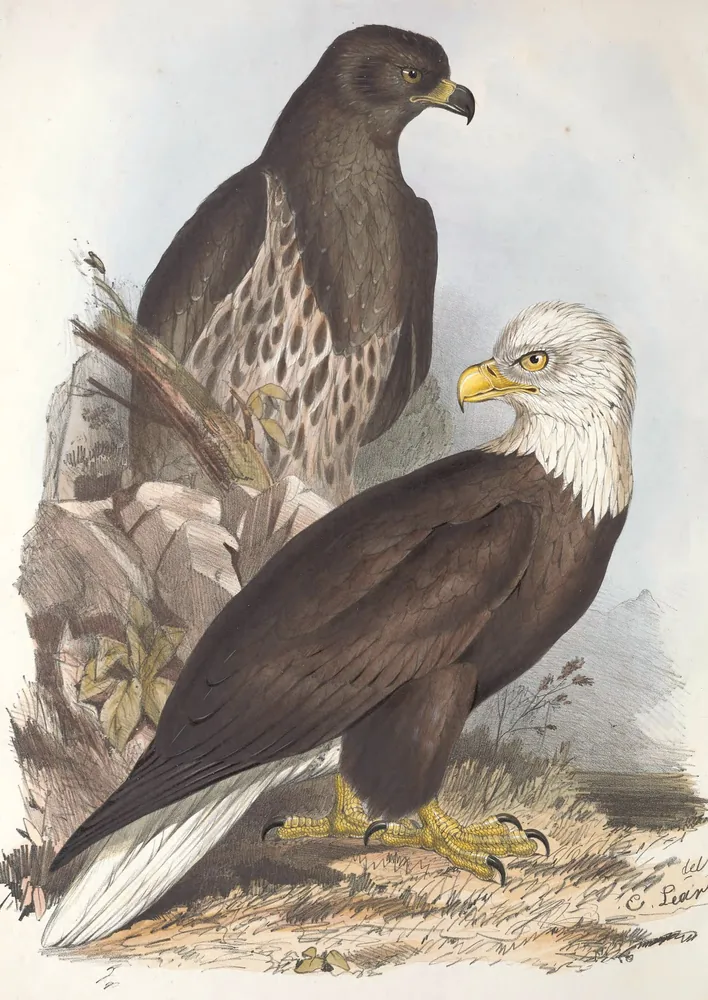
The old painters noticed the long wait too. In the text that went with Edward Lear's plate, John Gould wrote in 1837 that the white head and tail weren't complete until the third year. He added a note from the naturalist Sir William Jardine: in captivity, the change took three to five years. John James Audubon wrote in 1831 that a captive bird needed at least four years, and he knew of two whose white heads didn't appear until their sixth spring.
Audubon also believed young eagles could breed the spring after they hatched, because he had seen brown birds paired with white-headed mates. Today's figure is later. Most Bald Eagles can breed at 4 or 5, the Fish and Wildlife Service says, and the 2007 federal rule that took them off the endangered species list put a typical life cycle, from hatching to breeding, at about 6 years.
You can see Lear's plate in full, with Audubon's own Bald Eagles, on our page of classic Bald Eagle paintings.
Do Bald Eagles mate for life?
Yes, as a rule. Bald Eagles mate for life, the US Fish and Wildlife Service says, but if one of a pair dies, the survivor will accept a new mate. The Missouri Department of Conservation says the same, adding that a survivor also finds a new mate if its partner disappears. Audubon magazine says they "usually" mate for life, and describes their courtship flight: the pair soar into the sky, lock talons and spiral toward the ground, letting go just before they would crash.
The record eagle shows how a new mate steps in. When the male of New York's last original pair died, 03142 took his place in the old nest at Hemlock Lake, Audubon reported.
Pairs are loyal to their nests, too. They often use the same nest each year and keep making it bigger, the Fish and Wildlife Service says. Nests are generally 4 to 5 feet wide and 2 to 4 feet deep. The largest on record, in St. Petersburg, Florida, was 9.5 feet across and 20 feet deep, and weighed almost 6,000 pounds.
How did the comeback change Bald Eagle survival?
It let Bald Eagles raise young again. The pesticide DDT, the US Fish and Wildlife Service explains, kept eagles from making strong eggshells, and the US banned most uses of it in 1972. The Smithsonian's National Zoo calls that ban perhaps the single most important rule behind the Bald Eagle's recovery.
Shooting was the older danger: eagles were shot because people saw them as a threat, the Fish and Wildlife Service says. In 1940, Congress passed a law that prohibited killing, selling or possessing them.
The numbers since then:
- 1963: only 417 nesting pairs known, the Fish and Wildlife Service's species page says. The 2007 federal rule gives a different count for the same year: about 487 nesting pairs in the lower 48 states, from an Audubon Society estimate. Either way, the species was "in danger of extinction," the Fish and Wildlife Service says.
- 1967: first listed as endangered, south of the 40th parallel.
- 1978: listed as endangered across the lower 48 states, except in Michigan, Minnesota, Oregon, Washington and Wisconsin, where it was listed as threatened.
- 1995: moved down from endangered to threatened.
- 2007: on June 28, the Fish and Wildlife Service announced the Bald Eagle's recovery; it came off the list that August.
- 2009: an estimated 72,434 Bald Eagles in the lower 48, including 30,548 breeding pairs.
- 2018 to 2019: an estimated 316,700 Bald Eagles, including 71,467 breeding pairs.
None of these sources says the comeback made each eagle live longer. What they describe is eggs hatching again and eagles protected by law. What kills eagles now is mostly injuries, often from cars, then lead and electrocution, as above. Bald Eagles are still protected by two federal laws, the Migratory Bird Treaty Act and the Bald and Golden Eagle Protection Act, which prohibit killing, selling or otherwise harming eagles, their nests or their eggs.
The Bald Eagle had been a national symbol since 1782, Audubon magazine notes. A law approved on December 23, 2024, made it the official national bird (Audubon gives the date as December 24). More on that, and on every state's own bird, in our guide to the state birds.
Questions people ask
Can a Bald Eagle live 70 years?
No. A story shared widely online says an eagle can reach 70 if, at about 40, it breaks off its own beak and plucks out its talons and feathers so new ones can grow. Lead Stories, a fact-checking site, called it false in 2021. Erin Katzner of the World Center for Birds of Prey told the site there is "no record of bald eagles losing their beaks and growing them back." The bird writer Laura Erickson pointed out that eagles replace their feathers gradually, a few at a time, all through their lives. The oldest wild Bald Eagle anyone knows of lived to 38.
Do Bald Eagles live longer than Golden Eagles?
Their records are close, and the Bald Eagle's is longer. The oldest known wild Golden Eagle was at least 32 years and 10 months old: banded in Idaho in 1992 and found dead in Montana in 2024, the USGS table shows. The Bald Eagle's record is at least 38 years.
Do Bald Eagles live longer than other birds?
Longer than most. Among the 98 common North American birds in our guide to how long wild birds live, only the Sandhill Crane matches the Bald Eagle's record: a crane banded in Florida in 1982 was found in Wisconsin in 2019, also at least 38 years old. Some seabirds live longer still. For the record age of every species the USGS lists, see the oldest wild birds on record.
How long do young Bald Eagles stay with their parents?
For a few weeks after they first fly. Eaglets are flying within 3 months, their parents keep caring for them for another four to six weeks, and then they disperse on their own, the US Fish and Wildlife Service says.
Are Bald Eagles still endangered?
No. The Bald Eagle came off the endangered species list in 2007, after the population recovered. It is still protected by federal law: killing, selling or otherwise harming Bald Eagles, their nests or their eggs is prohibited.
A bird worth writing down
If you keep a list of the birds you've seen, your first Bald Eagle is a line worth keeping: a date and a place. A year list counts the birds of one year, and a life list counts every one. A Birdfolio prints a life list as a hardcover book, with a classic painting beside every species: how to print your life list.