The American Ornithological Society (AOS) added three birds to the US list in 2026: the Hen Harrier, the Oriental Honey-buzzard and the Pearly-eyed Thrasher. They came in its 67th Supplement to the Check-list of North American Birds, published on October 20, 2026. Two are first records for North America, both from Alaska's Aleutian Islands. The third turned up in Key West, Florida. A fourth bird got a new name: on the AOS list, Fea's Petrel, a rare seabird far off North Carolina, is now the Desertas Petrel.
The AOS checklist is the scientific list of the birds of North and Middle America and the Caribbean. The US Fish and Wildlife Service follows it when it decides which birds federal law protects.
The new US birds of 2026 at a glance
| Bird | Where | When | The proof | Its usual home |
|---|---|---|---|---|
| Hen Harrier | Attu Island, Alaska | Wing found in early June 1999 | A partial wing, identified by its DNA in 2024 | Europe and Asia |
| Oriental Honey-buzzard | Shemya Island, Alaska | May 27, 2024 | Photos of an adult female | East and South Asia |
| Pearly-eyed Thrasher | Key West, Florida | March to April 2024 | A record accepted by the American Birding Association | Puerto Rico, the Virgin Islands, the Lesser Antilles |
| Desertas Petrel (new name) | Gulf Stream off North Carolina | Seen there before; only the name is new | Fea's Petrel split in two | Nests near Madeira, in the eastern Atlantic |
Facts checked: October 24, 2026, in the AOS's own papers and the two journal articles behind the Alaska records.
Hen Harrier: a wing from Attu Island, proved by DNA
The Hen Harrier is on the US list because of a single partial wing, picked up on Attu Island in Alaska's western Aleutians in early June 1999. The bird had probably died the fall or winter before. For the next 25 years, experts argued about which harrier it came from.
The argument started because of a split. In 2017 the AOS divided the harrier into two species: the Northern Harrier of North America and the Hen Harrier of Europe and Asia. It wanted firmer proof about the Attu wing, so the Hen Harrier left the North American list. The American Birding Association (ABA), whose committee keeps the official list for the US and Canada, turned the record down as recently as April 2024.
Then Jack Withrow of the University of Alaska Museum and two colleagues read 1,887 base pairs (letters of genetic code) of the wing's mitochondrial DNA. It grouped plainly with Hen Harriers. Their paper in Western Birds (2024) calls it the first North American record of the species, from a young male. The ABA committee then accepted it unanimously, and the AOS added the species in 2026.
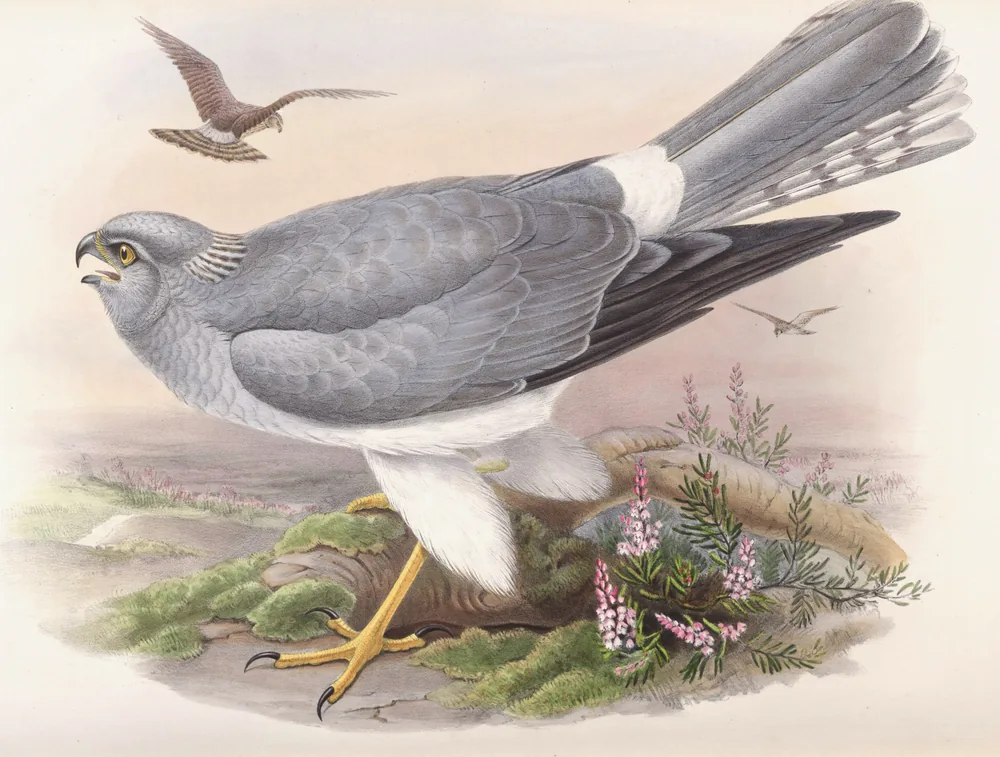
The wing itself had taken a beating. The authors note it had been stored flat in a bag for 24 years, and it no longer had its natural curve. The painting at the top of this page, a gray adult male, is from John Gould's The Birds of Great Britain.
Is a Hen Harrier the same as a Northern Harrier?
No: since 2017 the AOS has counted them as two species, the Hen Harrier in Europe and Asia and the Northern Harrier in North America. They look very much alike. One clue is the dark bars under the longest wing feathers: a Hen Harrier usually shows three or four, a Northern Harrier five to seven. Even experts with the wing in hand couldn't settle it for 25 years, which is why it took DNA.
Oriental Honey-buzzard: a first for North America on Shemya Island
An adult female Oriental Honey-buzzard seen on Shemya Island, Alaska, on May 27, 2024, was the first one ever recorded in North America. Zachary Pohlen and Bradley Benter, of the US Fish and Wildlife Service, were surveying wildlife for the US Air Force at Eareckson Air Station when it flushed from a meadow. They followed it along the coast, lost it, and found it again three and a half hours later at the island's southeastern tip. Their photos convinced the ABA committee unanimously, and the AOS added the species in 2026.
Why Shemya? The migratory form of this bird breeds from Siberia to Japan and winters in South and Southeast Asia. The authors think strong west and southwest winds that May pushed it north and east on its way to Japan. Shemya sits in the Near Islands, the westernmost of the Aleutians, a stopover that has produced several birds new to North America.
How do you tell an Oriental Honey-buzzard from a European one?
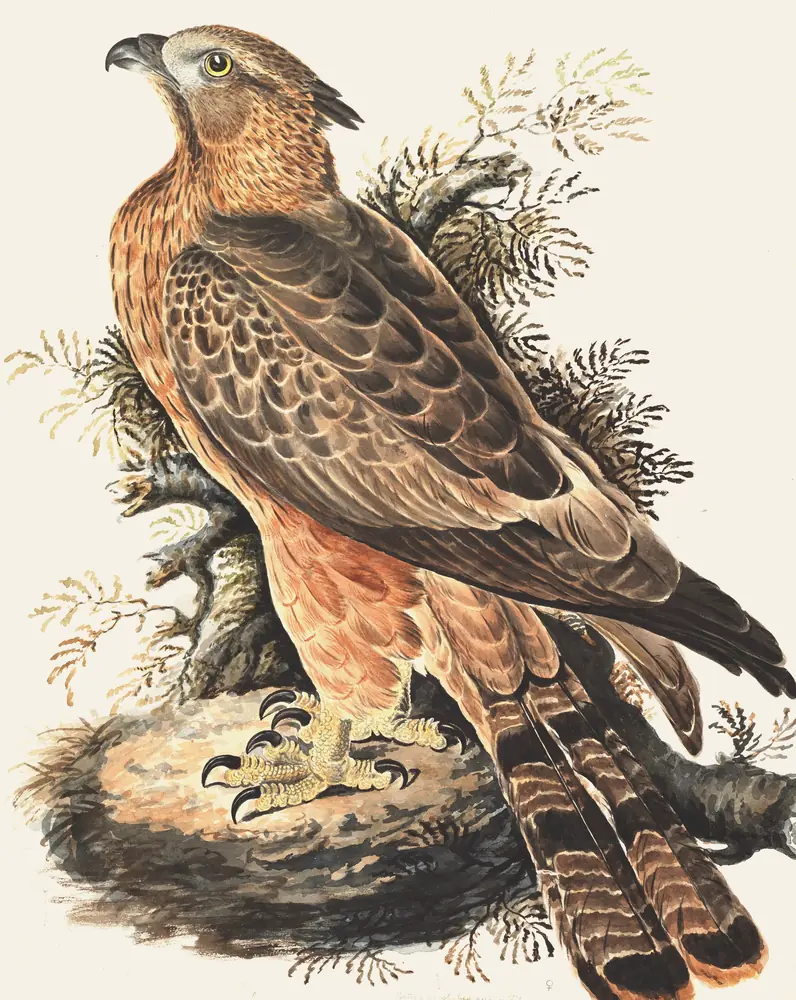
Count the long "fingers" at the wingtip: an Oriental Honey-buzzard shows six, a European Honey-buzzard five. The Shemya bird also lacked the dark patch at the bend of the wing that a European shows, and its underside was plain cinnamon. The European Honey-buzzard has never been recorded in North America, the paper adds. Its other name is Crested Honey Buzzard; perched, the Shemya bird looked slightly crested, the paper says. Elizabeth Gwillim painted it under that name in 1801, in the picture above.
Pearly-eyed Thrasher: a Caribbean bird in Key West
A Pearly-eyed Thrasher that stayed in Key West, Florida, from March to April 2024 put the species on the AOS's US list. The ABA's rare bird alert of April 19, 2024 already called it a potential first for the US and Canada. The ABA committee accepted it, and the AOS followed in 2026. The AOS points out that the species has wandered to several Caribbean islands outside its usual range, which supports a wild visitor rather than an escaped cage bird.
It wasn't new to the AOS checklist itself, which covers the Caribbean. The National Park Service says it lives in Puerto Rico, the Virgin Islands and some of the Lesser Antilles. On St. John it's called the thrusie, and it's bold enough to threaten park staff who come near its nest.
In Puerto Rico's Luquillo Mountains it's a villain of sorts. A USDA Forest Service study by Wayne Arendt (2006) found it a major nest robber of the endangered Puerto Rican Parrot, and a rival for the same nest holes. Arendt calls it a classic "supertramp": a strong flier that moves into small, disturbed islands, about 80 of them across the Caribbean.
How do you recognize a Pearly-eyed Thrasher?
Look at its eye: the genus name, Margarops, comes from the Greek for "pearl" and "eye." Despite its name, it isn't a close relative of the Brown Thrasher and the other mainland thrashers. It belongs to an old Caribbean branch of the mockingbird family, Arendt explains, about 4 million years old.
Desertas Petrel: the new name for Fea's Petrel
On the AOS list, the rare petrel of the Gulf Stream off North Carolina is now the Desertas Petrel, Pterodroma deserta. The 67th Supplement split Fea's Petrel. The Fish and Wildlife Service's proposed list of protected birds (October 1, 2026) names Desertas Petrel as a bird once counted as part of Fea's Petrel, citing the AOS.
The ABA made the same change on January 29, 2026. Desertas Petrel had been confirmed off North Carolina, its committee said, although the two are hard to tell apart. The other half of the old species, the Cape Verde Petrel, has no accepted record in the US or Canada yet; the ABA will review possible ones.
For your list nothing is added: a Fea's Petrel from a Hatteras boat trip simply carries the new name. Our page on the Fea's Petrel split has the rest of its story, from storm-chasing to the one small island where it nests.
What else was added in 2026?
Four more species joined the AOS's main list in the same supplement, none of them on a US record: Little Swift, Audouin's Gull, Squacco Heron and White-winged Swallow. The Fish and Wildlife Service's proposal of October 1, 2026 names only the Hen Harrier and the Oriental Honey-buzzard as birds newly recorded in the US from it.
The supplement's bigger news for most birders is its splits: the Willet, the Marsh Wren, the Great Egret and the Tufted Flycatcher, and the Painted Redstart's new name, Painted Whitestart. They're all in every bird name change of 2026.
What do the new birds mean for your life list?
- Hen Harrier: the only North American record is a wing found in 1999. For almost every US birder, the harrier on the list stays the Northern Harrier.
- Oriental Honey-buzzard: one bird, seen on one day on an Air Force station. Your count doesn't change unless you were there.
- Pearly-eyed Thrasher: if you saw the Key West bird in spring 2024, it now stands on the AOS's US list as well as the ABA's. A thrasher seen in Puerto Rico or the Virgin Islands counts where you saw it, as before.
- Desertas Petrel: same bird, new name. No change to your count.
- eBird: its own yearly taxonomy update is expected on October 27, 2026. What it changes is certain only once it's published, so this page doesn't guess. Our bird name changes page follows it.
Why the AOS list matters beyond birders' totals: on October 1, 2026, the Fish and Wildlife Service proposed adding the Hen Harrier and the Oriental Honey-buzzard to the birds protected by the Migratory Bird Treaty Act, citing this supplement.
For how one checklist change can raise or lower your total while you sit at home, see our guide to bird splits and lumps, and for the size of the whole list, how many bird species there are in the US and Canada.
Birdfolio is not affiliated with eBird, the Cornell Lab of Ornithology or iNaturalist.