Reference
How many bird species are in Kansas?
Kansas has 492 bird species on its official list (Kansas Bird Records Committee, March 31, 2026), the 16th highest count of the 49 states with a verified count. It includes 2 extinct species and 1 no longer found in Kansas, which the printed field checklist leaves out.
Kansas’s state bird is the Western Meadowlark: our Kansas state bird page tells how it was chosen.
Updated
What are the most common birds in Kansas?
In summer, the 25 most common birds in Kansas are led by the Dickcissel, at about 181 birds per survey route, then the Cliff Swallow and the Horned Lark, by the USGS Breeding Bird Survey’s counts for 2021–2025. Together these 25 made up 73% of all the birds counted on Kansas’s 50 survey routes.
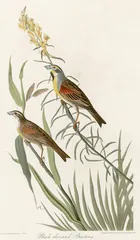
John James Audubon, The Birds of America (1827–38) 1 Dickcisselabout 181 per routeon 100% of routesno clear trend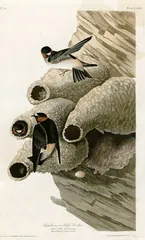
John James Audubon, The Birds of America (1827–38) 2 Cliff Swallowabout 159 per routeon 82% of routesno clear trend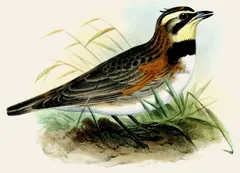
Joseph Wolf, Proceedings of the Zoological Society of London (1855) 3 Horned Larkabout 158 per routeon 94% of routesno clear trend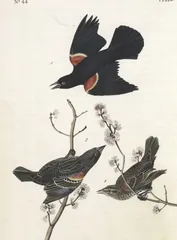
John James Audubon, The Birds of America (1840–44) about 110 per routeon 100% of routesno clear trend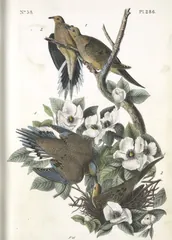
John James Audubon, The Birds of America (1840–44) about 94 per routeon 100% of routesno clear trend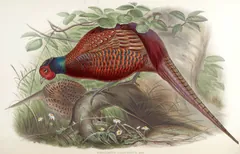
Joseph Wolf and Henry Constantine Richter, in John Gould's The Birds of Asia, part XXI (1869) 6 Ring-necked Pheasantabout 87 per routeon 68% of routesno clear trendintroduced species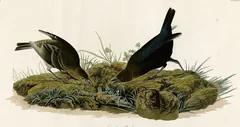
John James Audubon, The Birds of America (1827–38) 7 Brown-headed Cowbirdabout 37 per routeon 100% of routesno clear trend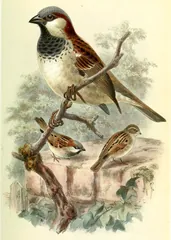
John Gerrard Keulemans, Lord Lilford’s Coloured Figures of the Birds of the British Islands (1885–97) 8 House Sparrowabout 35 per routeon 96% of routesno clear trendintroduced species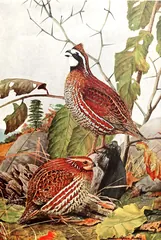
Louis Agassiz Fuertes, Elon H. Eaton’s Birds of New York (1910–14) 9 Northern Bobwhiteabout 33 per routeon 92% of routesno clear trend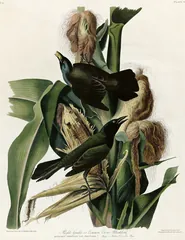
John James Audubon, The Birds of America (1827–38) 10 Common Grackleabout 24 per routeon 96% of routesno clear trend
Show all 25
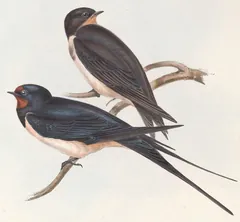
John and Elizabeth Gould, The Birds of Europe (1832–37) 11 Barn Swallowabout 23 per routeon 100% of routesno clear trend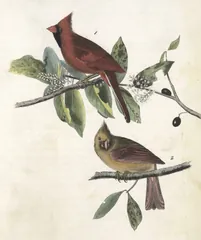
John James Audubon, The Birds of America (1840–44) about 23 per routeon 84% of routesrising since 2015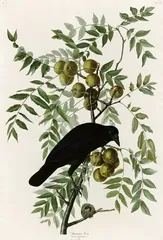
John James Audubon, The Birds of America (1827–38) about 21 per routeon 80% of routesrising since 2015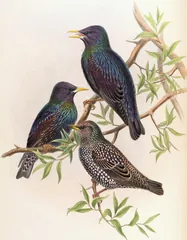
John Gould and Henry Constantine Richter, The Birds of Asia, vol. 5 (1850–83) 14 European Starlingabout 20 per routeon 98% of routesfalling since 2015introduced species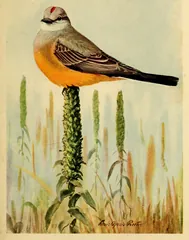
Louis Agassiz Fuertes, Food of Our More Important Flycatchers (1912) 15 Western Kingbirdabout 16 per routeon 80% of routesno clear trend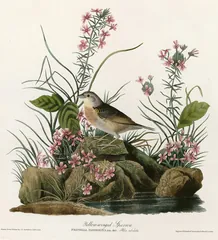
John James Audubon, The Birds of America (1827–38) 16 Grasshopper Sparrowabout 15 per routeon 86% of routesfalling since 2015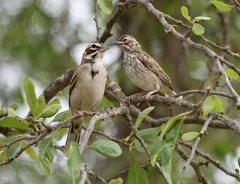
Photo: Cody Stricker, CC BY 4.0 17 Lark Sparrowabout 13 per routeon 90% of routesno clear trend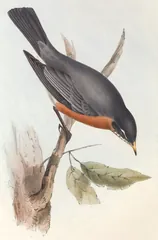
John and Elizabeth Gould, The Birds of Europe (1832–37) about 13 per routeon 92% of routesno clear trend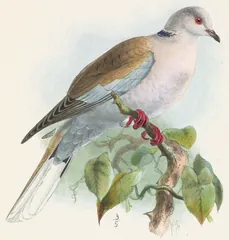
John Gerrard Keulemans, R. B. Sharpe’s Scientific Results of the Second Yarkand Mission (1891) 19 Eurasian Collared-Doveabout 10 per routeon 86% of routesrising since 2015introduced species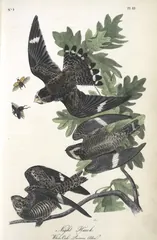
John James Audubon, The Birds of America (1840–44) 20 Common Nighthawkabout 10 per routeon 80% of routesno clear trend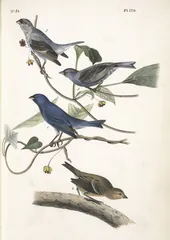
John James Audubon, The Birds of America (1840–44) 21 Indigo Buntingabout 9.9 per routeon 72% of routesrising since 2015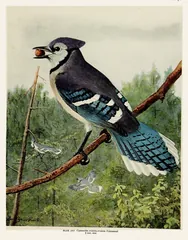
Louis Agassiz Fuertes, Elon H. Eaton's Birds of New York (1910–14) 22 Blue Jayabout 8.8 per routeon 88% of routesno clear trend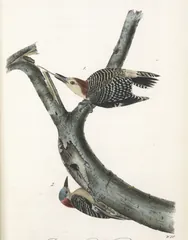
John James Audubon, The Birds of America (1840–44) about 8.7 per routeon 80% of routesno clear trend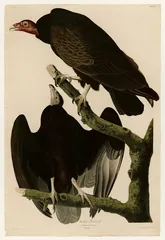
John James Audubon, The Birds of America (1827–38) about 8.6 per routeon 92% of routesno clear trend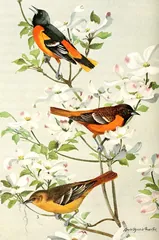
Louis Agassiz Fuertes, Bird-Lore (1922) about 8.5 per routeon 88% of routesfalling since 2015
In winter, the Red-winged Blackbird: Kansas's Christmas Bird Counts of 2023-24 tallied 974,142 of them, 43 percent of all the birds counted, with the Snow Goose second at 444,101. Nine species turned up on every count that winter: the Canada Goose, Mourning Dove, Red-tailed Hawk, Downy Woodpecker, European Starling, Harris's Sparrow, Song Sparrow, Red-winged Blackbird and Northern Cardinal.
The blackbird usually tops the winter totals, but not always: in 2022-23 the Snow Goose came first. These are winter tallies, so they say nothing about the birds that nest here in summer.
Sources: The Kansas Winter Bird Count for 2023-2024 (Kansas Ornithological Society Bulletin 75:1, March 2024); The Kansas Winter Bird Count for 2022-2023 (Kansas Ornithological Society Bulletin 74:1, March 2023), read October 8, 2026.
Once you know the Dickcissel, the Horned Lark and the rest of these 25, a field guide takes you further into Kansas’s list of 492 species; our comparison of the best bird books of 2026 shows which one to start with.
What is the most common bird in Kansas?
The Dickcissel leads Kansas’s summer survey: about 181 a route on average in 2021–2025, ahead of the Cliff Swallow at about 159, seen on every one of the 50 routes. USGS finds no clear rise or fall in its Kansas numbers since 2015.
How was this list made?
Each of Kansas’s 50 routes is a roadside count, 50 stops along about 25 miles, run once a year in early summer by a volunteer. We took USGS’s yearly estimate for each species in Kansas, the number of birds a typical route records, averaged it over the five latest survey years (there was no survey in 2020) and ranked the birds by it. To keep the list to birds you’re likely to meet across Kansas, we left out species recorded on fewer than one in five of its routes, and those USGS can only estimate very roughly, which usually means big flocks or colonies on a few routes.
For Kansas that left out the Lark Bunting. The survey counts Western and Eastern Meadowlarks together in Kansas, so neither is listed on its own, though as a group they would rank 4th, at about 142 a route.
The share of routes is our own count from USGS’s route data for Kansas, using only counts that met the survey’s standards; “rising” and “falling” are USGS’s trends for the state since 2015, named only where it finds a clear change. Roadside counts on early-summer mornings miss most of Kansas’s owls and waterbirds, and its winter visitors aren’t here at all.
Kansas’s counts come from two USGS data releases, the North American Breeding Bird Survey Analysis Results 1966–2025 (Hostetler et al., 2026) and its Dataset 1966–2025 (Ziolkowski et al., 2026), gathered by volunteer observers and free for anyone to use; Birdfolio isn’t connected with the USGS.
How many bird species are in Kansas?
| Official count | 492 species |
|---|---|
| List’s date | March 31, 2026 |
| Kept by | Kansas Bird Records Committee (Kansas Ornithological Society) |
| Hypothetical species | 9, known from sight records only, counted in the 492 |
| Fewer than ten records | 79 species, marked with a dagger (our count) |
| Records committee | Rules adopted in 1990; 7 voting members |
| Among US states | 16th highest of the 49 states with a verified count |
| Official list | Kansas Checklist, full details (updated March 31, 2026) |
What does Kansas’s count include?
- Every species the Kansas Bird Records Committee had accepted by March 31, 2026, named as in the American Ornithological Society's 66th supplement (July 2025).
- 2 extinct species, the Passenger Pigeon and Carolina Parakeet, and 1 no longer found in Kansas, the Gunnison Sage-Grouse. The printed field checklist leaves these 3 out.
- 9 hypothetical species, in brackets: first state records accepted from sight reports alone, such as the Tufted Duck and the Northern Wheatear. They stay hypothetical until a photo, recording or specimen turns up.
- A dagger on the 79 species with fewer than ten Kansas records (our count).
- Not counted: one bean goose record not settled as a Taiga or a Tundra Bean-Goose.
Why do other sources give a different number?
Kansas has added species quickly in recent decades, so older and narrower totals are still in print:
- 489. The printed field checklist of March 31, 2026, which leaves out the three species gone from Kansas. Source: Kansas Birds: Species List for Kansas, the field checklist of March 31, 2026 (Kansas Ornithological Society).
- 481. The species documented by September 2018, on a K-State Research and Extension checklist for 4-H members; 13 of them were hypothetical then, against 9 today. Source: Kansas Birds: Species List for Kansas, 4-H 1026 (K-State Research and Extension, 2018).
- 415. The species known in Kansas in 1988, when the state wildlife agency's magazine counted 320 of them at Cheyenne Bottoms alone. Source: Cheyenne Bottoms: Jewel of the Prairie (Kansas Wildlife & Parks magazine, July-August 1988, Kansas Department of Wildlife and Parks).
Kansas’s list follows its own committee’s rules, and so does every other state’s: see why the counts differ from state to state.
Kansas records, from a Piratic Flycatcher to a bean goose known from a sketch
- A Piratic Flycatcher spent May 8 to 10, 2015, at Scott Lake State Park in Scott County, where many birders photographed it. It was the first in Kansas, and the review list still shows just that one accepted record. Sources: Summary of Kansas Bird Records Committee Actions, 1990-2024; KBRC Review List (Kansas Bird Records Committee), read October 8, 2026.
- On July 1 and 2, 2012, an adult Red-necked Stint was photographed at the Little Salt Marsh in Quivira National Wildlife Refuge, Stafford County: Kansas's first. Source: Summary of Kansas Bird Records Committee Actions, 1990-2024, read October 8, 2026.
- A Yellow-eyed Junco settled in at Scott Lake State Park from November 2, 2020, to March 31, 2021, and was seen by many birders: another first state record from the same park. Source: Summary of Kansas Bird Records Committee Actions, 1990-2024, read October 8, 2026.
- A goose at Wilson Lake on January 25, 2014, was reported as a Taiga Bean-Goose, with a drawing. The committee first turned it down; on a second look it accepted the bird as either a Taiga or a Tundra Bean-Goose, which is why the checklist mentions it but doesn't count it. Sources: Summary of Kansas Bird Records Committee Actions, 1990-2024; Kansas Ornithological Society Check-list of Kansas Birds, full details, updated March 31, 2026, read October 8, 2026.
Questions people ask about Kansas’s birds
Which state has the most species of birds?
California, with 696 species as of September 8, 2026, by the count of the California Bird Records Committee. Texas follows with 682 (our table), and Kansas has 492.
Sources: Official California Checklist, updated 8 September 2026 (California Bird Records Committee); Kansas Ornithological Society Check-list of Kansas Birds, full details, updated March 31, 2026, read October 8, 2026.
What is the filthiest bird?
No scientist ranks birds that way, but the usual answer is the vultures, which clean up dead animals along roads and in forests and so help stop the spread of diseases such as rabies, the National Park Service says. Kansas has two, the Turkey Vulture and the Black Vulture. The Black Vulture is regular only in southeast Kansas, and the records committee wants a report of any seen elsewhere.
Sources: NETN Species Spotlight: Turkey and Black Vultures (National Park Service, last updated August 15, 2021); Kansas Ornithological Society Check-list of Kansas Birds, full details, updated March 31, 2026; KBRC Review List (Kansas Bird Records Committee), read October 8, 2026.
Are there 10,000 species of birds?
Yes, the world has more than 11,000. The 2025 edition of AviList, the global checklist, lists 11,131 species in 46 orders (our sum), so Kansas's 492 are about 4.4 percent of the world's birds.
Sources: AviList: The Global Avian Checklist, v2025, first released June 11, 2025 (AviList Core Team, CC BY 4.0); Kansas Ornithological Society Check-list of Kansas Birds, full details, updated March 31, 2026, read October 8, 2026.
What are some rare birds to see in Kansas?
The checklist marks 79 species with fewer than ten Kansas records, from the Piratic Flycatcher and Spotted Redshank to the Mexican Jay, 9 of them known only from sight records. Some birds are rare only away from one corner of the state, such as the Black Vulture outside the southeast, and a few haven't been seen in a very long time: the committee's review list gives 1885 as the Black-capped Vireo's latest valid Kansas report.
Sources: Kansas Ornithological Society Check-list of Kansas Birds, full details, updated March 31, 2026; KBRC Review List (Kansas Bird Records Committee), read October 8, 2026.
What kind of birds are there in Kansas?
Birds of the prairies and of some of the most important wetlands on the continent. Cheyenne Bottoms, the largest marsh in the interior of the US, and Quivira National Wildlife Refuge 30 miles south are both wetlands of international importance, which only Florida and Kansas can claim twice over. The tallgrass of the Flint Hills draws grassland shorebirds too: The Nature Conservancy estimates more than 225,000 a year, and almost the whole population of the Buff-breasted Sandpiper.
Both prairie-chickens are on the state list, the Greater and the Lesser. In one stretch of the Flint Hills of about 190 square miles, the Greater Prairie-Chicken's display grounds, called leks, fell from 31 in 1997 to 5 in 2023, the society's Bulletin reported, losses linked to spreading woody plants and frequent spring burning of pastures.
Sources: Migratory Shorebird Conservation in the Central Flyway (The Nature Conservancy in Kansas, March 4, 2020); Kansas Ornithological Society Check-list of Kansas Birds, full details, updated March 31, 2026; Decline of a Kansas Flint Hills Greater Prairie-Chicken Population over 25 Years (Kansas Ornithological Society Bulletin 76:1, March 2025), read October 8, 2026.
Why is Cheyenne Bottoms a crossroads for shorebirds?
Because it is a huge marsh on the Central Flyway, the birds' migration route through the Great Plains. The International Shorebird Survey found that 45 percent of North America's northbound shorebirds stopped there, and more than 90 percent of five species, among them the White-rumped Sandpiper and Wilson's Phalarope, the state wildlife agency's magazine reported in 1988. Seventy percent of all the shorebird species of North America have been recorded at the Bottoms, The Nature Conservancy says.
A farmer helped prove it. By 1923 Frank Robl, who farmed on the south shore of what was then called Cheyenne Swamp, was putting homemade tin bands on ducks and geese there. Within five years his bands came back from as far away as Alaska, Mexico and Central America; in 1934 he spoke about them on national radio, and his records helped document the flyway itself.
In the 1980s people feared the Bottoms would dry up because of diversions upstream, until the state's water office made sure that water coming down the Arkansas River and Wet Walnut Creek reaches it. Today the basin covers 41,000 acres, including the state's Cheyenne Bottoms Wildlife Area and a preserve The Nature Conservancy began buying in 1990.
Sources: Cheyenne Bottoms: Jewel of the Prairie (Kansas Wildlife & Parks magazine, July-August 1988, Kansas Department of Wildlife and Parks); Migratory Shorebird Conservation in the Central Flyway (The Nature Conservancy in Kansas, March 4, 2020), read October 8, 2026.
Why does Kansas count birds nobody has photographed?
Because of its rules for first records. The committee needs physical evidence, such as a photo, recording, specimen or band, to accept a new species fully, but a first state record supported only by sight reports may be accepted as hypothetical and added to the checklist in brackets, and it stays there until proof turns up. Nine such species are among the 492.
They include an Arctic Tern at Perry Lake on September 3, 1994, a Tufted Duck at Lake Afton on October 27, 1996, and a Northern Wheatear in Cheyenne County on April 5, 1997. A Glaucous-winged Gull at a Wichita landfill in 1998 even came with video, but the committee didn't find the images conclusive. The list is shrinking: in 2018 it held 13 hypothetical species.
Sources: Procedural Rules of the Kansas Bird Records Committee, adopted October 6, 1990, last amended June 19, 2022; Summary of Kansas Bird Records Committee Actions, 1990-2024; Kansas Ornithological Society Check-list of Kansas Birds, full details, updated March 31, 2026; Kansas Birds: Species List for Kansas, 4-H 1026 (K-State Research and Extension, 2018), read October 8, 2026.
Where is the official Kansas bird list, and how often is it updated?
On the Kansas Ornithological Society's website, ksbirds.org: the Check-list of Kansas Birds, full details, a PDF that reflects every action of the Kansas Bird Records Committee through March 31, 2026, with a printable field checklist beside it. The committee's yearly reports are on the same site from 1991 on, and a summary of its actions from 1990 to 2024 counts 1,242 submissions, of which 762 were accepted.
The committee has seven voting members, elected for four-year terms two at a time, under procedural rules the society's board first adopted on October 6, 1990. A record is accepted outright with six or seven votes in favor and rejected with four or more against; anything in between goes round again. The society itself was formed in 1949.
Sources: Kansas Ornithological Society Check-list of Kansas Birds, full details, updated March 31, 2026; Kansas Birds: Species List for Kansas, the field checklist of March 31, 2026 (Kansas Ornithological Society); Kansas Bird Records Committee (Kansas Ornithological Society); Summary of Kansas Bird Records Committee Actions, 1990-2024; Procedural Rules of the Kansas Bird Records Committee, adopted October 6, 1990, last amended June 19, 2022; History and Mission of the Kansas Ornithological Society, read October 8, 2026.
How do you count your own Kansas list?
Your Kansas list is every species you’ve seen in Kansas. eBird can filter your life list to Kansas, and your eBird data download gives the state of every sighting. On paper, count the species you’ve seen in Kansas; what is a life list? explains how birders keep their lists.
To print your whole list, Kansas birds and all, see how to print your bird life list, or let Birdfolio make it a hardcover book.
Kansas’s state bird
Kansas’s state bird is the Western Meadowlark (officially, the “western meadow lark”), the state bird since 1937. Its story, the state flower and animal, and a free picture card for a report are on our Kansas state bird page.
Birding festivals in Kansas
Our birding festivals calendar lists 2 in Kansas, with dates from each festival’s own website:
- Kansas Lek Treks, Hays: April 7–11, 2027
- Kansas Crane Festival, Sterling: dates not announced yet; expected in November 2027 (2026 festival: November 6–8, 2026)
Christmas Bird Count in Kansas
Kansas had 36 Christmas Bird Count circles on Audubon’s map last winter, each counted on a single day between December 14 and January 5. Our guide shows where to find Kansas’s counts and lists 28 Kansas count dates already announced for this winter; it’s free, and beginners are welcome.
More about bird counts
- How many bird species are in each state: Kansas beside all 50 states, DC and Canada.
- Bird lists of nearby states: Colorado, Missouri, Nebraska and Oklahoma.
- State birds of all 50 states, Kansas’s Western Meadowlark among them
- How many bird species are in the US and Canada
- Bird splits and lumps
If you’re shopping for a birder in Kansas, our gift guide for birders and our pick of coffee table bird books are good places to start.