Reference
How many bird species are in Utah?
Utah has 465 bird species on its official list (Utah Bird Records Committee, February 2026), the 22nd highest count of the 49 states with a verified count. A species joins it with physical evidence, such as a photo or a specimen, or with two accepted sight records.
Utah’s state bird is the California Gull: our Utah state bird page tells how it was chosen.
Updated
What are the most common birds in Utah?
In summer, the 25 most common birds in Utah are led by the Horned Lark, at about 76 birds per survey route, then the Common Raven and the Western Meadowlark, by the USGS Breeding Bird Survey’s counts for 2021–2025. Together these 25 made up 56% of all the birds counted on Utah’s 79 survey routes.
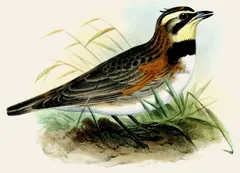
Joseph Wolf, Proceedings of the Zoological Society of London (1855) 1 Horned Larkabout 76 per routeon 70% of routesno clear trend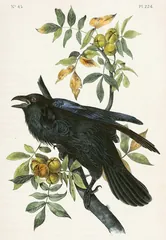
John James Audubon, The Birds of America (1840–44) 2 Common Ravenabout 19 per routeon 97% of routesno clear trend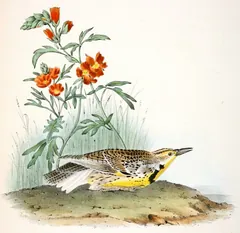
John James Audubon, The Birds of America (1840–44) 3 Western Meadowlarkabout 17 per routeon 80% of routesfalling since 2015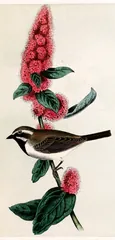
William E. Hitchcock, John Cassin’s Illustrations of the Birds of California, Texas, Oregon, British and Russian America (1853–56) 4 Black-throated Sparrowabout 17 per routeon 65% of routesfalling since 2015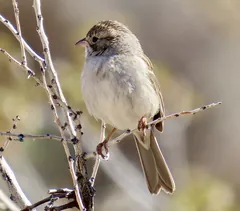
Photo: an iNaturalist contributor, CC0 1.0 5 Brewer's Sparrowabout 17 per routeon 76% of routesfalling since 2015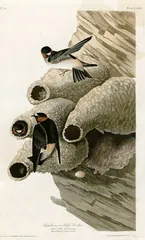
John James Audubon, The Birds of America (1827–38) 6 Cliff Swallowabout 16 per routeon 42% of routesno clear trend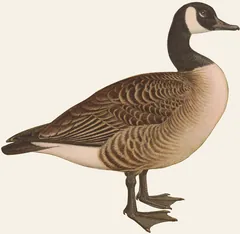
Marinus Adrianus Koekkoek, E. D. van Oort's Ornithologia Neerlandica (1922) about 11 per routeon 28% of routesno clear trend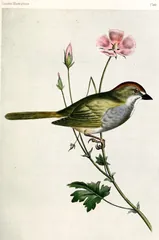
George G. White (on stone by William E. Hitchcock), John Cassin’s Illustrations of the Birds of California, Texas, Oregon, British and Russian America (1853–56) 8 Green-tailed Towheeabout 9.3 per routeon 41% of routesno clear trend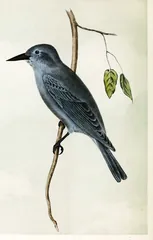
William E. Hitchcock, John Cassin’s Illustrations of the Birds of California, Texas, Oregon, British and Russian America (1853–56) 9 Pinyon Jayabout 8.9 per routeon 48% of routesno clear trend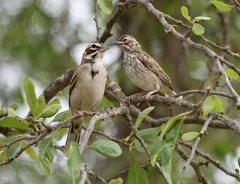
Photo: Cody Stricker, CC BY 4.0 10 Lark Sparrowabout 7.8 per routeon 87% of routesno clear trend
Show all 25
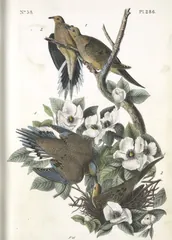
John James Audubon, The Birds of America (1840–44) about 7.8 per routeon 92% of routesno clear trend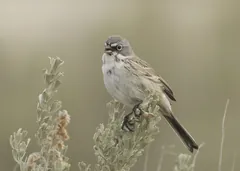
Photo: RJ Baltierra, CC BY 4.0 12 Sagebrush Sparrowabout 7.6 per routeon 33% of routesno clear trend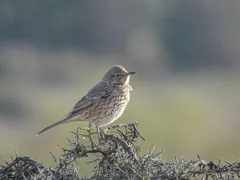
Photo: Pedro Guevara, CC BY 4.0 13 Sage Thrasherabout 6.7 per routeon 57% of routesno clear trend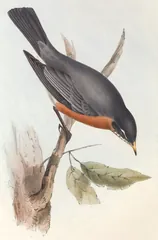
John and Elizabeth Gould, The Birds of Europe (1832–37) about 6.0 per routeon 72% of routesno clear trend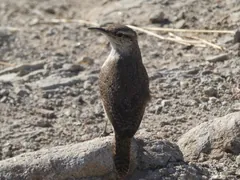
Photo: Eric Johnson, CC BY 4.0 15 Rock Wrenabout 5.8 per routeon 77% of routesfalling since 2015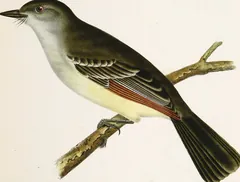
Artist unrecorded, Reports of Explorations and Surveys for a Railroad from the Mississippi River to the Pacific Ocean, vol. 10 (1859) 16 Ash-throated Flycatcherabout 5.8 per routeon 54% of routesno clear trend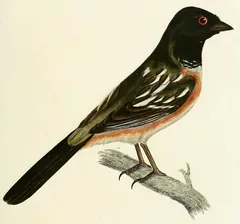
Artist unrecorded, Illustrations of Ornithology (1826) 17 Spotted Towheeabout 4.4 per routeon 65% of routesno clear trend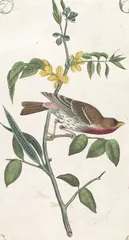
John James Audubon, The Birds of America (1840–44) 18 House Finchabout 4.1 per routeon 75% of routesno clear trend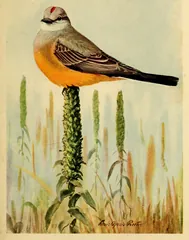
Louis Agassiz Fuertes, Food of Our More Important Flycatchers (1912) 19 Western Kingbirdabout 4.1 per routeon 67% of routesno clear trend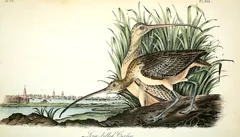
John James Audubon, The Birds of America (1840–44) 20 Long-billed Curlewabout 4.1 per routeon 22% of routesno clear trend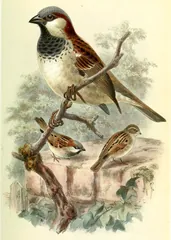
John Gerrard Keulemans, Lord Lilford’s Coloured Figures of the Birds of the British Islands (1885–97) 21 House Sparrowabout 4.0 per routeon 35% of routesno clear trendintroduced species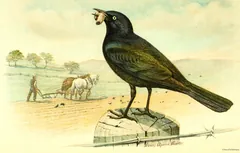
Louis Agassiz Fuertes, Bulletin, Biological Survey (1908) 22 Brewer's Blackbirdabout 3.9 per routeon 52% of routesno clear trend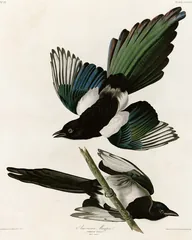
John James Audubon, The Birds of America (1827–38) 23 Black-billed Magpieabout 3.7 per routeon 57% of routesfalling since 2015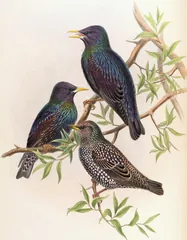
John Gould and Henry Constantine Richter, The Birds of Asia, vol. 5 (1850–83) 24 European Starlingabout 3.5 per routeon 38% of routesno clear trendintroduced species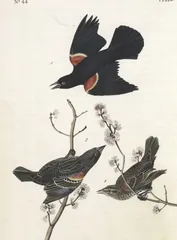
John James Audubon, The Birds of America (1840–44) about 3.4 per routeon 49% of routesno clear trend
These 25, led by the Horned Lark and the Common Raven, are a small part of the 465 species on Utah’s official list; to name the rest, our comparison of the best bird books of 2026 shows which field guide suits a beginner.
What is the most common bird in Utah?
The Horned Lark leads Utah’s summer survey: about 76 a route on average in 2021–2025, more than twice the Common Raven’s 19, seen on 70% of the 79 routes. USGS finds no clear rise or fall in its Utah numbers since 2015.
How was this list made?
Each of Utah’s 79 routes is a roadside count, 50 stops along about 25 miles, run once a year in early summer by a volunteer. We took USGS’s yearly estimate for each species in Utah, the number of birds a typical route records, averaged it over the five latest survey years (there was no survey in 2020) and ranked the birds by it. To keep the list to birds you’re likely to meet across Utah, we left out species recorded on fewer than one in five of its routes, and those USGS can only estimate very roughly, which usually means big flocks or colonies on a few routes.
For Utah that left out the White-faced Ibis, the California Gull, the American White Pelican and 1 more.
The share of routes is our own count from USGS’s route data for Utah, using only counts that met the survey’s standards; “rising” and “falling” are USGS’s trends for the state since 2015, named only where it finds a clear change. Roadside counts on early-summer mornings miss most of Utah’s owls and waterbirds, and its winter visitors aren’t here at all.
Utah’s counts come from two USGS data releases, the North American Breeding Bird Survey Analysis Results 1966–2025 (Hostetler et al., 2026) and its Dataset 1966–2025 (Ziolkowski et al., 2026), gathered by volunteer observers and free for anyone to use; Birdfolio isn’t connected with the USGS.
How many bird species are in Utah?
| Official count | 465 species |
|---|---|
| List’s date | February 2026 |
| Kept by | Utah Bird Records Committee |
| Review species | 155, marked # (our count) |
| Common all year | 64 species (our count of the CP code) |
| Washington County specialties | 23 species, marked with a star |
| Among US states | 22nd highest of the 49 states with a verified count |
| Official list | Checklist of the Birds of Utah (Feb 2026) |
What does Utah’s count include?
- Species with physical evidence, or with at least two sight records the committee accepted, through February 2026, named as in the American Ornithological Society's 66th supplement.
- 155 review species, marked #: the committee asks for documentation of every sighting of them, and of any bird not on the list (our count). A few are exempt where they are regular, such as Costa's Hummingbird in Washington County.
- Ten established introduced species, such as the Chukar, Ring-necked Pheasant, California Quail and Wild Turkey, and, by the committee's reckoning, the California Condor, first released in Arizona.
- A code for how common each bird is, from common to accidental, and one for when it is here, from year-round resident to migrant.
- Not counted: species on separate provisional, unverified and introduced-species lists. The unverified list holds 29 species reported but never confirmed, such as the Black Vulture and the Pileated Woodpecker.
Why do other sources give a different number?
Utah's checklist grows whenever the committee accepts a new bird, and other figures you may see count something else:
- 473. The Olive Warbler's number on the committee's running list of first state records, accepted in September 2025. That list keeps species since merged into others, and species known from a single sight record, so it runs ahead of 465. Source: First State Records (Utah Bird Records Committee).
- 339. The species that use Great Salt Lake and its wetlands and uplands, over 12 million birds in all, by the Utah Division of Wildlife Resources' count. Source: Birds at the Great Salt Lake (Utah Division of Wildlife Resources, last updated July 31, 2026).
- 274. The species on Utah County's tourism page headed 270+ Bird Species in Utah. They are the birds of Utah Valley, from Utah Lake to Mount Nebo, not of the whole state. Source: 270+ Bird Species in Utah, a birding checklist (Explore Utah Valley, the Utah County tourism bureau, July 22, 2026).
Utah’s list follows its own committee’s rules, and so does every other state’s: see why the counts differ from state to state.
Utah records, from a booby on Lake Powell to a hummingbird seen in 1972
- On September 19, 2018, a Blue-footed Booby turned up at Warm Creek Bay on Lake Powell, in Kane County: Utah's first. It was still being seen in early November, dozens of birders came to see it, many with cameras, and the committee accepted the record unanimously in its first round. Source: Record 2018-46, Blue-footed Booby (Utah Bird Records Committee), read October 8, 2026.
- A Blue-throated Mountain-gem, then called the Blue-throated Hummingbird, visited Springdale, Washington County, from August 3 to 8, 1972. The committee accepted the sighting in 2021, 49 years later, by 7 votes to 2. The photos reported at the time have never turned up, so the bird sits on the provisional list, not the checklist. Sources: Record 2021-26, Blue-throated Mountain-gem (Utah Bird Records Committee); Auxiliary Lists, updated September 2025 (Utah Bird Records Committee), read October 8, 2026.
- Utah's newest bird is an Olive Warbler photographed at Lava Point Campground in Zion National Park on August 22, 2025. The committee accepted it 9-0, the 473rd species on its running list of first state records. Sources: Record 2025-44, Olive Warbler (Utah Bird Records Committee); First State Records (Utah Bird Records Committee), read October 8, 2026.
Questions people ask about Utah’s birds
What is the rarest bird in Utah?
The rarest are the 120 species the official checklist codes accidental, not expected and out of their normal range, with few records (our count), such as the Blue-footed Booby and the Olive Warbler. Birds known from one accepted sight record without a photo, such as the Elf Owl, wait on a separate provisional list. Among birds that live here all year, the Gunnison Sage-Grouse is coded rare and is a review species.
Sources: Checklist of the Birds of Utah, February 2026 (Utah Bird Records Committee); Auxiliary Lists, updated September 2025 (Utah Bird Records Committee), read October 8, 2026.
What is the filthiest bird?
No scientist ranks birds by dirtiness; the label usually lands on scavengers. Utah's list has two: the Turkey Vulture, coded common in summer, and the California Condor, a rare year-round resident that feeds mainly on the carcasses of mammals, the National Park Service says. The Black Vulture has been reported in Utah but never confirmed, so it sits on the committee's unverified list.
Sources: Checklist of the Birds of Utah, February 2026 (Utah Bird Records Committee); Condor pair likely incubating an egg in Zion National Park (Zion National Park, April 19, 2016); Auxiliary Lists, updated September 2025 (Utah Bird Records Committee), read October 8, 2026.
What is the most popular bird in Utah?
No poll ranks Utah's birds, but the one the state chose is the California Gull, its state bird, and it is hard to miss around Great Salt Lake: about 160,000 breeding adults nest there, a Division of Wildlife Resources survey report says. The checklist codes it common in summer and uncommon in winter.
Sources: The Great Salt Lake's Importance to Birds, from the Great Salt Lake waterbird survey report (Utah Division of Wildlife Resources); Checklist of the Birds of Utah, February 2026 (Utah Bird Records Committee), read October 8, 2026.
What is the largest bird found in Utah?
The California Condor, the largest land bird in North America: it can weigh 26 pounds and spread its wings 9½ feet, the National Park Service says. In 2019 about 96 condors were flying free in northern Arizona and southern Utah.
Sources: Two of Three Wild-Hatched Condors Have Fledged (Zion National Park, December 17, 2014); California Condor Chick #1000 Fledges at Zion National Park (Zion National Park, October 1, 2019), read October 8, 2026.
What are common birds in Utah?
The official checklist answers this itself: it codes 179 species as common in at least one season and 64 as common all year (our count). The year-round regulars include the Black-billed Magpie, American Robin, House Finch, Western Meadowlark, Common Raven and Golden Eagle. The biggest crowd gathers on Great Salt Lake: as many as 5 million Eared Grebes, at times half to 90 percent of North America's.
Sources: Checklist of the Birds of Utah, February 2026 (Utah Bird Records Committee); Birds at the Great Salt Lake (Utah Division of Wildlife Resources, last updated July 31, 2026), read October 8, 2026.
Which birds live in Utah?
Water birds above all. Great Salt Lake and its wetlands draw over 12 million birds of 339 species, the Utah Division of Wildlife Resources says; up to 20,000 American White Pelicans nest on Gunnison Island, and 21 percent of the continent's Snowy Plovers use the lake.
The southwest corner adds its own: the checklist marks 23 species found mainly in Washington County, from the Verdin and Cactus Wren to Abert's Towhee. Among the birds it codes as year-round residents are the White-tailed Ptarmigan, the Black Rosy-Finch, the Greater Sage-Grouse and the rarer Gunnison Sage-Grouse.
Sources: Birds at the Great Salt Lake (Utah Division of Wildlife Resources, last updated July 31, 2026); Checklist of the Birds of Utah, February 2026 (Utah Bird Records Committee), read October 8, 2026.
Why do millions of birds fatten up on Great Salt Lake?
Because the lake is ideal for brine shrimp, being too salty for the fish that would eat them. Eared Grebes feed almost only on the shrimp while they prepare to migrate, growing from about 13 ounces to about 20; Wilson's Phalaropes gain as much as 2 grams a day and double their weight before they leave, the Utah Division of Wildlife Resources has found. Without the shrimp, it says, their long migrations would not be possible.
The crowds are vast: as many as 5 million Eared Grebes, and over 600,000 Wilson's Phalaropes, the largest gathering of the species anywhere and more than a third of all the Wilson's Phalaropes in the world.
The partnership is old. Brine shrimp have lived in the Great Salt Lake area for at least 600,000 years, geologic cores show, and scientists believe they first arrived as cysts, embryos in a protective shell, carried on the feet and in the feathers of migrating birds.
Sources: Brine shrimp, Great Salt Lake Ecosystem Program (Utah Division of Wildlife Resources, last updated July 31, 2026); Birds at the Great Salt Lake (Utah Division of Wildlife Resources, last updated July 31, 2026), read October 8, 2026.
Why does Utah count the California Condor as an introduced bird?
Because Utah's condors descend from birds people released. The southwestern flock began in 1996 with releases at Vermilion Cliffs National Monument in northern Arizona. After sightings in Utah from 2003 to 2016, the records committee accepted the condor as an established species in June 2016, and its lists group it with the Chukar, Ring-necked Pheasant and other established introduced birds.
Utah's first wild-hatched chick, in a nest cave in Zion National Park in 2014, did not survive. Then on September 25, 2019, chick #1000 of the whole recovery program flew from its cave in Zion: the first to fledge in the park since the recovery began, and likely the first there in over a hundred years. Climbing routes on the east face of Angels Landing were closed because of the condors.
Lead has been the biggest threat. Condors swallow it when they feed on animals shot with lead ammunition, or on gut piles left in the field, and lead caused 53 percent of diagnosed deaths, the park said in 2016; Utah and Arizona run voluntary programs to get hunters in condor country to use non-lead ammunition.
Sources: Condor pair likely incubating an egg in Zion National Park (Zion National Park, April 19, 2016); First State Records (Utah Bird Records Committee); Auxiliary Lists, updated September 2025 (Utah Bird Records Committee); Two of Three Wild-Hatched Condors Have Fledged (Zion National Park, December 17, 2014); California Condor Chick #1000 Fledges at Zion National Park (Zion National Park, October 1, 2019), read October 8, 2026.
Where is the official Utah bird list, and how often is it updated?
On utahbirds.org, the Utah Bird Records Committee's website: the Checklist of the Birds of Utah, a web page with a four-page printable PDF, dated February 2026. Each species has codes for abundance and season; separate auxiliary lists hold the provisional, unverified and introduced species. The bylaws call for a review of the checklist at least every three years, and a new state bird goes onto the website as soon as it is accepted.
The committee was set up in 1982 with the Utah Ornithological Society and its Utah Birds magazine, and it has outlived both, hosted now on the Utah County Birders' website. It has nine voting members and a secretary, and a record is decided in its first round only if at least seven members vote and all agree. A species stays on the review list while it averages two or fewer Utah records a year over ten years.
Sources: Utah Bird Records Committee, home page; Checklist of the Birds of Utah, February 2026 (Utah Bird Records Committee); Auxiliary Lists, updated September 2025 (Utah Bird Records Committee); Bylaws of the Utah Bird Records Committee, passed June 2002, last amended November 2024; A Brief History of the Utah Bird Records Committee, read October 8, 2026.
How do you count your own Utah list?
Your Utah list is every species you’ve seen in Utah. eBird can filter your life list to Utah, and your eBird data download gives the state of every sighting. On paper, count the species you’ve seen in Utah; what is a life list? explains how birders keep their lists.
To print your whole list, Utah birds and all, see how to print your bird life list, or let Birdfolio make it a hardcover book.
Utah’s state bird
Utah’s state bird is the California Gull (officially, the “sea gull”), the state bird since 1955. Its story, the state flower and animal, and a free picture card for a report are on our Utah state bird page.
Birding festivals in Utah
Our birding festivals calendar lists one festival in Utah, with dates from its own website:
- Great Salt Lake Bird Festival, Farmington: May 13–16, 2027
Christmas Bird Count in Utah
Utah had 28 Christmas Bird Count circles on Audubon’s map last winter, each counted on a single day between December 14 and January 5. Our guide shows where to find Utah’s counts and lists 1 Utah count date already announced for this winter; it’s free, and beginners are welcome.
More about bird counts
- How many bird species are in each state: Utah beside all 50 states, DC and Canada.
- Bird lists of nearby states: Arizona, Colorado, Idaho and Nevada.
- State birds of all 50 states, Utah’s California Gull among them
- How many bird species are in the US and Canada
- Bird splits and lumps
If you’re shopping for a birder in Utah, our gift guide for birders and our pick of coffee table bird books are good places to start.