2019 new name
Blue-throated Hummingbird is now Blue-throated Mountain-gem
The Blue-throated Hummingbird is now called the Blue-throated Mountain-gem: the American Ornithological Society (AOS) changed its English name on June 24, 2019, and eBird followed in August 2019. It is the same bird, the largest hummingbird that nests in the US, found in the mountains of southeastern Arizona, southwestern New Mexico and west Texas, so your life list doesn't change.
Updated
What changed
Nests in the mountains of southeastern Arizona and southwestern New Mexico, in the Chisos Mountains of west Texas, and in the mountains of Mexico.
What is the Blue-throated Hummingbird called now?
The Blue-throated Mountain-gem, Lampornis clemenciae: the same bird with a new English name. The AOS made the change on June 24, 2019, eBird and its Clements Checklist followed in August 2019, and the AviList world checklist agrees, spelling it Blue-throated Mountaingem.
The scientific name is unchanged and old: René Primevère Lesson described the bird from Mexico in 1830, in his Histoire naturelle des oiseaux-mouches, a natural history of hummingbirds, according to AviList.
Surprising facts about the Blue-throated Mountain-gem
It is the heavyweight. It is the largest hummingbird that nests in the US, says Audubon's field guide: 6 to 9 grams (about a quarter of an ounce), and up to 10 grams, says the Texas Breeding Bird Atlas. A Broad-billed Hummingbird weighs 3 to 6. It beats its wings about 23 times a second, about half as fast as smaller hummingbirds, says the Tucson Bird Alliance.
The females sing back. In southeastern Arizona, Millicent Ficken and colleagues found that both sexes sing, and that a female often sings over the male's song when she is within a few centimeters of him. Of the hummingbirds studied, it had the most complex songs, and it was the only one known with complex female songs. Instead of a flashy display flight, males court with a quiet "whisper song," says the Tucson Bird Alliance.
Some of its notes are too high for us to hear. It can make sounds up to 30 kilohertz, beyond human hearing. Yet when researchers tested these hummingbirds' own hearing, neither males nor females responded to sounds above 7 kilohertz, Popular Science reported.
Its nest can grow 10 inches tall. Nests are reused, with a new nest built on top of the old; one reached 25 centimeters (10 inches), says the Texas Breeding Bird Atlas. Nests turn up under eaves and bridges and on wires, nails and chains, and their covering of green moss is unique among North American hummingbird nests, says Audubon's field guide.
It eats spiders. It feeds heavily on small insects and spiders, sometimes plucking insects from spider webs, and can live on them in dry seasons when few flowers bloom.
Why the name changed
To give its whole group one name. There are seven hummingbirds in the genus Lampornis, and all but two were already called mountain-gems, explained Terry Chesser, who chaired the AOS committee. The two exceptions, the Blue-throated and the Amethyst-throated Hummingbird, became mountain-gems too.
The AOS doesn't usually rename birds just to make a name better, Chesser said, but here it hoped one shared name would help birders see that the seven are related, and tell them apart from birds called simply "hummingbird."
The idea came from Marshall Iliff, in a proposal dated November 27, 2018. He counted 37 groups of hummingbirds, or genera, that already used the plain name "hummingbird," and added that the new name would set the bird apart from the similar-looking female Rivoli's Hummingbird.
The hyphen survived. The same proposal also asked to drop it, as the IOC world list already did; the AOS still writes Mountain-gem, while AviList writes Mountaingem.
Who decided, and when
- American Ornithological Society (AOS): the 60th Supplement to its Check-list of North American birds
- eBird and the Clements Checklist: its 2019 taxonomy update
- AviList, the shared world checklist: agrees, writing it Blue-throated Mountaingem
Is a blue hummingbird rare?
In the US, the Blue-throated Mountain-gem is local more than rare: north of Mexico its normal range is limited to canyons in a few mountains near the border, says Audubon's field guide, but where it lives it is bold and easy to notice. Worldwide it isn't threatened: the IUCN lists it as Least Concern, according to AviList.
Most US birds go south in fall, though a few spend the winter at feeders in Arizona's canyons. The blue throat itself is hard to see: only males have it, and it shows only at the right angle, says the Tucson Bird Alliance.
Are there blue hummingbirds in the United States?
Yes, two with blue on the male, both in the Southwest. Besides the Blue-throated Mountain-gem, the male Broad-billed Hummingbird of southern Arizona is dark blue-green, with a blue-black tail and a red-based bill. It is very common in its small US range, mostly from March to September, says Audubon's field guide.
Where can you see a Blue-throated Mountain-gem?
In shady mountain canyons near flowing water, with sycamores and pine-oak woods, says Audubon's field guide. Cave Creek Canyon near Portal, in Arizona's Chiricahua Mountains, is the best spot in the US, and the feeders at the Southwestern Research Station there are close to a sure thing, says the Tucson Bird Alliance. Other places to try: the Palisades visitor center on Mount Lemmon and feeders in the eastern Huachuca Mountains. Trogon seekers know Cave Creek Canyon too, as one of the best-known places to look for the Coppery-tailed Trogon, called Elegant Trogon until 2025.
In Texas it was first found in the Chisos Mountains of Big Bend, and later in the Davis and Guadalupe Mountains, where atlas workers found the most signs of nesting. It is on its breeding grounds from mid-April through September, says the Texas Breeding Bird Atlas. Listen for the male's loud, repeated seep.
Why don't you see baby hummingbirds?
Because they stay hidden in the nest until they can fly. A Blue-throated Mountain-gem lays 2 white eggs and sits on them for 17 to 18 days; the female alone feeds the young, which first fly at about 24 to 29 days old, says Audubon's field guide. The nest is usually well sheltered from above, under a branch, an eave or a bridge, and a female may raise up to three broods a year.
What is the number one predator of hummingbirds?
No study names a single top predator, but one of the most surprising is the praying mantis. A 2017 review by Martin Nyffeler, Mike Maxwell and James Van Remsen gathered 147 cases of mantises catching small birds around the world. More than 70 percent were in the US, often at hummingbird feeders, and hummingbirds were most of the victims, the University of Basel reported. The authors urged caution about releasing mantises for pest control.
Which bird is it?
There is nothing new to tell apart: Blue-throated Hummingbird and Blue-throated Mountain-gem are the same bird.
To know it from other hummingbirds, look for its size, a white stripe behind the eye and big white corners on a big black tail, says Audubon's field guide. A female Rivoli's Hummingbird, once the Magnificent Hummingbird, is similar but more mottled below, with smaller, duller pale tail corners.
What it does to your list
A new name only: your Blue-throated Hummingbird now counts as Blue-throated Mountain-gem.
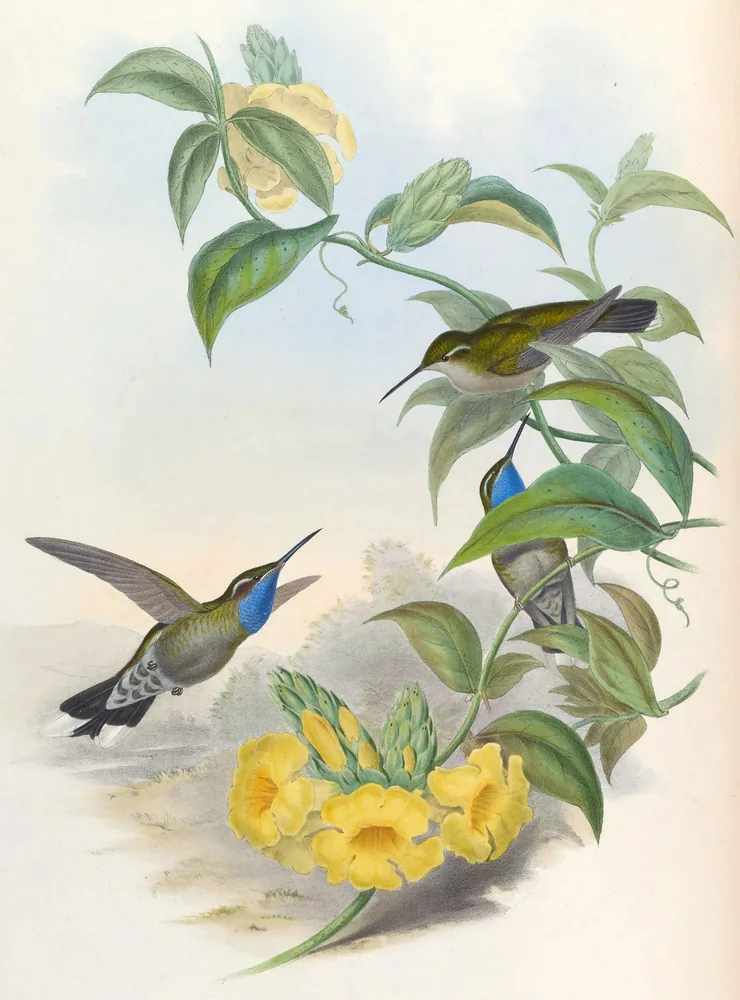
Other birds got new names too: see Gray Jay to Canada Jay and McCown's Longspur to Thick-billed Longspur. In 2026 a warbler of the same Arizona mountains was renamed: the Painted Whitestart. The painting at the top of this page is from John Gould's book of hummingbirds; read more about John Gould, and about how bird splits and lumps work.
Keep your hummingbirds in Merlin? Birds saved there while you're signed in go to your eBird account; here's how to get them out of Merlin.
Check your own list. Drop your eBird download or type your birds: the free checker shows which of them this and other recent changes touched.
Check my list