2021 lump
Northwestern Crow is now part of American Crow
The Northwestern Crow is no longer a species of its own: the American Ornithological Society (AOS) merged it into the American Crow on June 30, 2020, and eBird followed in August 2021. The crows of the coast from southern Alaska to Washington now count as American Crows. If you had counted both, your life list is one species shorter, but every sighting is kept.
Updated
What changed
Across most of the US and southern Canada. It includes the crows of the coast from southern Alaska to Washington, which used to count as Northwestern Crow.
Is the Northwestern Crow still a species?
No. Since June 30, 2020, the AOS has counted it as part of the American Crow, in the 61st Supplement to its Check-list. eBird made the same change in its August 2021 update (it had no update in 2020), and the AviList world checklist agrees.
The name lives on as a subspecies, which AviList places from Kodiak Island and coastal southern Alaska to southwestern Washington. The same AOS update brought back the Mexican Duck as a species, so the AOS announced it as "Goodbye Northwestern Crow, Hello Mexican Duck."
What are the key differences between the American Crow and the Northwestern Crow?
On paper, size and voice: Northwestern Crows were described as smaller, with lower, huskier voices, and as birds of beaches and tidal flats, says BirdWeb. In the field there was no reliable difference: David Sibley's guide said the Northwestern Crow could be identified only by where it lived, 10,000 Birds noted in 2011.
The DNA shows why. Seattle's crows are a mix, with slightly more American Crow genes, and so are crows along the Washington coast. In Oregon they are almost all American Crow; northward through British Columbia the mix leans Northwestern, and by Juneau, Alaska, the crows are "pure" Northwestern, Swift explains.
Surprising facts about the Northwestern Crow
It was named in a railroad survey. Spencer F. Baird described Corvus caurinus in 1858, in the reports of the surveys for a railroad route from the Mississippi River to the Pacific, according to AviList. The bird he named it from came from Fort Steilacoom, Washington: the very region where, 162 years later, the DNA study found only mixed crows.
Even a crow scientist couldn't tell. During her graduate research on Seattle's crows, Kaeli Swift wrote in Audubon, she called all her study birds American Crows while privately unsure. The 2020 study finally gave her the confidence she had wanted.
It works the tides. Crows on the coast store extra food at low tide, when it is plentiful, and eat it at high tide, when the shore is under water, says BirdWeb. They also drop hard-shelled food on rocks and roads to crack it.
Crows remember your face for years. University of Washington researchers who trapped crows while wearing one rubber mask were scolded whenever they wore it again. Nearly seven years later the crows still mobbed that mask, and the share of birds joining in had roughly doubled, though most had never been caught, National Wildlife magazine reported.
They hold "funerals." Crows gather and call around a dead crow. In a 2015 University of Washington study, Swift found they use these gatherings to learn about danger: after seeing a person with a dead crow just once, they scolded that person, and remembered for six weeks.
Why it changed
A study of the crows' DNA settled it. Dave Slager and colleagues at the University of Washington compared crows from across North America, with nuclear DNA from 62 specimens and mitochondrial DNA from 259, crow researcher Kaeli Swift explains on her blog, Corvid Research.
The two lines began to split some 440,000 years ago, when Ice Age glaciers cut the population apart. When the ice retreated, they met again and mixed. Along their shared range, about 550 miles from coastal Washington to British Columbia, the team found not one "pure" bird of either kind, Swift wrote in Audubon magazine.
The old differences didn't hold up. Northwestern Crows had been described as smaller and as behaving differently, but people who studied specimens or watched the birds mostly found those differences inconsistent, said Terry Chesser, who chaired the AOS committee. The genomic data pointed to variation within one species.
AviList agrees and keeps the Northwestern Crow as a subspecies, Corvus brachyrhynchos caurinus, though it notes that one 2020 paper, by Butler, suggests the mixing may be limited to some areas.
Who decided, and when
- American Ornithological Society (AOS): the 61st Supplement to its Check-list of North American birds
- eBird and the Clements Checklist: its 2021 taxonomy update (eBird had no update in 2020)
- AviList, the shared world checklist: agrees
What kind of crows are in North America?
Regularly in the US and Canada, three crows and two ravens, by the AOS's Check-list and AviList: the American Crow, now including the Northwestern Crow, across most of the continent; the Fish Crow, in the eastern US from New England to eastern Texas; the Tamaulipas Crow, which reaches the lower Rio Grande Valley of south Texas; the Common Raven; and the Chihuahuan Raven of the arid Southwest.
Hawaii has its own species, the Hawaiian Crow, and the Mariana Crow lives on Rota in the Northern Mariana Islands.
What is the rarest type of crow?
The Hawaiian Crow, or ʻAlalā. It went extinct in the wild in 2002 and survived only in captivity, NPR reported, and birds released on the Big Island were caught by hawks. In November 2024 five young ʻAlalā were released into a hawk-free forest on Maui. A year later they were thriving, and two more were added in November 2025, Hawaii's Department of Land and Natural Resources said.
Close behind is the Mariana Crow, or Åga, rated Critically Endangered: it survives on Rota and is gone from Guam, according to AviList.
What is a crow's worst enemy?
The Great Horned Owl, which can easily take a lone crow at night, birder and park ranger Sharon Stiteler told MPR News. That is one reason crows sleep in big flocks: among thousands, the odds of escaping an owl are much better, Swift notes.
By day the crows turn bully, mobbing hawks and ravens: in one study, crows were the aggressors in 97 percent of reported crow-raven run-ins, National Geographic reported. People have been enemies too: past attempts to wipe out crows included dynamiting their winter roosts, says Audubon's field guide.
What does a large gathering of crows mean?
Usually it's bedtime. Outside the nesting season, crows gather at dusk in communal roosts, sometimes thousands or even tens of thousands in one grove, says Audubon's field guide. Before settling, they collect in noisy "staging" areas, often on pavement or lawns; why is still something of a mystery, Swift writes.
A loud crowd by day often means danger: crows gang up on a hawk or other threat, or gather around a dead crow, which, Swift's research found, teaches them which places and people to avoid.
Do crows sleep in the same place every night?
Often, for months at a time, and then they move. Roosting peaks in winter, when pairs aren't tied to eggs or nestlings, Swift explains. For many years, tens of thousands of crows came every night, from late summer to early spring, to a wetland on the University of Washington Bothell campus, north of Seattle; Swift put the roost at 12,000 to 15,000 crows in 2017.
Then it shifted. In 2023, more than 9,000 crows flew past Bothell to a newly found roost in Redmond, less than five miles away, and by January 2025 there was little or no roosting left on the campus, the university says. In spring, crows move to their nesting territories.
Which bird is it now?
You don't need to any more. All of these crows now count as American Crow.
The studies behind the change found that the crows change little by little along the coast, and that the two interbreed freely where they meet. They found no steady difference in size, habits or calls.
What it does to your list
If you had both American Crow and Northwestern Crow on your list, your total went down by one.
If you had only one of them, your count stays the same; the bird is now American Crow. Your sightings themselves are all kept.
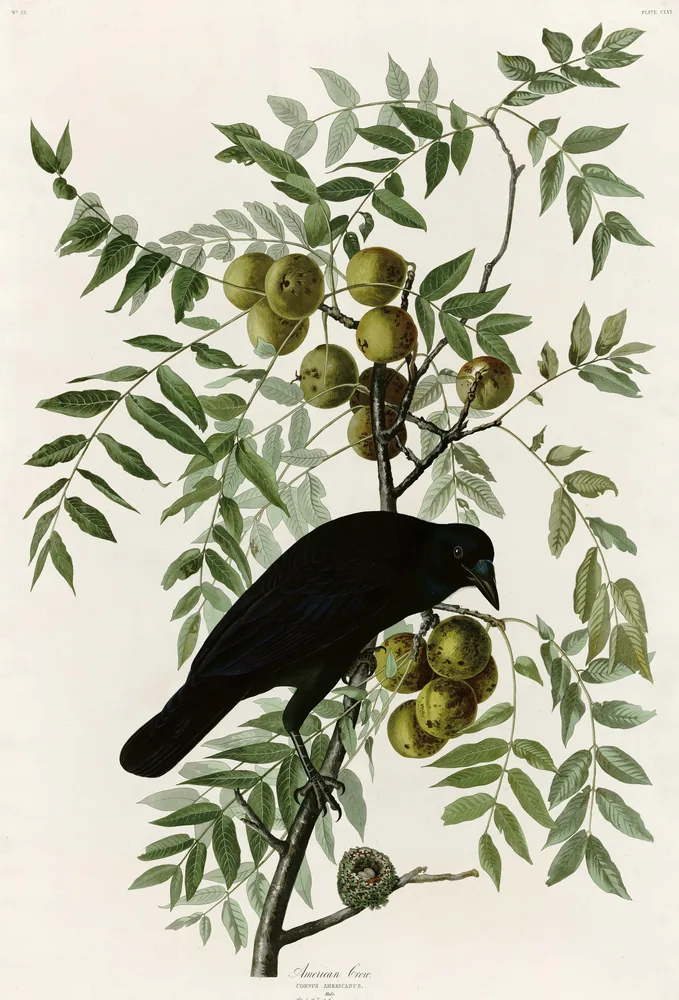
Other lumps went the same way: see the redpoll lump and the Western Flycatcher lump. The painting at the top of this page is plate 156 of John James Audubon's The Birds of America. And read more about how bird splits and lumps work.
Your Northwestern Crow sightings are all still in your records, now as American Crow; see your whole list as a book, free to try.
Check your own list. Drop your eBird download or type your birds: the free checker shows which of them this and other recent changes touched.
Check my list